Incoterms are International Chamber of Commerce (ICC) rules that allocate delivery responsibilities, costs, and transport risk between buyers and sellers.
If you are researching shipments for 2027, start with this clarification: as of November 24, 2026, ICC identifies Incoterms® 2020 as the latest edition, not “Incoterms 2027.”
This incoterms guide explains the rules, compares all 11 terms, and highlights practical checks before you agree to a shipment.
Is there an official Incoterms 2027 edition?
As of November 24, 2026, ICC’s official resources identify Incoterms® 2020, effective January 1, 2020, as the most recent edition. “Incoterms 2027” should therefore be understood as a search for rules relevant to trading in 2027, rather than the name of an officially published replacement. Do not label a contract “Incoterms 2027” based only on its shipment year.
The edition incorporated into the sales contract matters. ICC recommends identifying the selected rule, named port or place, and edition explicitly; a calendar change does not substitute for that contractual reference. Before finalizing future shipments, check ICC’s official resources for confirmed incoterms updates instead of assuming that a new year brings new terms.
What do Incoterms mean in international shipping?
Incoterms, short for International Commercial Terms, are standardized rules explaining which party performs specified delivery tasks, pays particular costs, and bears the risk of loss or damage at different stages. These international trade rules give buyers and sellers a common reference for their sales agreement. They can also be used in domestic transactions.
Three distinctions make shipping incoterms easier to understand:
- Delivery: The contractual event at which the seller fulfills the rule’s delivery obligation. It does not always mean arrival at the buyer’s warehouse.
- Risk: The point at which responsibility for accidental loss of or damage to the goods passes from seller to buyer.
- Costs: The allocation of specified expenses, including carriage, clearance, and handling where applicable. Cost responsibility does not always change hands at the risk-transfer point.
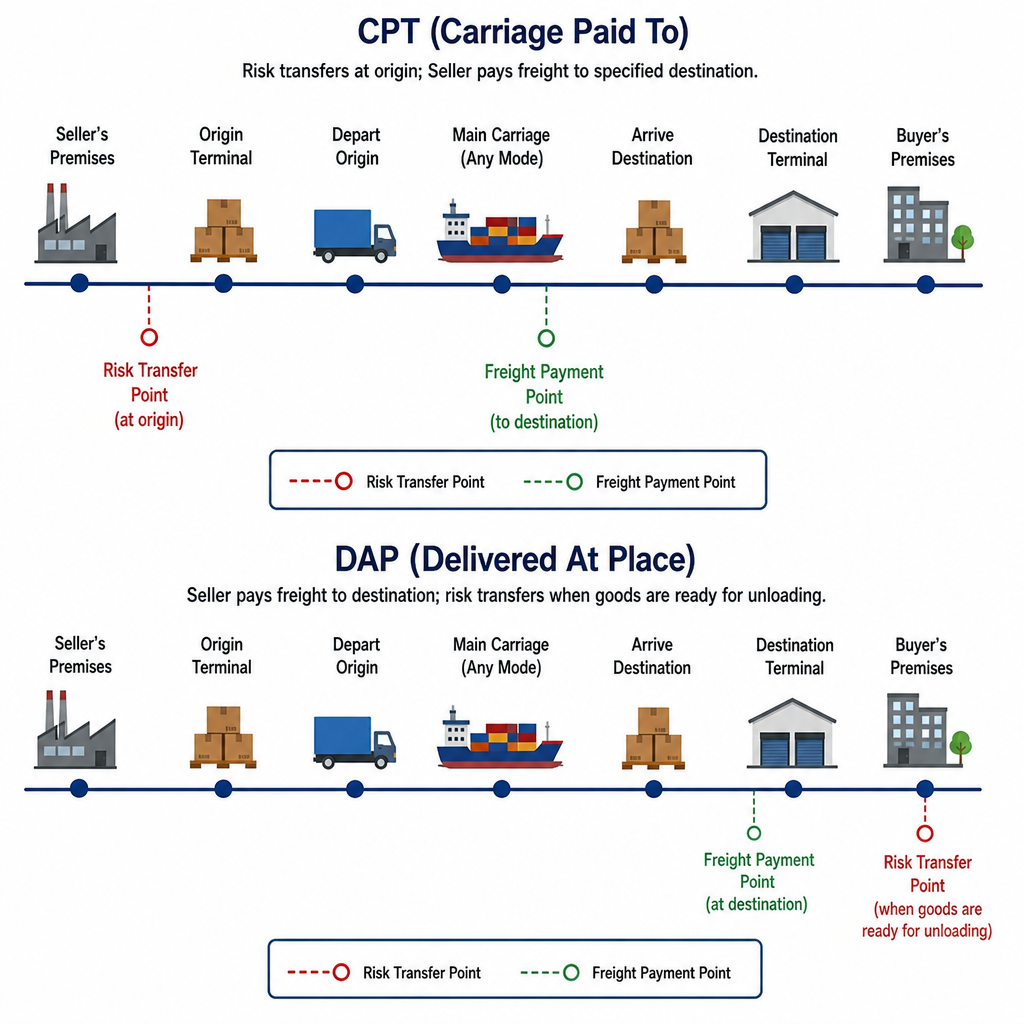
For example, a seller can pay freight to a destination while transferring transit risk much earlier. That distinction is central to the C terms: CPT, CIP, CFR, and CIF. Treating “freight prepaid” as “seller bears risk until arrival” misunderstands how those terms work.
Chart & List Of Incoterms
There are 11 Incoterms® 2020 rules. Seven apply to any mode or combination of transport modes, while four apply only to sea and inland waterway transport. Use the tables to shortlist a rule, then check its full provisions before contracting; a summary chart cannot capture every obligation or exception.
Rules for any mode of transport
These seven rules accommodate road, rail, air, sea, and multimodal movements. Their main differences concern where delivery occurs, who arranges carriage, and whether the seller handles unloading or import clearance. Read the risk column separately from the carriage column.
|
Rule |
Full meaning |
Main carriage arranged by |
Normal delivery and risk-transfer point |
|---|---|---|---|
|
EXW |
Ex Works |
Buyer |
Goods placed at the buyer’s disposal at the named place, not loaded |
|
FCA |
Free Carrier |
Buyer |
Delivery to the buyer’s nominated carrier or person at the agreed place |
|
CPT |
Carriage Paid To |
Seller |
Delivery to the carrier, not arrival at the paid destination |
|
CIP |
Carriage and Insurance Paid To |
Seller |
Delivery to the carrier; seller also obtains required insurance |
|
DAP |
Delivered at Place |
Seller |
Named destination, on arriving transport, ready for unloading |
|
DPU |
Delivered at Place Unloaded |
Seller |
Named destination, after unloading |
|
DDP |
Delivered Duty Paid |
Seller |
Named destination, import-cleared, ready for unloading |
These are simplified normal delivery points; the full rules govern the precise circumstances.
Rules for sea and inland waterway transport
These rules use delivery alongside or on board a vessel as their defining handover. Select them because that handover matches the transaction, not simply because a ship appears somewhere in the route. Container movements often need a different approach.
|
Rule |
Full meaning |
Main carriage arranged by |
Normal delivery and risk-transfer point |
|---|---|---|---|
|
FAS |
Free Alongside Ship |
Buyer |
Alongside the nominated vessel at the shipment port |
|
FOB |
Buyer |
On board the nominated vessel at the shipment port |
|
|
CFR |
Cost and Freight |
Seller |
On board the vessel at shipment, although seller pays freight to destination |
|
CIF |
Seller |
On board the vessel at shipment; seller pays freight and required insurance |
The destination named under CFR or CIF identifies where the seller pays carriage, not where transit risk first passes.
Differences that matter when comparing shipping quotes
FCA offers a different handover from EXW
Under EXW, the seller makes goods available without an obligation to load the collecting vehicle or clear them for export. That can create difficulties when an overseas buyer cannot practically complete export formalities. FCA places export clearance with the seller and may better match an international collection arrangement.
FCA also distinguishes between delivery locations. At the seller’s premises, delivery occurs after loading onto the buyer-arranged vehicle. At another agreed place, delivery occurs with the goods on the seller’s arriving vehicle, ready for unloading and available to the nominated carrier or person. Specify the locati0n carefully rather than treating every FCA quotation as identical.
CPT and CIP separate paid carriage from transit risk
Under CPT and CIP, the seller arranges and pays carriage to the named destination, but risk passes when the goods are delivered to the carrier under the rule. Where multiple carriers are involved, identify the agreed delivery point rather than assuming risk continues through every transport leg. CIP additionally requires the seller to obtain cargo insurance.
Imagine a hypothetical CIP shipment moving by truck, aircraft, and another truck. Paying carriage to the final destination does not, by itself, keep transit risk with the seller throughout that journey. Use the contract review to identify the handover point and confirm that insurance documentation matches the intended movement.
DAP, DPU, and DDP divide destination tasks differently
DAP and DDP normally deliver goods ready for unloading; DPU requires the seller to unload them. Import clearance and applicable import duties fall to the buyer under DAP and DPU, but to the seller under DDP. Those differences affect operational responsibility, not just the wording on an invoice.
Before selecting DPU, confirm access to unloading equipment and a suitable receiving locati0n. Before selecting DDP, establish whether the seller can actually meet destination-country import and tax requirements. ICC Academy notes that foreign sellers may face restrictions or significant administrative difficulties when undertaking those formalities.
CIF and CIP require different default insurance cover
Both CIF and CIP require seller-arranged insurance, but their default coverage differs. CIF generally uses Institute Cargo Clauses (C) or similar minimum cover, while CIP requires the broader Institute Cargo Clauses (A) or similar cover. Parties can agree on different coverage, so the acronym alone should not end the insurance discussion.
Ask for the policy or certificate and review exclusions with an insurance professional. Match the cover to the goods, route, and commercial exposure rather than treating insurance as a checked box. Broader cover is not a promise that every possible loss will be insured.
How do you choose the right Incoterms rule?
Choose the rule that matches the actual transport handover, desired risk allocation, and each party’s ability to perform clearance and delivery tasks. Start with the route and responsibilities, then compare the commercial price. ICC’s selection guidance distinguishes shipment arrangements, where risk transfers earlier, from arrival arrangements, where the seller bears risk to destination delivery.
Use this sequence during negotiations:
- Map the handover. Identify whether the seller delivers at its premises, a terminal, alongside a vessel, on board, or at destination.
- Match the transport mode. For containers handed to a carrier before vessel loading, assess FCA rather than automatically choosing FOB.
- Assign main carriage. Establish whether buyer or seller will contract and pay for the principal journey.
- Test clearance capability. Confirm who can complete export and import formalities before accepting EXW or DDP.
- Review destination handling. Agree whether delivery includes unloading and identify the receiving point.
- Align insurance and documents. Check coverage, transport evidence, and payment-document requirements together.
As a practical comparison exercise, request itemized quotations against the same destination and service scope. Ask each supplier to identify freight, handling, clearance, insurance, and unloading assumptions. This makes your negotiation about identifiable tasks rather than whether one three-letter abbreviation sounds more comprehensive.
Write the rule clearly into the contract
ICC recommends a reference combining the chosen rule, named place or port, and edition. An illustrative format is “FCA [precise named delivery place], Incoterms® 2020.” Replace the bracketed wording with the actual agreed locati0n, including the relevant terminal, address, or delivery point where needed.
Avoid naming only a large city when several possible handover points exist. For C terms, distinguish the named destination for paid carriage from the delivery point where risk transfers. Check that the purchase order, sales confirmation, and logistics instructions describe the same intended arrangement.
Before signing, use a short internal checklist:
- Record the complete rule reference and edition.
- Describe the physical handover and receiving arrangements.
- Identify who will book transport and communicate collection instructions.
- Confirm responsibility for clearance, insurance, and relevant documents.
- Escalate any gap between the agreed responsibilities and either party’s practical capabilities.
Treat this checklist as a discussion aid, not a replacement for reviewing the selected rule and the wider sales agreement.
Incoterms updates do not replace a complete sales agreement
Incoterms allocate defined delivery obligations, risks, and costs; they do not determine every aspect of a sale. They do not establish when ownership transfers, set payment terms, select governing law, or provide a complete framework for breach-of-contract remedies. Those matters need separate treatment in the agreement.
Keep product specifications, inspection arrangements, payment deadlines, and dispute provisions alongside the delivery clause. Additional customs, tax, accounting, or regulatory evidence may also be needed even when the seller has performed its Incoterms obligations.
Review the transaction as a whole instead of expecting the selected abbreviation to solve every documentation issue.
For future updates, verify three things: whether ICC has announced an edition, when it becomes effective, and which version your contract incorporates. Do not relabel a 2020 rule as a 2027 rule simply to make a document look current. The contract reference should identify an actual published edition.
The practical takeaway for 2027 planning
Use the chart to narrow your options, then work through the physical shipment with your supplier, buyer, and logistics team. Write down who hands over the goods, who pays each major charge, and when risk changes hands. If those answers remain unclear, resolve them before accepting the quotation—not after collection has been booked.
As of November 24, 2026, the verified starting point remains Incoterms® 2020. For 2027 shipments, check for official updates, specify the agreed edition, and use the full ICC rules alongside the sales contract.
Frequently Asked Questions About Incoterms
What are Incoterms?
Incoterms are a set of international commercial terms published by the International Chamber of Commerce (ICC) that define the responsibilities of buyers and sellers in international trade, including delivery obligations, costs, and risk management.
What is the latest edition of Incoterms?
As of November 24, 2026, the latest official edition is Incoterms® 2020. There is no recognized edition called "Incoterms 2027"; instead, it refers to rules applicable to trading in 2027 based on the existing edition.
How do Incoterms affect shipping costs?
Incoterms specify who is responsible for various costs such as shipping, handling, insurance, and customs duties. These terms help clarify financial obligations for both parties, impacting the overall shipping cost negotiation.
Can Incoterms be used for domestic transactions?
Yes, Incoterms can be used in domestic transactions as well as international trade. They provide a common reference for the roles of each party in the sale agreement.
How should I choose the right Incoterms rule?
Choose the Incoterms rule that best matches the delivery method, risk allocation, and the parties' capabilities to fulfill export and import obligations. It's important to assess the transport handover points and responsibilities carefully to select the appropriate term for your shipment.