U.S. importers received a temporary reprieve from some Section 301 tariffs in November 2026, when the Office of the United States Trade Representative extended 178 existing product exclusions through January 9, 2027.
The extension does not repeal the broader China tariff program. Businesses still need to distinguish the original product-specific duties, subsequent strategic-sector increases, and separate tariff actions before calculating shipment costs.
Updated November 24, 2026.
What are Section 301 tariffs on Chinese goods?
Section 301 tariffs are additional U.S. import duties imposed under the Trade Act of 1974 to address foreign practices that burden or restrict U.S. commerce.
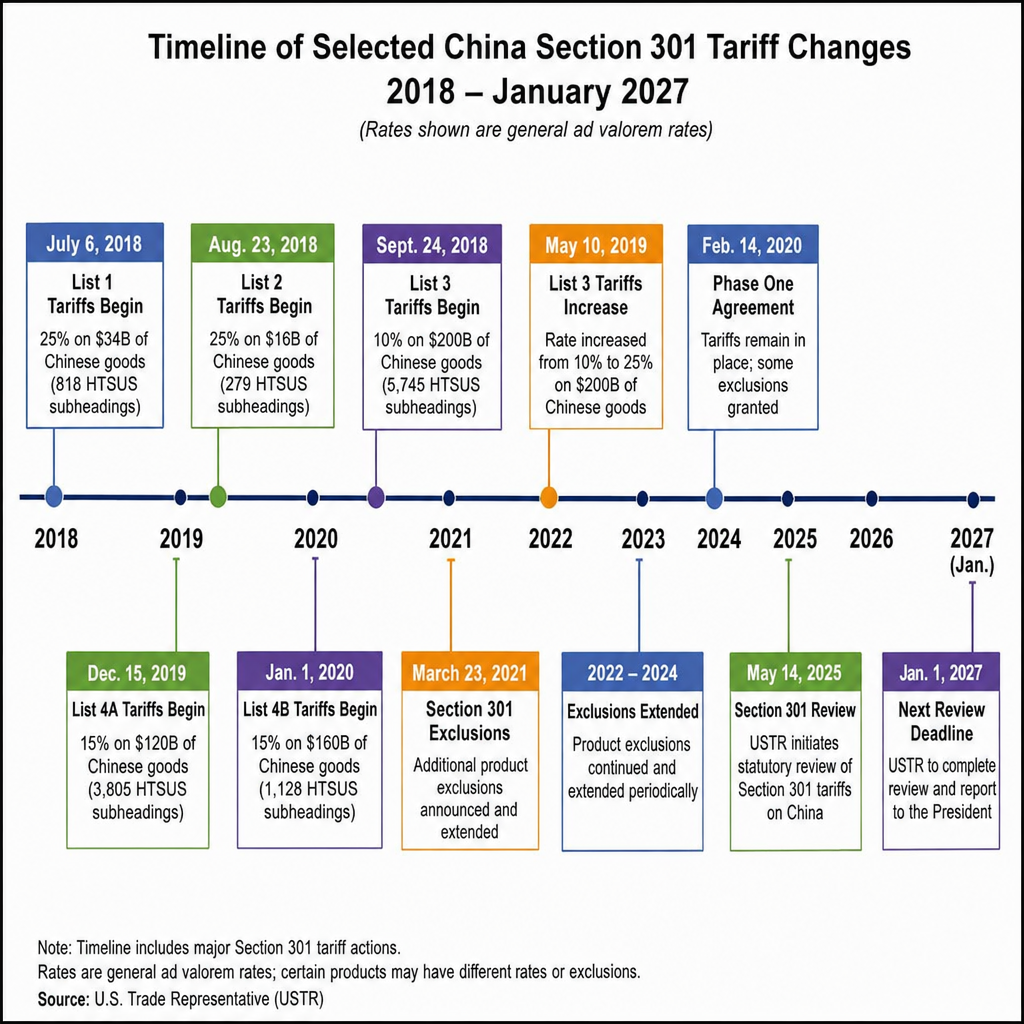
The original China actions followed an investigation into technology transfer, intellectual property, and innovation. Duties began in 2018 and were subsequently expanded and modified; they are not one uniform tax covering every Chinese product at the same rate.
The familiar labels List 1, List 2, List 3, and List 4A describe different groups of covered products. The established framework generally applies additional rates of 25% to Lists 1–3 and 7.5% to List 4A, although later modifications assign higher rates to selected goods.
Exclusions can temporarily remove qualifying products from particular duties.
For importers, the practical distinction is between a product’s normal customs duty and additional trade-remedy duties. A product described as carrying a 25% Section 301 tariff does not necessarily have a total import duty of 25%. Other applicable charges must be assessed separately under the current tariff schedule.
November extension follows confirmation that the original actions continue
The November exclusion extension followed an October 7, 2026, Federal Register notice confirming that the original China actions had not terminated at their latest four-year anniversaries.
USTR said domestic industries had submitted qualifying requests for continuation. The agency also said it would conduct another statutory review and publish separate information about that process.
That matters because a review anniversary is not an automatic expiration date. The October notice continued the actions, subject to possible modifications, rather than canceling them or replacing them with a single new rate.
Importers should therefore avoid treating the review process itself as grounds to stop declaring duties.
A separate development also changed the tariff landscape during 2026. Effective July 24, USTR imposed duties following investigations into whether trading partners prohibited and effectively enforced prohibitions on imports made with forced labor.
Its determination assigned China a 12.5% rate, subject to specified exemptions. This action is distinct from the original technology-transfer investigation, even though both use Section 301 authority.
Consequently, references to “new Section 301 tariffs” need context: the investigation, covered goods, effective date, and exemptions matter as much as the headline percentage.
The May 2024 product announcement remains important background
The list of products affected by Section 301 tariffs in May 2024 marked a targeted expansion, not the beginning of the China tariff program.
On May 14, 2024, the Biden administration directed increases across strategic sectors, including electric vehicles, batteries, semiconductors, solar cells, critical minerals, metals, port cranes, and medical products.
The announcement proposed a phased schedule rather than making every increase immediately effective.
USTR finalized major modifications in September 2024 after reviewing public comments. Several medical-product rates and implementation dates changed from the original proposal, while certain exclusions were added or adjusted. For that reason, a May 2024 summary is useful historical context but should not serve as a current entry-filing reference.
Selected increases under the finalized 2024 framework included:
|
Covered product group |
Additional Section 301 rate |
Implementation |
|---|---|---|
|
Electric vehicles |
100% |
September 27, 2024 |
|
Solar cells, whether or not assembled into modules |
50% |
September 27, 2024 |
|
Certain steel and aluminum products |
25% |
September 27, 2024 |
|
Lithium-ion EV batteries |
25% |
September 27, 2024 |
|
Semiconductors |
50% |
January 1, 2025 |
|
Lithium-ion non-EV batteries |
25% |
January 1, 2026 |
|
Natural graphite and permanent magnets |
25% |
January 1, 2026 |
These are selected product-specific Section 301 rates from that framework, not comprehensive current duty totals. Exact tariff classifications and subsequent modifications control individual shipments.
Annex A and tariff classifications determine product coverage
Annex A is not a standalone tariff program. In the September 2024 modification notice, it provided an informal table summarizing tariff increases across covered product groups. Other annexes implemented tariff-schedule changes and addressed exclusions.
Anyone researching a new Section 301 tariffs Annex A should check the document’s publication date and identify which action it accompanies.
The starting point is the product’s Harmonized Tariff Schedule of the United States classification, commonly called its HTSUS code. USTR’s product-search tool accepts an eight-digit subheading and identifies relevant China tariff actions and additional rates. It is more reliable than searching by a broad commercial description such as “battery equipment” or “metal components.”
Classification still requires care. The U.S. International Trade Commission explains that national tariff codes can differ after the first six internationally harmonized digits.
A supplier’s foreign tariff code should therefore not be assumed to be the complete U.S. classification. The USITC also warns that its helpful China tariff reference table is not itself an authoritative part of the HTS.
The practical implication is straightforward: retain the current legal provision, applicable Chapter 99 heading, and supporting product description rather than relying solely on a search result or an old spreadsheet.
Product exclusions offer limited, time-sensitive relief
The November 2026 notice extended all 178 existing exclusions through 11:59 p.m. Eastern time on January 9, 2027. It continued existing relief rather than opening a blanket exemption for Chinese goods. Eligibility remains tied to the applicable tariff classifications and exclusion descriptions.
Importers should also distinguish an exclusion’s product coverage from the tariff action it addresses. An exclusion associated with the original China measures is not, by itself, proof that a shipment is exempt from the separate forced-labor-related action. That action has its own exemption provisions, which must be checked independently.
Recent classification amendments illustrate why exclusion records need maintenance. In October 2026, CBP issued updated instructions covering five exclusions affected by statistical reporting changes effective July 1, 2026.
The bulletin also explained that qualifying refunds could be requested through post-summary corrections within the relevant filing timeframe, or through protests where applicable after liquidation.
For a business reviewing past payments, the useful questions are therefore specific: Did the merchandise meet the exclusion description, was the entry within the covered dates, and is the appropriate correction procedure still available? An exclusion extension alone does not establish that every earlier payment is refundable.
Section 232 and 301 tariffs require separate analysis
Section 232 and 301 tariffs arise under different statutes and address different policy concerns. Section 232 concerns national-security effects of imports; Section 301 addresses specified foreign trade practices. The same broad product sector can appear in discussions of both, but that does not make the programs interchangeable.
Nor should businesses simply add every percentage mentioned in a tariff headline. CBP’s July 2026 forced-labor guidance includes exemptions for specified categories, including certain goods addressed by other sectoral measures. Whether an exemption applies depends on the legal descriptions and tariff provisions, not merely on whether merchandise contains steel, aluminum, or another named material.
A useful costing approach is to keep separate lines for normal customs duties, each applicable additional duty, and any qualifying exclusion or exemption.
This makes assumptions visible when a broker, finance team, or trade adviser reviews the calculation. It also prevents a product-specific Section 301 rate from being mistaken for the complete landed-cost impact.
For purchasing decisions, request a dated, shipment-specific duty assessment. A quotation that says only “China tariff included” leaves uncertainty about which actions, classifications, and relief provisions the estimate actually covers.
The Trump Section 301 tariffs lawsuit has a specific outcome
The major lawsuit challenging the original List 3 and List 4A duties was HMTX Industries LLC v. United States. Importers challenged USTR’s authority to expand the actions and raised Administrative Procedure Act issues.
On September 25, 2025, the Federal Circuit upheld the challenged actions, concluding that the agency had statutory modification authority and had cured the procedural shortcomings addressed on remand.
The Supreme Court subsequently declined to hear the appeal. Its docket records the petition’s denial on June 15, 2026. That left the lower-court judgment in place; it was not a Supreme Court merits ruling endorsing every possible use of Section 301.
Describing this litigation simply as an unresolved “Trump Section 301 tariffs lawsuit” would miss that important development.
Separate litigation concerns the newer forced-labor-related tariffs. In August 2026, state officials announced a challenge arguing, among other things, that USTR had exceeded its authority and failed to satisfy procedural requirements.
Those statements describe the plaintiffs’ allegations, not a judicial determination that the duties were unlawful. The newer challenge should not be confused with the concluded Supreme Court petition in HMTX.
For importers, a lawsuit announcement is not equivalent to an order stopping collection. Any decision to change entry treatment should rest on the operative legal requirements and applicable customs guidance, rather than an assumption that litigation will produce refunds.
Importers face decisions before the next exclusion deadline
The immediate planning issue is the January 2027 exclusion deadline, alongside the continuing original tariff actions and separate 2026 measures. Businesses importing covered machinery, components, or finished goods should identify which purchases depend on temporary relief.
That creates a clearer basis for budgeting than applying one assumed US-China tariffs rate across an entire supplier catalog.
A practical internal review should connect purchasing records with customs records. For each material product line, assemble the U.S. classification, merchandise specifications, relevant entry dates, declared additional-duty headings, and any claimed exclusion.
Where a classification changed during 2026, retain both the previous and replacement reporting numbers so past and future entries can be checked consistently.
Finance teams can then model the business consequences of relief continuing or expiring without treating either outcome as certain. Purchasing teams should ask suppliers to separate merchandise pricing from assumed duties and clarify who bears a tariff change under the contract.
These are planning safeguards, not predictions that a particular rate will rise or fall.
The central lesson is that Section 301 tariffs remain a collection of legally distinct actions, product rules, and temporary exceptions. Current classification and effective-date checks matter more than a remembered headline rate.
Before committing to a shipment or claiming relief, have the specific treatment reviewed against the governing tariff provisions and current CBP instructions.
Frequently Asked Questions About Section 301 tariffs on Chinese goods
What are Section 301 tariffs?
Section 301 tariffs are additional U.S. import duties imposed to address foreign trade practices that negatively impact U.S. commerce, particularly focusing on issues like technology transfer and intellectual property violations. They were first implemented against China in 2018.
How do I find out if my products are affected by Section 301 tariffs?
To determine if your products are subject to Section 301 tariffs, check the Harmonized Tariff Schedule of the United States (HTSUS) classification for your goods. The U.S. Trade Representative (USTR) also provides a product-search tool for identifying relevant tariff actions.
What is the process for applying for exclusions from Section 301 tariffs?
Businesses can apply for product exclusions by submitting requests to the USTR, detailing how their products meet the criteria for exclusion. The USTR reviews these requests and issues decisions based on industry feedback and other considerations.
Are there any temporary exclusions from Section 301 tariffs?
Yes, certain products have received temporary exclusions from Section 301 tariffs. These exclusions are periodically reviewed, and businesses must stay updated on any changes or deadlines related to their specific products.
How do Section 301 tariffs relate to other tariffs, such as Section 232 tariffs?
Section 301 tariffs and Section 232 tariffs arise under different statutes and focus on different issues. While Section 301 tariffs address specific foreign trade practices, Section 232 tariffs are imposed for national security reasons. Businesses must analyze each separately when determining applicable duties for imported goods.