









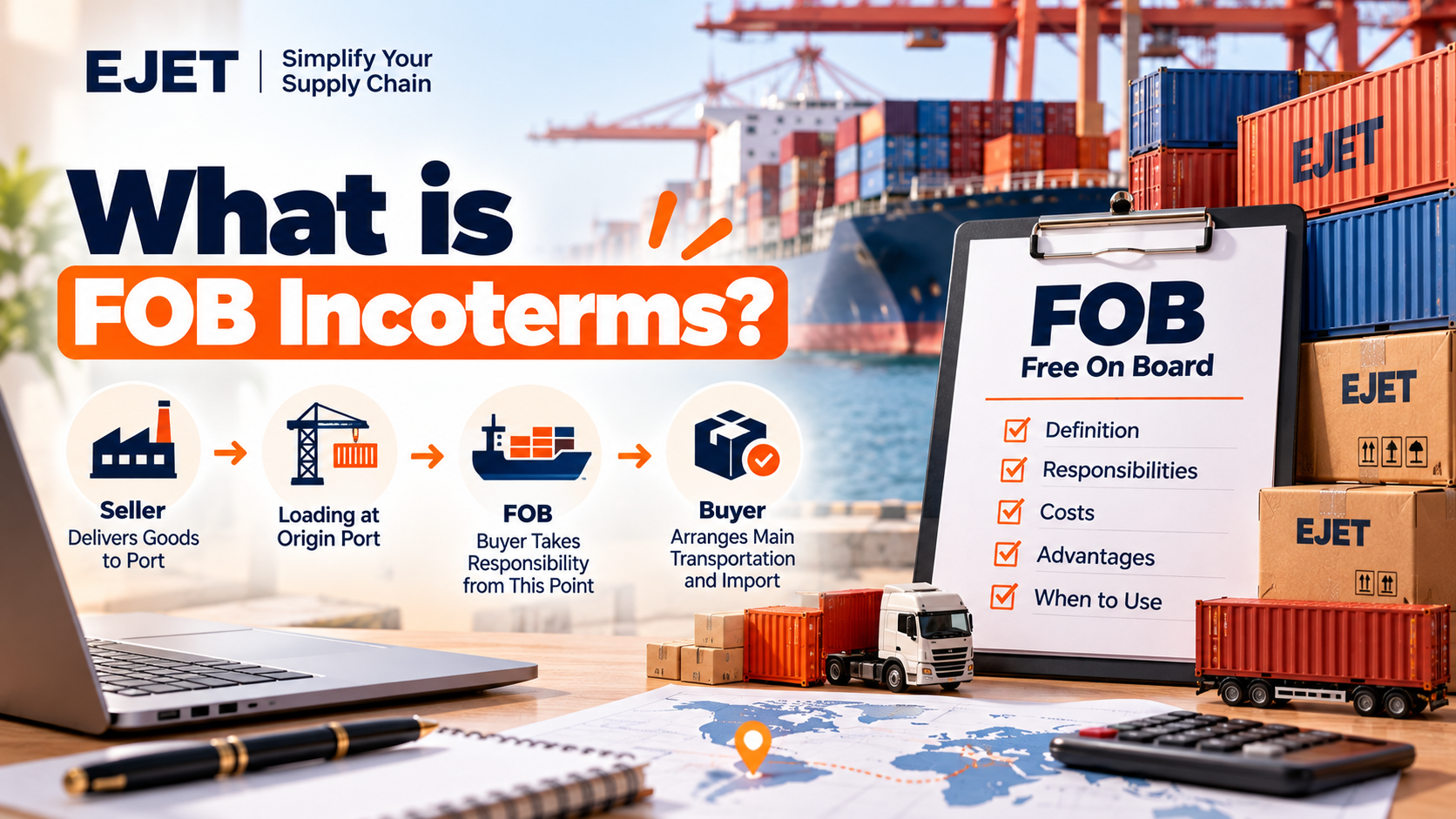
International trade involves complex shipping arrangements, transportation expenses, customs procedures, and contractual responsibilities. Understanding FOB Incoterms (Free on Board) is essential for importers, exporters, freight forwarders, and businesses engaged in global commerce.
FOB (Free on Board) is one of the internationally recognized trade terms established by the International Chamber of Commerce (ICC). It defines the responsibilities of buyers and sellers when goods are transported by sea or inland waterways.
Under FOB Incoterms, the seller is responsible for delivering goods on board the vessel nominated by the buyer at the agreed port of shipment. Once the goods are on board, the risk of loss or damage transfers from the seller to the buyer.
In this comprehensive guide, we explain FOB shipping terms, FOB pricing, buyer and seller obligations, freight costs, risk transfer, insurance considerations, and the differences between FOB and other Incoterms.
What Are FOB Incoterms?
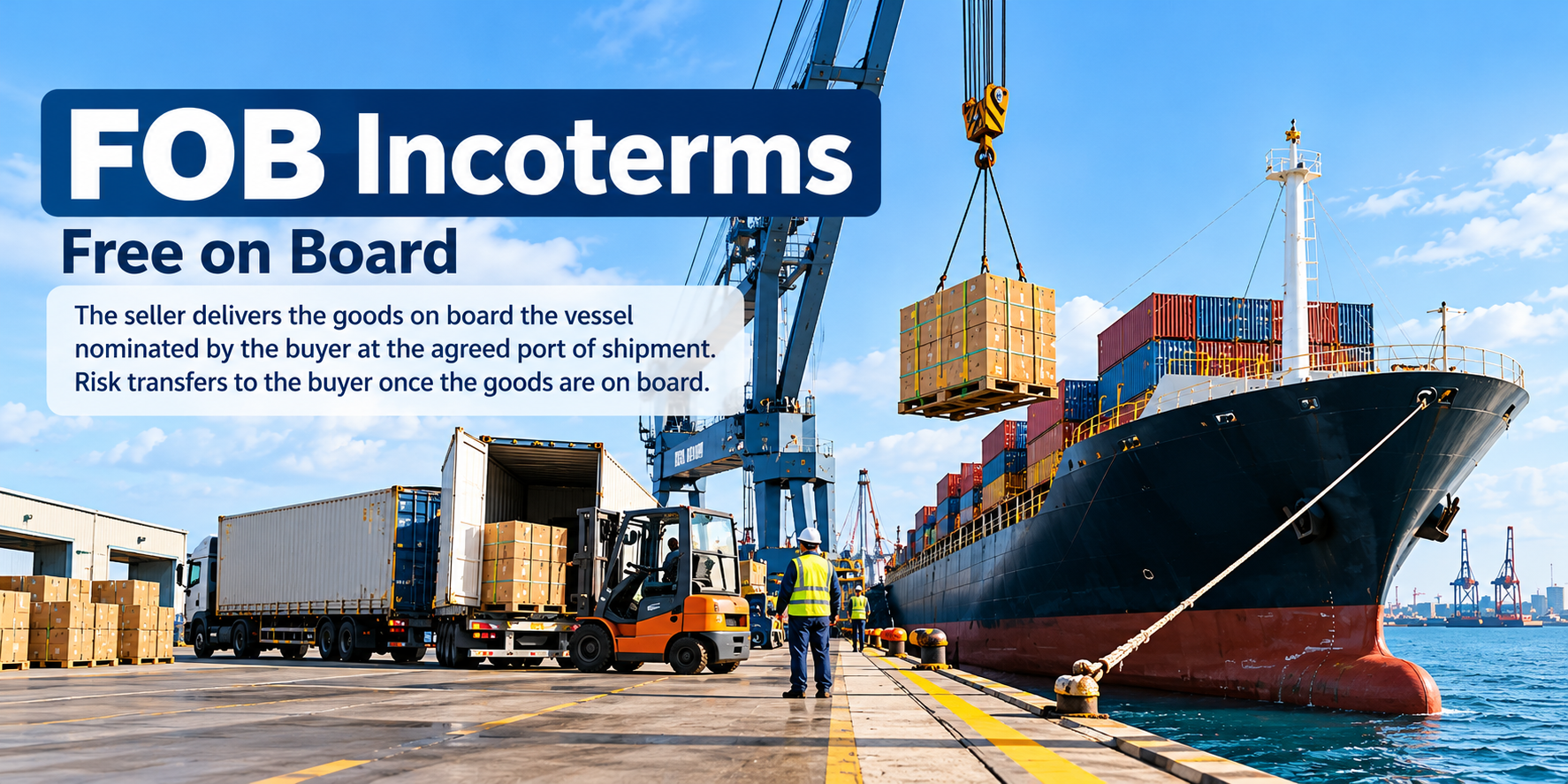
FOB stands for Free on Board, an international shipping term established by the International Chamber of Commerce (ICC) as part of its Incoterms rules.
Under FOB Incoterms 2020, the seller fulfills its delivery obligation when the goods are placed on board the vessel nominated by the buyer at the specified port of shipment.
The buyer assumes responsibility for the goods from that point, including the risk associated with the main ocean voyage and subsequent transportation.
FOB is specifically intended for sea and inland waterway transportation. It is not designed for air freight, road transportation, or multimodal shipments where goods are handed to a carrier before being loaded onto a vessel.
A typical FOB contractual description is:
FOB Port Klang, Malaysia, Incoterms® 2020
This indicates that the seller must deliver the goods on board the buyer's nominated vessel at Port Klang, Malaysia, according to the FOB rules published in Incoterms 2020.
The agreed port should be identified clearly to avoid misunderstandings regarding delivery arrangements and costs.
How Does FOB Shipping Work?
FOB shipping establishes a clear division of obligations between the exporter and importer.
The seller handles the goods until they are loaded onto the designated vessel. The buyer arranges the main transportation and assumes the associated risks once loading is completed.
The FOB shipping process generally follows these stages:
-
Goods preparation: The seller manufactures, packages, labels, and prepares the products for export.
-
Export documentation: The seller arranges export clearance and obtains the necessary export permits.
-
Origin transportation: The seller transports the goods to the agreed port of shipment.
-
Port handling: The seller handles the costs and arrangements necessary to place the goods on board the nominated vessel.
-
Loading onto the vessel: Delivery occurs when the goods are on board the vessel.
-
Risk transfer: The buyer assumes the risk of loss or damage from the FOB delivery point.
-
Ocean transportation: The buyer pays for and arranges the main sea freight.
-
Destination procedures: The buyer manages import clearance, applicable duties, and transportation to the final destination.
An important distinction is that risk transfer and cost allocation are not identical concepts. Certain costs may be assigned differently under the agreed contract, but the FOB delivery point determines when the risk transfers under the Incoterms rule.
FOB Incoterms 2020: Buyer and Seller Responsibilities
Understanding the obligations of both parties helps prevent unexpected shipping expenses and contractual disputes.
|
Responsibility |
Seller |
Buyer |
|---|---|---|
|
Export packaging |
Responsible |
Not responsible |
|
Export customs clearance |
Responsible |
Not responsible |
|
Transport to origin port |
Responsible |
Not responsible |
|
Loading goods on board |
Responsible |
Not responsible |
|
Main ocean freight |
Not responsible |
Responsible |
|
Cargo insurance |
No obligation to procure |
No obligation to procure |
|
Import customs clearance |
Not responsible |
Responsible |
|
Import duties and taxes |
Not responsible |
Responsible |
|
Destination transportation |
Not responsible |
Responsible |
|
Risk after on-board delivery |
Transferred |
Assumed |
Seller Responsibilities Under FOB
Under FOB Incoterms, the seller must deliver goods in accordance with the sales contract.
We identify the seller's principal responsibilities as follows.
1. Supplying goods and commercial documentation
The seller must provide the contracted goods, commercial invoice, and other evidence of conformity required by the sales agreement.
2. Export packaging and marking
The seller must arrange appropriate packaging and marking, unless the particular trade normally transports the goods unpackaged or the parties agree otherwise.
3. Export customs formalities
The seller must complete applicable export clearance procedures, including export licenses, security requirements, and customs declarations.
4. Inland transportation to the port
The seller bears the costs and risks of transporting the goods to the named port of shipment before delivery.
5. Loading onto the nominated vessel
The seller must place the goods on board the vessel nominated by the buyer at the agreed port and within the agreed shipment period.
6. Proof of delivery
The seller must provide the buyer with the customary proof that the goods have been delivered in accordance with FOB.
Buyer Responsibilities Under FOB
The buyer's principal obligations begin with arranging the vessel and extend through importation and final delivery.
1. Vessel nomination
The buyer must nominate the vessel and provide the necessary shipment instructions, including the relevant loading point and timing.
2. Main carriage arrangement
The buyer normally contracts with the shipping line or freight forwarder responsible for transporting the cargo to its destination.
3. Ocean freight payment
The buyer bears the cost of the main international sea transportation.
4. Cargo insurance decisions
Although FOB does not require either party to procure cargo insurance for the other, we recommend that buyers arrange suitable coverage for risks assumed after on-board delivery.
5. Import customs procedures
The buyer must complete import clearance, obtain necessary import licenses, and pay applicable import duties and taxes.
6. Final delivery
The buyer arranges unloading and onward transportation, subject to the costs included in its carriage contract.
FOB Incoterms: When Does Risk Transfer?
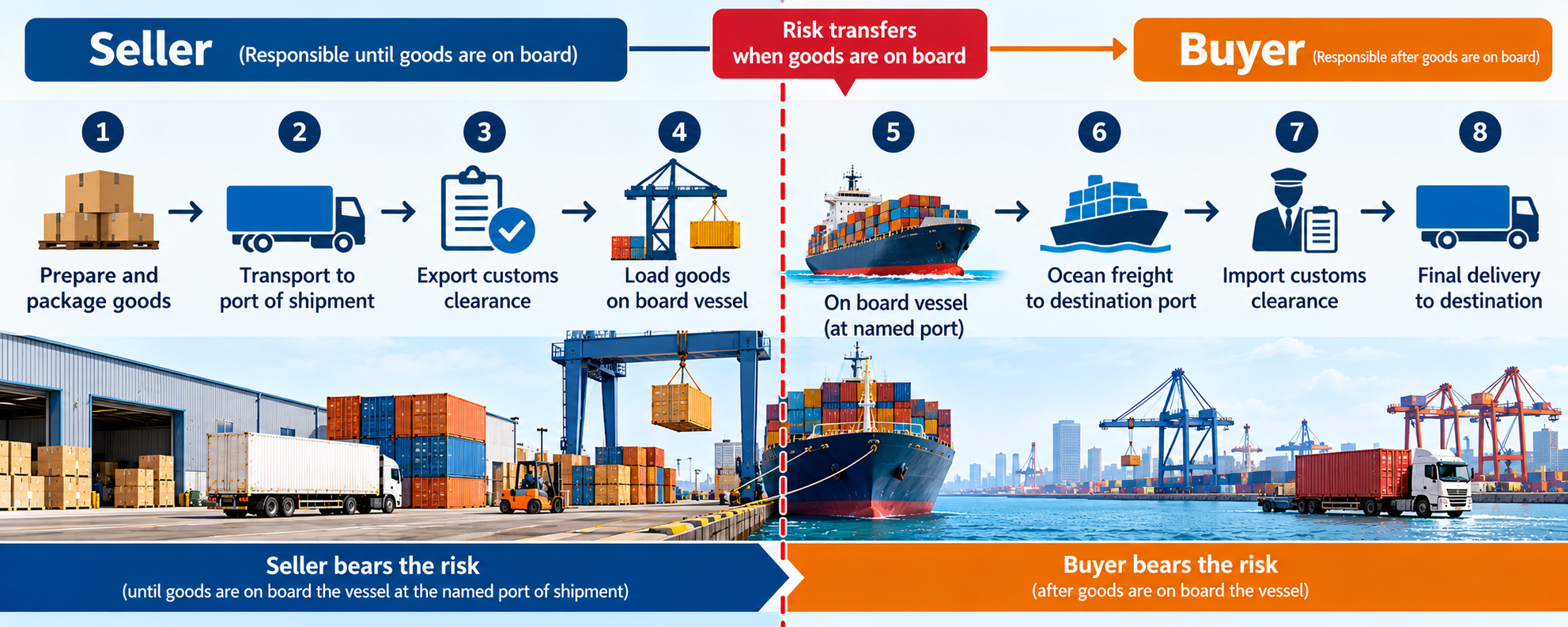
One of the most important aspects of FOB shipping is identifying the precise point at which risk transfers.
Under FOB Incoterms 2020, risk transfers when the goods are on board the nominated vessel at the agreed port of shipment.
This means that the seller generally bears the risk while the goods are being transported to the port and placed on board.
After the goods are on board, the buyer bears the risk during the sea voyage and subsequent transportation.
For example, suppose a Malaysian exporter sells machinery to a Japanese importer under:
FOB Port Klang, Malaysia, Incoterms® 2020
If the machinery is damaged before it is placed on board, the seller generally bears the risk.
If the machinery is damaged during the ocean voyage after loading has been completed, the buyer generally bears the risk.
There are exceptions where the buyer fails to provide the required vessel nomination or instructions, subject to the conditions specified in the FOB rule.
We therefore recommend defining the port, loading arrangements, and shipment period precisely in the sales contract.
FOB Shipping Costs: Who Pays for What?
FOB cost allocation is a major consideration when negotiating international sales contracts.
The seller typically pays the expenses necessary to deliver the goods on board the vessel.
The buyer generally pays the expenses associated with transportation after that delivery point.
Costs Paid by the Seller
Typical seller expenses include:
-
Export packaging and labeling.
-
Inland freight to the port of shipment.
-
Export customs clearance.
-
Export documentation.
-
Applicable origin terminal handling and loading expenses required to deliver the goods on board.
Costs Paid by the Buyer
Typical buyer expenses include:
-
International ocean freight.
-
Cargo insurance, if purchased.
-
Destination terminal and handling charges, as applicable.
-
Import customs clearance.
-
Import duties and taxes.
-
Inland delivery from the destination port.
-
Applicable warehousing or storage charges after delivery.
FOB Shipping Cost Example
Consider an international shipment with the following hypothetical costs.
|
Expense |
Amount (USD) |
Responsible Party |
|---|---|---|
|
Export packaging |
$300 |
Seller |
|
Inland transportation |
$450 |
Seller |
|
Export clearance |
$150 |
Seller |
|
Origin handling and loading |
$400 |
Seller |
|
Ocean freight |
$1,800 |
Buyer |
|
Cargo insurance |
$120 |
Buyer, if purchased |
|
Destination handling |
$350 |
Buyer |
|
Import customs processing |
$200 |
Buyer |
|
Final delivery |
$500 |
Buyer |
In this example, the seller's additional logistics expenses total $1,300, while the buyer's listed transportation and handling expenses total $2,970, including optional insurance.
These figures are illustrative and exclude the purchase price of the goods, import duties, and taxes.
Actual costs depend on the shipping route, cargo characteristics, terminal tariffs, and contractual arrangements.
FOB vs CIF Incoterms: Key Differences
FOB and CIF are frequently compared because both are used for international sea freight.
CIF stands for Cost, Insurance and Freight.
The primary difference is the allocation of freight and insurance responsibilities.
Under FOB, the buyer arranges and pays for the main ocean transportation.
Under CIF, the seller arranges and pays for freight to the named destination port and must obtain cargo insurance meeting the minimum coverage requirements specified by the CIF rule, unless greater coverage is agreed.
|
Feature |
FOB |
CIF |
|
Full name |
Free on Board |
Cost, Insurance and Freight |
|
Main freight arranged by |
Buyer |
Seller |
|
Main freight paid by |
Buyer |
Seller |
|
Insurance procurement obligation |
Neither party |
Seller |
|
Risk transfer |
Goods on board at origin |
Goods on board at origin |
|
Transport mode |
Sea/inland waterway |
Sea/inland waterway |
|
Freight control |
Primarily buyer |
Primarily seller |
A critical distinction is that CIF does not transfer risk at the destination port.
Under both FOB and CIF, risk normally transfers when the goods are placed on board the vessel at the port of shipment.
The seller's payment of freight and insurance under CIF does not mean the seller retains transit risk until arrival.
FOB vs FCA Incoterms: Which Is Better for Container Shipping?
FOB is often used in containerized international trade, but it is not always the most appropriate Incoterm.
FCA (Free Carrier) is generally more suitable when containerized cargo is delivered to a terminal or carrier before being loaded onto a vessel.
Under FCA, the seller delivers the goods to the buyer's nominated carrier or another designated person at the agreed place.
The precise risk-transfer point depends on whether delivery occurs at the seller's premises or another named location.
With FOB, the seller retains risk until the goods are on board the vessel.
This distinction becomes significant when containers are handed over to a terminal several days before vessel loading.
For example, a seller may deliver a container to a port terminal on Monday, while the shipping line loads it onto the vessel on Thursday.
Under FOB, the seller generally retains risk until Thursday, even though the terminal or carrier has physical custody of the container.
Under a properly structured FCA arrangement, risk may transfer when the container is delivered to the carrier at the designated terminal.
For this reason, we generally recommend FCA for containerized cargo handed to a carrier before vessel loading, while FOB remains appropriate for shipments where delivery on board the vessel reflects the commercial arrangement.
Advantages of FOB Incoterms
FOB offers several advantages to international buyers and sellers.
Greater Freight Control for Buyers
Buyers can select their preferred shipping lines, negotiate ocean freight rates, and coordinate transportation schedules.
This can be especially valuable for importers handling frequent shipments or maintaining established freight forwarding relationships.
Clear Export Responsibilities
Sellers are responsible for export procedures and on-board delivery, creating a recognizable division of responsibilities.
Potential Freight Cost Savings
Importers with substantial shipping volumes may obtain competitive ocean freight rates through consolidated purchasing or long-term carrier contracts.
Suitable for Traditional Maritime Cargo
FOB is particularly relevant to conventional maritime shipments where goods are delivered directly on board, including certain bulk and breakbulk cargoes.
Disadvantages and Risks of FOB Shipping
Despite its benefits, FOB also presents potential challenges.
Origin Port Coordination
The seller and buyer must coordinate vessel nominations, cargo readiness, terminal operations, and loading schedules.
Poor communication can result in delays and additional charges.
Risk Before Loading
The seller remains exposed to loss or damage before on-board delivery, which can be problematic when cargo is under terminal custody for an extended period.
Unexpected Local Charges
Disputes may arise over terminal handling, documentation, and loading-related expenses when the parties do not clearly identify the applicable charges.
Container Shipping Complications
Because containers are normally handed over to terminals before loading, FOB can create a mismatch between physical cargo control and contractual risk allocation.
FOB Incoterms 2020 vs FOB Incoterms 2010
The fundamental FOB delivery and risk-transfer principles remain substantially unchanged between Incoterms 2010 and Incoterms 2020.
Both versions establish on-board delivery at the named port of shipment as the central obligation.
Incoterms 2020, however, provides updated presentation and provisions relating to matters such as security-related requirements and cost allocation across the Incoterms rules.
We recommend identifying the applicable version explicitly in every international sales contract.
For example:
FOB Shanghai Port, China, Incoterms® 2020
Without a clearly stated version, disagreements may arise regarding which rules the parties intended to incorporate.
Common FOB Shipping Mistakes to Avoid
Businesses using FOB should pay particular attention to the following issues.
Using FOB for air freight: FOB is intended exclusively for sea and inland waterway transport. FCA is generally more appropriate for air cargo.
Confusing FOB with destination delivery: FOB does not require the seller to deliver goods to the buyer's destination port.
Assuming insurance is included: FOB does not impose an obligation on either party to obtain insurance for the other.
Failing to identify the port: Contracts should specify the named port of shipment and, where practical, the precise loading point.
Confusing risk transfer with ownership: Incoterms govern delivery obligations, costs, and risks, but do not determine when legal title to goods transfers. Ownership should be addressed separately in the sales agreement.
Overlooking carrier documentation: Buyers and sellers should coordinate the issuance of bills of lading and other transport documents, especially where documentary payment arrangements are involved.
How to Write FOB Terms in an International Sales Contract
A well-drafted FOB clause should identify the named port, the applicable Incoterms version, and relevant shipment conditions.
An example is:
Delivery term: FOB Port Klang, Malaysia, Incoterms® 2020. The seller shall deliver the goods on board the vessel nominated by the buyer at the agreed loading point within the contractual shipment period. The buyer shall arrange and pay for the main ocean carriage.
Additional contractual provisions should address vessel nomination deadlines, shipment notices, loading schedules, demurrage or detention exposure, required documents, and applicable payment terms.
We also recommend identifying how any unusual terminal charges will be allocated to avoid disputes.
Frequently Asked Questions About FOB Incoterms
What does FOB mean in shipping?
FOB means Free on Board. It is an Incoterms rule under which the seller delivers goods on board a vessel nominated by the buyer at the agreed port of shipment.
Who pays freight under FOB Incoterms?
The buyer normally arranges and pays for the main ocean freight, while the seller pays the costs necessary to deliver the goods on board at the origin port.
Who pays insurance under FOB?
Neither party is required by the FOB rule to procure cargo insurance for the other. Buyers commonly arrange insurance to protect against risks assumed after on-board delivery.
Who pays customs duties under FOB?
The seller handles export clearance and applicable export-related duties or taxes. The buyer handles import clearance and pays applicable import duties and taxes.
When does ownership transfer under FOB?
FOB does not determine the transfer of ownership. Legal title is governed by the sales contract and applicable law.
Can FOB be used for container shipping?
FOB can be contractually used for container shipments, but FCA is generally more suitable when containers are delivered to a carrier or terminal before being loaded onto a vessel.
Is FOB suitable for international sea freight?
Yes. FOB is specifically designed for sea and inland waterway transportation, particularly where on-board delivery is commercially appropriate.
What is the difference between FOB origin and FOB destination?
In domestic commercial terminology, particularly in the United States, expressions such as FOB origin and FOB destination may have meanings under applicable domestic law or trade practice.
These expressions should not be confused with the ICC's FOB Incoterms rule, which uses on-board delivery at the named port of shipment.
Conclusion: Choosing FOB Incoterms for International Trade
FOB Incoterms 2020 provides an established framework for allocating shipping responsibilities, transportation costs, and cargo risks between international buyers and sellers.
The seller is responsible for delivering the goods on board the buyer's nominated vessel at the agreed port of shipment, while the buyer generally arranges the ocean freight and subsequent transportation.
For traditional maritime shipments, FOB can offer a practical balance between seller obligations and buyer control over international freight arrangements.
For containerized shipments delivered to terminals before loading, FCA may provide a more suitable allocation of delivery responsibilities and risk.
By selecting the appropriate Incoterm, specifying the named delivery point, and clearly documenting the responsibilities of both parties, we can reduce shipping disputes, improve logistics planning, and support more efficient international trade operations.