Incoterms define how buyers and sellers divide shipping responsibilities, costs, and cargo risk.
For goods imported from China, FOB, CFR, CIF, and DDP differ most in who arranges freight, when risk transfers, and who handles import clearance.
This Incoterms guide explains those differences so you can compare supplier quotes and choose terms that match your shipment—not just the lowest headline price.
What do Incoterms mean when importing from China?
Incoterms are standardized trade rules published by the International Chamber of Commerce (ICC). When incorporated into a sales contract, they allocate delivery obligations, transport costs, customs responsibilities, and the risk of loss or damage between seller and buyer. Incoterms® 2020 is the current edition, containing 11 rules for different transport arrangements.
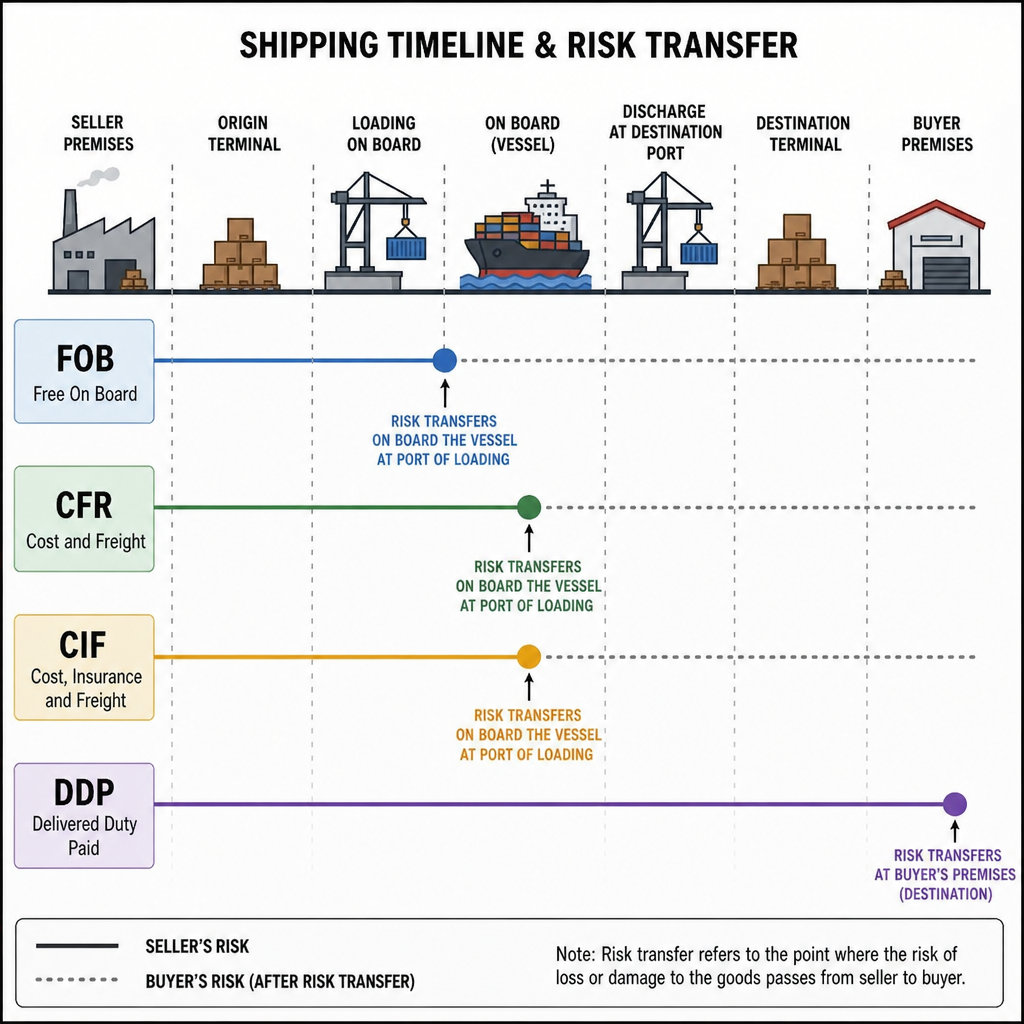
The distinction to understand first is cost versus risk. A seller can pay for transportation to your destination while your business carries the cargo risk during that journey. CFR and CIF work this way; freight paid does not mean seller risk continues until arrival.
Incoterms also have limits. They do not determine ownership transfer, payment terms, product specifications, or every remedy for breach of contract. Put those matters in your purchase agreement rather than expecting three shipping letters to settle them.
This article primarily addresses imports from China. Imports into China, including food shipments, require a separate look at Chinese entry requirements.
FOB, CFR, CIF, and DDP at a glance
Use this comparison to separate the main freight arrangement from the risk-transfer point. Under all four terms, the seller handles export clearance; import responsibilities differ. FOB, CFR, and CIF are waterway rules, while DDP can apply to any transport mode.
|
Term |
Main freight paid by |
Risk normally transfers |
Import clearance and duties |
|---|---|---|---|
|
FOB: Free on Board |
Buyer |
Once goods are onboard at the shipment port |
Buyer |
|
CFR: Cost and Freight |
Seller, to named destination port |
Once goods are onboard at the shipment port |
Buyer |
|
CIF: Cost, Insurance and Freight |
Seller, plus required cargo insurance |
Once goods are onboard at the shipment port |
Buyer |
|
DDP: Delivered Duty Paid |
Seller, to named destination |
At destination, ready for unloading |
Seller |
These are core allocations, not a complete landed-cost quotation. Destination handling, unloading, and other charges still deserve specific attention in the transport and sales contracts.
FOB: buyer control over the main shipment
The FOB Incoterm means the seller delivers goods onboard the vessel nominated by the buyer at the named shipment port. The seller completes export clearance and bears the normal costs and risks up to that delivery point. The buyer arranges and pays for the main sea carriage and takes cargo risk once delivery occurs.
For example, a contract might specify FOB Ningbo, China, Incoterms® 2020. Ningbo identifies the shipment port—not the destination. Your freight arrangements should connect that agreed onboard handover with the rest of the journey.
FOB deserves consideration when you want to select the ocean carrier or forwarder and negotiate the main freight arrangement yourself. Before accepting it, ask your logistics provider to map the origin handover and destination charges. Do not compare a FOB goods price directly with a delivered quote without adding the missing services.
Coordinate vessel nomination and shipping instructions carefully. Under specified circumstances, failure to provide required notices or a vessel that cannot take the goods can shift additional costs and risks to the buyer.
CFR: seller-paid freight, buyer-held voyage risk
The CFR Incoterm requires the seller to contract and pay for carriage to the named destination port. However, delivery and risk transfer occur when the goods are placed onboard at the shipment port. The seller’s freight obligation extends farther than its ordinary cargo-risk obligation.
For a hypothetical CFR Los Angeles, United States, Incoterms® 2020 shipment, the Chinese seller pays the agreed ocean freight to Los Angeles. That wording does not make the seller responsible for transit damage simply because it booked the vessel.
Unlike CIF, CFR does not require the seller to procure cargo insurance. If you choose CFR, arrange suitable coverage yourself or confirm that an existing policy covers the shipment and relevant risk period.
Before approval, request a destination-charge breakdown. Unloading charges included in the seller’s carriage contract are treated differently from charges outside it, so avoid assuming either that everything is included or that every arrival charge belongs to you. Ask what is prepaid, what is collect, and which party invoices each item.
CIF: freight plus insurance, not arrival protection
CIF follows the same basic delivery and risk structure as CFR, but the seller must also arrange cargo insurance for the buyer’s benefit. Risk still transfers onboard at origin, even though the seller pays freight and insurance to the named destination port.
The insurance detail matters. Under CIF, the default requirement permits limited cover equivalent to Institute Cargo Clauses (C), rather than automatically requiring broader Clauses (A) protection. A quote that says “insured” therefore does not establish that every loss affecting your goods will be covered.
Before relying on the policy, request:
- The insurance certificate or policy and the applicable clauses.
- Confirmation of the insured goods, voyage, and coverage period.
- Applicable exclusions, deductibles, and claims procedures.
- Written confirmation of any additional protection you requested.
Treat this as a document review, not a box-ticking exercise. If the cargo is fragile, temperature-sensitive, or difficult to replace, discuss those characteristics with an insurance professional before accepting the cover. CIF provides an insurance arrangement; it does not guarantee an undamaged arrival or a successful claim.
DDP: greater seller responsibility needs verification
DDP, or Delivered Duty Paid, puts responsibility on the seller for transport to the named destination, export and import formalities, and applicable import duties and taxes. Delivery occurs when the cleared goods are available to the buyer on the arriving vehicle, ready for unloading.
That makes the destination description important. Specify the actual warehouse or delivery point rather than relying on a city name. Also plan the unloading operation: DDP does not ordinarily require the seller to unload the final vehicle, although unloading costs may already be included in its carriage contract.
Before accepting a DDP offer, ask the seller to explain its import-clearance arrangement. Who will act as importer of record? Which broker will handle entry? What customs and tax documents will be available to your business? Request written answers rather than relying on “tax included” language.
A seller must be able to perform its destination-country obligations. Where local rules prevent the seller from handling import clearance, DAP—under which the buyer handles import formalities—may be more suitable. DDP is not a workaround for customs restrictions.
Container shipments need a different starting point
FOB, CFR, and CIF are designed for sea or inland waterway shipments involving onboard delivery. They may not fit a container shipment handed to a carrier at a terminal before vessel loading. ICC guidance points toward FCA, CPT, or CIP for containerized or multimodal arrangements, depending on who arranges freight and insurance.
For international shipping from China, start by identifying the real handover point. Ask whether the supplier delivers onboard the vessel or hands the container to a carrier earlier. Then select a rule that reflects that movement instead of accepting FOB simply because it appears on the supplier’s usual quotation.
How should you choose the right shipping term?
Choose the term that matches your transport mode, preferred control, insurance arrangements, and ability to manage customs. No term is automatically best for every China import. The appropriate rule depends on the transaction and the point where the parties intend delivery and risk transfer to occur.
Use these four checks before comparing prices:
- Confirm the delivery point. Ask the supplier to describe exactly where its delivery obligation ends, including whether the goods are onboard, at a terminal, or at your premises.
- Identify who books transport. Decide whether you want your own forwarder coordinating the main movement or prefer the seller to arrange it.
- Match insurance to your risk. Review coverage against the actual handover and journey, especially when using CFR or relying on CIF insurance.
- Verify customs capability. Before choosing DDP, confirm that the seller’s proposed clearance process is workable in the destination country.
Next, compare total expected landed cost using the same delivery endpoint. Ask each bidder to itemize goods, origin services, freight, insurance, destination handling, customs brokerage, duties, taxes, and final delivery. Treat estimates as estimates and request the assumptions behind them.
Keep a separate column for uncertainty. A quote with unclear destination charges or an unexplained customs arrangement should prompt further questions, even when its headline total looks attractive.
China import rules and food shipments into China
China import rules apply to goods entering China, whereas imports from China must meet the destination country’s requirements. Incoterms allocate contractual responsibilities for clearance, but they do not replace regulatory obligations or create permission to import a product.
If you are researching common Incoterms for food imports to China, distinguish the shipping arrangement from food-market access. FOB, CFR, and CIF may be considered for suitable waterborne movements, but the term alone does not establish whether the food or manufacturer is eligible.
For applicable overseas food manufacturers, Chinese rules require registration with the General Administration of Customs of China (GACC).
Registration guidance also changes. GACC Decree No. 280 took effect on June 1, 2026, replacing the previous registration framework. Product categories and applicable registration routes require current checks rather than reliance on an older shipping checklist.
When checking import regulations in China, have the importer and broker verify the product’s entry requirements, manufacturer registration where applicable, and declaration information before dispatch. GACC’s implementation guidance specifies registration information for relevant food import declarations. Choosing DDP does not remove those requirements.
Put the full agreement in writing
The ICC recommends identifying both the chosen rule and the named place or port, with the edition specified. CIF [named destination port], Incoterms® 2020 is more useful than “CIF China,” because the destination needs to be identifiable. FOB instead requires the named shipment port.
Before issuing the purchase order, use this checklist:
- Record the rule, precise place or port, and Incoterms edition.
- Ask for an itemized list of included and excluded charges.
- Confirm the booking party, forwarder contacts, and shipping instructions.
- Review insurance documents before cargo risk transfers.
- Identify the customs-clearance parties and required supporting documents.
- Specify delivery appointments, unloading arrangements, and access requirements.
- Document product specifications, payment terms, and dispute procedures separately.
Share the agreed wording with the supplier, forwarder, and broker. Ask each to flag any mismatch between the sales contract and the planned shipment before booking. Resolve exceptions explicitly rather than leaving them in informal messages.
The takeaway
With Incoterms explained in practical terms, focus on three separate questions: who pays, who carries cargo risk, and who handles clearance. FOB, CFR, CIF, and DDP answer those questions differently.
Before accepting your next China shipment quote, request the complete named term and a landed-cost breakdown. Then verify the handover, insurance, and customs arrangements—not just the price.
Frequently Asked Questions About Incoterms for China imports
What are Incoterms?
Incoterms, or International Commercial Terms, are standardized trade rules published by the International Chamber of Commerce (ICC) that define the responsibilities of buyers and sellers regarding the delivery of goods, transport costs, and risk management during international shipping.
What is the difference between FOB, CFR, CIF, and DDP?
- FOB (Free on Board): The seller delivers goods onboard the vessel, transferring risk to the buyer at that point. The buyer then handles shipping costs.
- CFR (Cost and Freight): The seller pays for the transport to the destination port, but the risk transfers to the buyer once the goods are onboard.
- CIF (Cost, Insurance, and Freight): Similar to CFR, but the seller also provides insurance for the goods during transit. Risk still transfers when goods are onboard.
- DDP (Delivered Duty Paid): The seller assumes full responsibility for transport, import duties, and delivery to the buyer's locati0n, with risk transferring upon arrival.
How do I choose the right Incoterm for my shipment from China?
Consider factors such as the mode of transport, your control preferences over shipping arrangements, and your ability to manage customs and duties. Assess what works best for your specific shipment needs and risks.
Are Incoterms the same for all types of goods?
No, Incoterms can vary based on the nature of the goods and the transportation method used. For example, terms like FOB, CFR, and CIF are tailored for sea or inland waterway shipments, while others like FCA, CPT, or CIP may apply for container shipments or multimodal arrangements.
Do Incoterms cover customs clearance requirements?
No, Incoterms do not govern customs clearance procedures or the legal ownership of the goods. It's essential to understand the regulatory obligations for import permits, inspections, and compliance with the destination country's requirements in addition to the chosen Incoterm.