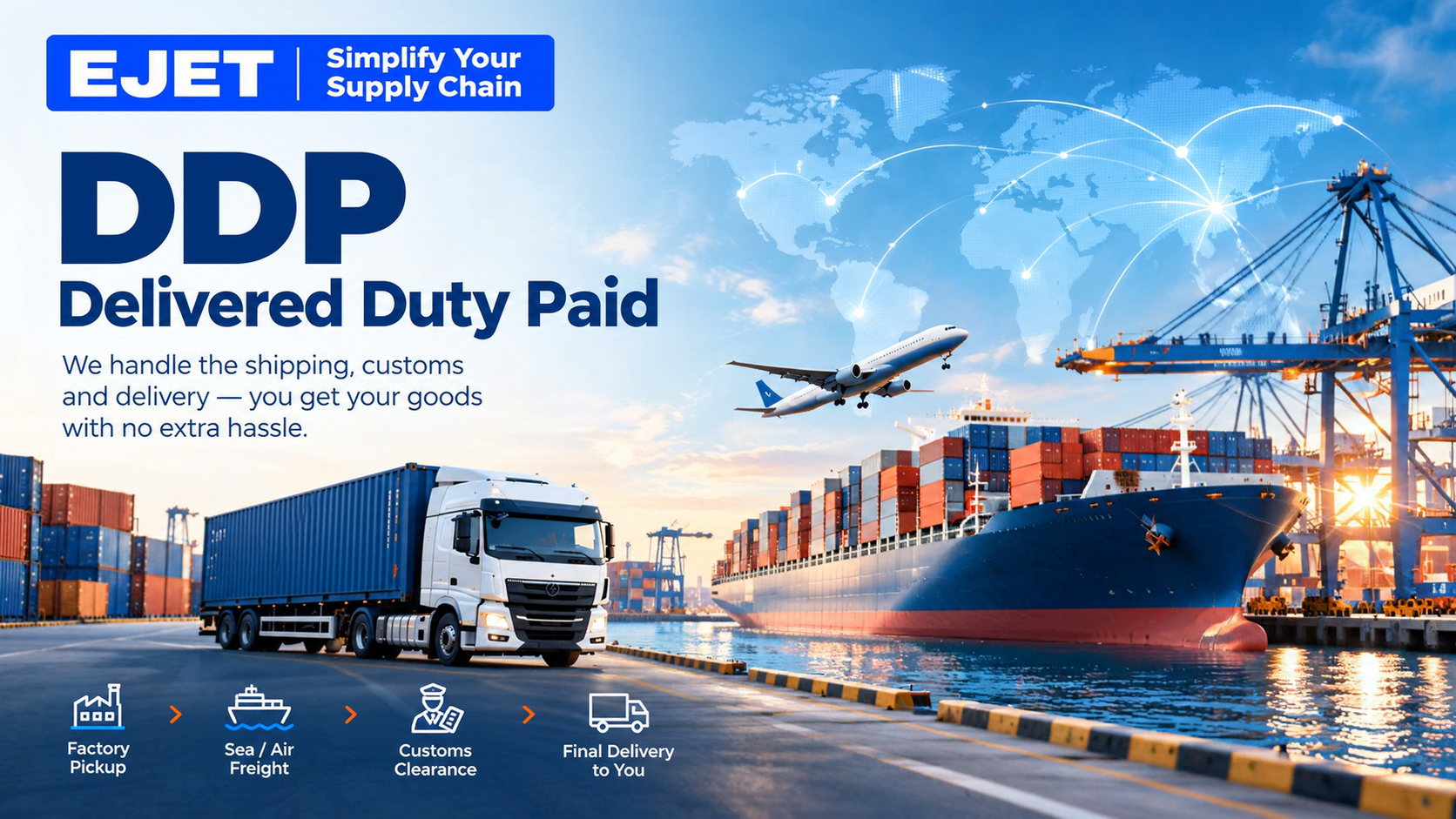
DDP, or Delivered Duty Paid, is an international trade term under which the seller arranges delivery to an agreed destination and handles export and import clearance, including applicable import duties and taxes.
Delivery takes place when the goods are available to the buyer on the arriving vehicle, ready for unloading.
For buyers importing from China, DDP can simplify purchasing by placing much of the transport and customs coordination with the seller.
However, a reliable DDP arrangement requires more than a quotation marked “tax included.” We need a precise delivery address, transparent pricing, a workable customs clearance arrangement, and written agreement on additional services.
What Does DDP Delivered Duty Paid Mean?
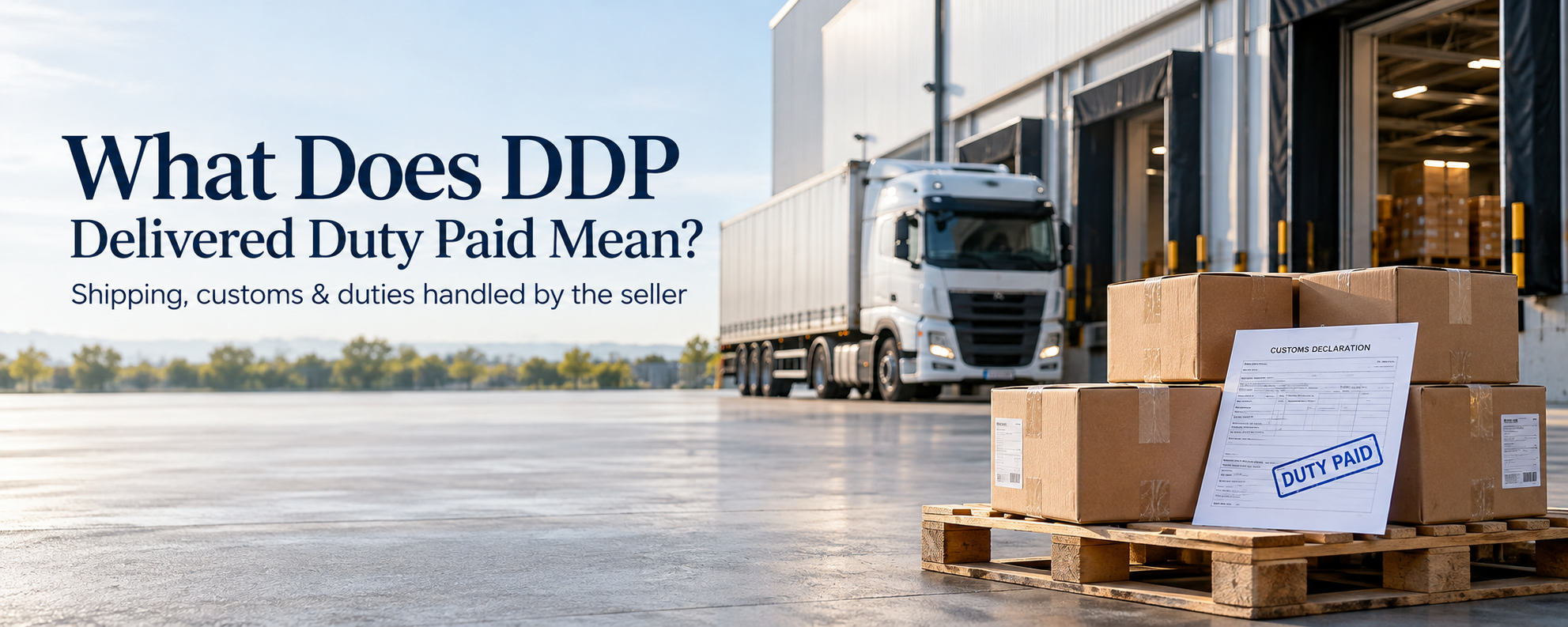
Delivered Duty Paid describes how the buyer and seller divide delivery responsibilities, costs, and transport risks under the agreed Incoterms® rule.
In a DDP transaction, the seller takes responsibility for moving the shipment to the named destination. This includes arranging the necessary transport and completing the applicable customs procedures.
The purchase contract should identify the destination clearly:
DDP [full delivery address and agreed delivery point], Incoterms® 2020
Writing only “DDP USA” or “DDP London” leaves important questions unanswered. A warehouse loading bay, a port terminal, and a residential address involve different delivery requirements.
We should specify the exact receiving location, contact person, access restrictions, and any appointment requirements before approving the shipment.
Seller and Buyer Responsibilities Under DDP
DDP places extensive obligations on the seller, but the buyer still has responsibilities. The following table summarizes the main allocation.
| Activity | Seller’s responsibility | Buyer’s responsibility |
|---|---|---|
| Prepare the goods | Supply goods meeting the sales contract | Provide agreed specifications |
| Export packaging | Arrange suitable packaging | Communicate special requirements |
| Export clearance | Arrange and pay | Provide assistance when required |
| International transport | Arrange and pay | Coordinate receiving plans |
| Import clearance | Arrange and pay | Provide necessary assistance |
| Import duties and applicable taxes | Pay under standard DDP terms | Check any expressly agreed variation |
| Transport to the named destination | Arrange and pay | Make the receiving location accessible |
| Final unloading | Normally outside the seller’s unloading obligation | Arrange unloading |
| Payment for the goods | Issue the agreed invoice | Pay according to the contract |
For practical purchasing, we should also assign responsibility for shipment updates, document review, delivery appointments, and damage reporting. These operational details help prevent disputes even when the trade term is correctly written.
How DDP Shipping From China Works
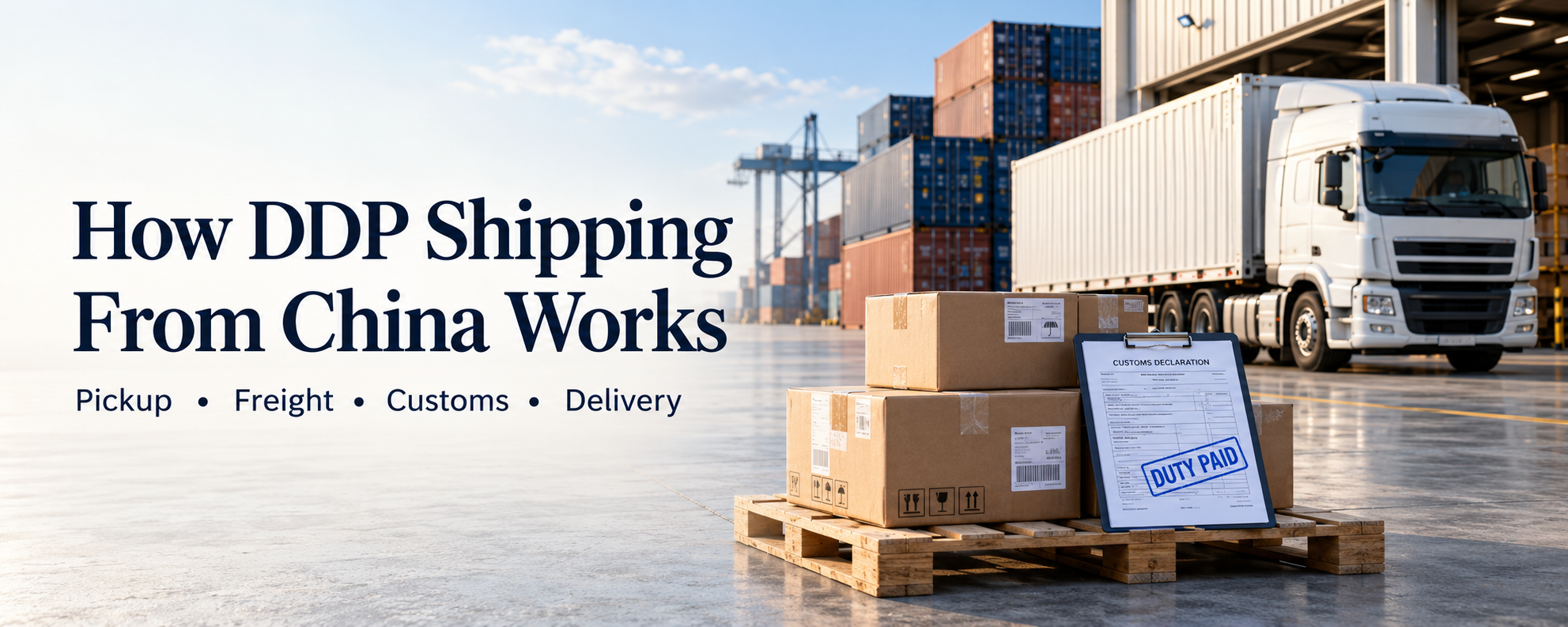
A well-organized DDP shipment begins before the goods leave the factory.
1. Confirm Product and Packaging Details
We first establish the product description, quantity, materials, intended use, carton dimensions, gross weight, and packaging method.
A quotation based on estimated dimensions may change after packing. For bulky products such as furniture or wall panels, accurate shipment measurements are especially important.
2. Agree on the Delivery Scope
The seller should quote against a complete destination address and a clearly described service.
We should confirm whether the arrangement includes:
-
Collection from one factory or several suppliers.
-
Consolidation and temporary storage.
-
Export documentation.
-
International freight.
-
Customs brokerage.
-
Applicable import duties and taxes.
-
Final delivery and appointment booking.
-
Any requested unloading equipment.
3. Review the Customs Arrangement
Before dispatch, we should identify the party responsible for the import declaration and confirm that the seller’s proposed arrangement can operate in the destination country.
A freight quotation alone does not establish that the customs structure is workable.
4. Track Shipment and Delivery
We should request milestone updates covering collection, departure, arrival, customs release, and final delivery.
At receipt, we should count packages, inspect visible damage, photograph any problems, and record discrepancies on the delivery paperwork.
What Does a DDP Price Include?
For budgeting, we can build a DDP quotation from separate cost components rather than accepting an unexplained total.
| Cost component | Information to request |
|---|---|
| Product price | Quantity, unit price, specifications |
| Origin transport | Collection address and consolidation scope |
| Export charges | Documentation and handling assumptions |
| Main freight | Transport mode and shipment measurements |
| Destination handling | Included terminal and handling services |
| Customs clearance | Brokerage scope and required documents |
| Duties and taxes | Classification, valuation, and tax assumptions |
| Final delivery | Exact address and receiving requirements |
| Additional services | Storage, appointments, special equipment |
A transparent DDP price should explain its assumptions and exclusions. We should establish how quotation validity, changes in shipment size, buyer-requested changes, and exceptional charges will be handled.
This allows us to compare suppliers using the same delivery scope.
DDP Shipping Cost Example
Consider an illustrative purchase of 1,000 stationery gift sets from China.
| Item | Illustrative cost |
|---|---|
| Goods | $5,000 |
| Collection and export handling | $300 |
| International freight | $850 |
| Destination handling and clearance | $250 |
| Assumed duties and import taxes | $600 |
| Final delivery | $200 |
| Total quoted DDP price | $7,200 |
The quoted delivered cost per set would be:
$7,200 ÷ 1,000 = $7.20 per set
These figures are a purchasing example, not a freight quotation or tariff calculation. Actual charges depend on the product, shipment, destination, and applicable import treatment.
For profitability planning, we should add costs outside this delivery calculation, such as inspection, marketplace fees, local storage, marketing, returns, and distribution.
DDP vs. DAP: What Is the Difference?
The central difference between DDP and DAP is responsibility for import clearance and the associated duties and taxes.
Under DDP, these obligations fall to the seller. Under DAP, the buyer handles import clearance and pays the relevant import charges. Under both rules, delivery normally occurs before unloading at the agreed destination.
For purchasing decisions, we can compare the two approaches as follows:
| Purchasing consideration | DDP | DAP |
|---|---|---|
| Customs coordination | Managed through the seller’s arrangement | Managed through the buyer’s arrangement |
| Quote review | Requires visibility into included import charges | Requires a separate import cost estimate |
| Buyer’s operational involvement | Usually lower | Usually higher |
| Broker relationship | Confirm the seller’s proposed structure | Buyer can coordinate its own broker |
| Budget comparison | Review the complete delivered quotation | Combine the supplier quote with import costs |
We should choose the arrangement that fits our actual capabilities and documentation needs.
Advantages of DDP for Importers
Simpler Shipment Coordination
DDP can reduce the number of logistics activities we manage directly. A buyer without an established freight and customs team may find it easier to coordinate delivery through one commercial contact.
This is particularly useful when the order combines products from multiple factories and requires careful consolidation.
Clearer Purchasing Budgets
A detailed delivered quotation helps us estimate product margins before placing an order.
For wholesalers and retailers, this supports decisions about selling prices, minimum margins, and purchase quantities. The benefit depends on the quotation being complete and based on accurate shipment information.
Less Administrative Work
When the seller’s delivery network is capable and transparent, our team can spend more time on product selection, quality control, inventory planning, and sales.
We should still retain shipment records and review the proposed process before dispatch.
DDP Risks and Common Mistakes
Unclear Importer Arrangements
We should never assume that writing “DDP” automatically enables a foreign seller to complete every destination-country import requirement. ICC guidance highlights that national regulatory barriers can complicate the seller’s import clearance obligations.
Before shipment, we should ask:
-
Who will appear on the customs declaration?
-
Which broker will handle clearance?
-
Which registrations or authorizations are required?
-
What documents will we receive after release?
Vague “All-Inclusive” Quotations
A low price may be based on incomplete dimensions, an unsuitable delivery address, or missing services.
We should request written confirmation of the delivery scope and investigate quotations that are substantially below competing offers.
Incorrect Product Information
Incomplete descriptions create avoidable problems. “Accessories,” “gifts,” or “plastic products” may provide too little information for a proper shipment review.
We should supply accurate product descriptions, materials, intended uses, values, quantities, and supporting documents.
Confusing Delivery With Product Acceptance
Receiving cartons does not establish that the goods meet our quality requirements.
We should define inspection standards, defect remedies, warranty arrangements, and claims procedures separately in the purchase contract.
Does DDP Include Unloading?
Under standard DDP, the buyer is responsible for unloading at the final destination. Unloading costs may already be included in the seller’s transport contract, so the cost arrangement should be checked separately from the unloading obligation.
For heavy or oversized goods, we should confirm:
-
Whether a forklift or crane is available.
-
Whether a tail-lift vehicle is needed.
-
Who books the unloading team.
-
How much unloading time is allowed.
-
Whether the delivery point can accommodate the vehicle.
These details are especially relevant for machinery, palletized wall panels, furniture, and large appliances.
Checklist Before Accepting a DDP Quotation
Before approving a DDP order, we should obtain clear answers to the following questions:
-
What is the exact named delivery point?
-
Are the packed dimensions and weights confirmed?
-
Which duties, taxes, and delivery services are included?
-
Who will manage the import declaration?
-
What customs and shipping records will be provided?
-
Which additional charges could arise, and who bears them?
-
What is the delivery estimate, and when does it begin?
-
Who arranges unloading and receiving appointments?
-
What happens if packages arrive damaged or incomplete?
-
How long is the quotation valid?
We should retain these answers with the purchase order, product specifications, and final quotation.
Frequently Asked Questions About DDP Delivered Duty Paid

Is DDP Shipping Suitable for Small Businesses?
DDP can suit small businesses seeking simpler shipment coordination. We should evaluate the seller’s delivery capability, pricing transparency, and customs arrangements before choosing it.
Does DDP Mean Free Shipping?
No. Delivery expenses are generally reflected in the commercial price. A supplier may present freight separately or include it within the total quotation.
How Long Does DDP Shipping From China Take?
There is no universal DDP transit time. We should request a route-specific estimate that distinguishes production, consolidation, transport, customs processing, and final delivery.
Can We Use DDP for Bulk Orders?
Yes, but order size increases the importance of accurate measurements, receiving capacity, unloading arrangements, and clear documentation.
What Should We Prioritize When Choosing DDP?
We should prioritize a precise destination, a complete written quotation, a verified clearance arrangement, and accessible shipment records. These elements make DDP easier to assess and help us purchase with a clearer understanding of the delivered cost.