Learning how to start selling on Amazon begins with choosing an eligible product, calculating its costs, opening a seller account, and deciding how orders will reach customers.
You can handle fulfillment yourself or use Fulfillment by Amazon (FBA) to outsource storage and order fulfillment.
This Amazon seller guide focuses on the US marketplace and gives you a practical sequence for researching products, testing a small launch, and deciding whether to expand.
How does selling on Amazon work?
Selling on Amazon means creating offers for products in Amazon’s marketplace, receiving customer orders, and fulfilling those orders yourself or through Amazon. You manage listings, pricing, inventory, and account operations through Seller Central. Amazon charges selling fees, with additional costs depending on your fulfillment method and optional services.
A product detail page describes the item; your offer specifies details such as its price, condition, and fulfillment arrangement. If the exact product already exists in Amazon’s catalog, you generally add your offer to that page rather than create a duplicate. Multiple sellers can offer the same product on one detail page.
Think of your first launch as a controlled experiment:
- Identify a product and confirm you can list it.
- Estimate the money left after every relevant expense.
- Source a manageable quantity and inspect it.
- Publish an accurate offer and arrange fulfillment.
- Review actual results before buying more.
The goal is not simply your first sale. Aim to learn whether you can repeat that sale at an acceptable profit.
Choose a business model before buying inventory
Start with a clear sourcing plan rather than a broad ambition to sell on Amazon. Consider these approaches as options to investigate, not promises of easy income:
|
Approach |
What you would do |
What to investigate first |
|---|---|---|
|
Resale |
Buy existing products and resell them |
Listing eligibility, authenticity evidence, and reliable sourcing |
|
Wholesale |
Purchase stock from a manufacturer or distributor |
Supplier requirements, order quantities, and competitive pricing |
|
Private label |
Source products under your own brand |
Development costs, quality control, differentiation, and brand requirements |
|
Used books |
Source and grade eligible secondhand books |
Edition matching, condition, demand, and per-copy economics |
Your ability to sell a product can depend on its category, brand, and condition. Some products require approval, and others cannot be sold by third-party sellers. Check the specific item before committing money, regardless of your preferred sourcing model.
Choose the approach whose uncertainties you can realistically investigate. For example, before ordering branded goods, ask what documentation the supplier will provide. Before developing your own product, write down the customer problem it improves and how you will verify that improvement.
What should you sell on Amazon first?
Your first product should be eligible to sell, supported by evidence of demand, and financially workable at a realistic selling price. There is no universal list of profitable Amazon niches that guarantees a good opportunity. Amazon’s Product Opportunity Explorer provides information about demand, competition, search behavior, reviews, and returns to support your research.
Use the hottest selling items on Amazon as research leads, not an automatic shopping list. Amazon recommends its Best Sellers and Movers & Shakers lists for spotting trending products, but product selection still depends on competition, seasonality, and your business goals.
Build a shortlist around customer needs
Pick a few specific customer problems you understand. Instead of researching an entire category such as kitchen supplies, investigate a narrower use case, such as organizing utensils in a shallow drawer. Treat that example as a research direction, not a proven opportunity.
For each candidate, record:
- Customer need: What job does the buyer want the product to perform?
- Competitive alternatives: What already solves that problem, and at what price?
- Unresolved complaints: What concerns appear repeatedly in reviews?
- Operational demands: What must you inspect, package, store, or explain?
- Financial limits: What purchase price would leave enough room for expenses?
Review insights and return information can help identify product weaknesses or unmet needs. Use those findings to form a testable improvement, rather than copying a competitor’s listing or assuming every complaint represents a large market.
Apply a stop-before-you-buy check
Before contacting suppliers, review product restrictions, safety requirements, and listing rules. Products supplied for sale must comply with applicable laws and Amazon policies. Do not assume an existing listing proves that your proposed product, documentation, or selling account meets those requirements.
If you cannot explain why a customer would choose your offer—or what evidence supports the purchase—keep researching.
Calculate profit before setting a budget
Separate sales revenue from the money your business actually keeps. Amazon’s standard selling fees include selling-plan fees and referral fees; optional services such as FBA and advertising can add costs. Referral fees vary by category, so use the fee schedule for the specific products you are evaluating.
Build a worksheet with these lines:
- Expected selling price and any shipping revenue.
- Product purchase cost.
- Freight, preparation, labeling, and packaging expenses.
- Amazon selling and fulfillment fees.
- Storage and other applicable inventory charges.
- Advertising or promotional spending.
- An allowance for returns, damage, and unsold stock.
Then calculate your estimated contribution per sale: revenue minus the variable costs associated with that sale. Keep fixed overhead and your own compensation visible separately so an attractive per-unit result does not hide an unprofitable overall operation.
Amazon’s Revenue Calculator can compare estimated results for FBA and your own fulfillment. Enter accurate product dimensions, weight, category, and costs, then inspect what the estimate includes rather than treating the result as a guaranteed payout. (
Stress-test the numbers
Run a base case and a less favorable case. In the second version, try a lower selling price, higher advertising costs, and slower sales. Ask whether you would still want to own the inventory under those conditions.
Set your maximum purchase quantity from the amount you can afford to have tied up, not from the supplier’s most attractive volume discount. Keep some cash uncommitted for problems and replenishment. A useful first budget should tell you both what you can buy and when you should stop.
Open your seller account and select a plan
Amazon’s US Individual plan charges $0.99 per item sold, while the Professional plan charges $39.99 per month; applicable selling fees are additional. The plans also differ in features, including bulk listing and reporting capabilities. Compare the tools you need as well as your expected volume, and confirm current terms before registering.
Do not confuse a selling plan with a business structure. Amazon says you do not need an LLC or incorporated business to register: an individual can select the relevant individual business-type option. That platform rule does not determine every obligation that may apply to your circumstances.
Prepare the information requested during registration, including:
- Government-issued identification and contact details.
- Bank account details for receiving payments.
- A chargeable credit card.
- Tax information.
- Address documentation and business information, where applicable.
Registration includes business, seller, billing, and store information, followed by identity verification. Follow the document instructions shown for your application rather than relying on an old checklist from another seller.
Before listing stock, make yourself an account-setup checklist. Review your payment details, return arrangements, shipping settings, notification preferences, and access permissions. Keep a secure record of the information submitted so you can respond consistently if Amazon requests clarification.
Decide between FBA and merchant fulfillment
With FBA, you send inventory into Amazon’s fulfillment network, and Amazon handles picking, packing, shipping, customer service, and returns for those orders. With Fulfilled by Merchant, you retain responsibility for fulfillment rather than using FBA. Compare both arrangements for each product instead of assuming one is always the cheaper choice.
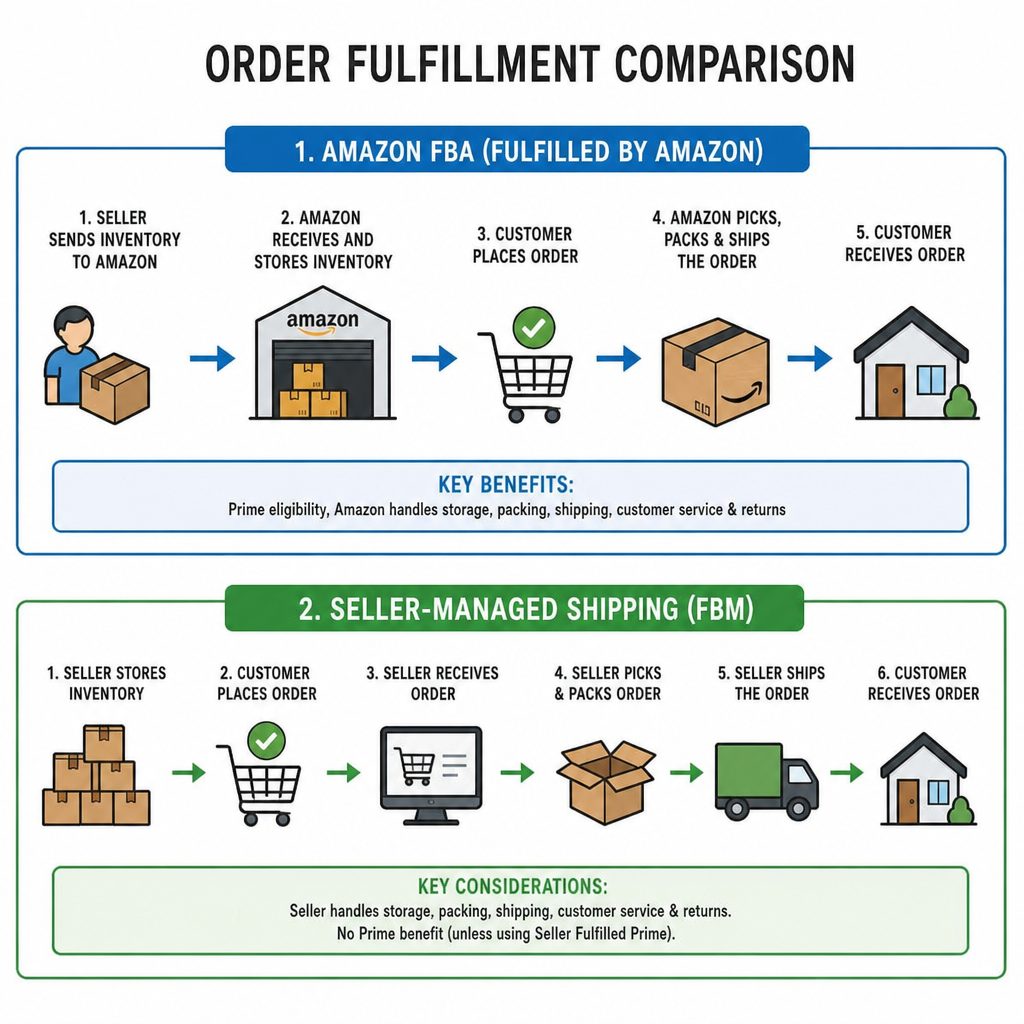
For merchant fulfillment, prepare a realistic operating plan. Decide where inventory will live, who will pack orders, how you will buy postage, and how you will handle a busy day or an absence. Include your labor in the comparison, even if you initially do the work yourself.
For FBA, review fulfillment and storage charges along with other applicable costs. An inbound placement service fee may also apply, and Amazon provides estimates through its Revenue Calculator. Check the shipment options and fees presented for your inventory before sending it.
Practical Amazon FBA tips for a first shipment
Use this preparation checklist:
- Measure packaged units: Base your estimate on the item as it will actually be fulfilled.
- Inspect before shipping: Look for damage, missing components, and inconsistent packaging.
- Read current preparation instructions: Confirm the requirements for your particular inventory.
- Send a controlled quantity: Choose an amount that lets you test demand without an unnecessarily large commitment.
- Track shipment records: Keep quantities, shipment references, and supporting documents together.
After launch, compare the actual charges with your estimate. Investigate differences before expanding the next shipment; a small test is most useful when you use it to correct your assumptions.
Create listings that answer buying questions
Amazon requires product information to be accurate, clearly written, and correctly categorized. Images must meet its standards and any category-specific requirements. Before writing persuasive copy, establish exactly what the product is, what is included, and what claims you can support.
If you are matching an existing product, verify that it is an exact match. If the product is new to the catalog, create its detail page using the appropriate product information. Amazon distinguishes between creating a new listing and adding an offer to an existing one.
For your own listing content, work through five buyer questions:
- What is it? Name the product clearly, with the relevant identifying details.
- Will it fit my needs? Explain dimensions, compatibility, materials, or other selection criteria.
- What will I receive? State quantities and included components without ambiguity.
- How will I use it? Give useful instructions and identify genuine limitations.
- What might I misunderstand? Address likely assumptions before they become complaints.
For example, replace “ideal for every drawer” with the actual dimensions and a reminder to measure available space. Replace “premium quality” with a supported description of the material or construction. Specific information gives shoppers something meaningful to evaluate.
Follow current title requirements for your category rather than stuffing every search phrase into the title. Amazon’s title policies emphasize clear, consistent wording and restrict excessive repetition. (sellercentral.amazon.com)
Before publishing, review the listing on a phone and ask someone unfamiliar with the item to explain what they think they would receive.
Consider selling books on Amazon as a focused test
Selling books on Amazon is one possible starting point, particularly if you already have eligible books to evaluate. Amazon supports new and used books, but accurate edition matching and condition assessment matter. Check the ISBN, format, and current listing eligibility before purchasing or listing a copy.
Create a repeatable inspection routine. Check the cover, binding, pages, writing or highlighting, moisture damage, and any advertised supplementary material. Then consult Amazon’s condition guidance before choosing a condition grade. Avoid describing a copy more favorably than your inspection supports.
Researching the best selling books on Amazon can help you explore demand, but popularity alone should not determine what you buy. Amazon recommends checking a book’s condition and Best Seller ranking when evaluating resale opportunities. It also notes that textbook demand can be seasonal and that some textbook types may be prohibited.
For each copy, record its acquisition cost, expected proceeds, and the time needed to inspect and list it. Decide whether that individual transaction is worthwhile rather than treating books as a uniformly profitable category.
Launch small and use results to improve
Make your first launch answer a specific question: can this offer generate enough contribution to justify replenishment? Set a review date and a spending limit before you start. Avoid changing your product, price, imagery, and promotion simultaneously, because that makes the results harder to interpret.
Use a simple weekly scorecard:
|
Measure |
What to investigate |
|---|---|
|
Visits and orders |
Whether shoppers are finding and choosing the offer |
|
Revenue after variable costs |
Whether sales are contributing enough toward overhead |
|
Advertising spend |
Whether paid traffic fits your margin allowance |
|
Returns and customer concerns |
Whether the product or listing needs correction |
|
Remaining inventory |
Whether to reorder, wait, or stop purchasing |
Amazon offers optional advertising and promotional tools, but using them adds another decision to your economics. Start with a defined test budget rather than assuming promotion will repair an unclear or uncompetitive offer. (sell.amazon.com)
Keep review collection within Amazon’s rules. Paying or offering incentives for reviews, reviewing your own products, and asking customers to change or remove reviews are prohibited activities. Do not purchase a shortcut from a service promising positive feedback.
Among the most useful Amazon selling tips is this: establish a reorder rule before excitement takes over. Replenish because the evidence supports another purchase, not merely because the first batch produced sales.
Compare selling on Amazon vs eBay using the same item
When considering selling on Amazon vs eBay, compare a real product and operating plan rather than declaring one platform universally better. Amazon allows multiple sellers’ offers on a shared product detail page. eBay offers auction and fixed-price listings, creating different options for presenting and pricing inventory.
Fees also need a like-for-like comparison. Amazon has selling-plan and referral fees, with optional service costs; eBay’s fee structure includes insertion and final value fees, with conditions and category differences. Check both platforms’ current schedules for the item you intend to sell.
Prepare two worksheets using the same acquisition cost, expected sale price, packaging, labor, and return allowance. Then add the relevant platform expenses and fulfillment arrangements. If you test both marketplaces, keep inventory records coordinated so you do not promise the same unit to two buyers.
Explore alternatives if you do not want inventory
If your real question is how to make money on Amazon without selling, distinguish owning inventory from earning through another activity. Amazon Associates, for example, allows eligible participants to earn commission income from qualifying purchases through affiliate links, subject to its program terms. It is a different model from operating a product-selling account.
Affiliate participation requires appropriate disclosures. Amazon requires disclosure with affiliate links and identification as an Amazon Associate using its required language. Review the current agreement and disclosure guidance before publishing promotional content.
Choose based on the work you want to do. If you prefer researching and explaining products to sourcing and fulfilling them, investigate affiliate content. If you want control over a physical offer, continue evaluating a selling business. Neither choice should begin with an assumed income figure.
Is selling on Amazon worth it?
Selling on Amazon may be worth testing if your expected margin, sourcing reliability, available cash, and operating capacity support the commitment. It is not automatically worthwhile because a product is popular or because fulfillment can be outsourced. Amazon itself notes that profitability depends on factors including products, pricing, and marketing strategy.
Before you start an Amazon business, write down your decision criteria:
- The amount you are comfortable committing to an initial test.
- The minimum contribution you need from each sale.
- The weekly time you can devote to operations.
- The evidence that would justify a reorder.
- The losses or unresolved problems that would trigger a stop.
When selling products online, use these boundaries to decide what deserves more time and money. If the numbers work only at an unusually high price or depend on ignoring your labor, revise the plan before ordering stock.
Start with one product and a clear learning goal
Your next step is not a large inventory purchase. Choose one candidate, confirm its eligibility, complete a conservative cost worksheet, and plan a manageable test. Use the first results to improve your assumptions before expanding.
A disciplined launch gives you something more useful than an ambitious sales target: evidence about what to keep doing, what to change, and when to walk away.
Frequently Asked Questions About Starting to Sell on Amazon
What are the initial steps to start selling on Amazon?
To start selling on Amazon, you need to choose an eligible product, calculate costs, set up a seller account, and decide on your fulfillment method (either by yourself or through Fulfillment by Amazon).
How do Amazon selling fees work?
Amazon charges various selling fees, including selling-plan fees and referral fees based on the product category. Additional costs may apply if you use Fulfillment by Amazon (FBA) or other optional services.
What are the best products to sell on Amazon?
The best products to sell depend on demand, competition, and profitability. Use Amazon's Product Opportunity Explorer to research potential products and consider niche markets for better chances of success.
Can I sell books on Amazon?
Yes, you can sell both new and used books on Amazon. It’s essential to accurately match book editions and assess their condition before listing them for sale.
Is selling on Amazon worth it?
Whether selling on Amazon is worthwhile depends on your expected profit margins, reliable sourcing, and business capacity. Evaluate these factors carefully to determine if it's a suitable venture for you.