










.png)
Amazon FBA is a legitimate fulfilment service—but that doesn’t mean every person selling an FBA course, automated store, supplier list, or investment opportunity is trustworthy.
Amazon FBA scams often borrow the credibility of Amazon’s marketplace to sell unrealistic income promises, steal account access, or push sellers into risky purchases.
This guide explains how those schemes work, what warning signs to look for, and how to protect your money and seller account.
It also covers a critical distinction: a seller can face serious problems even when nobody deliberately set out to scam them—for example, if a supplier provides counterfeit or poorly documented stock.
Is Amazon FBA Legit or a Scam?
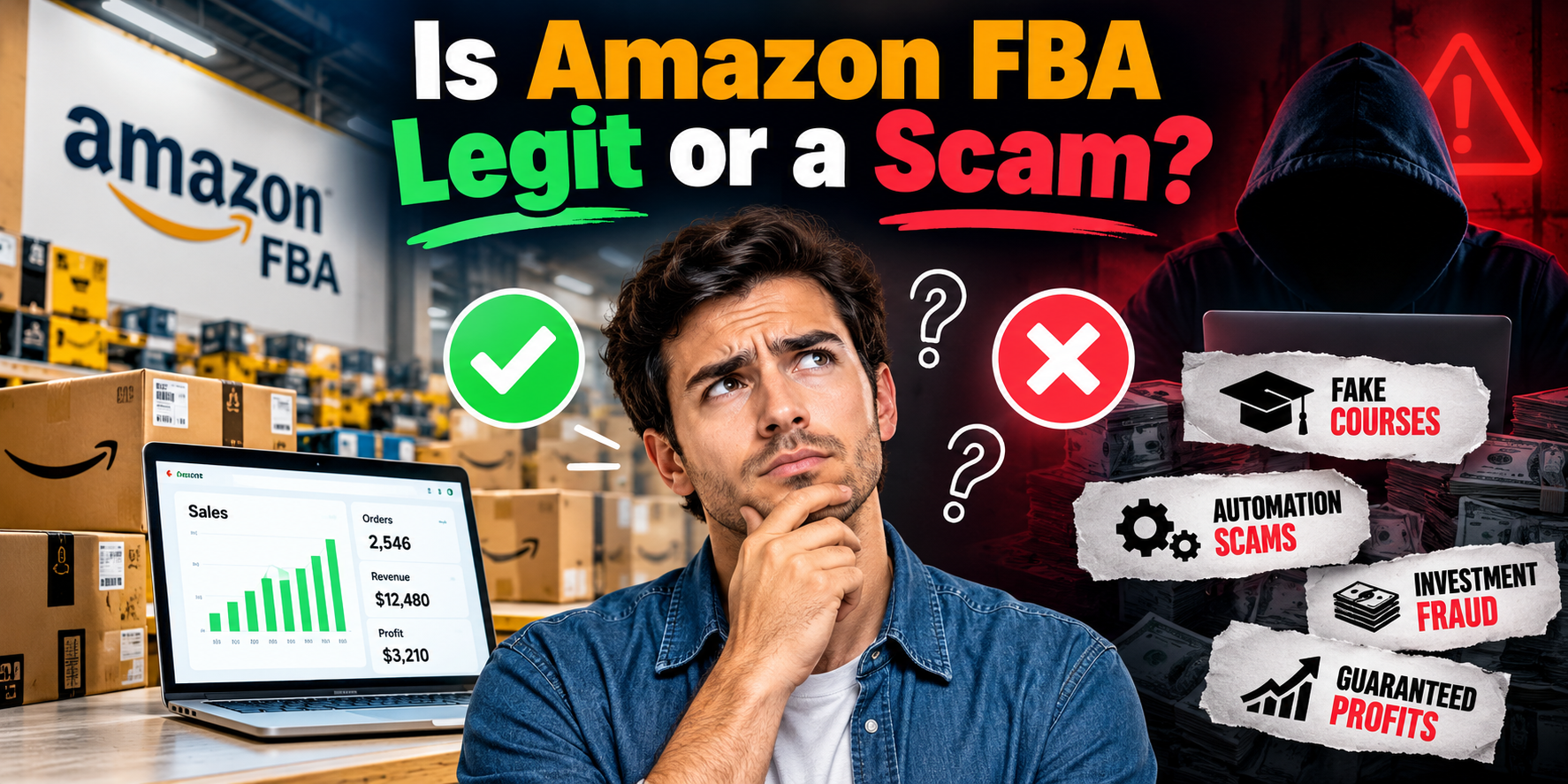
Fulfilment by Amazon, or FBA, is a real logistics service. A seller sends eligible products to Amazon fulfilment centres; Amazon stores the inventory and, when an order comes in, picks, packs and ships it.
Amazon also provides customer service and handles returns for FBA orders.
The seller remains responsible for choosing and sourcing products, setting up the business, managing listings, meeting applicable requirements and understanding the costs.
That is different from paying a third party to “build a guaranteed Amazon income stream” for you. An agency or coach might provide legitimate help, but its private service is not the same thing as Amazon FBA.
Amazon does not promise that a particular product will sell, that a store will make a profit, or that a third-party provider’s claims are accurate.
FBA is a business model, not a guaranteed return. Amazon’s UK pricing information, for example, describes selling-plan charges, category-based referral fees, fulfilment charges, storage costs and other possible fees.
Amazon’s Revenue Calculator lets sellers estimate costs for particular products, but estimates are not promises of sales or profit.sell.amazon+1
So, is Amazon FBA legit? The fulfilment service is legitimate; particular FBA-related offers must be assessed on their own merits.
That distinction helps you avoid two opposite mistakes: assuming every FBA business is a scam, or assuming a sales pitch is safe because it mentions Amazon.
Why Amazon FBA Scams Persuade People
The appeal is easy to understand. Online sellers see success stories, impressive sales dashboards and promises of a business they can run from home.
An FBA-related promoter may suggest that a “system,” AI tool or team of specialists has removed the difficult parts.
But the real work still matters: choosing and testing a product, calculating costs, checking suppliers, handling cash flow, complying with marketplace policies and responding when something goes wrong.
Outsourcing tasks doesn’t remove the business risk. It can add another risk if you don’t know who controls the store, how money is spent or what the service provider is actually doing.
Sales revenue is not profit. A screenshot showing high sales may leave out inventory costs, advertising, Amazon fees, refunds, taxes, contractor charges and unsold products. Ask for the full financial picture—not just the number that looks most impressive.
Common Amazon FBA Scams
Amazon Automation and “Done-for-You” Stores
An automation scheme typically offers to set up and manage an Amazon storefront for you.
The promoter may describe the business as passive, point to proprietary AI or promise access to special brands.
You pay an upfront management fee, may provide additional money for inventory, and are told the experts will take care of everything.
Some hands-off store-management services may be genuine. The warning sign is not simply that a company offers management.
It is the combination of large fees, weak transparency and confident income promises, especially when the buyer is discouraged from understanding the business.
A documented example illustrates why buyers should investigate claims. In March 2025, the FTC said it had obtained a temporary court order against
Click Profit, alleging the business promised consumers large sums of passive income from online stores, including Amazon stores.
The FTC’s complaint alleged that customers paid a management fee of at least US$45,000 plus thousands more for inventory; it also alleged that Amazon had blocked, suspended or terminated about 95% of the company’s stores.
The FTC announced a proposed settlement in August 2025 that would permanently ban the operators from the business-opportunity industry.
These are findings and allegations tied to a particular case—not evidence that all store-management agencies behave the same way.
Before considering an automation service, ask to see the account’s actual performance records, including costs and losses, not just hand-picked success stories.
Find out who owns the Seller Central account, who pays for inventory, how your money is handled, what the management fee covers, and how you can end the contract.
Fake Investment Offers and Guaranteed Returns
Some promoters market Amazon stores as if they were low-risk investments. They may claim that your money will be used to purchase inventory, that an expert team will run the store, and that you will receive predictable monthly returns.
That pitch can blur an important line: buying a business service is not the same as making a regulated investment, and putting money into a retail business does not guarantee a return.
You could lose some or all of your money if products do not sell, costs rise, an account is restricted, or the service provider fails to deliver.
The FTC warns consumers to be cautious of business or coaching offers that promise guaranteed income, large returns or a “proven system.”
It also advises people to take time, research the company, treat testimonials skeptically and get a second opinion before paying.
Be especially cautious when the pitch urges you to borrow money or use credit to invest. In the Click Profit case, the FTC alleged that many consumers did not recover their costs and that some were left with credit-card debt and unsold products.
That example does not predict the outcome of every FBA venture; it shows why risk, debt and inventory exposure should be made clear before you commit.
Amazon FBA Course and Coaching Scams
A course or coaching program is not automatically a scam. Training can help a beginner understand product research, listing basics or account operations.
But some sellers of training rely on aggressive sales tactics and then push increasingly expensive mentoring, software or “exclusive” opportunities.
Potential warning signs include:
-
A coach guarantees that you will earn a particular amount.
-
The course seller claims you can succeed without understanding the business.
-
You must make a quick decision to unlock a “limited” price.
-
The advertised success stories do not disclose how many students failed or what expenses they incurred.
-
The provider charges more before explaining the curriculum, support or refund terms.
-
The coach’s credentials, experience or business history cannot be independently checked.
Ask for the course outline, total cost, refund terms, and a written explanation of what support you will receive. Contact former students independently where possible.
A helpful course teaches skills and explains uncertainty; it does not promise that following a script will eliminate risk.
The FTC’s guidance recommends researching the promoter, reviewing the contract, and being skeptical of testimonials and income claims.
Seller Account Phishing and Takeover Attempts
A phishing message tries to trick a seller into sharing login credentials, payment information or identity documents.
It might claim that your account will be suspended unless you verify details urgently, or that a payment problem requires immediate action.
The link may lead to a website designed to look like Amazon.
If a criminal obtains account access, they could attempt to change payment details, alter listings, misuse account permissions or lock the seller out.
Even a message that contains accurate-looking account details should be verified independently.
Amazon Seller Central advises sellers to use two-step verification, choose unique passwords, review secondary-user access, and go directly to the site by typing its address rather than clicking a suspicious message link.
Its guidance says sellers should submit sensitive information through Amazon’s website or Seller Central—not by replying to an email request.
Never give a caller or email sender your one-time verification code. If you receive an unexpected account warning, sign in through your usual route and check your Seller Central notifications.
Don’t use a phone number or link supplied in the message until you have independently verified it.
Fake Suppliers and Counterfeit Inventory
A supplier may present itself as a manufacturer, authorised distributor or brand partner when it is not. It may take payment and fail to deliver, ship goods that differ from the approved sample, or supply products that are counterfeit or otherwise non-compliant.
A supplier can also be unreliable without being a deliberate fraudster; either way, the seller may be left with poor-quality stock, customer complaints or an account problem.
Counterfeit inventory is especially serious because the seller is responsible for sourcing and selling authentic products.
Amazon’s anti-counterfeiting policy says counterfeit products are prohibited and that violations can lead to loss of selling privileges, funds being withheld or inventory being disposed of.
In the UK, Amazon’s invoice guidance says it may use supplier invoices to verify products and requires documents to be authentic and unaltered
. It lists details such as a recent issue date, sufficient quantities, product identifiers and supplier contact information; it also notes that supplier information should be independently verifiable.
Reduce sourcing risks by ordering samples, checking the supplier’s business details independently, agreeing product specifications in writing, and keeping original invoices and shipping records.
For branded goods, ask whether the supplier is authorised and whether the paperwork creates a credible trail back to the manufacturer or distributor. A polished website, marketplace badge or low price alone does not prove authenticity.
Fake Amazon Support and Account-Recovery Services
A person may contact you claiming to be an Amazon employee, account specialist or suspension expert. They may offer to restore a suspended account, remove a policy violation or “escalate” a case through an insider connection.
Some may demand payment for guaranteed reinstatement or ask for your login details.
A legitimate consultant can explain what work they will perform and help you prepare a response, but nobody outside Amazon can honestly promise a particular internal decision.
Be sceptical of claims about secret contacts, guaranteed reinstatement or special access to Amazon staff.
Keep your account recovery process inside Seller Central and contact Selling Partner Support through the official account interface. If you hire a consultant, use limited, authorised access and do not hand over your password or verification codes.
Amazon FBA Scam Comparison Table
| Scam type | Warning signs | Possible risks | Protective measures |
|---|---|---|---|
| Automation or done-for-you store | "Passive income," guaranteed profits, large upfront fees, vague account ownership | Lost fees, unsold inventory, debt, suspended store | Verify performance records, ownership, fees, refund terms and exit rights |
| Fake investment offer | Predictable returns, pressure to borrow or pay immediately | Loss of capital, credit-card debt, no control over the business | Treat it as a risky business venture; get independent financial and legal advice |
| Course or coaching scam | Guaranteed income, repeated upsells, unverifiable testimonials | Expensive training with little practical value | Review the syllabus, full price, refund policy and independent feedback |
| Phishing or account takeover | Urgent links, requests for login or one-time codes, threats of suspension | Stolen credentials, changed payment details, account disruption | Use unique passwords and two-step verification; sign in directly |
| Fake supplier or counterfeit goods | No verifiable business details, suspiciously low prices, weak or altered paperwork | Lost payment, unsellable inventory, authenticity violations | Verify the supplier, inspect samples, retain genuine invoices and traceable records |
| Fake support or recovery service | "Insider" access, guaranteed reinstatement, password requests | Extra fees, compromised account, further policy problems | Use official support channels and grant only limited authorised access |
Amazon FBA Red Flags to Check
One warning sign on its own may not prove fraud. Look for a pattern: unusually strong promises, pressure to act, missing details and requests for risky access or payment.
Before you sign or pay, ask:
-
Is a result guaranteed? Sales and profits depend on factors no coach or agency fully controls.
-
Can the provider explain the business? You should understand what is sold, who buys it and how revenue is generated.
-
Are all the costs stated? Ask about management charges, inventory, advertising, Amazon fees, software, refunds and any revenue share.
-
Do the numbers show profit or just sales? Request a breakdown of costs, returns, inventory purchases and the period covered.
-
Can you verify the evidence? Look for complete records and independent references rather than selected screenshots.
-
Will you control the store and its money? Find out who owns the Seller Central account and where payouts go.
-
Are you being rushed? A legitimate offer should allow time for review and independent advice.
The UK’s Financial Conduct Authority is not the main regulator of ordinary
Amazon retail businesses, but if a promoter describes an arrangement as an investment, promises returns, or pools money, make sure you understand the legal structure and seek qualified advice appropriate to that offer.
Don’t assume the word “investment” means the opportunity is regulated or protected.
How to Vet an Agency, Coach, or Supplier
Check Business Claims and Contracts
Search the company’s exact legal name, trading names and owners alongside terms such as “complaint,” “refund,” “lawsuit” and “review.” Look beyond the company’s own website and paid search results.
A lack of complaints does not prove a company is trustworthy, but a pattern of similar complaints deserves attention.
Request the contract before a sales call ends. Check:
-
What the provider will do and when.
-
What each fee covers and whether additional charges may arise.
-
Who owns the seller account, listings, inventory and brand assets.
-
Who controls advertising budgets and supplier payments.
-
Whether the provider can use your funds for anything beyond agreed expenses.
-
How cancellations and refunds work.
-
Whether you can inspect reports, supplier invoices and account activity.
If someone makes an earnings claim, ask for written evidence that explains how the claim was calculated and whether it reflects typical results.
If the provider will not give you time to review the paperwork, do not let urgency make the decision for you.consumer.ftc+1
Verify Products and Supply-Chain Documents
Before placing a large order, verify the supplier’s identity using sources independent of the supplier.
Contact the business through details you find yourself, rather than relying solely on contact information in an unsolicited message. Ask for samples and compare them with the agreed specifications.
Keep original purchase orders, completed invoices, payment records, shipping documents and product specifications.
Do not edit documents to make them appear more complete, and do not submit a pro forma invoice as if it were proof of a completed purchase.
Amazon’s UK guidance says submitted invoices must be authentic and unaltered; it may contact the supplier to verify information.
For branded products, ask the brand or distributor whether the supplier is authorised. Confirm that product identifiers, quantities and descriptions match what you intend to sell.
If the goods are regulated or safety-sensitive, check the relevant UK product-safety and compliance requirements before ordering.
Grant Account Access Safely
A consultant may need access to some Seller Central functions to do their job.
That does not mean they need your password or unrestricted control of the business.
Amazon provides tools for managing user and service-provider permissions.
Where available, authorise a provider through Amazon’s official process, review the requested permissions, set an appropriate duration, and remove access when it is no longer needed.sellercentral.amazon+1
Use a separate login for each person who needs account access. Grant only the permissions needed for the work, and review access periodically.
Amazon’s account-security guidance specifically recommends separate user accounts and regular review of secondary users.
If a provider insists on your primary password, asks you to send a one-time code, or wants access unrelated to their work, pause and verify the request.
A professional service should be able to explain its access needs clearly.
Protect Your Seller Account and Your Money
Use these habits to reduce exposure to account theft, misleading offers and sourcing problems:
-
Secure your logins. Use a strong, unique password for Seller Central and your business email. Turn on two-step verification and keep your recovery details current.
-
Verify messages independently. Don’t click unexpected links to “save” an account. Open Seller Central directly and review account notifications there.
-
Keep control of your bank and payment details. Avoid letting a provider redirect payouts or spend money without clear, written authorisation.
-
Reconcile sales with costs. Review Amazon settlements, advertising charges, refunds, inventory purchases and service-provider invoices.
-
Keep a paper trail. Store contracts, invoices, product specifications, supplier correspondence and payment evidence in an organised, backed-up location.
-
Use Amazon’s cost tools. Estimate referral, fulfilment, storage and other fees for your product, then update the calculation when the details change. Amazon’s UK Revenue Calculator is intended to help compare fulfilment options and estimate proceeds.sell.amazon+1
-
Start with a manageable commitment. Test a product or service on a scale you can afford to lose, rather than taking on debt based on someone else’s earnings forecast.
For UK sellers, a practical profit estimate should include more than the product cost and sale price.
Consider Amazon’s charges, inbound shipping, packaging, advertising, returns, taxes, storage and possible unsold stock.
A product that appears profitable before those costs may not be profitable after them.
Advice for New and Experienced Sellers
If you’re new to FBA, learn how the model works before paying anyone to run it for you.
Read Amazon’s current policies and fee pages, use its Revenue Calculator, and start with a clear product and sourcing plan.
Don’t spend money you cannot afford to lose on a course, bulk inventory or an “exclusive” store before verifying the facts.
If you already sell, treat security and documentation as routine operations.
Review user permissions, monitor account notifications, keep supplier invoices accessible and investigate unexpected changes to listings, bank details or account access.
If you hire outside help, make sure the contract and permissions match the work.
For both groups, remember that legitimate business outcomes vary.
A seller can experience weak sales or lose money without having been scammed; likewise, a convincing professional presentation does not make an offer safe.
Focus on what you can verify: real costs, traceable products, clear agreements and control of your account.
Conclusion: Treat FBA as a Business, Not a Shortcut
Amazon FBA is a legitimate fulfilment service—not a guarantee of profit and not a shortcut around the work of building a retail business.
The biggest Amazon FBA red flags are usually familiar: guaranteed returns, pressure to act quickly, hidden fees, unverifiable success stories, suspicious sourcing and requests for excessive account access.
Slow down, check the numbers and keep control of your account, inventory decisions and payments.
If a seller, coach or agency cannot clearly explain what you are buying, how it works and what could go wrong, that uncertainty is itself a reason not to proceed.
Frequently Asked Questions About Amazon FBA
1. Is Amazon FBA legit or a scam?
Amazon FBA is a legitimate fulfilment service: Amazon stores and ships eligible products for sellers and handles some customer-service and returns functions.
A third-party company selling an FBA course, automation service or investment opportunity is separate from Amazon, so check its claims, fees, contract and business record independently.
2. Are Amazon automation stores always scams?
No. Some businesses provide genuine account-management or ecommerce services. But a promise of guaranteed passive income, large unexplained fees, unclear ownership or pressure to invest should prompt careful checks.
The FTC has taken action against specific e-commerce business-opportunity schemes; those cases are warnings to investigate, not proof that every agency is fraudulent.ftc+1
3. Can a seller lose money even if nobody scams them?
Yes. Products may sell slowly, advertising can cost more than expected, returns can reduce proceeds, and inventory may remain unsold.
That is ordinary business risk, not automatically fraud. The practical response is to estimate costs carefully, test demand and avoid committing money you cannot afford to lose.
4. What should I do if I clicked a suspicious Seller Central link?
If you entered a password or verification code, change your Seller Central password and your email password from a trusted device.
Review user permissions, payment information, contact details and storefront settings, then contact Selling Partner Support through Seller Central.
Amazon’s guidance also recommends reporting suspected phishing and reviewing account changes.
5. What should I do if a supplier may have sent counterfeit goods?
Stop selling the affected units while you investigate. Preserve samples and original invoices, payment records, shipping documents and supplier communications.
Contact the supplier and review any Amazon notification through Seller Central; respond with genuine, unaltered documents.
Amazon says counterfeit sales can lead to account consequences and inventory disposal, so do not edit paperwork or relist goods whose authenticity you cannot establish.