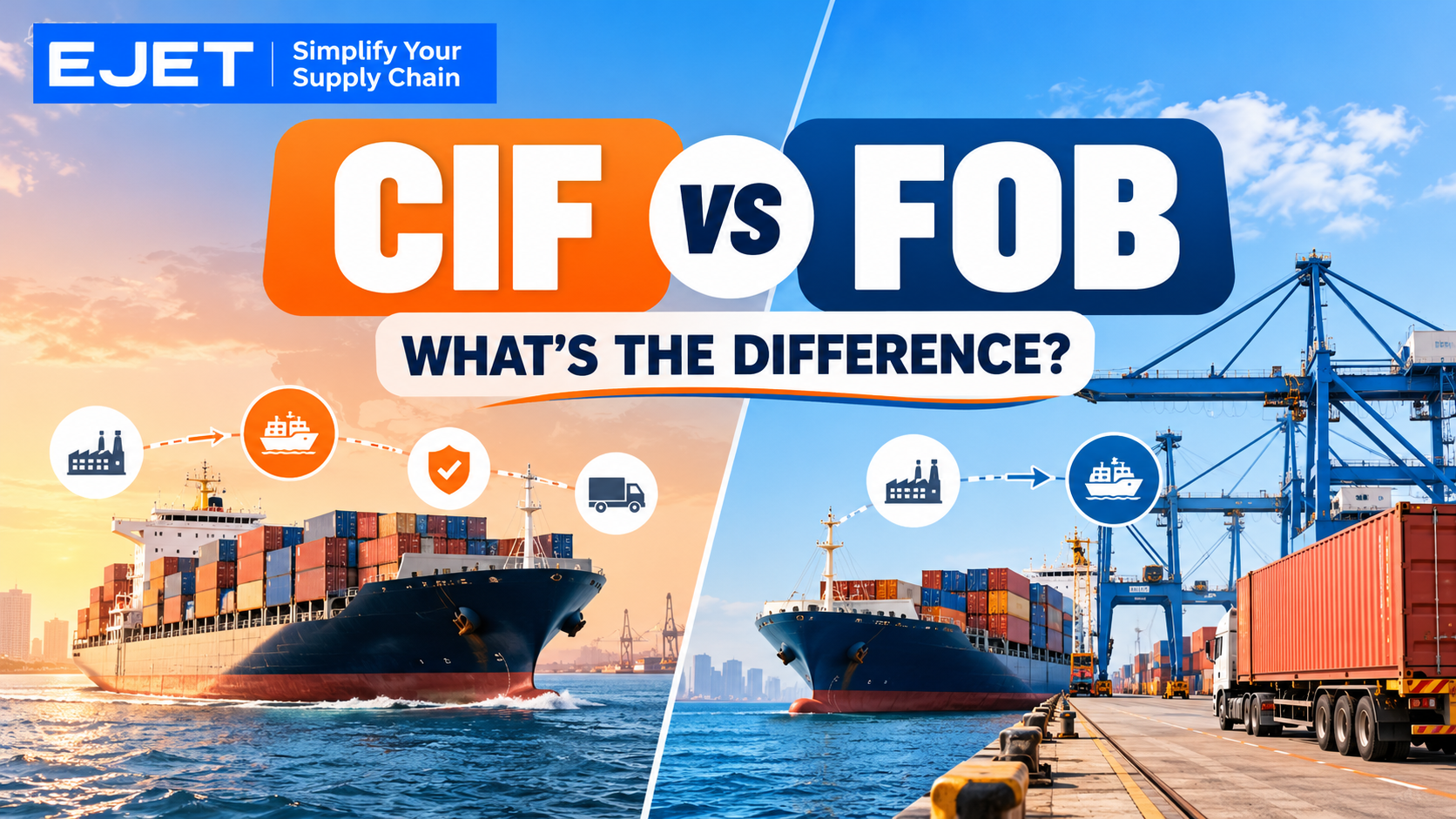
CIF and FOB are international trade terms that divide shipping responsibilities between buyers and sellers. Under CIF, the seller arranges and pays for ocean freight and specified cargo insurance; under FOB, the buyer arranges the main carriage.
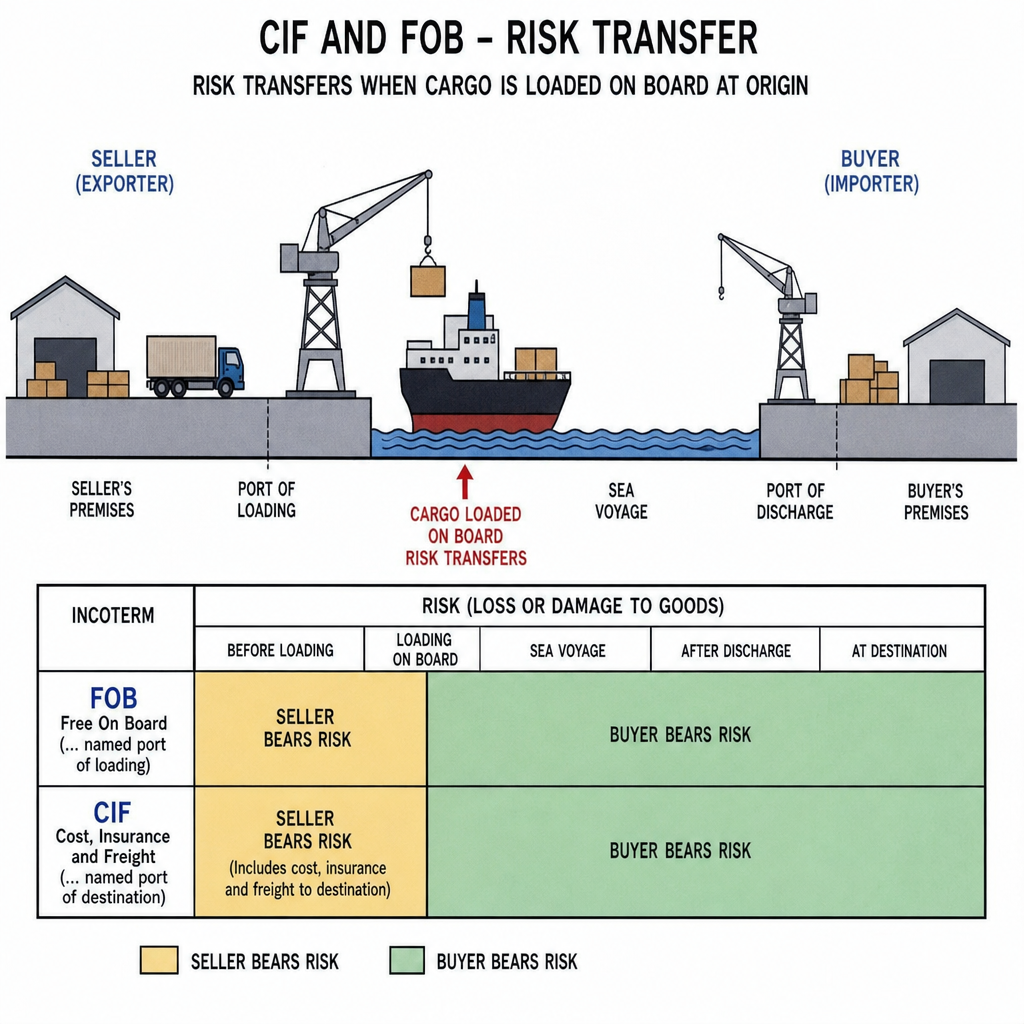
Crucially, both normally transfer the risk of cargo loss or damage to the buyer when the goods are loaded on board at the shipment port—not when they arrive.
This guide explains that distinction and how to compare quotations without overlooking costs or responsibilities.
What is the difference between CIF and FOB?
The main difference in CIF vs FOB is who contracts and pays for the main sea journey and whether the seller must obtain cargo insurance. CIF means Cost, Insurance and Freight; FOB means Free on Board.
Both are Incoterms® rules developed by the International Chamber of Commerce, and both apply to sea and inland waterway transport rather than every transport mode.
These freight terms allocate tasks, costs, and risk between the parties to a sale. They are not shipping methods like air freight, ocean freight, or express delivery. Choosing the transport method and choosing the applicable trade rule are related but separate decisions.
|
Responsibility |
FOB |
CIF |
|---|---|---|
|
Export clearance |
Seller |
Seller |
|
Loading on board at origin |
Seller |
Seller |
|
Main freight arrangement and payment |
Buyer |
Seller |
|
Seller required to obtain cargo insurance |
No |
Yes, with minimum default cover |
|
Normal risk-transfer point |
On board at shipment port |
On board at shipment port |
|
Import clearance and import duties |
Buyer |
Buyer |
The practical takeaway is simple: paying for transport is not the same as bearing transport risk. CIF gives the seller more transport-related obligations, but it does not normally keep voyage risk with the seller.
How FOB shipping works
Under FOB shipping, the seller delivers the goods loaded on the vessel nominated by the buyer at the named port of shipment. The seller handles export formalities and the origin movement needed to meet that delivery obligation. The buyer contracts and pays for the main carriage and handles import formalities.
For a buyer, this creates an opportunity to select a carrier or forwarder and assess freight options directly. It also creates work: someone must coordinate the booking, vessel nomination, loading information, and destination arrangements.
If your business wants that control, establish who will manage each task before accepting the quotation.
FOB does not require the seller to obtain insurance for the buyer. Because voyage risk normally passes on board, buyers should evaluate cargo insurance rather than assume the supplier’s policy protects them.
The rule’s normal delivery point should also not be mistaken for an unconditional protection: certain buyer failures, such as missing vessel information or a nominated vessel failing to take the cargo, can shift risk or additional costs earlier, subject to the rule’s conditions.
A practical FOB preparation list is:
- Confirm the shipment port and agreed loading point.
- Assign responsibility for nominating the vessel and communicating booking details.
- Obtain a freight quotation with clearly identified inclusions and exclusions.
- Review insurance and destination arrangements before dispatch.
How CIF shipping works
Under CIF shipping, the seller delivers the goods on board at origin, completes export formalities, and contracts and pays for carriage to the named destination port. The seller also obtains the cargo insurance required by the rule. The buyer still bears the voyage risk after on-board delivery and remains responsible for import formalities.
This arrangement may appeal to a buyer who prefers the supplier to organize the ocean journey. However, purchasing goods on CIF terms is not the same as buying an all-inclusive service to your warehouse.
The destination port marks the seller’s agreed freight destination, not an automatic commitment to complete every onward movement or pay every arrival charge.
Before accepting CIF, ask the seller for the proposed routing, destination agent, freight inclusions, and insurance documents. Request enough information to identify which services you must arrange yourself. That makes the apparent convenience easier to evaluate against the remaining workload.
Be especially careful with unloading and destination charges. Under CIF, unloading costs are the seller’s responsibility when included for the seller’s account in the carriage contract; otherwise, they fall to the buyer. Avoid treating every terminal or arrival charge as automatically included—or automatically excluded—without checking the actual arrangements. (
Why does CIF insurance not eliminate the buyer’s risk?
CIF insurance provides financial protection against covered losses; it does not change the normal on-board risk-transfer point. Under Incoterms® 2020, CIF’s default insurance requirement is minimum cover under Institute Cargo Clauses (C), or similar clauses.
That is narrower than a promise to cover every possible cause of damage, and the parties can agree to broader protection.
The distinction matters when assessing the word “insured.” Institute Cargo Clauses (C) cover specified risks, rather than every event that might affect a shipment. Even broader cover has conditions and exclusions, so the policy wording deserves attention alongside the commercial invoice.
Before shipment, ask for confirmation of:
- Coverage: Which clauses apply, and are additional protections needed for the cargo?
- Journey: Where does cover begin and end, including any onward transport?
- Financial terms: What insured amount, deductible, and exclusions apply?
- Claims process: Who can claim, which documents are required, and whom should you contact?
Treat these as questions for the insurer or insurance adviser, not assumptions to resolve from the three-letter term alone. If broader cover is important, agree to it explicitly before the seller purchases the policy. The ICC confirms that buyers and sellers can vary the default insurance level by agreement.
Comparing quotations on a like-for-like basis
A useful FOB vs CIF comparison starts with the same goods, shipment assumptions, and final destination. Because CIF bundles freight and insurance into the seller’s obligations while FOB leaves main carriage to the buyer, the two quoted prices represent different scopes. Comparing the headline amounts alone therefore misses part of the purchasing decision.
Build a worksheet that follows the shipment through to the place you actually need the goods. For every line, mark whether the charge is included, excluded, estimated, or still unconfirmed. This is a comparison exercise, not a claim that every shipment incurs every possible charge.
Use these categories:
- Goods and origin services: Confirm product specifications, packing, quantities, and origin handling assumptions.
- Main carriage: Identify freight, routing, and any quoted surcharges.
- Insurance: Compare the actual protection, not merely whether a premium appears.
- Destination services: Ask about unloading, terminal handling, release arrangements, and collection.
- Import and onward movement: Obtain estimates for clearance services, applicable duties or taxes, and delivery to your facility.
- Exceptions: Clarify how delays, storage, inspections, or changed instructions would be handled.
For U.S. imports, do not treat the supplier’s Incoterm as a substitute for checking customs requirements. The U.S. International Trade Administration explains that Incoterms allocate commercial responsibilities but do not determine regulatory transaction classifications. Ask your broker to verify the relevant entry requirements independently.
Choosing terms that fit your operation
Neither rule is automatically the better commercial choice. The ICC’s selection guidance distinguishes between buyers who want to arrange and pay directly for international carriage and those who want the seller to include carriage and, under CIF, insurance. Start with that responsibility decision rather than assuming one abbreviation always saves money.
Consider FOB when you want direct involvement in freight procurement and have someone ready to coordinate the transport. Consider CIF when you prefer seller-arranged carriage, provided you can assess the destination arrangements and insurance.
In either case, test the proposed setup against your actual staff capacity, not just the supplier’s preferred quotation format.
A useful internal discussion covers three questions: who will monitor the shipment, who will manage arrival, and who will respond if something goes wrong? Assign names or roles before confirming the order. If no one owns those tasks, a convenient-looking quotation can still leave an operational gap.
Container shipments deserve a different discussion
FOB and CIF should not be selected simply because a shipment includes an ocean leg. Containerized goods are commonly handed to a carrier or terminal before vessel loading, making on-board delivery an awkward match for the actual handover.
ICC guidance recommends considering FCA instead of FOB, and CPT or CIP instead of CFR or CIF, for container movements.
FCA means Free Carrier; CPT means Carriage Paid To; CIP means Carriage and Insurance Paid To. Unlike FOB and CIF, these rules can accommodate different transport modes. CIP also has a broader default insurance requirement than CIF under Incoterms® 2020, although the parties should still check the agreed coverage. Discuss the real handover point with your forwarder before choosing the rule.
Put the agreement into precise contract language
A three-letter abbreviation needs a locati0n and an identified rules edition. FOB names the shipment port, whereas CIF names the destination port. For clarity, a contract might use “FOB Port of Antwerp, Belgium, Incoterms® 2020” or “CIF Port of Boston, United States, Incoterms® 2020,” with additional shipment details recorded elsewhere as needed.
Treat those as illustrative formats, not complete contractual clauses. The correct wording must reflect the actual transaction, including agreed loading details and any expressly negotiated changes. Precise locations help prevent uncertainty over where obligations are performed.
Before signing, review this checklist:
- Rule and edition: Use the same agreed term across the purchase order, quotation, and contract.
- Ports and timing: Identify the relevant locations and distinguish shipment deadlines from expected arrival dates.
- Transport scope: Record freight inclusions, exclusions, and destination arrangements.
- Insurance: Specify any protection required beyond the default obligation.
- Separate sale provisions: Address payment, product quality, ownership transfer, and dispute resolution independently.
That last point matters: Incoterms do not determine when ownership transfers, replace payment terms, or select the governing law. Also, a CIF shipment deadline is not automatically an arrival deadline. If arrival timing is commercially essential, address it deliberately in the agreement rather than assuming the freight term guarantees it.
Ask the supplier to resolve inconsistencies before booking, not after departure. Keep the accepted quotation, contract, transport instructions, and insurance confirmation together so the person managing arrival can find them. A clear record is more useful than relying on a familiar abbreviation with different assumptions behind it.
The takeaway for international shipping
The central CIF vs FOB distinction is freight procurement and insurance—not a different normal voyage-risk transfer point. Both normally pass risk when the goods are on board at origin; CIF adds seller-arranged freight and minimum insurance to the named destination port.
Choose the arrangement your team can manage, compare the full shipment scope, and document responsibilities before dispatch. For containers, reconsider whether FCA or CIP better reflects the real handover. Understanding the term is the starting point; making the shipment workable is the goal.
Frequently Asked Questions About CIF & FOB Shipping Terms
What are CIF and FOB shipping terms?
CIF (Cost, Insurance, and Freight) and FOB (Free on Board) are Incoterms that define the responsibilities of buyers and sellers regarding shipping, risk transfer, and costs associated with maritime transport.
What is the primary difference between CIF and FOB?
The key difference is that under CIF, the seller is responsible for arranging and paying for the main sea freight and cargo insurance until the goods reach the destination port, whereas under FOB, the buyer assumes these responsibilities once the goods are loaded onto the vessel.
When does the risk transfer from the seller to the buyer under CIF and FOB terms?
In both CIF and FOB, the risk of loss or damage typically transfers to the buyer when the goods are loaded on board the vessel at the shipment port.
Do I need cargo insurance when shipping under FOB terms?
Yes, buyers should evaluate and obtain cargo insurance separately when using FOB terms, as the seller is not required to provide insurance coverage under this agreement.
How do I compare quotations for CIF and FOB shipments?
To compare CIF and FOB quotations accurately, ensure you assess all costs involved, including freight, insurance, and any additional charges at the destination. Create a worksheet that breaks down the different components of each quotation for a like-for-like comparison.