Before paying Chinese manufacturers, verify the company’s legal identity, its ability to make your product, and the destination of your payment.
Manufacturer due diligence should combine independent records, production checks, samples, and written transaction controls—not rely on a business license alone.
Use the following process to organize those checks before releasing a deposit or balance payment.
How do you verify Chinese manufacturers before paying?
Verify Chinese manufacturers by checking their registration independently, confirming who controls production, validating relevant certificates, and testing products against written specifications.
Then match the contracting company to the payment arrangement and agree on inspection and acceptance conditions.
Treat these as separate approval gates rather than allowing one reassuring document to stand in for the whole review.
Build your supplier verification process around a simple evidence file:
|
Check |
Evidence to request |
Decision it supports |
|---|---|---|
|
Legal identity |
Business license and independently checked registration |
Which entity you are evaluating |
|
Production capability |
Factory details and a product-specific audit |
Whether operations fit your order |
|
Quality |
Written specifications, samples, and inspection criteria |
What acceptable goods look like |
|
Certificates |
Issuer-confirmed records with relevant scope |
Whether claimed certification applies |
|
Payment |
Verified beneficiary details and contract terms |
Whether payment can be authorized |
Assign someone to own each check. Record unresolved questions alongside the evidence, rather than leaving them in scattered messages. Your final approval should explain both what has been verified and what remains conditional.
Start with the registered company, not the storefront
Request the supplier’s current Chinese business license, full Chinese legal name, and Unified Social Credit Code. Cross-check registration through China’s National Enterprise Credit Information Publicity System.
The Canadian Trade Commissioner Service recommends confirming registration details, business scope, address, and the authority of the people representing the business.
Use the Chinese legal name as the anchor for your records. Save the English trading name separately, then ask the supplier to identify the entity issuing quotations, signing the contract, manufacturing the goods, and receiving payment.
Put those answers on one page so inconsistencies are visible.
Do not automatically reject every difference. A manufacturer may use an affiliate or trading company, but the relationship and payment arrangement need a documented explanation.
Resolve unexplained discrepancies before proceeding, rather than accepting “this is how we always do it” as verification.
Chinese supplier verification should also consider financial health, litigation, regulatory records, and sanctions exposure. Use qualified local help when records are difficult to interpret or the transaction is significant.
The goal is a reasoned assessment, not simply a folder full of screenshots.
For your internal review, ask: Does each document identify the same business relationship? Who has authority to approve changes? Which unresolved finding could alter the decision to buy? Answer those questions before moving to production checks.
Confirm who will actually manufacture your order
Ask directly whether the seller manufactures the goods, uses an affiliated factory, or arranges production elsewhere. Verify the proposed manufacturing site rather than assuming the seller’s office is the production locati0n.
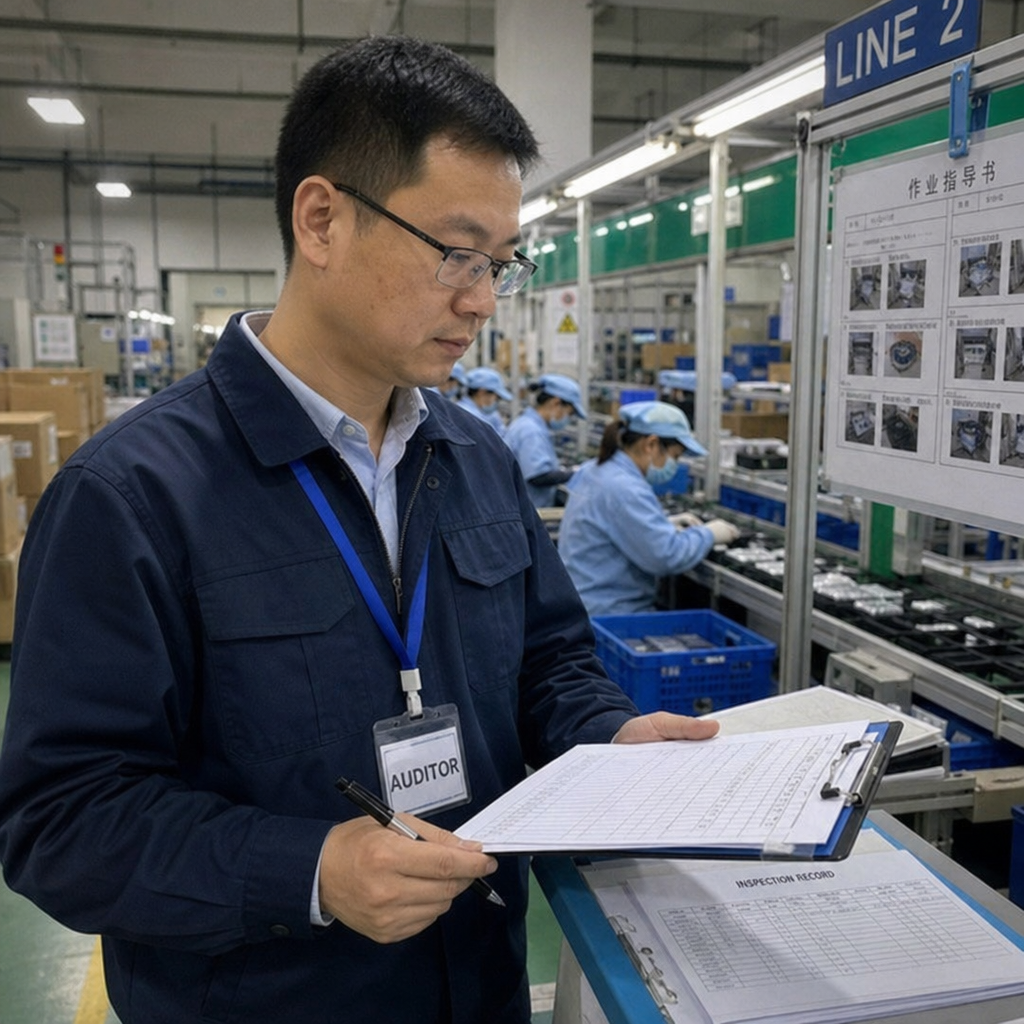
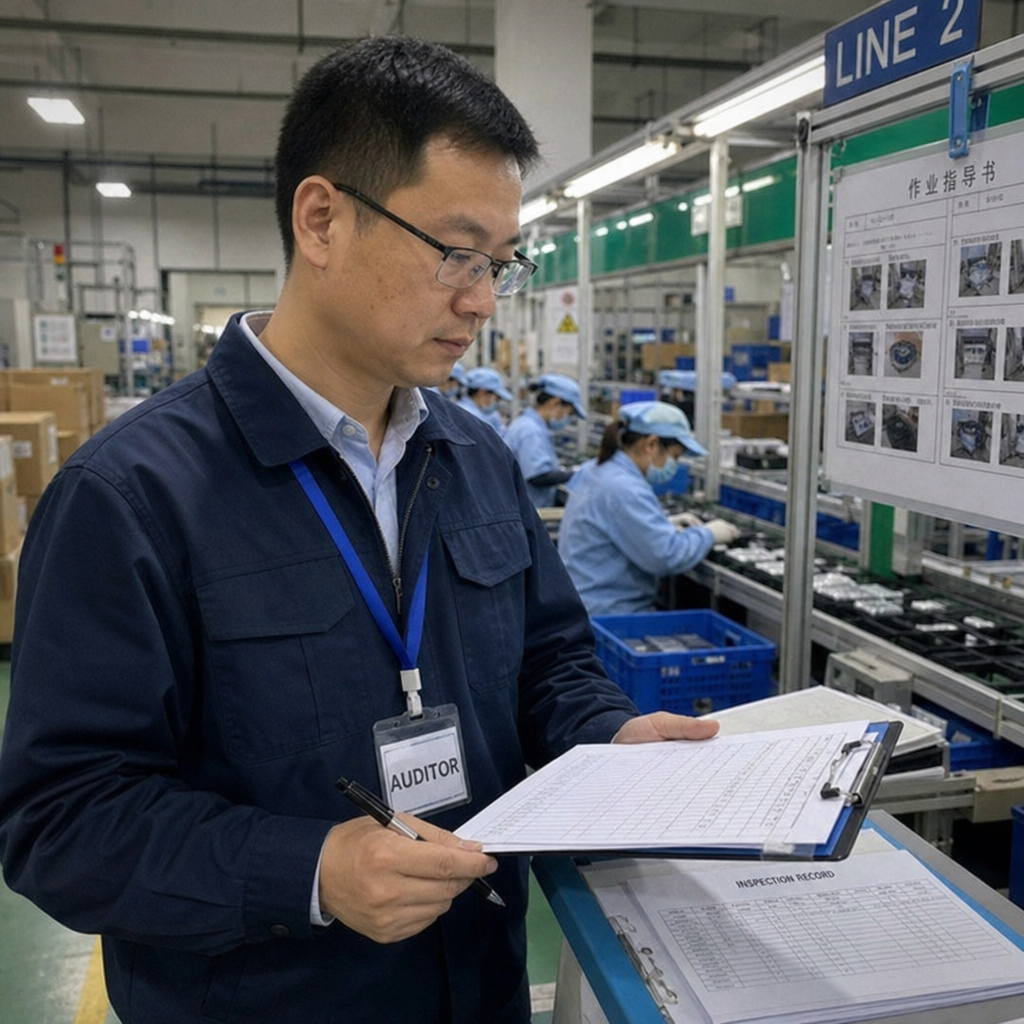
Factory capability reviews can examine production processes, material controls, and quality management systems.
Make your assessment specific to the product you intend to buy. Ask the auditor to follow the relevant workflow and explain how your specifications would be controlled. A useful audit brief should request:
- Process coverage: Identify the operations performed on-site and those outsourced.
- Equipment suitability: Assess equipment against the materials, tolerances, or processing conditions you require.
- Quality controls: Review incoming checks, production checks, and handling of rejected material.
- Capacity evidence: Ask how the proposed quantity and delivery schedule fit current production commitments.
- Corrective actions: Require findings, supporting evidence, responsible people, and completion dates.
These requests turn a general factory visit into a decision tool. Ask for a report that separates observations from claims made by management, and identify which findings must be closed before order approval.
If you begin with a remote walkthrough, use it to prepare questions for the next stage. Request views of the relevant production and inspection areas, not just reception rooms and finished displays. Decide in advance which questions require an independent site visit rather than a video answer.
Check certificates against their actual scope
For accredited management-system certificates, use IAF CertSearch where applicable and review the company, certification status, standard, and scope. Its records also identify issuing certification and accreditation bodies. Check the underlying details instead of treating a certificate image as sufficient evidence.
Create a certificate register with a row for each claim. Include the certificate number, named entity, covered site, scope, validity information, and verification method. Where information is missing or inconsistent, seek confirmation from the issuer before accepting the claim.
Keep product documentation in a separate review. Ask which product, model, material, or formulation each report covers, and have a technically qualified reviewer compare it with your intended order. Write down the connection explicitly: “Report reviewed against specification revision B” is more useful than “certificate received.”
For food facilities, be especially careful with claims of “FDA approval.” FDA states that assignment of a food facility registration number does not convey approval or endorsement of the facility or its products. Registration should not be presented as proof that an ingredient meets your purchasing specifications.
Turn samples into measurable acceptance criteria
Request samples before production and compare them with your drawings and specifications. Include packaging in the review, not just the product itself. The Canadian Trade Commissioner Service’s sourcing guidance specifically recommends checking both samples and packaging before placing production orders.
Before evaluating the sample, write down what “acceptable” means. For a manufactured component, your review might address dimensions, material, finish, fit, function, and labeling. Choose criteria that reflect how the item will actually be used, rather than approving it because it looks convincing on a desk.
Use an approval record that includes:
- Identification: Sample reference, supplier, date received, and specification revision.
- Results: Measurements, test methods, observations, and supporting photographs.
- Exceptions: Any accepted deviation and whether it applies to production.
- Authorization: The person approving the sample and any remaining conditions.
- Production instructions: The criteria inspectors should use when assessing the order.
Ask the supplier to acknowledge that record. If you change a material, drawing, or packaging requirement afterward, issue a revised approval rather than relying on a chat message. Keep purchasing, quality, and the supplier working from the same version.
Plan shipment inspections around those written criteria. Inspection services can assess goods and production progress against specified requirements; give the inspector your acceptance instructions rather than assuming a generic inspection covers everything important.
What extra checks do ingredient manufacturers need?
Chinese ingredient manufacturers verification needs a food- or ingredient-specific assessment in addition to company checks. For food, examine relevant hazards, the supplier’s controls, traceability, testing, and safety history. FDA’s supplier-verification framework uses risk-based activities such as audits, sampling and testing, and review of relevant food-safety records.
Start by defining the exact material and intended use. Ask your technical team to specify identity, composition, required quality attributes, and relevant safety limits. Then ask the supplier to explain how it controls those requirements from incoming materials through finished batches.
For a practical document review, request:
- A written specification: Identify the ingredient and the criteria your team must approve.
- Batch-linked results: Ask for certificates of analysis tied to identifiable lots, with methods and results.
- Traceability evidence: Request a demonstration connecting an example finished lot to production and source-material records.
- Hazard-control information: Have a qualified reviewer assess relevant biological, chemical, physical, and allergen concerns.
- Change procedures: Require notification before agreed changes to source materials, formulation, processing, or manufacturing locati0n.
Set your independent testing plan with an appropriately qualified laboratory or food-safety specialist. Specify which attributes will be tested, how samples will be collected, and how results will influence release. Avoid using “test everything” as a substitute for identifying the risks that matter.
For U.S. food imports, determine whether the Foreign Supplier Verification Programs rule applies, including any exemptions or modified requirements.
Where applicable, the importer’s responsibilities extend beyond collecting supplier documents: FDA describes requirements for hazard evaluation, supplier approval, verification, and documentation. Obtain qualified guidance for your particular product and role.
Verify payment instructions outside the email thread
The FBI warns that business email compromise can involve fraudulent messages appearing to come from a familiar vendor. It recommends independently verifying payment requests and changes to account numbers or payment procedures. Do not let a convincing email thread replace a separate confirmation.
Create a payment approval sheet before the first transfer. Record the contractual seller, beneficiary name, bank details, invoice reference, and the evidence supporting any difference between seller and beneficiary. Have purchasing resolve commercial questions before finance is asked to authorize payment.
Use a known, independently verified contact channel to confirm instructions. Do not verify a suspicious change using only the telephone number supplied in the same message. Treat urgency as a reason to slow down, especially when someone asks you to bypass the normal approval process.
Separate preparation from approval where your team allows it. One person can assemble the evidence while another confirms that the release conditions have been met. Keep the confirmation record with the invoice so a later reviewer can understand why payment was authorized.
If you suspect payment fraud after transferring funds, contact your financial institution immediately. The FBI also directs victims to report business email compromise through its Internet Crime Complaint Center.
Make the contract reflect what you verified
Use the contract to define quality, payment, inspection rights, compensation, and dispute resolution. The Canadian Trade Commissioner Service recommends clear, comprehensive, enforceable terms for sourcing relationships. Ask qualified counsel to adapt the agreement to the entities, goods, and transaction involved.
Build your negotiation draft around the decisions already made. Name the approved specification and sample record, identify the production site, and list required documents. Propose payment milestones tied to defined evidence, then have the arrangement reviewed before signing.
Before authorizing a deposit, run this final checklist:
- Identity: The contracting entity and representative have been checked.
- Production: The proposed site and production arrangement have been reviewed.
- Quality: Specifications, sample approval, and inspection instructions are documented.
- Compliance: Relevant certificates and product requirements have been assessed.
- Payment: Beneficiary details have been independently confirmed.
- Exceptions: Open findings have an owner, deadline, and explicit approval decision.
Use clear outcomes: approved, conditionally approved, or on hold. If approval is conditional, state exactly which action is permitted and which evidence is still required. Avoid a vague “supplier verified” label that could be mistaken for unrestricted purchasing authority.
The takeaway: approve evidence before releasing money
When evaluating China manufacturers, make each commitment depend on evidence appropriate to that stage. Keep company identity, production capability, quality requirements, and payment authorization visible in one review file.
The practical objective is not to collect the most documents—it is to know why you are comfortable making the next payment, and what would cause you to stop.
Frequently Asked Questions About Verifying Chinese Manufacturers
What documents should I request to verify a Chinese manufacturer?
You should request the manufacturer’s business license, registration details, factory audits, quality certifications, and samples of the product you intend to purchase. These documents help confirm the manufacturer's legal identity, production capabilities, and compliance with quality standards.
How can I confirm the manufacturing site and capability?
You can confirm the manufacturing site by visiting the factory or requesting a remote audit. During the audit, ensure that you assess the production processes, quality management systems, and equipment suitability. It's crucial to verify that the seller is indeed manufacturing the goods or using a reliable third party.
What is the importance of checking certifications?
Checking certifications ensures that the manufacturer meets industry standards and regulations. It is essential to confirm the validity of certificates through reliable sources, as incorrect or false certifications can jeopardize the quality and safety of the products.
How do I establish clear payment instructions to avoid fraud?
To avoid payment fraud, independently verify any changes to payment instructions outside of email communications. Use a known contact number or channel to confirm payment details and always document the approval process to maintain transparency.
What should be included in the contract with the manufacturer?
The contract should clearly define the quality standards, payment terms, inspection rights, and dispute resolution mechanisms. It should reflect all verified details related to the manufacturing process, specifications, and any conditional approvals related to production or payment.