


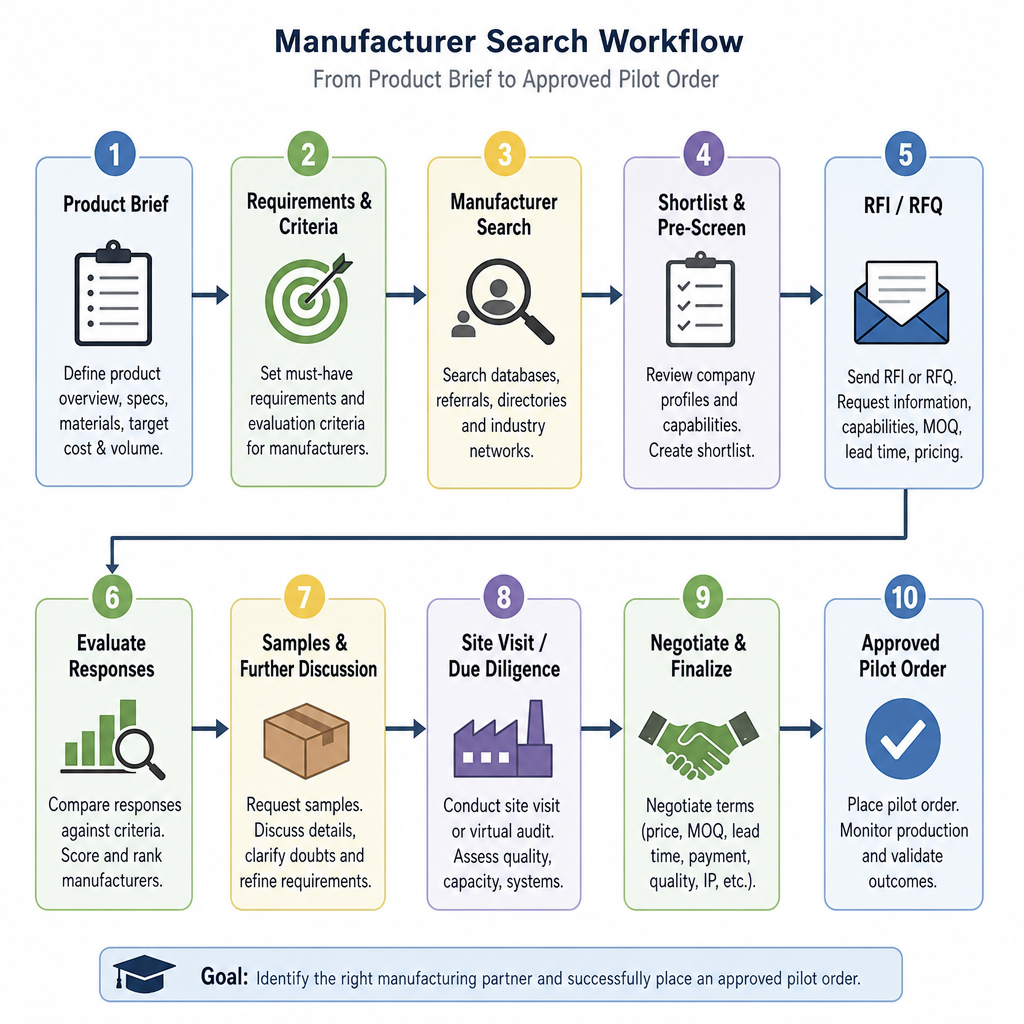
Finding a manufacturer means matching your product requirements with a supplier that can deliver the right quality, quantity, and commercial terms.
Start with a clear production brief, search through several channels, and verify shortlisted factories before committing to an order. This article explains how to find a manufacturer of a product, compare candidates, and build a working relationship without choosing on price alone.
What should you prepare before looking for a manufacturer?
Prepare a written description of what you want made, how it should perform, and how much you expect to order. Give prospective manufacturers enough information to assess feasibility and quote against the same requirements. NIST’s supplier scouting form provides a useful model: it requests technical specifications, materials, volumes, target pricing, delivery requirements, and supporting drawings.
First, clarify the work you need. Are you adapting an existing product with your branding, modifying a supplier’s design, or developing something custom? State this explicitly in your inquiry rather than assuming every company offers the same service.
If you only have an idea, make product development your first conversation. Ask whether the supplier can help with engineering and prototypes, what that work includes, and which deliverables you receive. Keep development approval separate from authorization to begin production.
Also define your immediate priority. A supplier suited to testing demand may not be your eventual high-volume partner. For an initial launch, prioritize a manageable commitment and a workable development process rather than negotiating around sales volumes you cannot yet support.
Turn your idea into a clear production brief
Use a brief that separates essential requirements from preferences. Mark unresolved details so suppliers can identify assumptions instead of silently filling the gaps. This becomes the reference document for your procurement process, from initial outreach through sample approval.
Include these details where relevant:
- Product and use: Explain who will use it, where, and what it must do.
- Design information: Provide drawings, dimensions, reference images, or an existing sample. Identify which measurements are critical.
- Materials and finish: Specify required materials, colors, textures, and acceptable alternatives.
- Order quantities: Distinguish your first order from estimated repeat demand. Ask about minimum order quantities, or MOQs.
- Quality expectations: Describe performance checks and unacceptable defects in observable terms.
- Packaging: Explain labeling, protective packaging, retail presentation, and shipping carton needs.
- Timing and destination: State your desired delivery window and destination, not just a factory completion date.
Ask suppliers to flag requirements they cannot meet and suggest alternatives separately. That preserves your original specification while giving them room to recommend a different material or process.
For example, if you are developing a storage container, “durable plastic” leaves important questions unanswered. Describe the intended contents, expected handling, lid fit, and appearance. Invite the manufacturer to explain how it would validate those requirements before you approve the design.
Maintain a dated revision number on every brief. When a requirement changes, send the revised version to every remaining candidate so comparisons stay meaningful.
Where can you find manufacturers for your product?
Build your candidate list through targeted searches, industry directories, trade associations, trade shows, referrals, and specialist support. Use more than one channel, and treat each result as a lead to investigate rather than an endorsement.
For U.S. production, NIST’s Manufacturing Extension Partnership offers supplier scouting that connects purchasers with domestic manufacturers based on specific capabilities. Companies can begin by contacting an MEP Center.
Search by process and capability
Try searches that combine the product or material with the likely production process. Compare results for phrases such as “custom metal enclosure manufacturer,” “sheet metal fabrication,” and “contract assembly,” then refine your search as you learn the industry’s terminology.
On each website, look for evidence relevant to your project: equipment, materials, production examples, and services. Record what needs verification rather than treating a broad capability statement as proof of suitability.
Ask relevant trade associations about member directories and events. When requesting referrals, describe your material, process, and order size so contacts can suggest a plausible match.
Consider sourcing agents when the scope justifies help
Sourcing agents are another option to evaluate, particularly when you want help identifying suppliers, coordinating communication, or arranging factory visits. Request a written scope instead of assuming those services are included. Establish who performs inspections, who approves changes, and who remains accountable for purchasing decisions.
When comparing sourcing solutions, ask how the provider is paid and whether it receives supplier commissions. Request clarity on access to factory contacts and records. Make transparency and relevant category experience part of your selection criteria, not optional extras.
Verify capability before discussing a large order
Use verification to answer two separate questions: does this business check out, and can it reliably make your product? A preliminary background check can establish details such as a company’s existence and address, but it should not replace deeper due diligence.
The U.S. Commercial Service makes that distinction in its background-check guidance.
Ask whether your contact operates the factory, represents another company, or coordinates subcontractors. Do not automatically reject an intermediary; instead, establish who controls production, who handles defects, and which entity will receive your order and payment.
For each shortlisted candidate, request:
- Relevant experience: Discuss products with similar materials, processes, and quality demands, respecting other customers’ confidentiality.
- Production responsibilities: Identify what happens in-house and what is subcontracted.
- Capacity information: Ask about available production slots, expected output, and bottlenecks for your proposed schedule.
- Quality records: Request examples of inspection documentation and traceability appropriate to your product.
- References: Where available, ask customers about communication, repeat-order consistency, and problem resolution.
NIST recommends assessing technical capability, available capacity, and proficiency with the specific product—not merely whether a supplier owns suitable equipment. Use those distinctions to structure a factory visit, live walkthrough, or independent assessment.
Record unanswered questions alongside positive findings. Do not allow a polished presentation to close an issue that still needs evidence.
Compare quotations on the same basis
Send the same request for quotation, or RFQ, to each qualified candidate. Ask suppliers to identify exclusions and assumptions explicitly. Keep clarification questions in writing so a revised price does not become detached from the specification it covers.
For vendor selection, build a comparison sheet with these fields:
|
Comparison point |
What to clarify |
|---|---|
|
Unit price |
Quantity, material, finish, and packaging included |
|
Setup and tooling |
Separate charges, maintenance, and expected replacement needs |
|
Minimum order |
Whether it applies per product, color, size, or total order |
|
Lead time |
Starting point, approval dependencies, and production completion |
|
Quality checks |
Inspection scope, acceptance criteria, and responsibility |
|
Delivery terms |
Named locati0n and allocation of shipping responsibilities |
|
Payment |
Milestones, currency, and conditions for each payment |
For international quotations, specify the agreed Incoterms rule, named place, and version. These rules allocate transport-related tasks, costs, and risks between buyer and seller; use them to clarify responsibilities rather than relying on a vague promise that shipping is included.
Build your budget beyond the quoted unit price. Request estimates for freight, inspection, packaging, storage, and applicable import costs from the relevant providers. Compare an initial-order budget with a repeat-order budget so one-time development expenses remain visible.
Set your priorities before choosing. You might place quality and technical fit ahead of price, then compare delivery confidence and responsiveness. Treat an unmet essential requirement as a reason to stop, not a weakness that a low quote can offset.
Use samples and a pilot order to test the relationship
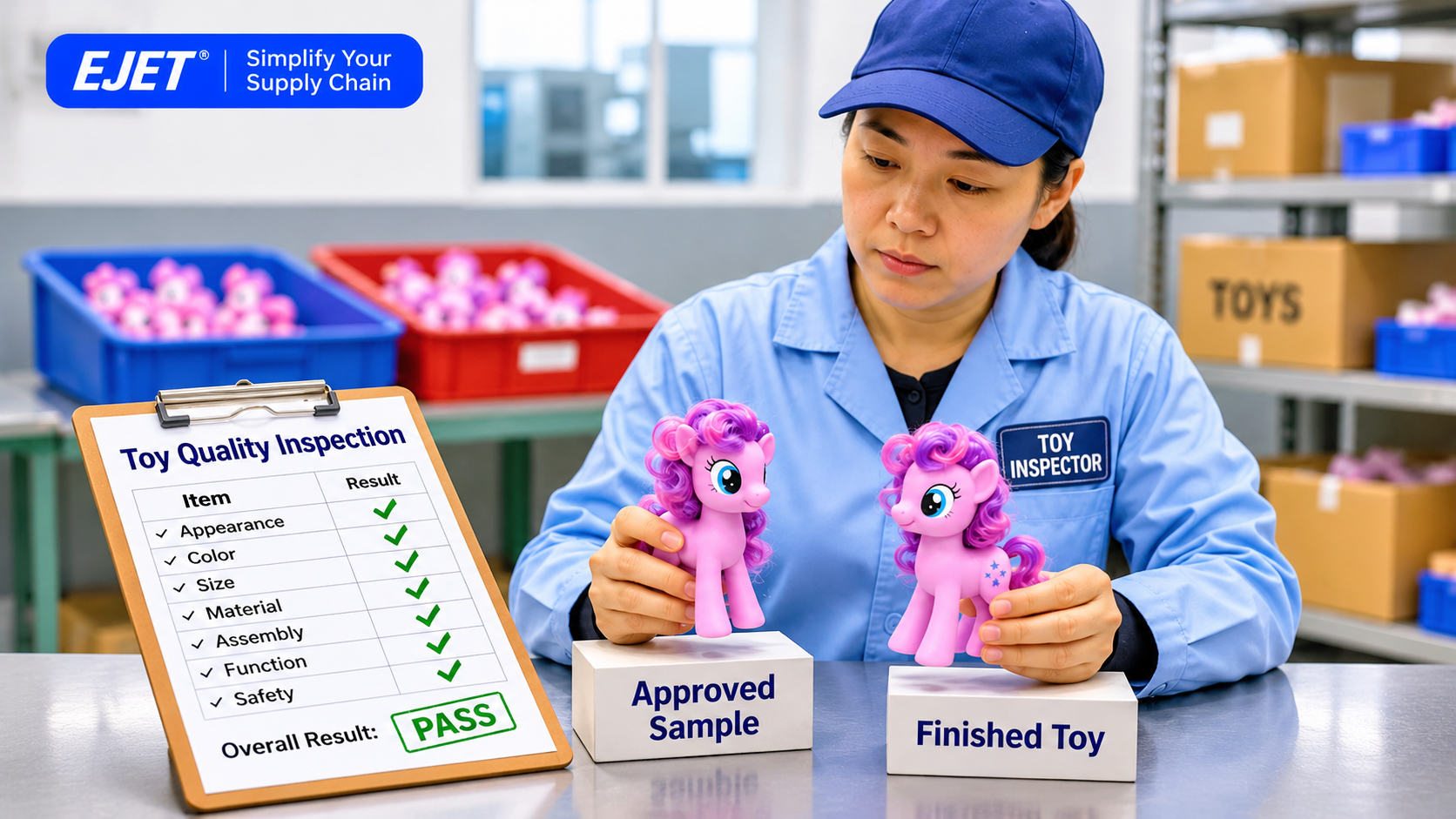
Make sample approval a defined step, not an informal reaction to something that looks promising. Ask what each sample represents: an existing catalog item, a handmade prototype, or a unit made using the intended production method. Record differences from the proposed final product before deciding what the sample proves.
Agree on a practical review sequence:
- Check the specification: Compare dimensions, materials, finish, function, and packaging with your current brief.
- Document findings: Use photographs and written observations to identify defects and requested changes.
- Approve a reference: Retain an approved sample and its specification revision as the comparison standard.
- Run a pilot: Where practical, place a limited production order before a larger commitment.
- Review the batch: Assess consistency across multiple units, not just the best example supplied.
Ask the manufacturer to explain how it will check the characteristics that matter most. For a fitted component, that might mean recording key dimensions; for a packaged retail item, include appearance and packaging checks.
If something fails, request an explanation and corrective action before proceeding. Use the supplier’s response to assess whether you can work through problems together, while keeping approval dependent on satisfactory results.
Set expectations before authorizing production
Put the commercial and operational agreement in writing before releasing the order. Identify the approved specification, quantity, price, schedule, inspection arrangements, and procedure for handling changes. Have responsibilities for tooling, design files, confidentiality, and defective goods reviewed by qualified advisers where appropriate.
Avoid payment milestones that depend on undefined phrases such as “production ready.” Instead, propose milestones tied to identifiable events and agreed evidence. Confirm who can approve a design change and what happens if that change affects cost or delivery.
Discuss product-specific testing, documentation, and market requirements with an appropriate specialist before committing to production. Ask the supplier for relevant evidence, but do not treat a general assurance as your completed review. Keep any unresolved requirement visible in the approval checklist.
Finally, verify payment instructions through a previously established contact channel, particularly when account details change. Pause the transaction if the receiving entity differs from the expected contracting party until you understand and document the reason.
Build supplier management into repeat orders
Treat the first delivery as the start of supplier management rather than the end of sourcing. NIST identifies supplier metrics and scorecards as tools for measuring performance and guiding improvements. Build a small scorecard around information you can consistently collect and discuss with your manufacturer.
Track delivery against the agreed date, accepted and rejected quantities, recurring defects, and the resolution of open issues. Separate a one-off problem from a repeated pattern. Share findings with the supplier and agree on actions, owners, and follow-up dates.
Before increasing order volume, review whether the process, capacity, and quality controls still fit. Ask the supplier to flag material substitutions, subcontracting changes, and schedule risks before they affect your order. Maintain revision control so repeat purchases do not quietly drift from the approved product.
Keep alternative sourcing strategies under review as well. Document your specifications and qualification work so you can evaluate another manufacturer if needed, rather than starting again with an incomplete record.
Choose the manufacturer you can verify
The strongest choice is a manufacturer whose capability, commercial terms, and production results fit your actual needs. Start with a clear brief, compare consistent quotations, and use samples and a pilot to resolve uncertainty before scaling. Your next step is straightforward: finish the brief, identify plausible candidates, and decide what evidence each must provide to earn the order.
Frequently Asked Questions About Finding a Manufacturer for a Product
What information should I include in my production brief for manufacturers?
Your production brief should include details such as product specifications, materials, design information, quality expectations, order quantities, and packaging requirements to ensure that manufacturers understand your needs.
How do I verify the capability of a manufacturer?
To verify a manufacturer’s capability, request details about their relevant experience, production responsibilities, available capacity, quality records, and references from other customers to assess their reliability and expertise.
What are minimum order quantities (MOQs) and why are they important?
Minimum order quantities (MOQs) are the smallest number of units that a supplier is willing to produce or sell. Understanding MOQs is crucial for budgeting and aligning with your production needs, especially for new products.
Should I work with a sourcing agent, and what should I consider?
Working with a sourcing agent can simplify the process of finding and communicating with manufacturers. Consider their fees, experience in your specific product category, and how they will facilitate inspections and decisions.
What steps should I take before authorizing production with a chosen manufacturer?
Before authorizing production, ensure you have a written agreement detailing the approved specifications, quantities, prices, payment schedules, and inspection processes to avoid misunderstandings later on.