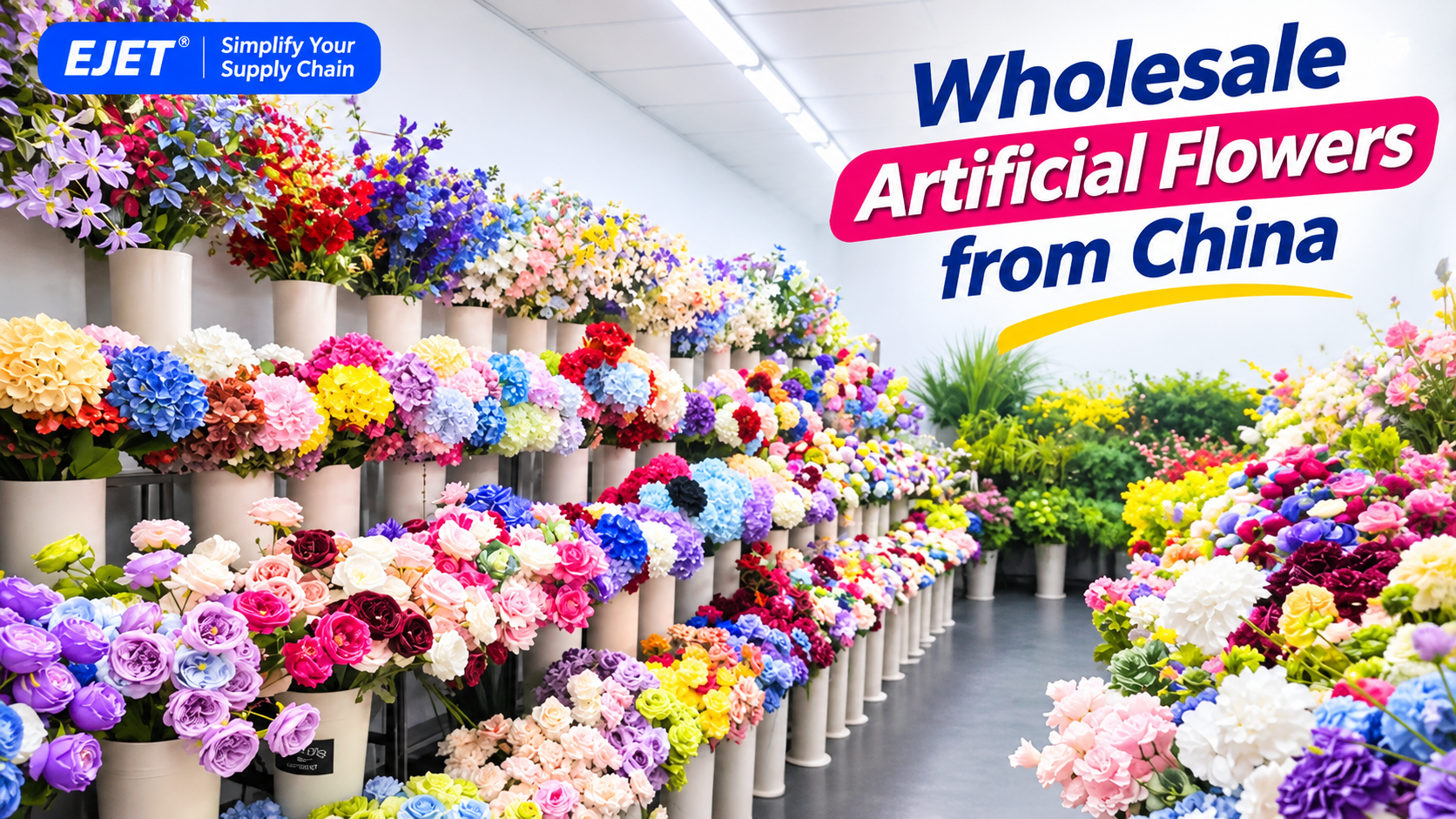
Source wholesale artificial flowers for retail collections, wedding designs, hospitality displays, and repeat décor projects.
Build your order around the flower styles, materials, quantities, and packaging your business needs, then compare Yiwu suppliers with direct factory quotations against the same specifications.
Start with a sample brief so you can evaluate the product before committing to bulk stock.
Should you buy artificial flowers through Yiwu or directly from a factory?
Choose the sourcing route that can meet your assortment, customization, and reorder requirements on acceptable terms. For a mixed collection, ask Yiwu suppliers to quote the complete assortment and explain how they will coordinate it. For a tightly specified repeat product, ask manufacturers to quote production against an approved sample. Neither locati0n nor a “factory direct” label should replace product checks.
Yiwugo lists artificial flower suppliers in Yiwu’s International Trade Mart, including District 1, making it a practical starting point for identifying sellers and comparing their stated ranges. A listing is a starting point for contact, not proof that every item is manufactured by that seller.
Use your purchasing priorities to shape the inquiry:
- A broad opening collection: Request a mixed assortment, with minimum quantities stated separately for each design and color.
- A repeat signature stem: Ask about specification control, production consistency, and how subsequent orders will reference the approved sample.
- A branded collection: Request separate feasibility and pricing for product changes, labels, and packaging.
- A deadline-driven event: Ask for confirmed availability, sample approval dates, dispatch arrangements, and a realistic delivery plan.
Next step: prepare one product brief and send it to shortlisted suppliers for comparable quotations.
Build an assortment around your customers
Start with the finished arrangement or retail display, not an oversized catalog. A florist creating table arrangements needs different proportions from a retailer selling individual stems. Specify what each item must do within the collection before deciding how many variations to purchase.
Use these flower categories as an inquiry framework rather than assuming every supplier stocks every option:
- Single stems: Request roses, peonies, tulips, or other focal flowers individually, with stem length and flower-head dimensions specified.
- Bushes and bouquets: Define the number of branches, flower heads, and leaves included in each selling unit.
- Filler flowers and greenery: Identify the supporting shapes needed to complete your arrangements, including foliage color and branch spread.
- Garlands and trailing designs: State the required length, attachment method, fullness, and intended installation.
- Flower heads and components: Specify attachment details for craft work, floral walls, accessories, or assembly projects.
- Finished arrangements: Confirm whether the quotation includes the vessel, filler, securing method, and protective packaging.
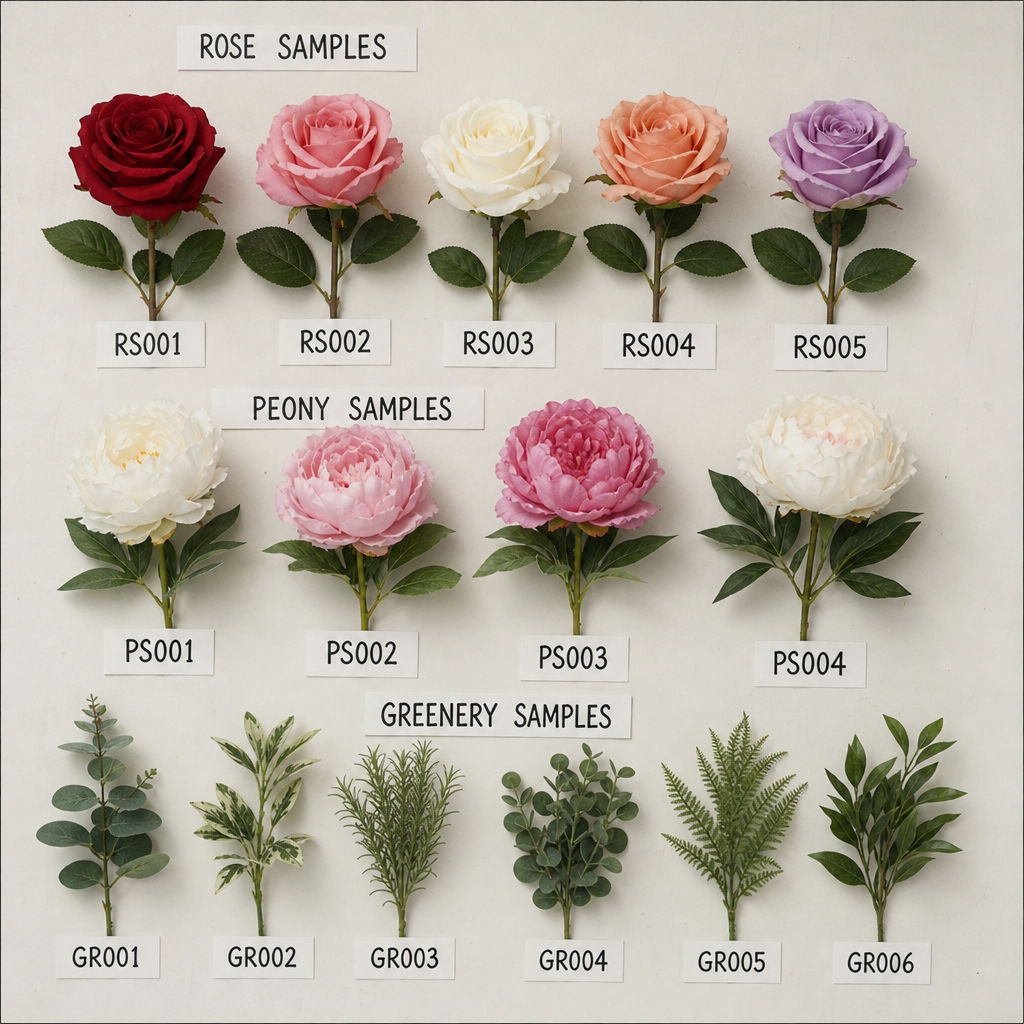
For example, a wedding stylist might request ivory focal flowers, muted greenery, and coordinating fillers as one sample collection. A home décor retailer might instead prioritize several stem styles that work together at a consistent display height. These are different buying briefs, even when both involve bulk faux flowers.
Keep your first selection focused enough to assess properly. Ask for item codes and labeled sample photographs so that a successful design can be reordered without relying on descriptions such as “the cream rose.”
Materials and finish matched to the application
Make material composition an explicit quotation requirement. When comparing wholesale silk flowers or other synthetic flowers wholesale, do not rely on the product name alone to define what you are buying. Ask the supplier to identify the petal, leaf, stem, coating, and internal support materials separately.
Evaluate the sample from the distance your customer will actually see it. For a dining table arrangement, examine petal edges, visible joins, color transitions, and the underside of the flower head. For a larger installation, review the overall silhouette, coverage, and consistency across several pieces.
Your material and finish checklist should include:
- Petals: Confirm composition, surface texture, edge finish, shape, and the approved color reference.
- Leaves: Review the front and reverse surfaces, vein detail, attachment, and consistency within the bunch.
- Stems: Specify length, diameter, finish, flexibility, and whether cutting or shaping is required for your application.
- Assembly: Check exposed adhesive, loose components, flower-head attachment, and the appearance of branch junctions.
- Special-use requirements: Request relevant evidence for any outdoor, UV-resistance, flame-performance, or other performance claim before relying on it.
Avoid approving a material solely because it photographs well. Handle the sample, place it in the intended vessel, and inspect the assembled result. If a finish or performance characteristic matters to the sale, put that requirement into the written specification rather than leaving it as an informal preference.
Product specifications to confirm before ordering
Turn the sample you like into a purchase-ready specification. Alibaba’s buyer guidance recommends detailed purchase orders, samples, and inspection arrangements; use those principles whether you purchase through a marketplace or negotiate elsewhere. The objective is a product description both sides can check.
|
Specification |
Detail to request or approve |
|---|---|
|
Product identity |
Supplier item code, your SKU, reference images, and sample version |
|
Selling unit |
One stem, bunch, bouquet, garland, component, or finished arrangement |
|
Dimensions |
Overall length, flower-head size, branch spread, and agreed tolerances |
|
Construction |
Materials, head count, leaf count, attachments, and finish |
|
Color |
Named reference, physical sample, and acceptable variation |
|
Order quantity |
Total quantity, quantity per design, and quantity per color |
|
Packaging |
Units per inner pack, units per carton, separators, and labels |
|
Acceptance |
Inspection criteria, unacceptable defects, and agreed remedies |
Be especially clear about the selling unit. A quotation per bunch cannot be compared directly with a quotation per stem without confirming the contents. Request the same breakdown from every supplier, then compare products that genuinely match.
Retain your approved sample and its specification together. If you later change a color, stem length, or packaging detail, issue a revised version and ask the supplier to acknowledge it before production.
Compare Yiwu and factory offers on equal terms
Treat Yiwu sourcing and factory sourcing as purchasing options to evaluate, not automatic quality grades. Ask every shortlisted seller who manufactures the goods, who manages the order, and who is responsible for correcting a problem. Where those roles differ, record the arrangement before payment.
For a Yiwu-based offer, request a line-by-line breakdown of the proposed assortment. Establish whether the items are available stock, made to order, or dependent on other suppliers. If several sources are involved, ask who will reconcile quantities, inspect the combined shipment, and approve substitutions.
For a factory offer, concentrate on the actual production scope. Ask which processes are completed at the quoted facility, what is subcontracted, and whether your design uses existing components or requires development. Request evidence relevant to your order rather than accepting a general claim of manufacturing capability.
Apply the same commercial checks to both:
- Obtain the seller’s legal business details and identify the contracting party.
- Request a written explanation of sample, production, inspection, and dispatch responsibilities.
- Confirm which product changes require additional approval or charges.
- Ask how shortages, failed inspection, and unauthorized substitutions will be handled.
- Establish how the approved design will be identified on future orders.
A useful supplier is one that can explain the order clearly and document its commitments. If a quotation leaves ownership of quality control or fulfillment unclear, resolve that gap before comparing its price with a more complete offer.
Customization with a defined approval process
Separate customization into product changes and presentation changes. For the product, your inquiry might cover color, stem length, flower-head arrangement, or a coordinated bouquet recipe. For presentation, it might cover branded sleeves, barcode labels, care information, or retail-ready cartons.
Ask the supplier to confirm feasibility before treating any option as included. Request the minimum quantity, development charge, sample cost, approval stages, and production implications for each change. A label update and a newly developed flower component should not be grouped into one unexplained customization fee.
Keep approvals specific. Instead of asking for a “more natural” result, describe the change: a less saturated leaf color, a different branch position, or a petal edge matching the reference sample. Provide annotated photographs where useful, then review the revised physical sample before authorizing the bulk order.
For private-label projects, supply final artwork and identify who checks text, barcode readability, placement, and print color. Agree that no unapproved product or packaging substitutions will be made. This gives both parties a clear reference when the order moves from development to fulfillment.
Pricing based on the complete order
Request a tailored quotation rather than assuming a universal wholesale price. No specific product configuration, order volume, or delivery destination has been established here, so a meaningful price must come from your completed brief. Ask suppliers to separate merchandise, development, packaging, and logistics charges.
Your quotation should identify:
- Unit price and the exact unit being priced.
- Minimum order quantity for each design and color.
- Quantity breaks, where offered, using the same specification.
- Sample, development, artwork, or tooling charges, if applicable.
- Standard packaging and separately priced packaging upgrades.
- Inspection, consolidation, freight, insurance, and delivery charges included or excluded.
- Currency, quotation validity, payment milestones, and agreed shipping terms.
Compare the total expected cost of receiving saleable stock, not just the merchandise subtotal. Include the expenses relevant to your arrangement, such as inspection, transport, customs clearance, duties, final delivery, and preparation for sale. Use confirmed quotations wherever possible and label estimates clearly.
For U.S. imports, verify the applicable classification and duty treatment with current official guidance or your customs broker. CBP identifies product classification as the starting point for determining duty rates and offers a ruling process for specific classification questions. Do not apply a generic tariff percentage to every artificial flower order.
When comparing fake flowers bulk quotations, keep the approved product constant. A lower price is not an equivalent offer if the head count, dimensions, finish, or packaging has changed.
Bulk packaging designed around receiving and display
Specify bulk packaging alongside the flowers, not after production. Ask the supplier to show how each selling unit will be arranged inside the carton and how the approved presentation will be maintained. Review a packed sample when appearance on arrival is important to your business.
Request the following packing details:
- Inner packing: Units per bundle or sleeve, tying method, and any separation between flower heads.
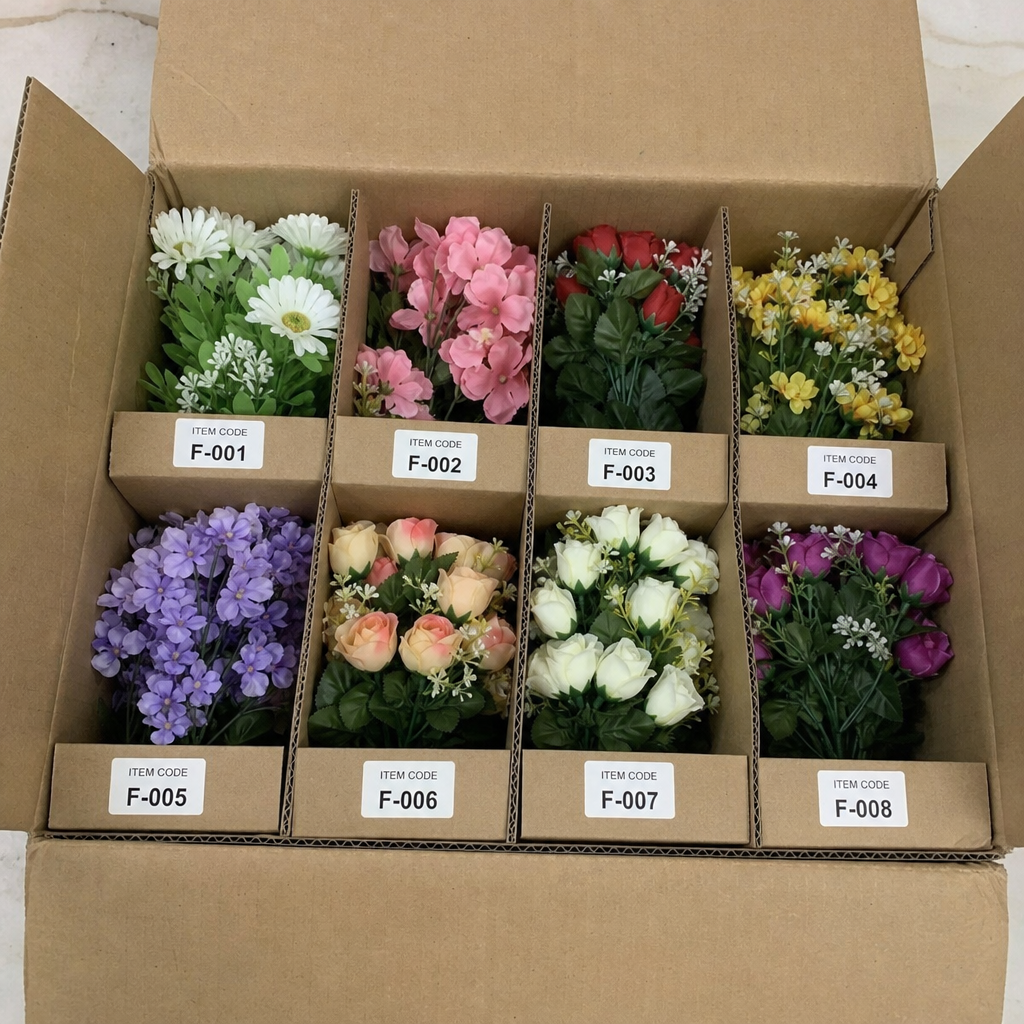
- Carton configuration: Units per carton, carton dimensions, gross weight, and item distribution.
- Identification: Item codes, colors, quantities, and carton numbering that match the packing list.
- Presentation: Expected shaping or unpacking work before the flowers are ready for sale or installation.
- Consolidation: The proposed arrangement when several designs or suppliers share one shipment.
Consider a retail receiving team opening a mixed order. If cartons contain clearly identified products and the packing list follows the same codes, the team has a straightforward way to check quantities and allocate stock. Make that receiving process part of your brief.
Do not approve tighter packing solely to reduce the quoted freight volume. First ask for evidence that the proposed packing method preserves the agreed product condition. Review the packing sample and record any preparation you are willing to perform after delivery.
Shipment protection with clearly defined responsibilities
Treat shipment protection as a set of documented arrangements rather than a badge or broad promise. Identify the contractual shipping terms, insurance arrangements, inspection records, and claim procedure separately. Ask who must provide each document and what evidence you should retain on receipt.
Where Incoterms® rules are used, specify the rule, named place or port, and version. ICC explains that these rules allocate particular costs and risks between buyer and seller; its guidance also distinguishes the insurance obligations under CIF and CIP. Do not assume a freight-inclusive quotation provides the coverage you want.
If ordering through Alibaba.com Trade Assurance, check eligibility and the protection attached to the actual order. Alibaba’s guidance ties protection to the agreed order terms, supported payment process, records, and applicable claim requirements. It does not replace supplier checks or clear specifications.
Before paying, request confirmation of the insured risks, exclusions, deductible where applicable, claim contact, and required evidence. Keep approved specifications, packing records, inspection results, transport documents, and delivery photographs together. If a problem occurs, describe it against the written agreement rather than relying on a general statement that the order was unsatisfactory.
Sample approval before a bulk commitment
Use sampling to make a buying decision, not simply to confirm that a parcel arrives. Request samples representing the materials, colors, and construction you intend to purchase. If the order is customized, identify whether you are reviewing a stock reference or the final preproduction version.
Follow a clear approval sequence:
- Submit the brief. Include intended use, reference images, quantities, destination, and required receiving date.
- Review the quotation. Resolve missing specifications, exclusions, and responsibilities before paying for development.
- Evaluate the sample. Check dimensions, construction, color, arrangement performance, and proposed packaging.
- Record the decision. Approve a named sample version or provide a consolidated list of required changes.
- Set the bulk checks. Agree what will be inspected, when inspection occurs, and how discrepancies will be resolved.
Alibaba’s sourcing guidance recommends requesting a sample and documenting specifications, quantities, and shipping information in the order. Carry approved changes into that order record rather than leaving them only in separate messages.
For an arrangement project, assemble a complete example before approving the component order. Check the quantities and proportions against your intended result. This gives you a stronger purchasing reference than assessing each stem in isolation.
Delivery planning for launches and events
Work backward from the date the flowers must be ready to sell or install. Ask for separate estimates for sampling, revisions, production, inspection, dispatch, transport, and receiving. Distinguish a promised dispatch date from an estimated arrival date in every quotation.
For U.S. shipments, prepare the product description, composition, intended use, origin, and transaction information needed for import discussions. CBP recommends providing these details when seeking commodity-specific assistance and checking the requirements relevant to the goods.
If your deadline cannot move, state that at the first inquiry. Ask suppliers to identify which parts of the schedule they control and which remain estimates. Make the order decision against that documented timeline, not an undefined promise of fast shipping.
Balance local purchasing with China sourcing
If you searched for “artificial flowers wholesale near me,” use the same product brief to compare local purchasing with an overseas order. Request confirmed availability, sample access, delivery terms, and return or discrepancy procedures from each option. Avoid comparing a locally available finished product with an overseas quotation that excludes transport and receiving costs.
You can also evaluate the two routes for different purchasing needs. For an urgent replacement, prioritize confirmed stock and a dependable receiving date. For a planned collection, assess the full sample, customization, and reorder proposal before selecting the supplier.
The right comparison is the cost and suitability of the product you can actually use. Keep your required quality and deadline unchanged while you assess the alternatives.
Request a comparable wholesale quotation
Move from browsing to a defined wholesale artificial flowers inquiry. Prepare a shortlist of designs, choose the specifications that matter, and request samples before committing to volume. Ask Yiwu suppliers and factories to respond to the same brief so their offers can be evaluated side by side.
Include these essentials in your request:
- Flower styles, reference photographs, and intended application.
- Quantities by item and color, including expected repeat orders.
- Dimensions, material requirements, and finish expectations.
- Product customization, branding, and packaging needs.
- Delivery destination and required ready-to-use date.
- Sample requirements and the commercial details you need quoted.
Request product samples and an itemized quotation before placing your bulk order. Choose the offer that documents the product, price, packing, and delivery responsibilities clearly. Whether you source through Yiwu or a factory, make the approved flower and the written agreement—not the sourcing label—the basis of your purchase.
Frequently Asked Questions About Wholesale Artificial Flowers
What is the difference between sourcing artificial flowers from Yiwu and directly from a factory?
Sourcing from Yiwu often allows for a broader assortment of products and potentially lower minimum order quantities, while direct factory sourcing can offer more control over customization and production quality.
How can I ensure the quality of the artificial flowers I purchase wholesale?
Always request samples that represent the exact products you intend to buy. Conduct thorough inspections of the samples regarding materials, construction, and visual appeal before making a bulk order.
What materials are commonly used in artificial flowers, and how do they affect quality?
Common materials include silk, plastic, and foam. The quality of these materials influences the flowers' appearance, durability, and suitability for specific applications, such as indoor or outdoor use.
Are there options for customizing artificial flowers in bulk orders?
Yes, many suppliers offer customization options that may include color, design, stem length, and packaging. It's important to confirm these options and the associated costs prior to placing an order.
What should I consider regarding shipment and packaging when ordering artificial flowers wholesale?
Consider how the flowers will be packaged to maintain their quality during transit. Additionally, clarify the shipment terms, including responsibilities for damage or loss during transport, and ensure you have proper insurance coverage.