Alibaba MOQ is the minimum quantity a supplier agrees to sell for a particular product or order, and some suppliers will negotiate that threshold.
The most useful tricks to get Alibaba suppliers to lower MOQ involve changing the order economics: choose existing stock, simplify customization, or propose a paid trial at a realistic price.
Alibaba’s own sourcing guidance recommends respectful negotiation and reasonable alternatives rather than demanding a small order at bulk pricing.
The goal is not simply fewer units. It is an opening order you can afford, evaluate, and sell without accepting unclear specifications or unnecessary commitments.
What does MOQ mean on Alibaba?
MOQ means Minimum Order Quantity: the smallest quantity a supplier is willing to sell under specified terms. The MOQ meaning is straightforward, but the applicable minimum needs clarification.
Before negotiating an Alibaba minimum order, ask what the number covers: the complete order, an individual product, a color, or a customized version. Alibaba’s supplier guidance distinguishes standard quantity thresholds from tiered and value-based minimums.
Use these questions to establish the starting point:
- Product minimum: What is the lowest quantity for this exact model without customization?
- Variant minimum: Does each color, size, or design have its own threshold?
- Branding minimum: What changes if you add a logo or custom label?
- Packaging minimum: Can you use standard packaging instead of printed boxes?
- Mixed-order minimum: Can different products count toward a minimum order value?
Request separate answers rather than accepting “MOQ 500” as a complete specification. Keep those answers beside the quotation so you can compare like-for-like offers. Your negotiation should target the requirement creating the problem, not an undefined headline number.
Why suppliers set minimum order quantities
A supplier’s minimum can reflect material purchases, production setup, tooling, color batches, packaging, or the margin needed to handle an order. Alibaba’s sourcing guidance identifies these as potential MOQ drivers. That makes “Why is this the minimum?” a more productive opening than “What is your lowest MOQ?”
Ask the supplier to identify the main constraint and suggest an alternative. If packaging is the obstacle, request a plain-box quotation. If a particular material is responsible, ask whether an existing material meets your essential requirements. Do not approve a substitution until you have assessed whether the revised product still suits your intended use.
Make a short list of nonnegotiable requirements before discussing changes. Keep essential materials, function, dimensions, and quality criteria separate from optional colors, decorative finishes, and launch packaging. Negotiate the optional features first instead of letting the conversation drift into unspecified quality reductions.
Practical Alibaba sourcing hacks that make smaller orders worth discussing
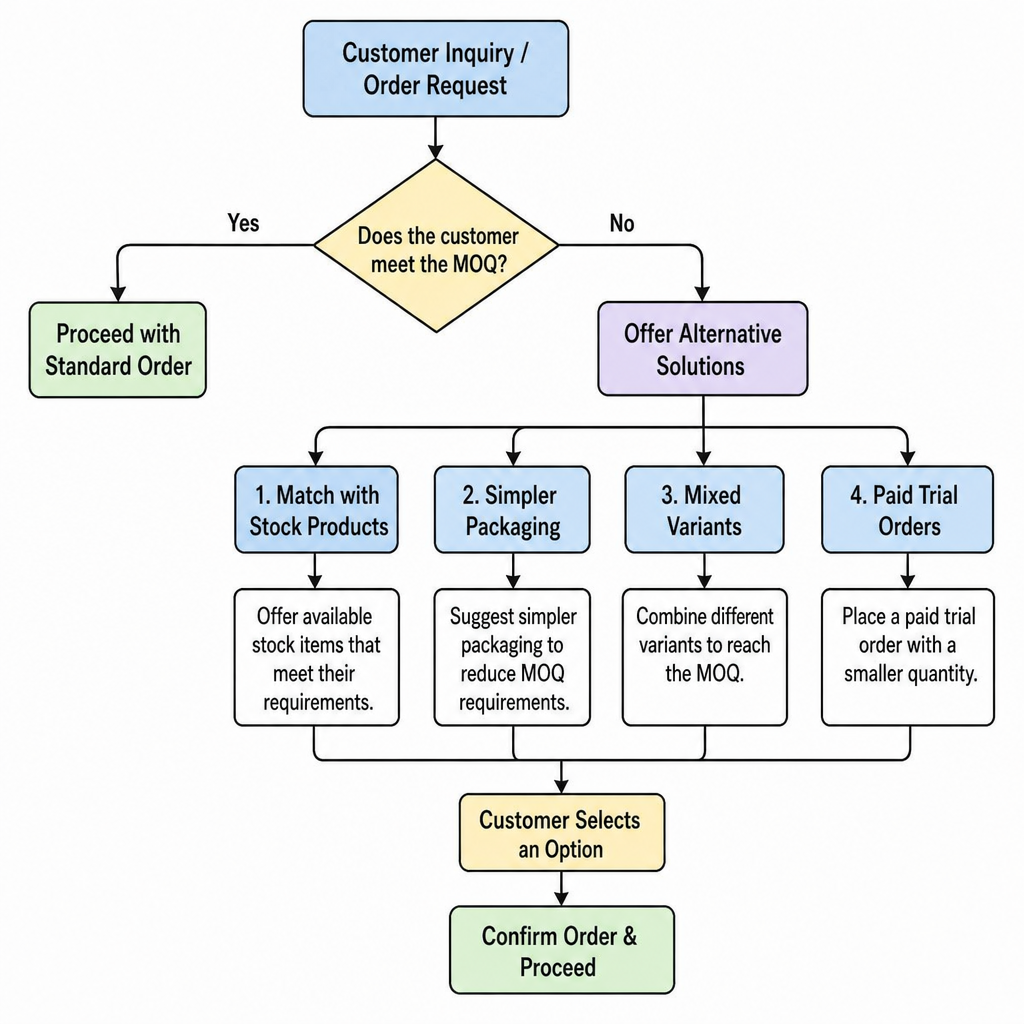
Treat these Alibaba sourcing hacks as proposals, not guaranteed shortcuts. Pick the options that address the supplier’s explanation, and request a revised written quotation for each serious alternative. Avoid changing every requirement at once; you need to understand which concession produces a workable offer.
Start with existing stock
Ask whether the exact product is available from inventory before discussing a new production run. Alibaba describes Ready to Ship products as an option for buyers seeking lower minimums because those goods are already held in stock. Availability still needs confirmation for your chosen quantity and variant.
Request the model number, current product photos, available quantity, packaging details, and proposed dispatch date. Specify whether you need identical units rather than an assortment. For a first test, consider dropping optional branding instead of insisting that an inventory purchase become a custom manufacturing project.
Simplify the custom work
Ask for separate quotations for an unbranded product, a product with basic branding, and your fully customized version. Alibaba’s supplier guidance shows that customization options can have different quantity thresholds, so separating them helps identify the requirement to reconsider.
For example, propose a standard product in plain protective packaging for the trial, then evaluate custom artwork for a later order. State precisely which features must remain unchanged. “Standard version” should not become permission to substitute materials, dimensions, or components without your approval.
Propose a genuine paid trial
Describe the order as a paid evaluation with a defined purpose: checking the product, testing packaging, or measuring customer response. Alibaba includes trial orders among its suggested MOQ negotiation approaches. Use that framing honestly; do not promise a larger reorder simply to obtain an exception.
Explain what would justify the next purchase and ask for both trial pricing and future quantity tiers. Keep any forecast conditional on actual results. A useful proposal might read: “We want to evaluate this product before deciding on a larger order. Please quote your smallest viable trial quantity using the standard specification.”
Negotiate price and quantity together
Request a comparison between a smaller run at a higher unit price and the supplier’s standard minimum. You can also ask whether a separately identified setup charge would make the smaller batch viable. Alibaba advises considering price, MOQ, setup fees, and landed cost together rather than treating quantity as an isolated negotiation.
Set your maximum total spend before reviewing the answer. Do not accept an unexplained surcharge merely because the quantity falls. Ask what each additional charge covers, whether it applies only to the first order, and whether the revised offer preserves the agreed specification.
Ask about mixed variants or products
Ask whether multiple colors, sizes, or related products can count toward the minimum. Alibaba discusses mixed-SKU orders as an option, although the supplier must confirm whether your proposed combination qualifies. Do not assume that unrelated products or different production processes share one threshold.
For an illustrative proposal, request 200 units divided between two existing colors instead of 200 units of each color. Ask the supplier to list quantities and prices separately. Only include variants you genuinely want to test; an unwanted assortment is not a useful concession.
Offer scheduling flexibility, not blind commitments
Ask whether a flexible production window or an alternative standard product would make a smaller order possible. Alibaba’s supplier guidance recommends discussing alternatives such as pooled orders and future scheduling when the requested MOQ cannot be met. Treat any proposed arrangement as something to verify, not an automatic saving.
Request a firm shipment commitment once the arrangement is agreed. If a supplier proposes producing everything now and shipping in stages, clarify the full purchase obligation, payment schedule, storage costs, and responsibility for damage. Do not confuse fewer units arriving today with fewer units purchased overall.
How do you ask an Alibaba supplier to lower MOQ?
Ask for a specific quantity, explain your evaluation purpose, identify acceptable compromises, and request an itemized quotation. Make it easy for the supplier to answer with a workable alternative rather than a simple refusal. Keep your message focused on the order you can place, not an exaggerated forecast.
Adapt this template:
Hello, we are evaluating [product/model] for [intended use or market]. We would like a paid trial order of [quantity] units before deciding on a larger purchase.
Please confirm whether this quantity is possible using your standard material, existing color, and plain protective packaging. Our essential requirements are [specifications].
If your listed MOQ still applies, please explain the main constraint and quote the smallest viable alternative. Please separate unit price, setup charges, sample cost, packaging, shipping, and production lead time.
We may reorder if the trial meets our quality and sales requirements, but we cannot guarantee future volume. Please also confirm sample availability and whether you support a Trade Assurance order.
Send the same core specification to each shortlisted supplier. Record exceptions instead of relying on memory, and ask suppliers to clarify vague responses before negotiating further. A courteous follow-up is more useful than repeatedly sending “best price?” without resolving the actual constraint.
Compare total commitment, not just unit price
Use a simple comparison sheet to decide whether a lower MOQ actually fits your budget. Alibaba recommends comparing total landed cost because smaller quantities can change unit pricing, setup charges, and shipping economics. Keep the product specification consistent across quotations.
Consider this hypothetical product-cost comparison, excluding all other charges:
|
Option |
Quantity |
Unit price |
Product subtotal |
|---|---|---|---|
|
Standard minimum |
500 |
$4.00 |
$2,000 |
|
Negotiated trial |
150 |
$5.00 |
$750 |
The trial costs more per unit but requires $1,250 less in product spending. That arithmetic does not establish which option is better. Add the actual quoted charges and assess how much inventory you are prepared to hold before choosing.
Use this checklist before accepting either offer:
- Upfront commitment: Include the deposit, balance, and any separately purchased materials or packaging.
- Order-level charges: Identify samples, tooling, artwork, setup, and inspection costs where applicable.
- Delivery costs: Request the shipping quotation and clarify what it includes and excludes.
- Inventory plan: Decide how many units you can realistically test or sell without assuming an immediate reorder.
- Reorder terms: Confirm whether the reduced MOQ is a one-time exception and what applies next time.
Keep budget headroom rather than allocating every available dollar to the supplier’s minimum. Set aside the amount you need for the rest of the launch before choosing your order quantity. Reject both offers if neither leaves you with a workable plan.
MOQ best practices for protecting the first order
Once quantity and price are settled, put equal attention into the sample and written order. Alibaba recommends requesting a sample and creating detailed purchase terms before proceeding with a full order. Its Trade Assurance guidance emphasizes that the online agreement should record the specifications and shipment terms that matter.
Apply these MOQ best practices before paying:
- Approve the relevant sample. Ask whether it represents the exact material, finish, branding, and packaging you are buying.
- Record measurable requirements. Include the model, dimensions, materials, variant quantities, and acceptance criteria relevant to your product.
- Document the negotiated exception. State the agreed trial quantity, price, additional charges, and shipment date in the order.
- Define change approval. Require written approval before substitutions or specification changes.
- Check the protection terms. Confirm eligibility and follow the payment and documentation requirements for the chosen transaction.
Trade Assurance can help resolve eligible disputes when agreed quality or shipping terms are not met, but it does not guarantee a refund for every dissatisfaction. Follow Alibaba’s supported payment process and retain clear evidence of what was agreed. Do not accept an off-platform payment request as the price of securing a lower minimum.
Pause if the supplier avoids defining the product, refuses to document changes, or pressures you to buy substantially more than your limit. You do not need to prove the supplier is unsuitable to decline the offer. A commercially reasonable minimum can still be wrong for your business.
Negotiate an order that fits your business
Start with the constraint behind the Alibaba MOQ, then propose a smaller order the supplier can realistically quote. Prioritize stock products, limited customization, transparent pricing, and an honest trial plan. Judge success by the complete commitment—not by how far you reduced the listed minimum.
Your next step is simple: prepare one clear buying brief, request comparable quotations, and choose only an order you can afford to evaluate properly.
Frequently Asked Questions About Alibaba MOQ and Ordering Practice
1. What does MOQ mean on Alibaba?
MOQ stands for Minimum Order Quantity. It is the smallest quantity that a supplier is willing to sell for a specific product or order. It's important to clarify what the MOQ applies to—whether it's a single product, a variant, or a customized version.
2. Can I negotiate the MOQ with suppliers on Alibaba?
Yes, MOQ can often be negotiated. Suppliers may be willing to lower the MOQ if you offer reasonable alternatives, such as choosing existing stock, simplifying customization, or proposing a paid trial order.
3. What should I include when asking a supplier to lower the MOQ?
When requesting a lower MOQ, you should specify the quantity you want, explain the purpose of the evaluation, identify potential compromises, and ask for an itemized quotation to make it easier for the supplier to respond positively.
4. Why do suppliers set minimum order quantities?
Suppliers set minimum order quantities based on various factors, such as production costs, material purchases, packaging requirements, and the margins needed to handle an order. Understanding these constraints can help you negotiate more effectively.
5. What are some best practices for ordering with a lower MOQ on Alibaba?
Some best practices include:
- Approving a sample that meets your specifications,
- Documenting all measurable requirements and terms,
- Ensuring written approvals for any changes,
- Requesting Trade Assurance for purchase protection, and
- Comparing total costs to determine the best value for your order.