Shipping from China to Australia involves more than booking freight: you need a suitable transport service, a complete landed-cost budget, accurate documents, and goods that meet Australian import requirements.
This guide explains how to compare shipping options, assess quotes, and prepare for customs and biosecurity clearance.
Use it to plan your first shipment or review an existing importing process before committing to your next order.
What is the best way to ship from China to Australia?
The best shipping method depends on your shipment’s size, urgency, handling requirements, and total delivery budget. Express services suit time-sensitive parcels, air freight serves larger urgent shipments, and ocean freight provides shared-container or full-container options. Compare services using packed dimensions and weight, not product weight alone.
Express courier and air freight
For samples or an urgent replenishment order, start by comparing express courier and air freight quotations. Ask each provider to identify the delivery scope, customs arrangements, and charges payable separately. A fast transport service is only useful if its complete offer matches your deadline and budget.
Air shipments may be priced using chargeable weight: the higher of actual gross weight and volumetric weight. Consequently, bulky, lightweight packaging can increase freight charges even when the products themselves weigh little. Obtain the provider’s calculation method before approving your cartons.
Sea freight: shared space or a dedicated container
Less than container load, or LCL, consolidates smaller consignments into a container shared with other shipments. Full container load, or FCL, gives your shipment a dedicated container. LCL involves consolidation and deconsolidation, which can make its transit time longer than FCL.
When booking a shipping container from China to Australia, request both options if your order could reasonably suit either. Ask for complete destination charges, not just the ocean freight component. Compare the total payable amount alongside delivery timing, handling arrangements, and receiving capacity rather than choosing by container space alone.
How much does shipping from China to Australia cost?
There is no single shipping from China to Australia price that applies to every consignment. Rates depend on the route, transport mode, packed weight and dimensions, service requirements, and applicable surcharges. A useful estimate therefore requires shipment-specific information and a clear description of what the quotation includes.
The cost of shipping from China to Australia should also be distinguished from the total cost of importing. Freight is one budget line; customs charges, taxes, clearance services, and any biosecurity intervention may require additional allowances.
Build a landed-cost budget
Use the following checklist to request a complete breakdown. Ask providers to mark each item as included, excluded, conditional, or not applicable rather than assuming every shipment attracts every charge:
|
Budget category |
What to confirm |
|---|---|
|
Goods and preparation |
Purchase value, export packaging, and any agreed preparation costs |
|
Origin services |
Collection, export clearance, and origin handling included in the quote |
|
International transport |
Main freight charge, charging basis, and applicable surcharges |
|
Cargo insurance |
Whether cover is arranged, its scope, and any deductible |
|
Australian clearance |
Brokerage, government charges, duties, and import GST |
|
Destination services |
Terminal or depot handling, delivery, unloading arrangements, and potential storage |
Keep the purchase price, logistics costs, government charges, and contingency separate in your spreadsheet. This makes it easier to identify which assumptions remain unconfirmed and which costs change between providers.
Compare equivalent quotations
To compare shipping costs to Australia, give every provider the same cargo description, collection locati0n, delivery postcode, ready date, package count, dimensions, and gross weight. These details affect freight pricing and help make the comparison meaningful.
Request a written list of exclusions and a quotation expiry date. Specify the quotation currency and ask how currency conversion will be handled. If one offer looks substantially cheaper, investigate the service boundaries before treating the difference as a saving.
Avoid comparing a port-only quotation with a delivered quotation. Instead, create one comparison sheet showing the same starting point, destination, and responsibilities for every offer.
How long does shipping from China to Australia take?
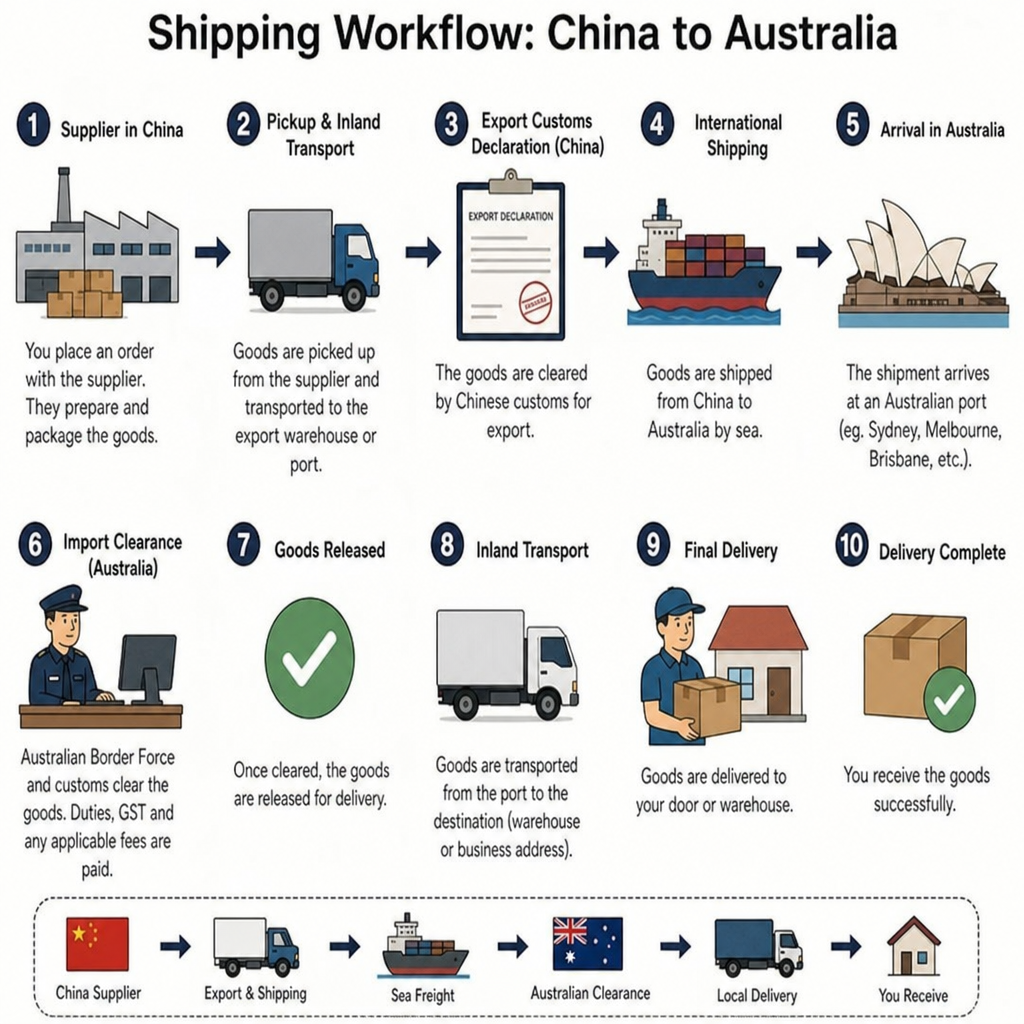
A useful delivery estimate covers the entire journey, not just the flight or ocean passage. Your planning window should include cargo readiness, collection, departure arrangements, international transport, clearance, and final delivery. Shared-container freight also requires consolidation and deconsolidation, while biosecurity inspection or treatment can introduce delays.
Ask your forwarder to separate the schedule into milestones:
- Cargo ready: When the supplier will have the finished, packed order available.
- Cargo accepted: The deadline for delivering goods and documents for the intended departure.
- Scheduled movement: The expected departure and arrival, including any connections.
- Available for delivery: The estimate after unloading, clearance, and release.
- Final receipt: The delivery appointment at your warehouse or nominated address.
Work backwards from the date you need saleable stock available. Ask which dates are estimates, what could change them, and when the provider will notify you of an exception. Keep your customer commitments separate from an unconfirmed arrival estimate.
Australian customs, GST, and biosecurity requirements
Before you import from China, check the product’s tariff classification and applicable import conditions. Customs clearance and biosecurity clearance address different requirements, so preparing for one does not replace preparing for the other. Australian Border Force encourages first-time or infrequent importers to use a licensed customs broker.
Duties, GST, and ChAFTA
For consignments valued above AUD1,000, an import declaration is generally required, with applicable duties, taxes, and processing charges payable. Most goods valued at AUD1,000 or less do not attract border duties and taxes, but exceptions apply. Separate GST rules can apply to low-value goods sold to Australian consumers, so a low shipment value does not automatically mean a GST-free purchase.
Import GST is generally 10% of the taxable importation value, which includes customs value, applicable duty, and relevant transport and insurance costs. Do not calculate it solely from the supplier’s invoice total without checking the correct basis. (
The China–Australia Free Trade Agreement, or ChAFTA, can provide preferential tariff treatment for qualifying goods. Shipping from China alone does not establish eligibility: the goods must satisfy the relevant origin rules and documentation requirements. Ask your broker to confirm eligibility before assuming a preferential duty rate.
Biosecurity starts before packing
Check the Department of Agriculture, Fisheries and Forestry’s BICON system before dispatch. It identifies whether goods can be imported and the conditions they must meet. Review packaging requirements as well as the product itself.
Containers must be free of contamination such as soil, grain, snails, and plant or animal material. Timber packaging must meet applicable treatment requirements; Australia accepts ISPM 15-compliant solid timber packaging and specified alternatives under BICON. Missing declarations or contamination can lead to inspection, treatment, delays, and charges.
Prepare a consistent shipping document pack
The documents required depend on the goods and shipment, but commercial invoices, transport documents, and supporting clearance information form the foundation. Prepare them before departure and have your broker confirm any product-specific permits or approvals. Treat document review as a booking task, not something to begin after arrival.
Your working checklist should include:
- Commercial invoice: Supplier and purchaser details, clear goods descriptions, quantities, values, currency, and agreed terms.
- Packing list: Package details and shipment identifiers that reconcile with the invoice and physical cargo.
- Bill of lading or air waybill: The relevant transport document for the shipment.
- Packing declaration: Required container-packing information, including relevant timber and cleanliness declarations.
- Origin evidence: Appropriate documentation when claiming preferential treatment under ChAFTA.
- Permits or certificates: Any additional documents required for your particular goods.
Ask the supplier, forwarder, and broker to review one consistent set of shipment details. Reconcile product descriptions, quantities, package counts, and reference numbers before approving final documents. Flag discrepancies for correction rather than leaving the receiving team to investigate them later.
Agree responsibilities before accepting the supplier’s offer
Incoterms define important delivery responsibilities, including cost allocation, risk transfer, and customs obligations. They should be agreed alongside a named place or port, rather than used as an unexplained abbreviation. Include the applicable rules version in your purchase agreement.
For containerised or multimodal movements, FCA is worth discussing when the buyer will arrange international carriage and the seller will handle export clearance. ICC guidance specifically identifies FCA for containerised goods or delivery to an inland or port terminal. Do not choose a term simply because it appeared on a previous supplier’s invoice.
With delivered offers, ask who will arrange import clearance, pay duties and taxes, and provide supporting records. Confirm the exact delivery point and unloading arrangements. Have the broker or forwarder explain any uncertainty before you approve the order, because a broad promise of “delivery included” leaves too much unresolved.
Reduce costs without creating avoidable problems
Reducing your shipping cost from China to Australia starts with better shipment information and a comparison of complete offers. Freight providers price according to factors including weight, dimensions, mode, route, and additional services. Packaging and service choices therefore deserve attention before booking.
Use these practical checks when reviewing the order:
- Review packaging: Ask whether unnecessary empty space can be removed without weakening product protection. Request revised packed measurements before comparing the saving.
- Price consolidation: If several suppliers are involved, ask for a consolidated option and compare its full collection, handling, and delivery scope with separate shipments.
- Test a split shipment: Request a price for sending only urgent stock by a faster service while moving the balance separately. Compare the combined total against one shipment.
- Challenge uncertain charges: Ask what would trigger storage, additional handling, inspection, or delivery surcharges and who would authorise extra work.
- Review insurance: Ask for the proposed cover, exclusions, claims process, and deductible in writing before deciding whether it suits the cargo.
After delivery, compare the original budget with the final invoices. Record which differences arose from changed shipment details, excluded services, or unexpected events. Use that record to improve the next quotation request rather than relying on the previous shipment’s headline freight rate.
Plan the shipment before placing the order
A practical shipping plan starts with the goods, their packed dimensions, the delivery deadline, and confirmed import requirements. Next, compare equivalent freight offers and build a landed-cost budget with clearly assigned responsibilities. Before dispatch, reconcile the documents and confirm how clearance and final delivery will be managed.
The goal is not simply the lowest freight quote. It is a shipment you can budget for, receive, and put to use without unresolved responsibilities or preventable surprises.
Frequently Asked Questions Related to Shipping from China to Australia
What is the average shipping cost from China to Australia?
The cost of shipping from China to Australia can vary significantly based on factors such as the shipping method (air freight, sea freight), cargo dimensions, weight, and any additional services required. For accurate pricing, it's essential to request detailed quotes from multiple shipping providers.
How long does it take to ship goods from China to Australia?
Shipping times depend on the chosen method. Air freight typically takes a few days to a week, while sea freight can take several weeks, especially for shared container shipments. It's crucial to account for potential customs clearance and biosecurity inspections when estimating total delivery time.
What customs duties and taxes apply when importing from China to Australia?
Goods valued above AUD 1,000 may require an import declaration, and customs duties, GST, and processing fees may apply. Import GST is generally 10% of the taxable value, which includes customs value, applicable duty, and relevant transport costs.
How can I prepare for Australian biosecurity requirements?
Before shipping, check the product's compliance with biosecurity regulations through the Australian Department of Agriculture's BICON system. Ensure that packaging is free from contamination and meets treatment requirements to avoid delays during clearance.
What documents are required for shipping from China to Australia?
Essential shipping documents typically include a commercial invoice, packing list, bill of lading or air waybill, packing declaration, and any necessary permits or certificates. Properly prepared and accurate documentation helps ensure smooth customs clearance.