










When importing products from China or shipping goods internationally, choosing between FCL vs LCL shipping is one of the most important logistics decisions. The right shipping method can help us reduce freight costs, shorten delivery times, protect our merchandise, and improve supply chain efficiency.
FCL (Full Container Load) and LCL (Less Than Container Load) are the two primary ocean freight shipping options used by importers, wholesalers, manufacturers, and e-commerce businesses.
Although both methods transport goods in shipping containers, they differ significantly in cost structure, cargo capacity, transit time, handling requirements, and flexibility.
FCL shipping allows us to reserve an entire container for our shipment, while LCL shipping enables us to share container space with other importers and pay according to the cargo volume or chargeable weight.
For smaller shipments, LCL is often the more economical solution. For larger shipments, FCL generally provides better cost efficiency per unit, fewer handling operations, and greater control over transportation.
However, cargo volume alone should not determine our decision.
In this comprehensive guide, we explain the differences between FCL and LCL shipping, compare their advantages and disadvantages, examine freight costs and transit times, and show how to choose the most suitable shipping method for international trade.
1. What Is FCL Shipping?
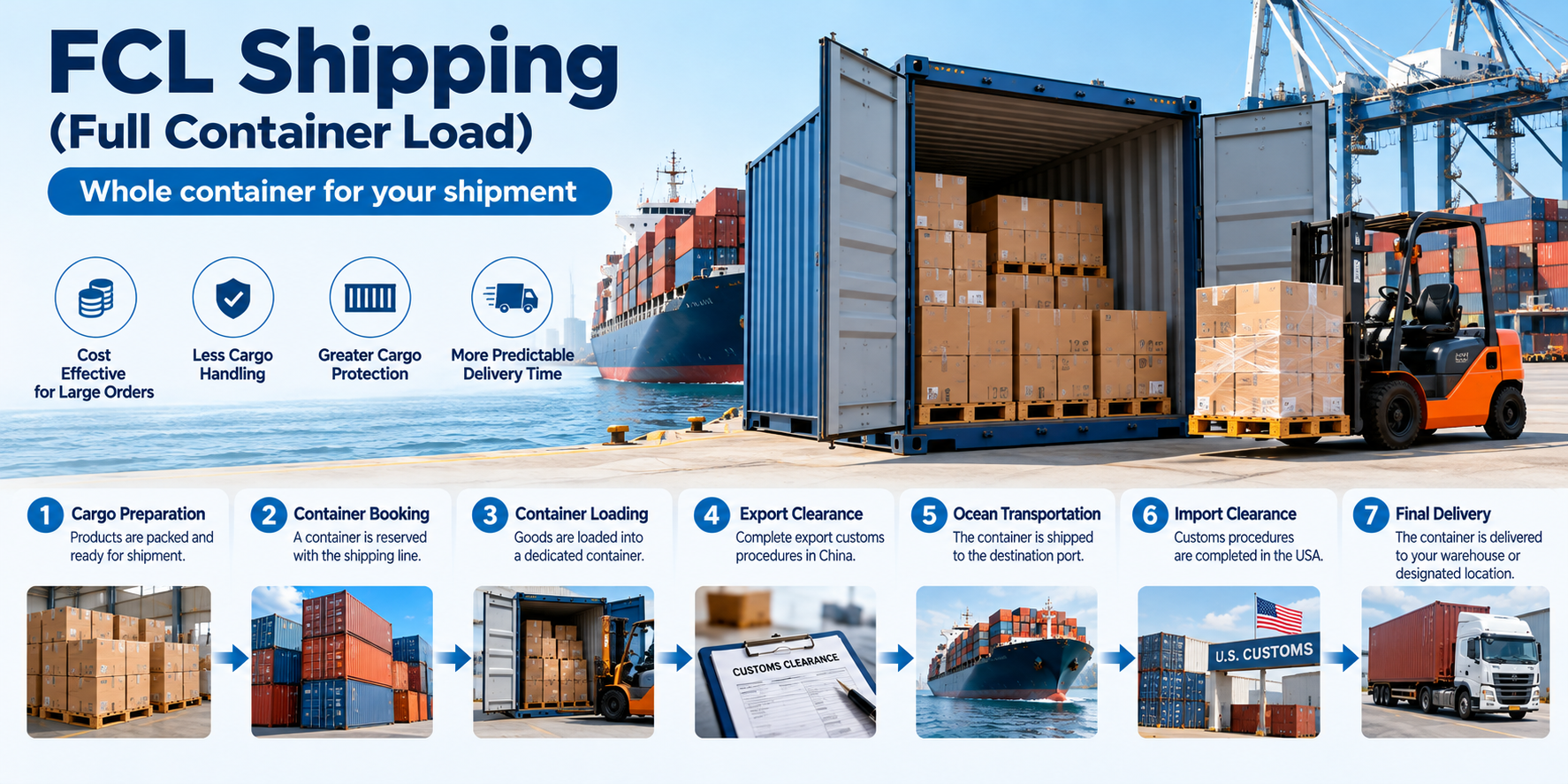
FCL stands for Full Container Load, an ocean freight shipping method in which one shipper reserves exclusive use of an entire container.
With FCL shipping, we can load products from one or multiple suppliers into a dedicated container. The container is generally sealed after loading and transported to the destination port without being opened for routine cargo consolidation.
FCL does not necessarily mean the container must be completely full. We can reserve a 20-foot or 40-foot container even when our products occupy only part of its available capacity.
For example, if we import 20 cubic meters of furniture from China, we may choose a 20-foot container rather than sharing space with other shipments.
How Does FCL Shipping Work?
The FCL shipping process generally involves:
Cargo preparation: We confirm product quantities, packing details, and shipment readiness with our suppliers.
Container booking: A freight forwarder reserves a container and shipping space with an ocean carrier.
Container loading: Goods are loaded at the supplier's factory, warehouse, or designated container loading facility.
Container sealing: The loaded container is secured with an appropriate seal.
Export customs clearance: Shipping documents and applicable customs requirements are completed.
Ocean transportation: The container travels to its destination port.
Import customs clearance: The importer completes customs procedures and pays applicable charges.
Final delivery: The container is transported to the designated warehouse or unloading location.
FCL shipping is widely used for transporting furniture, machinery, building materials, electronics, wholesale consumer products, and large commercial orders.
Advantages of FCL Shipping
Lower shipping cost per unit for larger orders
When cargo volume increases, FCL shipping can provide better freight efficiency because we pay for the container rather than individual cubic meters.
Reduced cargo handling
The container usually remains sealed during routine transportation, reducing cargo handling compared with consolidated shipments. Customs or security inspections may still require it to be opened.
Greater cargo protection
A dedicated container avoids routine consolidation with unrelated merchandise, helping reduce exposure to handling damage and contamination.
More predictable delivery schedules
FCL shipments usually avoid the additional consolidation and deconsolidation processes required for LCL cargo.
Suitable for high-volume imports
FCL is especially practical for businesses importing substantial quantities of products or regularly replenishing warehouse inventory.
Disadvantages of FCL Shipping
FCL shipping also presents certain challenges.
Higher upfront freight expenditure for small cargo volumes.
Potentially inefficient container utilization when shipping limited quantities.
Additional storage requirements for large inventory orders.
Container loading and unloading responsibilities.
Possible detention, demurrage, and container-related charges when deadlines are missed.
We therefore recommend evaluating cargo volume and total landed cost before reserving a full container.
2. What Is LCL Shipping?
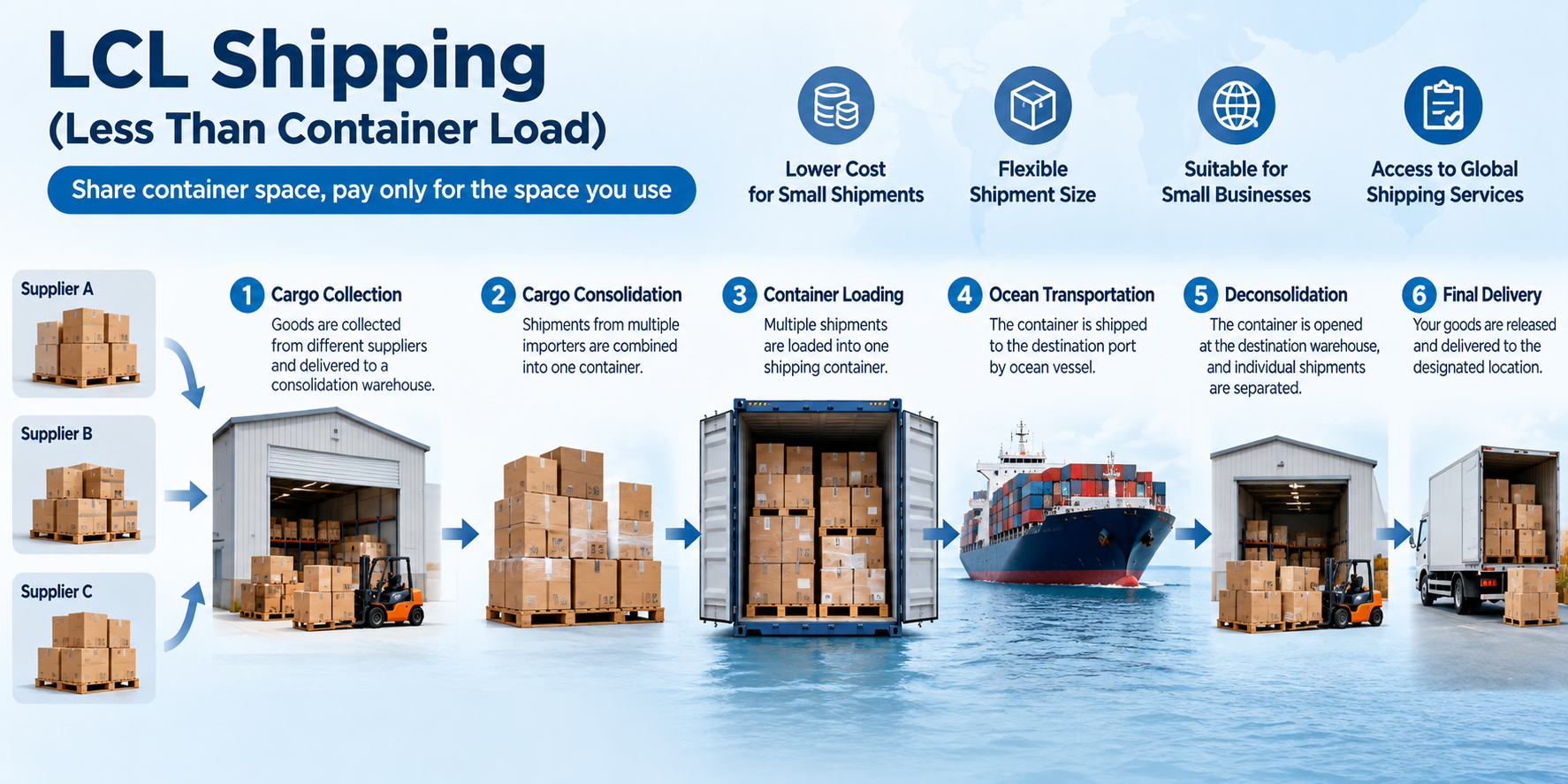
LCL stands for Less Than Container Load, a shipping method that allows multiple importers to share one container.
Instead of booking an entire container, we pay for the space or chargeable quantity occupied by our products.
LCL is especially beneficial when our shipment is too small to justify the cost of FCL shipping.
For example, suppose we purchase 4 cubic meters of stationery products from a Chinese manufacturer.
Rather than paying for an entire 20-foot container, we can arrange LCL shipping and share the container with other commercial shipments.
This allows smaller businesses to access international ocean freight services without purchasing enough inventory to fill a container.
How Does LCL Shipping Work?
The LCL process involves additional logistics operations compared with FCL.
Cargo collection: Our goods are collected from the supplier or delivered to a designated warehouse.
Cargo consolidation: The logistics provider combines our shipment with merchandise belonging to other importers.
Container loading: Multiple shipments are loaded into one container.
Ocean transportation: The consolidated container is transported to the destination port.
Import customs procedures: Necessary customs entry and release processes are completed.
Deconsolidation: The shared container is opened at a designated warehouse, where individual shipments are separated.
Final delivery: Our products are released and transported to their destination.
Because LCL shipments require consolidation and deconsolidation, the overall logistics process can take longer than FCL.
Advantages of LCL Shipping
Lower initial transportation expenses
LCL allows us to transport small shipments without paying the full cost of reserving a container.
Flexible shipment sizes
We can ship smaller quantities according to purchasing needs rather than waiting until we have enough products to fill an entire container.
Suitable for small businesses
LCL is particularly useful for new importers, Amazon sellers, small retailers, and businesses testing new product categories.
Better inventory flexibility
Smaller, more frequent imports can reduce the amount of capital committed to inventory and may lower warehouse storage requirements.
Useful for supplier sampling and trial orders
When evaluating new manufacturers, we can transport smaller commercial quantities without committing to a large shipment.
Disadvantages of LCL Shipping
The primary disadvantages include:
Additional cargo handling during consolidation and deconsolidation.
Potentially longer total delivery times.
Warehouse handling and documentation charges.
Greater exposure to damage from repeated cargo movement.
Possible delays involving shared-container operations.
Higher freight costs per cubic meter as shipment volume increases.
For businesses importing fragile, high-value, or time-sensitive products, these factors may make FCL more attractive even when the container is not completely filled.
3. FCL vs LCL Shipping: Key Differences
Understanding the primary differences between FCL and LCL helps us select the right transportation solution.
|
Comparison |
FCL Shipping |
LCL Shipping |
|---|---|---|
|
Full name |
Full Container Load |
Less Than Container Load |
|
Container usage |
Dedicated container |
Shared container |
|
Freight pricing |
Container-based |
Volume or chargeable-weight-based |
|
Ideal shipment size |
Medium to large |
Small to medium |
|
Cargo handling |
Generally fewer handling stages |
Additional consolidation handling |
|
Transit time |
Often faster overall |
May require additional time |
|
Cargo protection |
Greater control over container contents |
Shared-container exposure |
|
Cost efficiency |
Better for higher cargo volumes |
Better for smaller shipments |
|
Inventory requirements |
May encourage larger orders |
Supports smaller orders |
|
Best suited for |
Large importers and bulk shipments |
SMEs, trial orders, smaller shipments |
Global ocean carrier Maersk identifies approximately 15–20 CBM as a useful range in which FCL often becomes attractive, although the actual economic crossover varies by route, cargo and charges.
The choice should therefore be based on a complete comparison of costs, service requirements, and shipment characteristics.
4. FCL vs LCL Shipping Costs: Which Is Cheaper?
The most important consideration for many importers is the difference in shipping costs.
Neither FCL nor LCL is always the cheapest option.
The better choice depends primarily on the cargo's volume, weight, transportation route, and additional logistics charges.
How FCL Shipping Costs Are Calculated
FCL shipping rates are generally quoted per container.
For example, we may request prices for:
20-foot standard container (20GP)
40-foot standard container (40GP)
40-foot high-cube container (40HQ)
The base container freight price is usually independent of whether the container is fully loaded, provided weight and equipment limits are respected.
However, the total shipping expense may also include export handling, terminal charges, inland trucking, customs brokerage, insurance, and destination fees.
How LCL Shipping Costs Are Calculated
LCL freight is generally calculated using cargo volume or chargeable weight.
Many ocean freight quotations use the Weight or Measurement (W/M) principle, which compares shipment volume in cubic meters with its gross weight in metric tons and charges according to whichever is greater.
For example:
5 CBM of cargo weighing 2 metric tons may be charged as 5 revenue tons.
5 CBM of cargo weighing 7 metric tons may be charged as 7 revenue tons.
The exact conversion and minimum charges depend on the freight provider and tariff.
In addition to ocean freight, LCL quotations may include origin and destination warehouse fees, consolidation charges, documentation fees, and delivery expenses.
Example: FCL vs LCL Shipping Cost Comparison
Consider the following hypothetical shipping quotations.
These figures are illustrative only, not current China–USA shipping rates.
Assume that our total all-in LCL cost is $250 in fixed charges plus $150 per chargeable CBM, while an equivalent 20-foot FCL service costs $2,650.
|
Cargo Volume |
LCL Cost |
FCL Cost |
Cheaper Option |
|---|---|---|---|
|
5 CBM |
$1,000 |
$2,650 |
LCL |
|
8 CBM |
$1,450 |
$2,650 |
LCL |
|
12 CBM |
$2,050 |
$2,650 |
LCL |
|
16 CBM |
$2,650 |
$2,650 |
Equal |
|
20 CBM |
$3,250 |
$2,650 |
FCL |
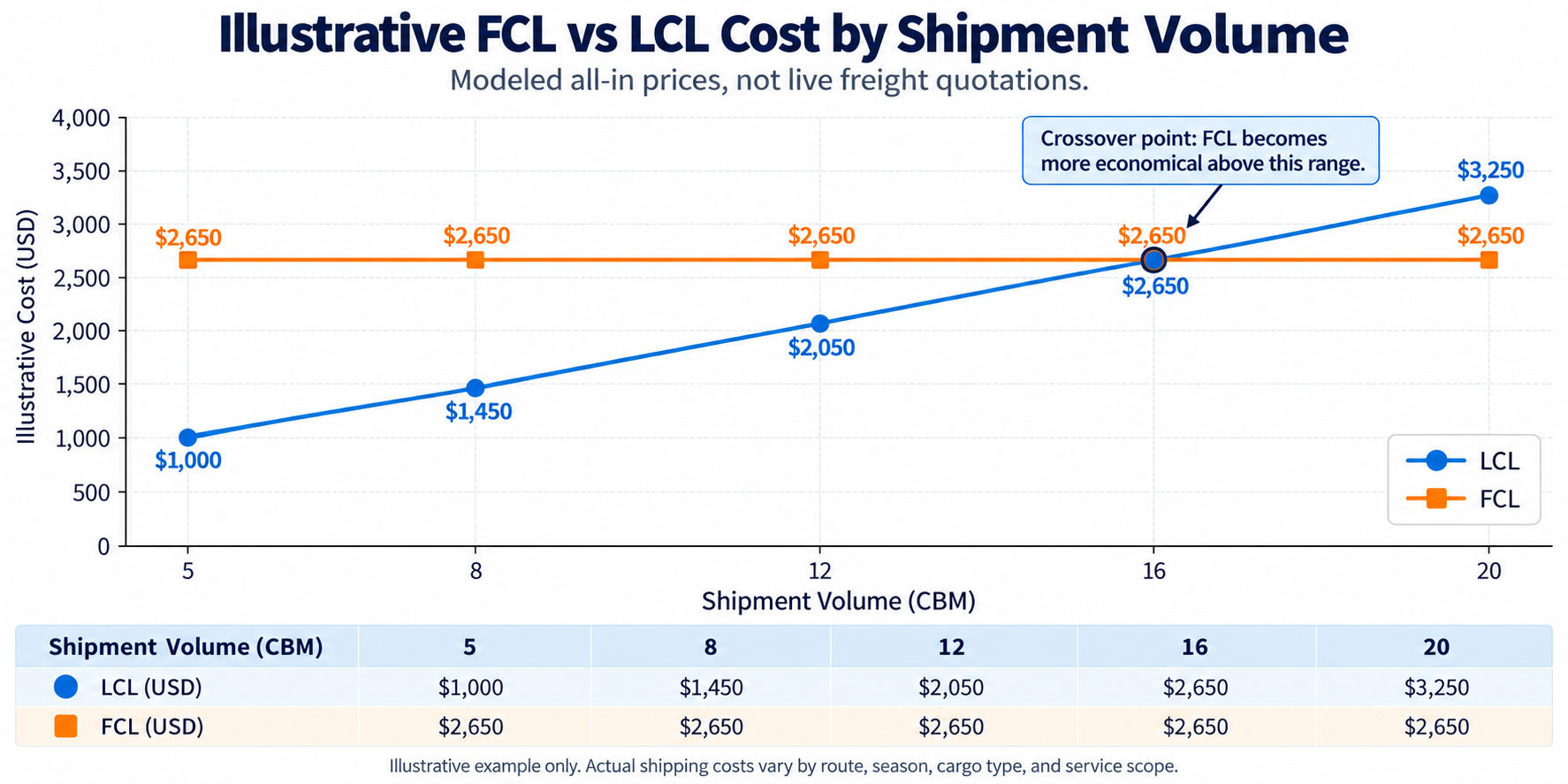
In this example, FCL becomes more economical above 16 CBM.
However, we must not treat 16 CBM as a universal threshold. Real shipping quotations vary according to trade route, cargo weight, handling costs, container availability, and delivery services.
We should always compare the complete door-to-door landed freight cost rather than ocean freight rates alone.
5. FCL vs LCL: How Much Cargo Do We Need?
Cargo volume is one of the most important factors when selecting between FCL and LCL shipping.
Before requesting freight quotations, we should calculate the total cubic meters (CBM) of our shipment.
How to Calculate CBM for International Shipping
CBM measures the volume occupied by cargo.
The standard formula is:
CBM = (Length × Width × Height) ÷ 1,000,000
For example, suppose we have 100 cartons, and each carton measures:
Length: 60 cm
Width: 40 cm
Height: 50 cm
Each carton occupies:
0.6 × 0.4 × 0.5 = 0.12 CBM
Therefore, the total shipment volume is:
100 cartons × 0.12 CBM = 12 CBM.
With 12 CBM of cargo, we should compare LCL shipping with a 20-foot FCL container to determine the most economical option.
What Shipment Size Is Best for FCL or LCL?
The following ranges provide a general starting point.
|
Shipment Volume |
Suggested Shipping Method |
|---|---|
|
1–5 CBM |
Usually LCL |
|
5–10 CBM |
Usually LCL |
|
10–15 CBM |
Compare LCL and FCL |
|
15–20 CBM |
FCL often becomes competitive |
|
20–28 CBM |
Usually 20-foot FCL if loading permits |
|
28–60 CBM |
Evaluate 40-foot FCL |
|
60+ CBM |
Consider 40-foot high-cube or multiple containers |
These are practical planning guidelines rather than strict limits. Heavy cargo may reach container weight limits before filling the available space.
Standard Shipping Container Sizes
|
Container Type |
Approximate Internal Volume |
Typical Usage |
|---|---|---|
|
20-foot standard |
33.2 CBM |
Dense and moderately sized cargo |
|
40-foot standard |
67.7 CBM |
Large wholesale shipments |
|
40-foot high cube |
76.3 CBM |
Bulky and lightweight merchandise |
These are nominal internal capacities based on Hapag-Lloyd equipment specifications. Actual usable loading space may be lower because of pallets, carton arrangement, stacking restrictions, and cargo dimensions.
6. FCL vs LCL Transit Time: Which Is Faster?
Shipping speed is particularly important when importing seasonal products, replenishing retail inventory, or fulfilling customer orders.
Both FCL and LCL shipments can travel aboard the same ocean vessels. Therefore, the actual ocean voyage may take approximately the same amount of time.
The main difference involves cargo handling before departure and after arrival.
Why Is FCL Shipping Usually Faster?
FCL shipments generally require fewer cargo handling operations.
Once the container is loaded and sealed, it can move through the shipping network without routine consolidation or deconsolidation.
After customs release and terminal availability, we can arrange container pickup and transportation to the designated unloading location.
Why Can LCL Shipping Take Longer?
LCL shipping involves additional warehouse procedures.
Before departure, the freight forwarder must receive and consolidate cargo from multiple shippers.
At the destination, the consolidated container must be moved to a suitable facility, unloaded, and separated into individual consignments.
This can add several days to the overall delivery process.
What About Customs Delays?
Customs inspections can affect both FCL and LCL shipments.
With FCL, an examination or documentation problem can delay our container.
With LCL, problems involving consolidated cargo or shared container handling may also affect delivery availability.
However, individual shipments may be cleared and released separately where customs procedures allow.
If delivery reliability and reduced handling are priorities, we generally favor FCL when the additional cost is commercially justified.
7. Cargo Safety: Is FCL Safer Than LCL?
Cargo safety is another important consideration when selecting an ocean freight method.
FCL generally provides greater control over cargo handling because the container is dedicated to one shipment.
LCL involves more handling and storage operations, potentially increasing exposure to accidental damage.
FCL Cargo Protection
FCL can be particularly suitable for:
Fragile furniture and glass products
Large machinery
Expensive commercial equipment
Sensitive electronics
Custom-manufactured products
High-value wholesale merchandise
However, FCL does not guarantee protection against cargo damage.
Poor loading practices, insufficient blocking and bracing, moisture exposure, container movement, and improper weight distribution can still result in damaged products.
We recommend inspecting container conditions and preparing an appropriate cargo-loading plan.
LCL Cargo Protection
LCL shipments require suitable packaging because goods may be moved multiple times during consolidation and deconsolidation.
When using LCL, we recommend strong export cartons, appropriate pallets or crates, protective wrapping, clear cargo labels, and moisture protection when necessary.
We should also confirm whether the consolidation provider accepts fragile, oversized, hazardous, or non-stackable cargo.
For high-value or easily damaged merchandise, the reduced handling associated with FCL can be a significant advantage.
8. FCL vs LCL for Shipping From China to USA
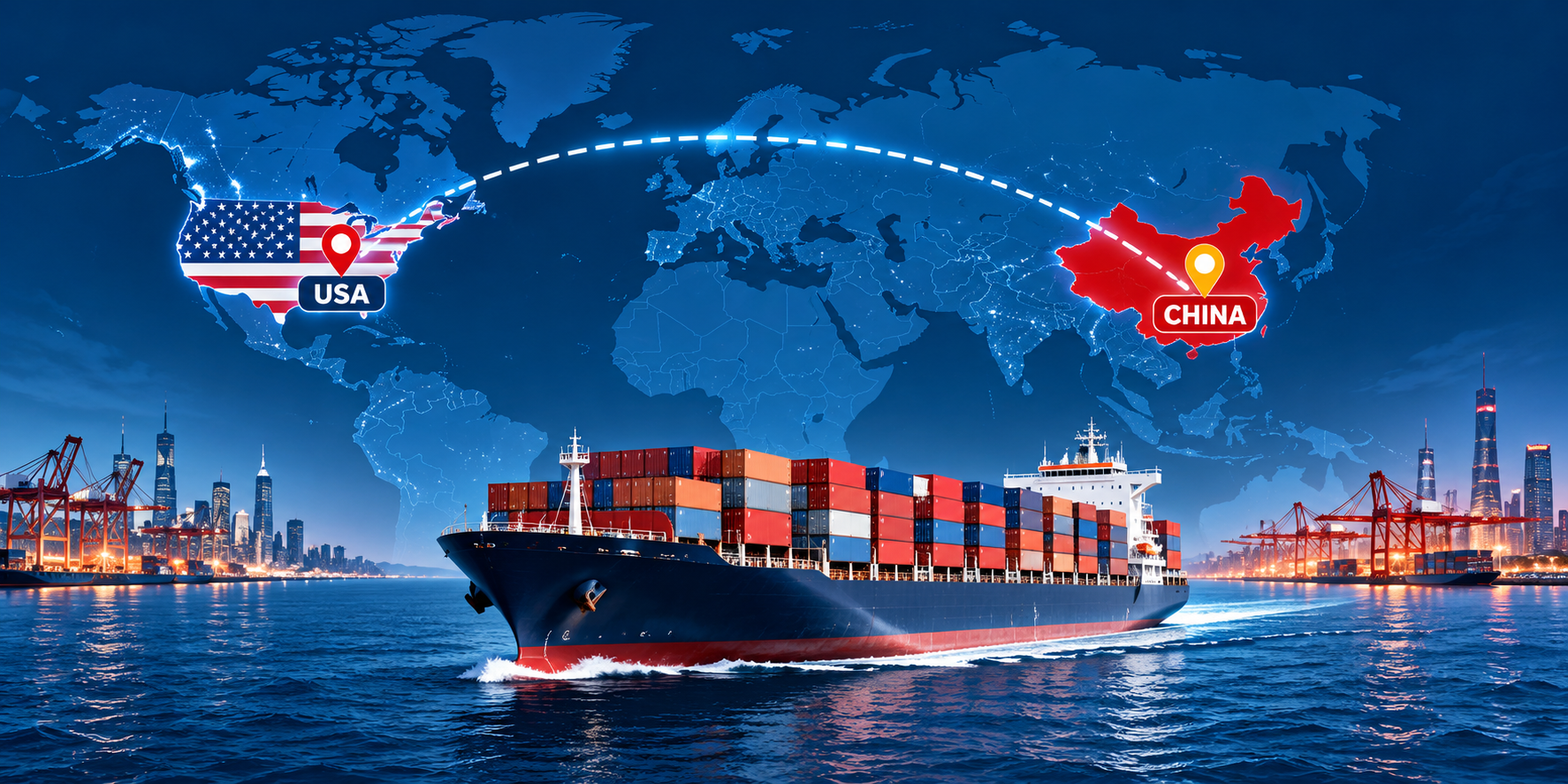
China is a major manufacturing and exporting destination for American importers, making FCL and LCL services essential for international trade.
When sourcing products from China for the U.S. market, we should consider the product category, shipping volume, manufacturing location, and destination warehouse.
When to Choose FCL From China to USA
We generally recommend evaluating FCL shipping when importing:
Large quantities of home furniture
Decorative building materials
Machinery and industrial equipment
Wholesale household products
Full-container consumer electronics orders
Large seasonal retail inventories
For example, a distributor importing 25 CBM of WPC wall panels from a Chinese manufacturer may find that a dedicated 20-foot container offers more economical transportation and better cargo control than LCL.
The final selection depends on cargo weight, packaging and loading feasibility.
When to Choose LCL From China to USA
LCL shipping is often more appropriate for:
Small wholesale orders
Product trial shipments
New e-commerce businesses
Small quantities of stationery and gifts
Mixed product orders
Importers with limited warehouse space
For example, an American retailer purchasing 3 CBM of toys, 2 CBM of stationery, and 1 CBM of gifts may combine the products into one 6 CBM LCL shipment.
This can reduce the need to arrange multiple international shipments.
Can We Combine Products From Different Suppliers?
Yes. We can consolidate merchandise from different Chinese suppliers before export.
For example, we may purchase products from manufacturers in Yiwu, Ningbo, and Guangzhou.
A sourcing or logistics partner can coordinate domestic transportation to a consolidation warehouse where products are inspected, organized, and prepared for international shipping.
After consolidation, we can select either FCL or LCL according to the final cargo volume.
9. FCL vs LCL for Amazon FBA Sellers
Amazon FBA sellers must balance inventory availability, delivery deadlines, and transportation costs.
Choosing between FCL and LCL depends on product demand, order quantity, warehouse arrangements, and replenishment frequency.
Why LCL Works for Small Amazon Sellers
LCL is useful when testing new products or importing limited quantities.
For example, an Amazon seller purchasing 500 units of a new kitchen accessory may not need an entire container.
By choosing LCL, we can reduce the initial freight commitment and avoid purchasing excessive inventory.
When FCL Becomes Better for Amazon Sellers
As sales increase, larger inventory orders may justify FCL shipping.
FCL offers better opportunities to reduce transportation expenses per unit, particularly for established products with consistent sales.
We must also arrange customs clearance, labeling, delivery appointments, and any required cargo preparation before delivering merchandise to Amazon fulfillment centers.
The container may need to be unloaded at a separate logistics facility before the products are delivered to Amazon in the required configuration.
10. Hidden Costs to Consider With FCL and LCL Shipping
A low ocean freight quotation does not always represent the lowest total shipping cost.
We should evaluate all logistics charges before selecting a freight service.
Common FCL Shipping Charges
Typical FCL-related charges may include origin pickup, container loading, terminal handling, documentation, ocean freight, destination terminal charges, customs brokerage, import duties, drayage, and container return.
Additional expenses may arise from demurrage, detention, storage, customs examinations, or overweight cargo.
Common LCL Shipping Charges
LCL shipments may incur origin and destination consolidation charges, CFS handling fees, documentation fees, customs brokerage charges, warehouse storage, and final delivery fees.
Some LCL services also apply minimum billing quantities or additional charges for heavy or non-stackable cargo.
Why Comparing Door-to-Door Costs Matters
Suppose one freight provider offers a low LCL ocean freight rate but charges high destination warehouse fees.
Another provider may offer a higher freight rate while including more destination services.
We should compare the total expense to deliver goods to our warehouse, not just the price of shipping them between ports.
11. How to Choose Between FCL and LCL Shipping
Selecting the right shipping method requires more than checking how many cubic meters we are importing.
We recommend evaluating these factors before confirming a shipment.
Consider Shipment Volume
LCL is generally suitable for smaller shipments, while FCL becomes increasingly attractive as volume grows.
Calculate Total Shipping Costs
Compare all relevant freight charges, terminal fees, warehouse handling expenses, customs services, and inland delivery costs.
Evaluate Cargo Characteristics
Fragile, high-value, sensitive, or oversized merchandise may benefit from a dedicated container.
Review Delivery Deadlines
If the goods must arrive within a narrow delivery window, we should consider the additional processing time required for LCL.
Assess Inventory Requirements
Shipping larger quantities may reduce freight costs per unit but increase inventory holding expenses.
We should compare transportation savings with storage costs and cash flow requirements.
Consider Supplier Locations
When purchasing from multiple suppliers, we can consolidate products at a warehouse to improve transportation efficiency.
Compare Freight Forwarder Services
We should ask each provider to clarify what is included in the quotation and whether delivery dates are estimates or guaranteed contractual commitments.
12. Interactive FCL vs LCL Shipping Decision Guide
Use the following guide to evaluate which option may be more appropriate for your cargo.
13. Common Mistakes to Avoid When Choosing FCL or LCL
Importers sometimes select shipping methods based only on advertised ocean freight prices.
This can lead to unexpected charges and inefficient logistics arrangements.
Mistake 1: Choosing LCL without comparing full container prices. As cargo volume increases, LCL may become more expensive than FCL.
Mistake 2: Ignoring destination handling fees. Warehouse and handling charges can significantly increase total LCL transportation expenses.
Mistake 3: Miscalculating cargo volume. Incorrect carton dimensions can produce inaccurate quotations and require costly shipment changes.
Mistake 4: Overlooking cargo weight. Heavy products may exceed permitted container payloads or lead to higher LCL chargeable weight.
Mistake 5: Assuming FCL always guarantees faster delivery. Vessel schedules, customs inspections, terminal congestion, and domestic transportation can affect both methods.
Mistake 6: Neglecting packaging standards. Both FCL and LCL shipments require suitable packaging, particularly for fragile and moisture-sensitive products.
Mistake 7: Failing to confirm Incoterms. We must understand whether the supplier or buyer is responsible for origin handling, international transportation, customs clearance, and destination delivery.
14. Conclusion: FCL vs LCL — Which Shipping Method Is Right for You?
Choosing between FCL vs LCL shipping depends on cargo volume, shipping budget, delivery requirements, product characteristics, and inventory management.
For small importers, e-commerce sellers, and businesses placing trial orders, LCL provides flexible access to international ocean freight without requiring a full container.
For larger wholesale shipments, FCL often delivers better cost efficiency, reduced handling, greater cargo control, and more predictable logistics operations.
When deciding between the two methods, we should calculate shipment volume, compare total freight quotations, assess handling risks, and consider the complete delivery process.
LCL is generally the better starting point for small shipments, while FCL becomes increasingly attractive as shipment volume grows.
By choosing the right container shipping strategy, we can reduce unnecessary transportation expenses, protect our products, and establish a more reliable international supply chain.
15. Frequently Asked Questions About FCL vs LCL Shipping

What Is the Main Difference Between FCL and LCL?
FCL uses a dedicated shipping container for one shipper, while LCL allows several shippers to share container space. FCL is generally suitable for larger shipments, whereas LCL is more flexible for smaller quantities.
Is FCL Cheaper Than LCL?
FCL can be cheaper for larger cargo volumes because the freight cost is distributed across more products. LCL is often more economical for small shipments because we only pay for the space or chargeable quantity used.
At What CBM Should We Choose FCL?
FCL often becomes competitive around 15–20 CBM, but the exact threshold depends on freight rates, cargo weight, destination charges, and container availability. We recommend comparing quotations before making a decision.
Is LCL Shipping Slower Than FCL?
LCL often requires additional time because products must be consolidated before departure and separated after arrival. However, the ocean voyage itself can be the same for FCL and LCL shipments traveling on the same vessel.
Can We Ship Fragile Products Using LCL?
Yes. Fragile products can be shipped through LCL when the service accepts them and suitable protective packaging is used. However, FCL may offer better cargo control by reducing routine handling operations.
Can We Use FCL Without Filling the Entire Container?
Yes. FCL refers to exclusive container use rather than a requirement to fill every available cubic meter. We can reserve a container even when it is partially loaded.
Is FCL Better for Shipping Furniture From China?
FCL is often preferable for large furniture orders because bulky products occupy significant container space and can be sensitive to repeated handling. Smaller furniture shipments may still be suitable for LCL with appropriate protective packaging.
What Is the Minimum Volume for LCL Shipping?
Many LCL services accept small commercial shipments, but minimum chargeable quantities vary by freight provider and route. Some services apply minimum billing equivalent to 1 CBM or 1 revenue ton.
Can We Combine Goods From Multiple Chinese Suppliers in One FCL Container?
Yes. We can collect products from multiple manufacturers at a consolidation warehouse and load them into a dedicated container. This is a common approach for importers purchasing different products from China.
Does FCL or LCL Affect Customs Duties?
The shipping method itself generally does not determine customs duty rates. Duties primarily depend on tariff classification, origin, customs value, and applicable import regulations. However, FCL and LCL may have different handling and customs brokerage expenses.