


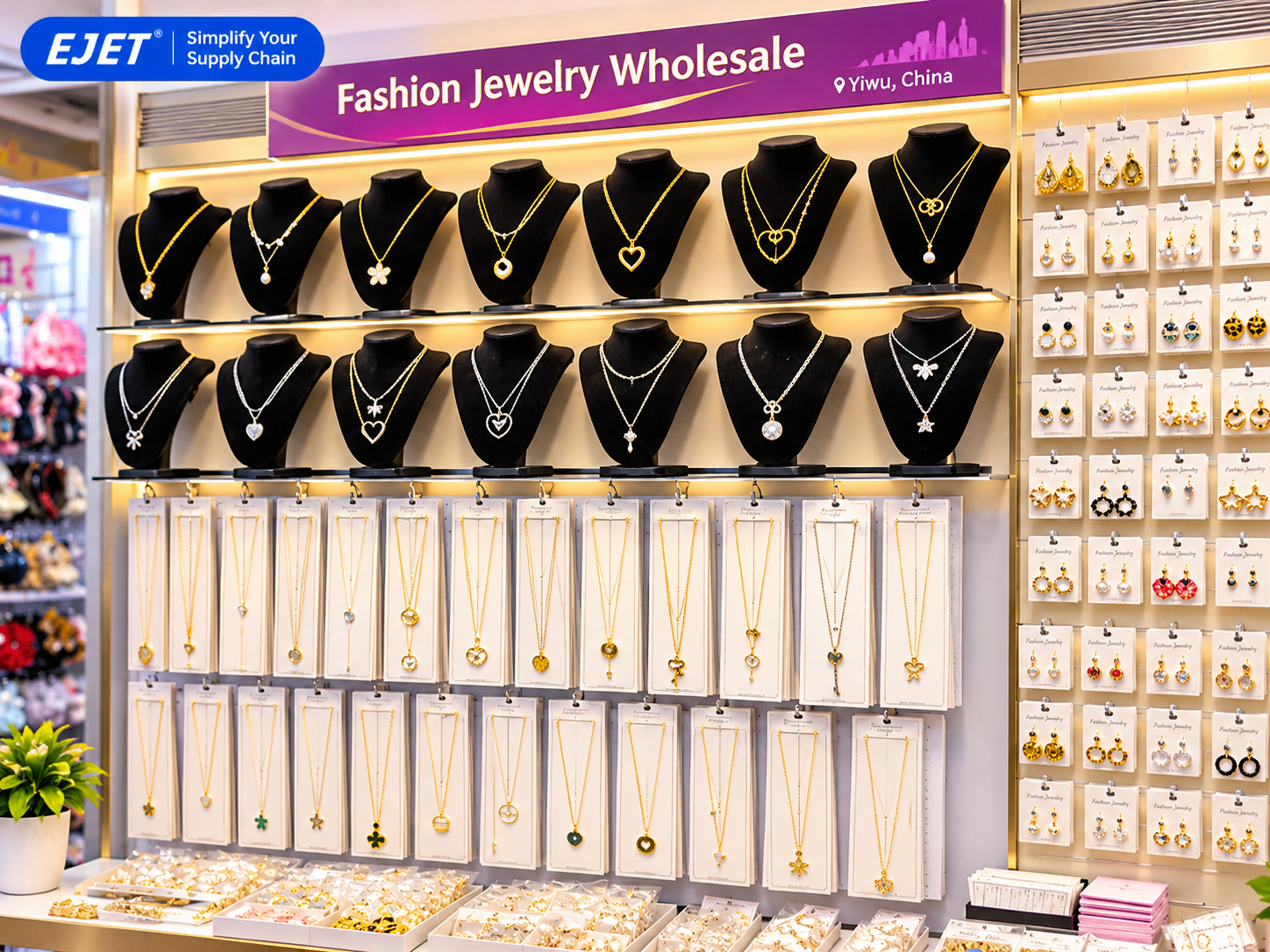
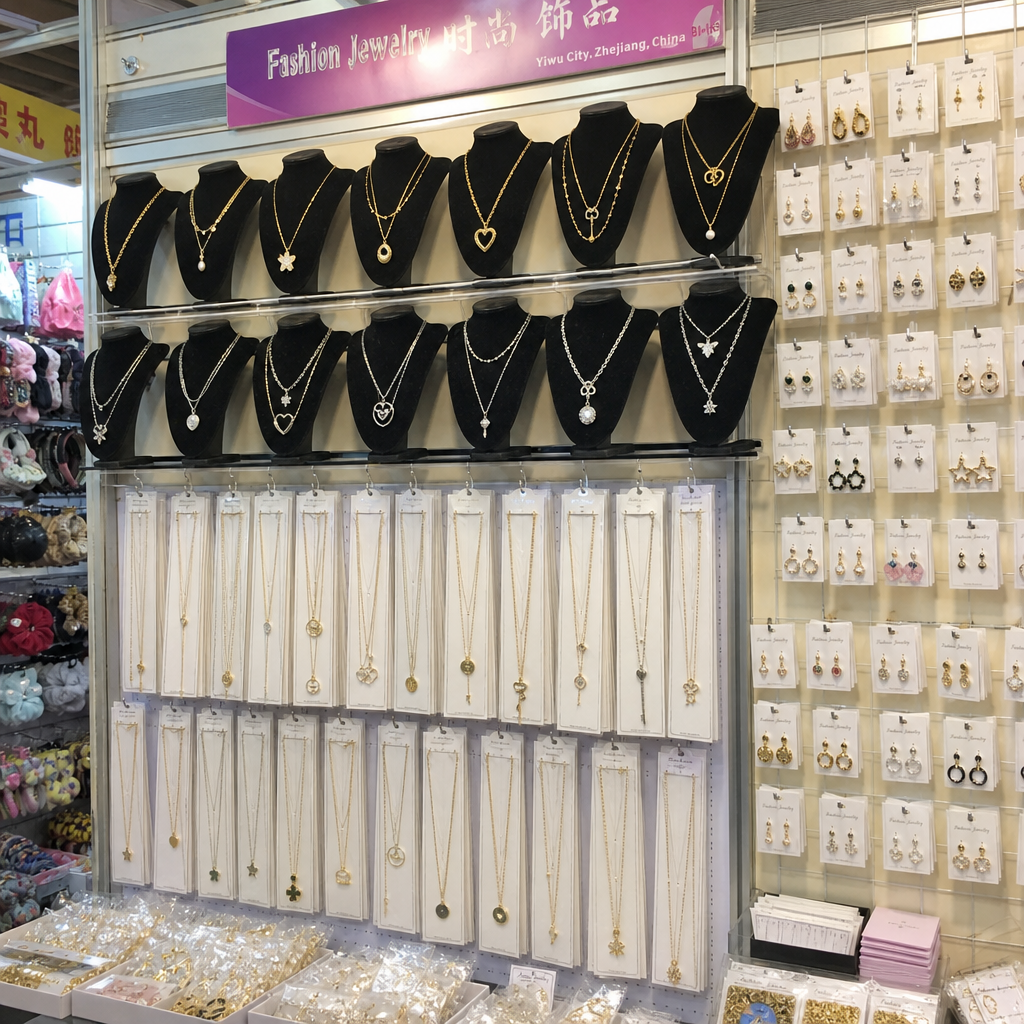
The Yiwu Jewelry Market brings together fashion jewelry and jewelry-accessory suppliers within the wider Yiwu International Trade Market in Zhejiang, China.
District 1 and District 1 East are established starting points for exploring finished pieces and components.
For retailers and independent brands, a productive visit means turning that selection into a focused sourcing plan—not simply collecting the lowest quotes.
Whether you are refreshing a boutique collection or developing an online store, approach the market with curiosity and clear buying criteria.
This article explains where to begin, how to evaluate suppliers, and what to resolve before placing a wholesale jewelry order.
What is the Yiwu Jewelry Market, and where should you start?
The Yiwu Jewelry Market is best understood as jewelry-focused areas within Yiwu’s broader wholesale marketplace, rather than one standalone jewelry shop or building. District 1’s second floor includes jewelry and hair ornaments.
In District 1 East, the first floor focuses on jewelry accessories, the second combines fashion jewelry and accessories, and the third focuses on fashion jewelry. Use those category groupings to build your initial route.
Do not treat an older district map as your entire sourcing universe. Yiwu’s Global Digital Trade Center, which opened on October 14, 2025, also includes fashion jewelry among its industries. Check current directories and ask shortlisted suppliers to confirm their locati0n before arranging meetings.
For a focused visit, organize your search around what you need to buy:
- Finished collections: Start with a defined category, such as earrings or necklaces, and compare pieces intended for the same customer and retail position.
- Components: Prepare a specification sheet for chains, clasps, charms, or other findings, including dimensions and material requirements.
- Customized products: Bring annotated references and ask which changes the supplier can actually produce, rather than assuming everything displayed is customizable.
Record booth details alongside every promising sample. A photograph without a supplier name, item reference, and written quotation is an incomplete buying record.
Build a buying brief before browsing
Give yourself a clear brief before entering the yiwu market. Write down who will wear the jewelry, where you intend to sell it, and what role each product should play in your collection. A necklace chosen as an occasional gift needs a different evaluation from an everyday staple.
Set a target landed cost rather than a product-price ceiling alone. Leave room in your buying plan for packaging, inspections, testing, transport, import charges, and selling expenses. If those costs are still unknown, mark them as unresolved instead of treating them as zero.
Your brief should include:
- Customer and occasion: Everyday wear, gifting, event accessories, or another clearly defined use.
- Product specifications: Dimensions, weight preferences, fastening style, finish, and materials to investigate.
- Assortment boundaries: A limited color palette, product categories, and maximum number of new designs.
- Commercial requirements: Initial quantities, acceptable reorder conditions, packaging needs, and delivery deadline.
- Evidence needed: Samples, composition details, relevant test reports, and documentation supporting product claims.
Keep an inspiration folder, but separate visual references from technical instructions. “Similar proportions with a shorter chain” is more useful than “something premium.” Avoid asking suppliers to reproduce another brand’s logos or distinctive branded designs.
Read jewelry trends through your customer’s needs
Use jewelry trends as prompts for investigation, not automatic purchase instructions. Instead of asking only what looks new, ask how a design would fit your existing assortment. Would it complement a bestseller, introduce a missing price point, or appeal to a different wearing occasion?
Build a comparison board around attributes you can describe: scale, texture, color, shape, and styling. For example, compare delicate and oversized versions of a similar motif. Then judge which version suits your customer rather than assuming the more dramatic display piece is the better purchase.
Consider dividing your proposed collection into three groups:
- Core pieces: Designs you intend to keep available and evaluate for repeat orders.
- Seasonal accents: Pieces selected for a particular collection, event, or gifting period.
- Small experiments: Unfamiliar silhouettes or finishes that deserve a limited test before a larger commitment.
This approach gives your fashion jewelry assortment a purpose beyond following whatever catches your eye. Set a spending allowance for experiments before browsing. If an unexpected design is compelling, decide which planned purchase it replaces rather than expanding the order automatically.
How do you compare wholesale jewelry suppliers fairly?
Compare suppliers against the same written specification, quantity, packaging requirement, and delivery expectation. Ask each candidate to quote an equivalent product and identify any differences. Treat the exercise as a comparison of complete offers, not a contest between headline unit prices.
Start by asking who will manufacture, pack, invoice, and ship the order. Establish whether your contact controls production or coordinates with another business. Request the legal business name and ensure the company details on quotations, invoices, and payment instructions are consistent before proceeding.
Use a comparison sheet with these fields:
|
Item to compare |
What to clarify |
|---|---|
|
Product construction |
Base material, components, dimensions, finish, and fastening method |
|
Minimum order |
Whether the minimum applies per design, finish, color, or total order |
|
Quoted price |
Currency, quantity basis, packaging, and excluded services |
|
Stock or production |
Whether the quoted goods are available now or require manufacturing |
|
Timing |
Sample approval, production, inspection, and dispatch milestones |
|
Quality agreement |
Reference sample, defect criteria, inspection, and remedies |
|
Reordering |
Future availability, minimums, and possible specification changes |
Ask about mixed orders explicitly. Do not assume that a total quantity can be divided freely across every displayed style. Likewise, request a separate quotation for customization instead of applying a stock-item price to a modified design.
After each conversation, send a short written recap. Include the item reference, agreed specification, unresolved questions, and next action. Give suppliers an opportunity to correct misunderstandings before you spend money on samples or production.
Turn samples into a quality standard
Treat sampling as a buying stage with a clear outcome: an approved reference and a written specification. Request samples that represent the materials, finish, and construction intended for your order. Ask the supplier to explain any difference between the sample and proposed production.
Start with a practical visual and functional review. Compare matching earrings for alignment, inspect edges and connections, and check that closures operate as expected. Record observations consistently so your decision does not depend on remembering which piece felt better.
A useful sample checklist includes:
- Finish: Inspect visible surfaces, recessed areas, edges, and connections under consistent lighting.
- Assembly: Check alignment, attachment points, stone settings, and loose components.
- Function: Open and close clasps, inspect earring backs, and verify adjustable parts.
- Dimensions: Measure chain lengths, pendant sizes, and other agreed specifications.
- Presentation: Review cards, labels, bags, boxes, and protection against movement during shipping.
Keep an approved sample and its photographs with the purchase documents. Specify how production will be checked against it, who will inspect, and what happens if goods do not meet the agreement. For larger commitments, consider an independent inspection before dispatch rather than relying only on supplier photographs.
Separate appearance from evidence
Do not use appearance or a sales description as your only basis for describing materials. The FTC’s Jewelry Guides address truthful representations of metallic content, gemstones, pearls, treatments, durability, and other jewelry characteristics. Match your eventual product descriptions to information you can substantiate.
Ask what evidence supports descriptions such as “sterling silver,” “gold-plated,” or “cultured pearl.” Keep material descriptions separate from aesthetic labels such as “gold-tone.” If a supplier offers claims such as “waterproof” or “hypoallergenic,” request supporting evidence before deciding whether to repeat them in your marketing.
What should you check before importing jewelry?
Before importing jewelry, confirm the rules for your destination, product category, materials, and intended age group. For U.S. shipments, review classification, valuation, documentation, and applicable duties with a qualified customs broker. CBP emphasizes the importer of record’s responsibility to exercise reasonable care, so do not leave these decisions entirely to a supplier.
Build compliance review into product selection rather than postponing it until dispatch. California’s Metal-Containing Jewelry Law applies to businesses that manufacture, ship, sell, or offer covered jewelry for sale in the state, including online sellers. Its restrictions distinguish between jewelry categories and address lead and cadmium. Check the current requirements for your specific products and sales destinations.
Children’s jewelry deserves particular attention. CPSC guidance flags children’s metal jewelry as a category requiring care over potential lead content. Before ordering products intended for children, establish applicable testing, certification, labeling, and other requirements with a qualified compliance professional or laboratory.
Request test documentation for the actual product and materials you plan to buy, not merely a report showing a similar-looking item. Ask a laboratory or compliance adviser whether the report covers the relevant requirements and whether additional testing is needed. Keep approved specifications, reports, supplier details, and shipment records together.
Calculate the complete order cost
For your internal budget, divide the expected total delivered cost by the number of sellable units. Include the goods, packaging, inspections, testing, inland transport, freight, insurance where applicable, customs charges, and brokerage. Review this estimate against your planned selling price before approving production.
Ask your broker to verify the applicable tariff classification and current import charges for the specific shipment. CBP’s jewelry import guidance directs importers to Chapter 71 of the Harmonized Tariff Schedule, while noting that treatment depends on the goods involved. Avoid borrowing a duty assumption from an unrelated jewelry order.
Organize the visit around decisions, not distance
Plan your market visit in stages: discovery, supplier comparison, sample review, and final clarification. Resist the urge to place a large order simply because the first promising booth looks convincing. Leave time to revisit candidates with more informed questions.
Before traveling, confirm appointments, opening arrangements, and any services you need directly with the relevant parties. If you use an interpreter or sourcing agent, agree on scope, fees, reporting, payment handling, and responsibilities in writing. Decide who will hold samples and documents after you leave.
Use a simple routine for each candidate:
- Identify: Record the supplier’s business name, contact, locati0n, and item codes.
- Document: Take permitted photographs and attach them to written specifications and quotations.
- Compare: Review equivalent offers together rather than judging from memory.
- Verify: Resolve material, quality, compliance, and delivery questions before commitment.
- Confirm: Issue a detailed purchase order and obtain written acceptance.
Maintain the same discipline after your first shipment arrives. Compare delivered goods with the approved reference, document discrepancies, and review customer feedback before reordering. Use what you learn to tighten specifications and refine the next collection.
Bring home a collection with a clear purpose
The most useful outcome of exploring the Yiwu Jewelry Market is a coherent assortment backed by clear specifications and dependable communication. Start with your customer, compare equivalent offers, and resolve quality and import questions before committing. Let the market inspire your next collection—but let your buying brief decide what belongs in it.
FAQs that could be included in the article "Exploring the Vibrant Yiwu Jewelry Market":
Frequently Asked Questions About Yiwu Jewelry Market
What types of jewelry can I find at the Yiwu Jewelry Market?
The Yiwu Jewelry Market features a wide variety of jewelry types, including fashion jewelry, hair ornaments, accessories, and custom pieces. It's essential to explore different districts to find specific items, such as earrings, necklaces, and other accessories.
How should I prepare for my visit to the Yiwu Jewelry Market?
Prior to your visit, create a clear buying brief that outlines your target customers, product specifications, and budget. Familiarize yourself with the market layout, focusing on the specific districts relevant to your needs.
What are the key factors to consider when evaluating suppliers?
When evaluating suppliers, consider factors such as product quality, pricing, minimum order quantities, lead times, and the supplier's capability to meet your specifications. A thorough comparison using a standardized checklist is recommended.
Are there any regulations I should be aware of when importing jewelry?
Yes, it's crucial to understand the rules for importing jewelry specific to your destination country. Regulations may cover material safety, labeling, and documentation requirements, particularly for children’s jewelry, which is subject to stricter guidelines.
How can I ensure quality when sourcing jewelry from Yiwu?
Ensure quality by requesting samples, checking materials and workmanship against your specifications, and documenting your findings. It's advisable to conduct a visual and functional review before placing any orders, and maintain clear communication with suppliers throughout the process.