










Shein’s low prices come from a combination of small-batch production, demand tracking, an online-focused retail model, and a closely connected supplier network.
These approaches help limit unsold inventory and some traditional retail expenses, although trade rules also affect what shoppers pay.
Understanding the model—and its labor, environmental, and quality trade-offs—makes it easier to judge whether cheap apparel is genuinely good value.
Why is Shein so cheap?
Shein is cheap largely because it tests products in small quantities, increases orders for successful styles, and sells through digital channels rather than relying on a conventional store network.
Its supplier relationships support quick responses to customer demand. Together, these practices reduce the financial risk of producing large quantities of clothing that shoppers never buy.
That is the company’s central explanation for its pricing, rather than one single manufacturing shortcut.
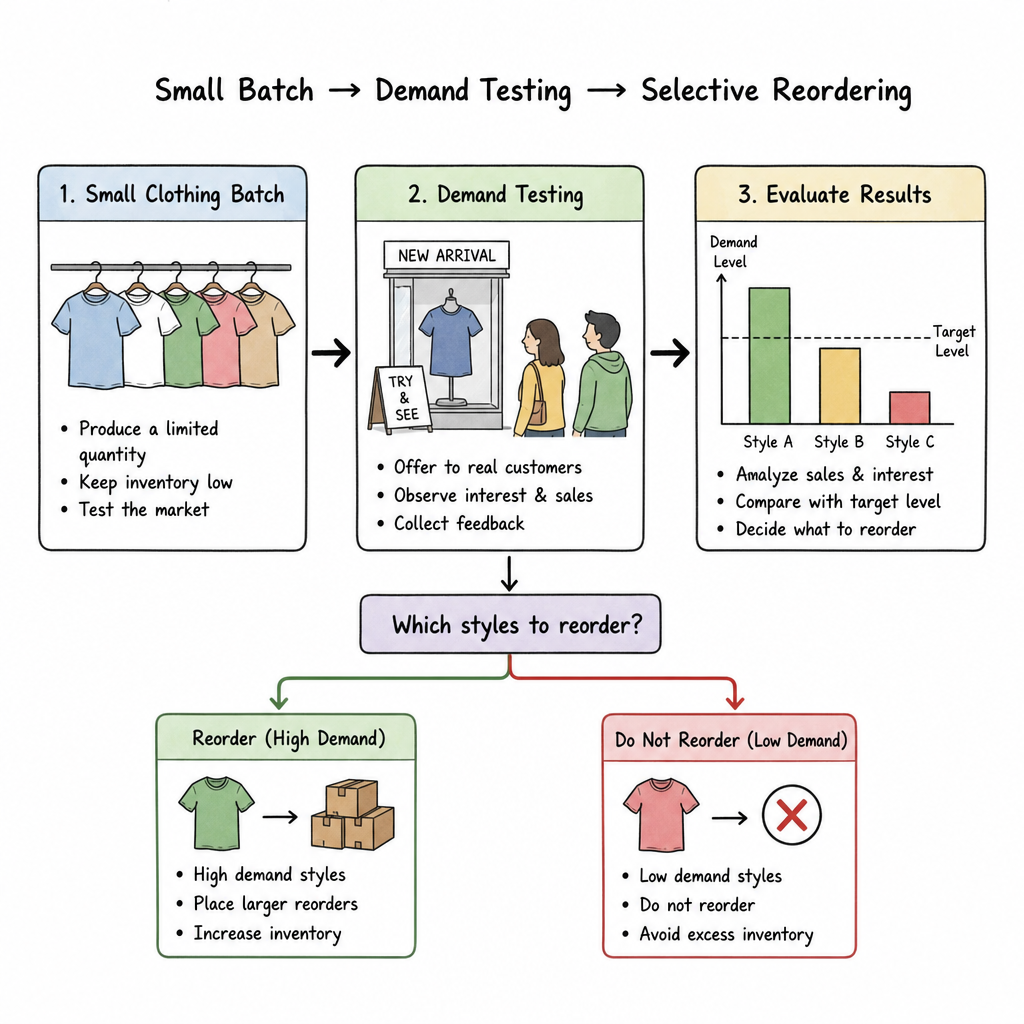
Think of the difference between ordering a large seasonal collection upfront and testing individual designs before committing more money. In the second approach, a retailer can discover which products deserve a larger investment while limiting its exposure to unsuccessful ones.
Shein’s model follows that test-and-reorder logic, although small initial batches should not be confused with small overall production.
The main factors fit together like this:
- Smaller initial orders: Less money is committed before demand becomes clearer.
- Demand-led replenishment: Successful styles receive additional production rather than every design receiving the same commitment.
- Online-focused selling: The model avoids some expenses associated with maintaining a large conventional store network.
- Supplier coordination: A connected production network supports rapid changes in orders and product availability.
Small production runs reduce inventory risk
Shein representatives have described initial orders of roughly 100 to 200 pieces per design, followed by additional production when customer demand supports it.
Those figures describe the company’s stated approach, not a guarantee that every product or marketplace seller follows an identical process.
The important mechanism is testing demand before committing to larger quantities.
Unsold inventory matters because a retailer has already paid to produce or acquire it. If the clothing does not sell, the business must still deal with that investment. Shein’s sustainability chief has attributed its low prices to reducing this kind of waste and inefficiency, an explanation that should be understood as the company’s position rather than independent proof of every claimed saving.
For shoppers, the practical implication is that low prices do not necessarily require every design to be manufactured in enormous quantities immediately. Instead, the company can offer many designs, then concentrate further production on the ones that gain traction. That distinction explains how a broad selection can coexist with relatively small opening orders.
Digital demand signals guide the next order
The production system depends on learning what customers want and responding quickly. Shein describes its approach as customer-led and on-demand: initial products help establish demand, and that information influences replenishment. T
echnology therefore supports a commercial decision—where to commit the next manufacturing order—rather than simply making the shopping app convenient.
Consider a hypothetical retailer testing two similar tops. If one attracts purchases while the other does not, ordering more of the successful design is less speculative than backing both equally. The example illustrates the logic; it is not a claim about a particular Shein product or its internal performance measures.
This also clarifies what “on-demand” means in this context. It does not mean that every garment is individually made after its eventual owner orders it. Shein’s stated model involves producing stock in small batches and using demand to decide what happens next.
Online selling changes the cost structure
Shein’s growth has been built around online shopping rather than the extensive permanent store networks associated with many established fashion chains.
Reporting on its business has identified avoiding store operating and staffing expenses as part of its price advantage. However, calling the company entirely free of physical retail activity would oversimplify a business that has also used pop-up stores.
The distinction is between reducing a particular category of overhead and eliminating overhead altogether. Shein still has substantial operations behind the screen.
Associated Press reporting has described digital and influencer advertising, as well as U.S. warehouses intended to improve delivery speed. Its online model changes where the money goes; it does not make selling and delivering clothing costless.
For a shopper comparing budget clothing, the useful lesson is to avoid treating store presence as a direct quality indicator. A lower-overhead sales channel can contribute to a lower price, but that alone tells you little about a particular garment’s fit or usefulness. Evaluate the item separately from the way it is sold.
A connected supplier network supports speed
Shein’s model also depends on the manufacturing ecosystem around it. Reuters reporting from southern China describes a supplier network closely tied to the company’s ability to produce numerous styles in small batches and move them quickly to customers. Experts interviewed for that reporting warned that relocating the system could disrupt turnaround times and increase costs.
The implication is that cheap production is not simply a matter of choosing any factory with a low quote. Coordination, supplier availability, and the ability to respond to changing orders also matter. That network helps explain why reproducing Shein’s approach elsewhere is more complicated than moving a sewing machine or signing a new manufacturing contract.
This is also why explanations based solely on “cutting out the middleman” fall short. Shein’s advantage involves an operating system connecting retail decisions with manufacturing, not merely removing one business from a supply chain. Its pricing cannot be traced to a single universal shortcut.
Materials and construction deserve a separate check
Shein’s own sustainability reporting identifies polyester as the majority of its materials portfolio. That is useful context, but fiber content alone is not a complete explanation of an individual garment’s price or quality. The company’s disclosed sourcing profile should not become a blanket assumption that every product uses the same fabric or construction.
When assessing affordable fashion, move beyond the product photograph. Check the listed composition, lining information, measurements, and care instructions where available. For a fitted dress, prioritize measurements and stretch; for a pale top, look for information that helps you assess coverage. These checks turn a vague question about quality into a decision about your actual needs.
Avoid assuming either that a low price guarantees disappointment or that an attractive listing guarantees durability. If an important detail is missing, treat that as uncertainty rather than filling the gap with optimism. A bargain should still meet the requirements that made you shop for the item in the first place.
What do Shein discounts actually save you?
Shein discounts save money only when they lower the final cost of products you already intended to buy. Its U.S. coupon policy includes different coupon types and restrictions, including expiration dates and eligibility distinctions for third-party products. A headline percentage therefore does not necessarily apply to every item in your basket.
Separate the retailer’s underlying prices from its promotions. Coupons can change your checkout total, but they do not explain the whole production and retail model. Likewise, Shein deals should be judged by what you pay, not simply by how large the advertised reduction looks.
Use this checkout checklist:
- Set your basket first. Choose what you need before looking for a promotion.
- Check eligibility. Read whether the coupon covers your selected products and sellers.
- Compare final totals. Include shipping and any other displayed charges rather than comparing discounts alone.
- Reject unnecessary additions. Spending more to unlock a saving is worthwhile only if the extra items have independent value to you.
- Read return terms. Shein’s U.S. policy contains non-returnable categories and notes that some third-party products have different return windows.
A simple rule helps: if you would remove an item without the promotion, pause before buying it because of the promotion.
Trade rules have affected the price advantage
Import treatment has historically contributed to Shein’s U.S. pricing. Associated Press reporting explained how the de minimis exemption allowed qualifying low-value shipments to enter without import duties, helping direct-shipping retailers offer steep bargains.
This was one part of the model, not a substitute for its manufacturing and retail efficiencies.
That historical explanation needs a date attached. U.S. Customs and Border Protection announced the suspension of duty-free de minimis treatment for covered shipments from all countries effective August 29, 2025. Separately, Shein had announced U.S. price adjustments in April 2025, citing changes in global trade rules and tariffs.
Consequently, older explanations claiming that small Shein packages simply arrive duty-free should not guide a purchase today. Check the applicable import information and the final checkout breakdown for your order rather than assuming a historical exemption still applies.
This article does not attempt to quote a universal tariff rate: the historical pricing advantage and the amount payable on a particular order are different questions.
Low checkout prices leave wider questions unresolved
Production efficiency does not settle concerns about working conditions. In its May 2024 follow-up investigation, advocacy organization Public Eye reported excessive working hours at investigated Shein suppliers.
Shein, meanwhile, says its supplier code prohibits forced labor, child labor, and abuses involving wages and working hours, and describes audits and supplier improvement measures. Those policies are relevant, but they are not proof that every workplace consistently complies.
Environmental impact also requires a broader view than inventory efficiency. Reducing unwanted stock can address one source of waste, but it does not establish that a large, fast-moving clothing business is environmentally sustainable.
NewClimate Institute’s assessment argues that Shein’s low-price, high-volume model is misaligned with the changes needed for a climate-compatible fashion sector.
For shoppers, distinguish three questions: Is the item affordable? Will it serve a useful purpose? Are you comfortable with the available information about its production? A low price answers only the first. You do not need to dismiss budget constraints to recognize that the other two deserve attention.
Is cheap apparel always good value?
Cheap apparel is good value when it meets your needs at a total cost you consider reasonable—not merely when it has the lowest purchase price. Fit, likely use, care requirements, and the possibility of a disappointing purchase should all enter your decision. A garment that stays unworn is not made useful by its discount.
Try a cost-per-wear comparison using hypothetical numbers: a $10 top worn twice costs $5 per wear, while a $30 top worn 30 times costs $1 per wear. These are illustrative figures, not Shein prices or lifespan claims. The point is to compare realistic use rather than assume either a cheaper or more expensive garment automatically wins.
Before ordering, ask yourself:
- Can I name several occasions when I would wear this?
- Does it work with clothing I already own?
- Have I checked the details that matter for its intended use?
- Would I still want it without a coupon or sale message?
The takeaway: understand the system, then judge the item
The answer to “Shein—why is it so cheap?” is a combination of demand-led production, limited initial inventory commitments, digital selling, and supplier coordination, with trade treatment also shaping its historical price advantage. No single explanation captures the whole business.
For your own wardrobe, focus on the final cost, the product details, and whether you will actually use what you buy. Affordable fashion is most useful when it solves a clothing need—not when a low price becomes the reason to invent one.
Frequently Asked Questions About Shein's Pricing Model and Affordable Fashion
Why is Shein able to offer such low prices for its clothing?
Shein's low prices come from its small-batch production model, demand-led replenishment, an online-focused retail approach, and a closely connected supplier network. These strategies help reduce the risk of unsold inventory and lower operational costs.
How does Shein determine which styles to produce in larger quantities?
Shein tests initial product designs with smaller orders and monitors customer demand. Successful styles receive additional production based on this demand-driven approach, allowing the brand to minimize financial risk.
Are Shein's low prices an indication of poor quality?
Not necessarily. While Shein offers budget clothing, the quality can vary between items. It's essential for customers to check product details, including material composition and care instructions, to evaluate the quality before purchasing.
What should I consider when using Shein's discount coupons?
When using coupons, ensure you check the eligibility for each item, understand the expiration dates, and compare the final total (including shipping) rather than just the advertised discount percentage.
How do trade rules affect Shein's pricing?
Import treatment, such as the de minimis exemption for low-value shipments, has historically influenced Shein's pricing by allowing the company to offer lower prices without import duties. However, changes to these regulations might impact future pricing strategies.