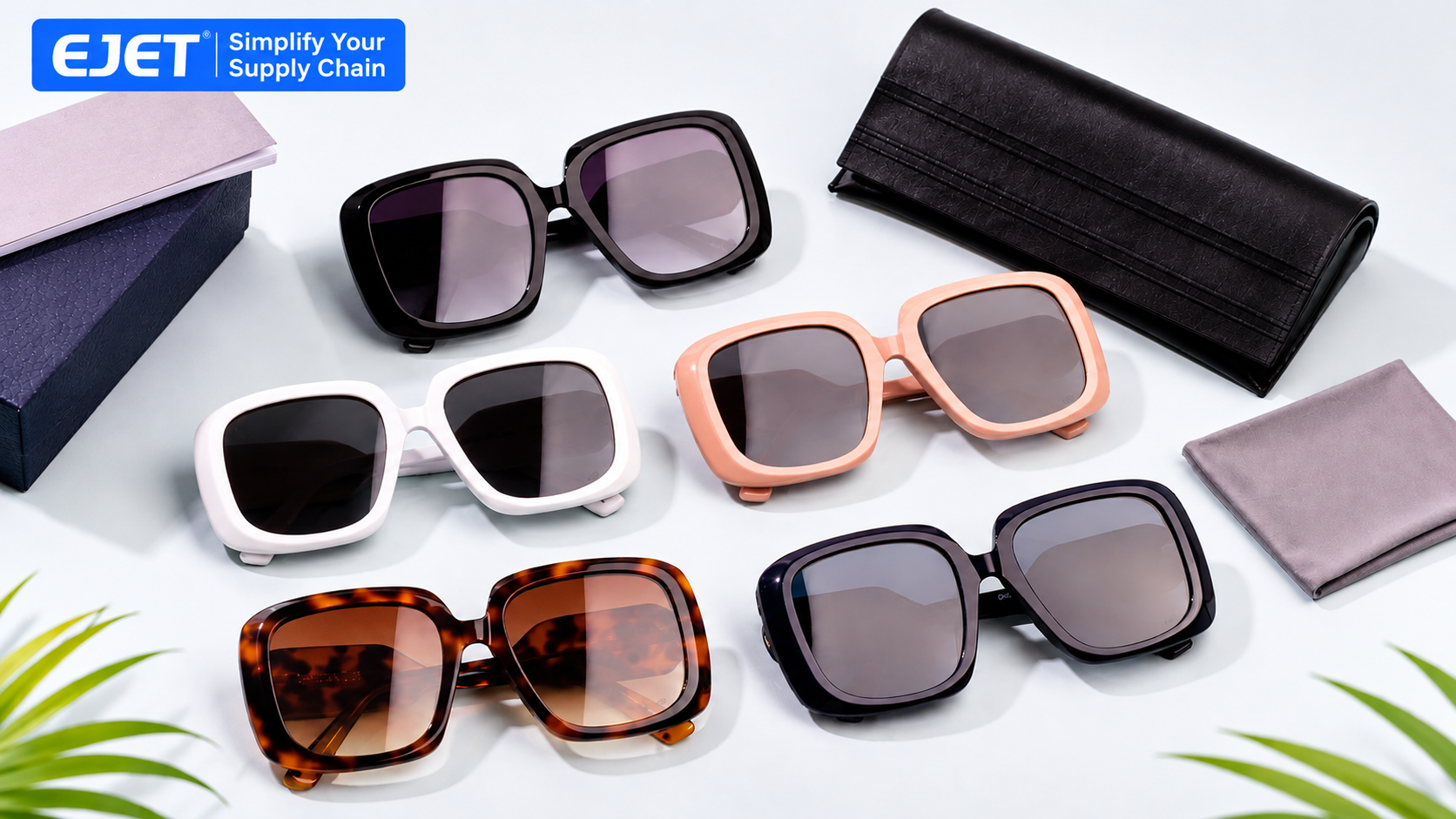
Sourcing wholesale sunglasses from China takes more than finding attractive frames at a low price. A practical buying process should connect supplier verification, product testing, clear order specifications, and a realistic delivered cost.
These tips help retailers and growing eyewear brands evaluate offers, avoid preventable mistakes, and build a repeatable purchasing process.
What should you check before buying wholesale sunglasses?
Before buying wholesale sunglasses, define your customer, required product features, acceptable quality, and total purchasing budget. Then compare suppliers against the same written specification rather than comparing catalog photographs alone.
Treat samples, supporting documentation, and written commercial terms as separate approval steps before committing to production.
Start with a buying brief that answers these questions:
- Who will wear them? Identify your intended customer and preferred fit, rather than ordering a broad assortment without a clear audience.
- Where will you sell? Specify your destination country and sales channels so compliance and packaging reviews have a clear starting point.
- What are you promising? List every proposed claim, including UV protection, polarization, frame material, and lens performance.
- What can you commit? Set a purchasing ceiling that leaves room for samples, testing, freight, and unexpected expenses.
- What constitutes acceptance? Define the defects, missing documents, or specification changes that would prevent approval.
For wholesale fashion sunglasses, separate dependable core designs from experimental styles. You might reserve most of a trial order for shapes that already fit your store’s assortment and use a smaller allocation to explore unfamiliar colors or silhouettes. Choose that balance from your own customer feedback and sales records, not a supplier’s bestseller label.
Compare suppliers with one consistent brief
Send the same request for quotation to every shortlisted supplier. Include model references, dimensions, materials, lens requirements, quantities by color, packaging, and delivery destination. Ask suppliers to identify any requirement they cannot meet instead of quietly substituting an alternative.
Whether you find candidates through a marketplace, exhibition, referral, or a search for wholesale eyewear in China, use those channels to build a shortlist—not to make the final approval decision.
Request the supplier’s registered business name, business license, operating address, and the identity of the entity receiving payment. Ask who manufactures the frames, who supplies the lenses, and where final assembly takes place. If the seller is a trading company, evaluate its coordination and accountability rather than rejecting it automatically.
Use a comparison sheet with columns for:
- Sample cost and whether it is credited against an order.
- Minimum order quantity by model, color, and customization option.
- Production timing and the event that starts the production clock.
- Included testing, inspection, packaging, and documentation.
- Payment milestones and remedies for nonconforming goods.
Keep unanswered questions visible. A blank field should trigger a follow-up, not an assumption that the missing service is included. Before sending money, independently confirm any change in payment instructions through a previously established contact method.
Turn samples into a written quality standard
Order samples of the exact models and lens options you intend to purchase. Ask whether they are existing stock, development samples, or representative production samples. Keep an approved reference pair and a signed specification sheet so later inspections have something concrete to compare against.
Inspect the physical details systematically. Check frame alignment on a level surface, open and close the temples, inspect hinge movement, and examine edges and nose-contact areas. Record scratches, loose components, uneven finishing, and discrepancies between the sample and the quoted dimensions.
For a basic optical screening check, view a straight edge or rectangular pattern through the lenses while moving them slowly. Wavy or distorted lines warrant further investigation; this visual check does not replace laboratory testing or establish regulatory compliance. FDA guidance describes a similar check for identifying possible optical defects.
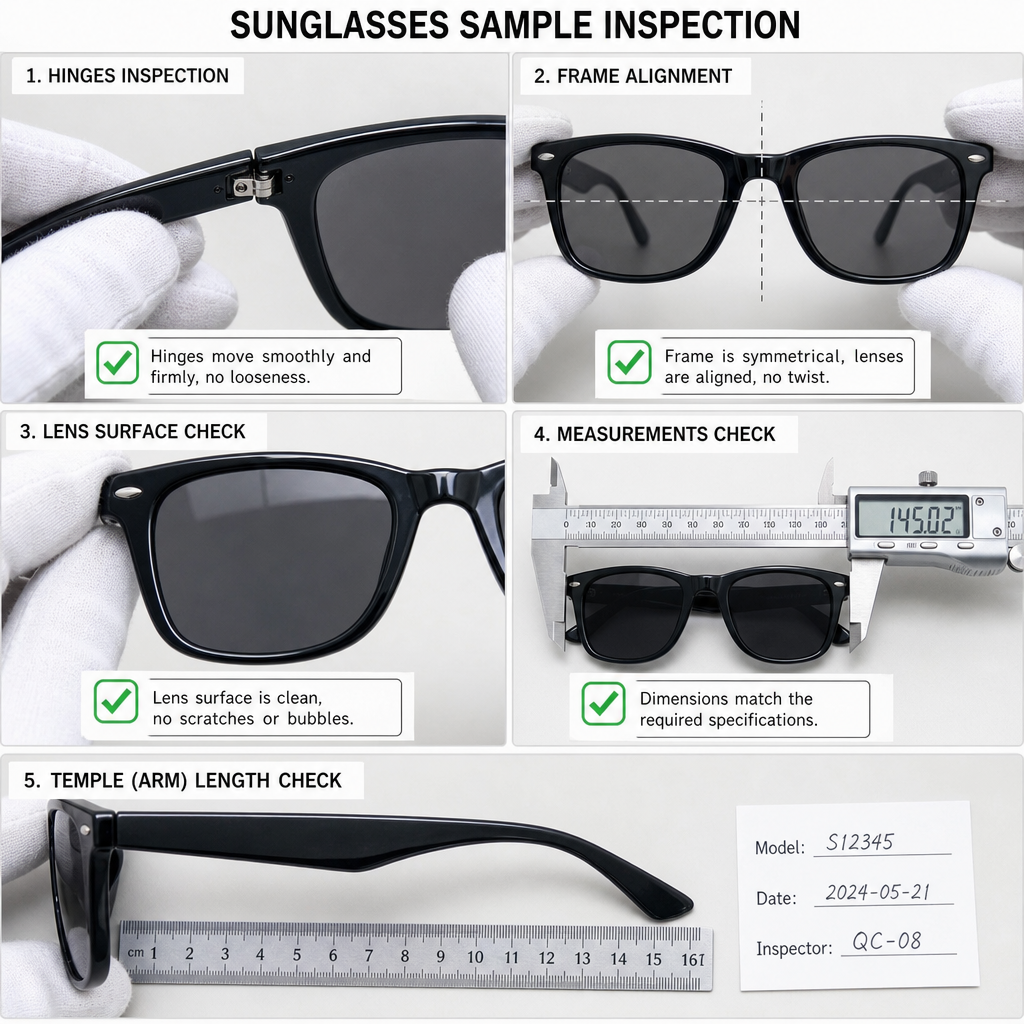
Build a sample record containing photographs, measurements, model identifiers, approved colors, packaging details, and unresolved issues. Send the record back to the supplier for confirmation. If you approve a change, update the record rather than leaving the agreement scattered across messages.
Also assess the complete retail presentation. Confirm that cases, cleaning cloths, tags, and cartons match your order, and check how the product sits inside its packaging. Include packaging approval in the sample process rather than treating it as an afterthought.
Verify lens claims and destination requirements
Do not use lens darkness as evidence of UV protection. The FDA explains that dark tint does not indicate a lens’s ability to block ultraviolet radiation. Request evidence supporting the specific protection claim you intend to print on packaging or product pages.
For polarized models, assess polarization and UV protection separately. Polarization reduces reflected glare, but it does not itself establish UV protection. Ask for documentation covering both properties when both appear in your product description.
Review test reports for the manufacturer, sample description, model references, test methods, dates, and results. Ask the laboratory to clarify any uncertainty about what was tested and whether the report supports your proposed claims. Do not accept a report for an unidentified lens or unrelated product as your approval basis.
For U.S. sales, nonprescription sunglasses are regulated by the FDA as medical devices. Conventional products are generally exempt from premarket notification, but that exemption does not remove other applicable obligations.
FDA guidance identifies establishment registration, device listing, and impact-resistant lens requirements among the considerations importers must address.
Before shipment, have a qualified regulatory adviser review the requirements for your product and business role. FDA’s import guidance states that an impact-resistance certificate must accompany each entry of eyeglasses and sunglasses. Build the relevant documentation into your shipment checklist rather than requesting it after the goods arrive.
Can you safely source branded sunglasses from China?
You should only proceed with branded sunglasses when you can verify authenticity, the supply chain, and the legal basis for importing and reselling the goods in your market. A seller’s locati0n, product photographs, or assurance of “original quality” should not be your approval standard. For a significant branded purchase, obtain specialist advice on the documentation and rights involved.
Searches such as “wholesale Gucci sunglasses from China” or “wholesale name brand sunglasses from China” need a different review process from an unbranded sourcing project.
Gucci guarantees authenticity for purchases through Gucci.com and Gucci stores, and its official guidance warns buyers about counterfeit products outside official retail channels. That guidance does not authenticate an independent wholesaler’s inventory.
Ask the proposed supplier for traceable commercial invoices and documentation explaining its source of goods. Independently check any claimed authorization with the brand or relevant authorized distributor. Do not treat branded packaging or a supplier-created certificate as a substitute for that verification.
Keep private-label sourcing separate from branded resale. Specify your own branding and original product presentation, and arrange an intellectual-property review where needed. If the supplier cannot establish a credible source for branded goods, decline the order rather than trying to solve the uncertainty with a larger discount.
How do you calculate the real cost per sellable pair?
Calculate cost per sellable pair by dividing the full acquisition cost by the number of units available for sale. Include the product price, packaging, samples, testing, inspection, shipping, applicable import charges, brokerage, and delivery to your storage locati0n. Use a conservative planning quantity until inspection confirms how many units meet your acceptance standard.
A useful working formula is:
Cost per sellable pair = total acquisition cost ÷ accepted units available for sale
When comparing sunglasses from China wholesale offers, request an itemized quote. Ask who pays each charge, which delivery locati0n the quote covers, and which services are excluded. Record the agreed shipping term and named place, then ask your freight provider or broker to explain any remaining responsibility.
U.S. import costs can include duties and additional fees, with charges depending on the goods, entry type, and transportation method. Have a customs broker confirm the applicable classification and current charges for your shipment instead of relying on an old tariff estimate or a supplier’s general assurance.
Keep acquisition cost separate from the rest of your selling economics. Marketplace fees, advertising, fulfillment, returns, and markdowns belong in your margin planning even when they are not part of landed inventory cost. Test whether the proposed retail price still works under a less favorable sales scenario.
For example, compare an order that includes individual cases with one that includes only protective sleeves. Price the missing cases and packing work before deciding which quote offers better value. Apply the same approach to testing, labeling, and inspection exclusions.
Negotiate quantities, payment, and inspection together
Ask whether minimum order quantities apply to the whole purchase, each model, each color, or each customized component. Request separate quotations for stock products and private-label versions. If the commitment is too large, reduce the number of variants before sacrificing an important specification.
Make payment milestones part of the written agreement. Identify what must happen before each payment becomes due, including sample approval, completion of production, document delivery, and inspection. Review the actual conditions of any payment-protection service rather than assuming it covers every type of dispute.
Before production starts, agree on an inspection plan covering:
- Product identity: Models, colors, quantities, dimensions, and approved components.
- Workmanship: Frame alignment, hinge operation, lens surfaces, assembly, and finishing.
- Presentation: Branding, packaging, labels, accessories, and carton markings.
- Documentation: Required reports, shipment certificates, invoices, and packing information.
- Failure handling: Rework, replacement, reinspection, timing, and responsibility for additional costs.
Set a written deadline for reporting problems and define what evidence supports a claim. Confirm whether replacements travel separately or with a later order, and who pays the associated freight. Avoid leaving the remedy at “we will take care of it.”
Plan shipping and replenishment before placing the order
Build your schedule backward from the date inventory must be ready to sell. Include sample approval, revisions, production, inspection, shipping, customs processing, and warehouse receiving. Ask which milestones the supplier controls and which depend on third parties.
For U.S. imports, using a customs broker does not transfer the importer of record’s responsibility for entry accuracy and applicable duties, taxes, and fees. Confirm who will act as importer of record and review the paperwork before dispatch.
For each China sunglasses wholesale order, keep one purchasing file containing the approved specification, purchase order, payment records, test documents, inspection results, and shipping paperwork. Assign someone to resolve discrepancies before the shipment leaves. Preserve model and batch references so receiving checks can connect the delivered goods to the order.
Start with an order you can evaluate thoroughly. After delivery, record accepted quantities, defects, customer returns, sales by style, and actual acquisition costs. Use those results to decide what to reorder, what to change, and whether the supplier deserves a larger commitment.
Make the next order more predictable
The goal is a repeatable buying process, not simply a cheaper first shipment. Define the product, verify the seller, approve representative samples, check the evidence, and document the commercial terms before committing. Then use the results of each order to improve the next one—keeping product quality, authenticity, and workable margins at the center of every purchasing decision.
Frequently Asked Questions About Wholesale Sunglasses
What should I look for when choosing a supplier for wholesale sunglasses?
When selecting a supplier, consider factors such as their business credentials, product quality, compliance with regulations, minimum order quantities, and customer reviews. It's also essential to ask for samples and verify the authenticity of any branded items.
How can I ensure the quality of wholesale sunglasses?
To guarantee quality, always request samples of the sunglasses you intend to buy. Inspect the samples for defects and discrepancies, and develop a written quality standard that the products must meet before approval.
What documentation do I need when importing sunglasses from China?
Essential documents may include the commercial invoice, packing list, bill of lading, and any necessary certifications or reports for compliance with regulations such as UV protection and impact resistance.
Can I source branded sunglasses at wholesale prices?
Yes, but sourcing branded sunglasses requires careful verification of authenticity and compliance with legal requirements for resale. Always obtain clear documentation from suppliers and consult with the brand for authorization.
What factors affect the cost of wholesale sunglasses?
The cost can vary due to factors like product price, shipping fees, import duties, and any additional expenses related to testing, packaging, and inspection. It's crucial to calculate the total acquisition cost to understand your real expenses per sellable unit.