


Customs clearance is the process of declaring goods to border authorities, meeting applicable requirements, and obtaining permission for a shipment to enter or leave a country. It involves shipment information, supporting documents, and any required duties, taxes, or inspections.
This guide explains the process, the costs to check, and how to respond when a commercial shipment or online order encounters a clearance delay.
What is customs clearance?
Customs clearance is the administrative and regulatory process that allows goods to cross an international border legally. Authorities review information about the products, their value, origin, and intended use to determine whether the shipment meets entry or exit requirements. Clearance can involve document checks, payment arrangements, and examination of the goods before release.
The process is not simply a payment checkpoint. Goods may also need permits or approval from agencies responsible for food, agriculture, consumer safety, or other regulated categories. Paying customs duties does not replace those requirements.
For shoppers, clearance usually appears as a tracking update. For businesses, it is a compliance task that should begin before dispatch, when product details, documents, and responsibilities can still be checked. Missing information becomes harder to resolve once goods are already moving.
Import clearance and export customs serve different purposes
Import customs clearance is the destination country's process for admitting goods. It establishes whether the products may enter, what declaration is required, and which duties, taxes, or other conditions apply. If you are asking what is import customs clearance, think of it as the destination-side permission needed before imported goods can proceed through the relevant release process.
Export customs procedures apply on the departure side. Exporters must establish which declarations, supporting documents, and authorizations their shipment requires. In the United States, most products do not need an export license, but export control rules still apply; the product, buyer, destination, and intended use can affect requirements.
These are separate checkpoints. Completing departure-side formalities does not establish that the destination country's requirements have been met. When reviewing shipment paperwork, distinguish documents needed to export the goods from those required to import them.
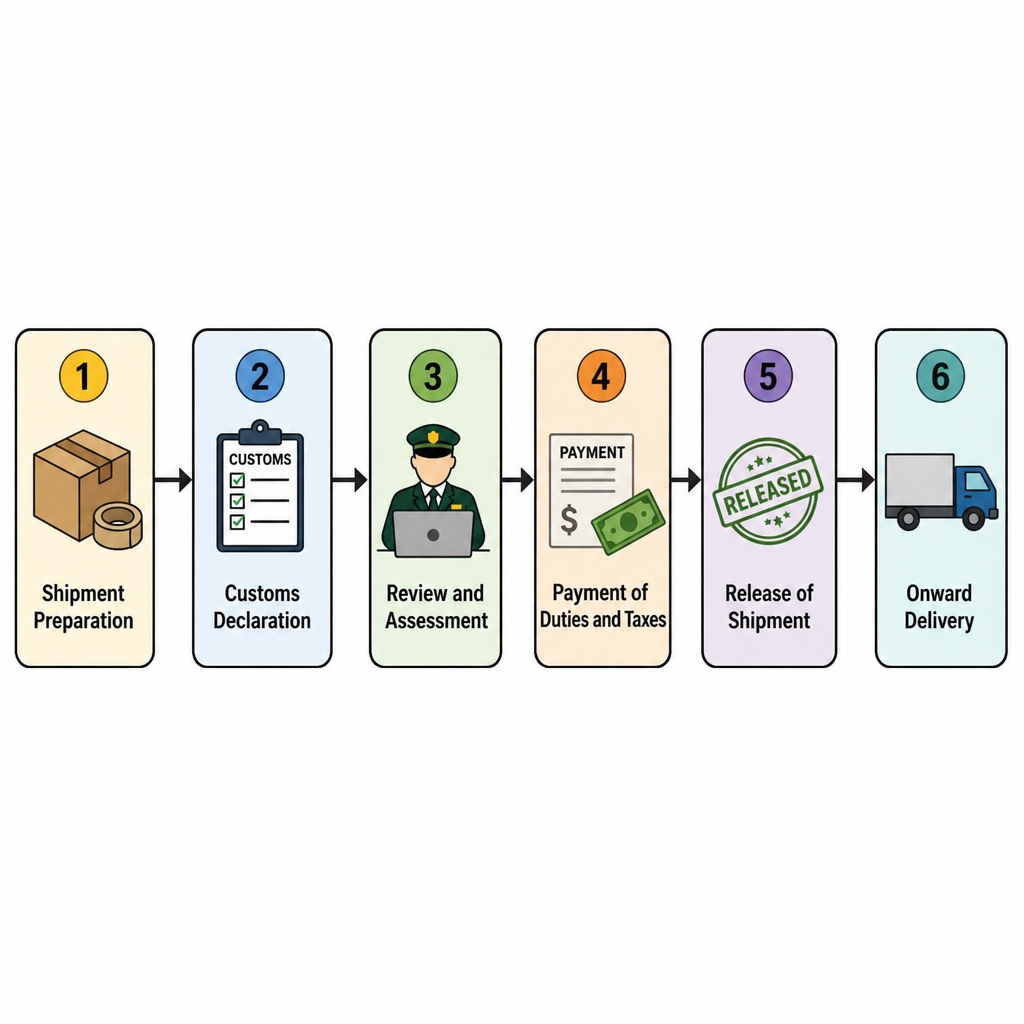
The customs clearance process, step by step
The exact sequence depends on the country, shipment, and transport service. However, the following framework is useful for understanding where information is checked and why a shipment might pause. Some document preparation or review can happen before physical arrival.
- Prepare shipment details. Establish the seller, buyer, recipient, product descriptions, quantities, values, and origin information. Identify any permits or product-specific requirements before shipping.
- Submit the required declaration. The importer, exporter, broker, or another authorized party supplies the relevant shipment information through the applicable process. Supporting commercial and transport documents help substantiate the declaration.
- Review classification and value. Customs uses the tariff classification and customs valuation information to establish the treatment of the goods. Authorities may request clarification when the information is insufficient.
- Resolve checks and charges. Supply additional documents, meet examination requirements, and arrange payment of applicable duties, taxes, or fees as required for the entry.
- Obtain release and continue transport. Once release requirements are satisfied, the goods can move onward through the transport network. A customs release event is distinct from the final delivery event shown by the carrier.
Documents that support a clear declaration
Document requirements vary by destination and commodity, so there is no universal packet that fits every shipment. Start with the destination's requirements, then ask the importer or broker to confirm what applies. A document that was sufficient for one product or market may not be sufficient for another.
|
Document |
Purpose |
Practical check |
|---|---|---|
|
Commercial invoice |
Describes the transaction and goods |
Check descriptions, quantities, values, and seller details |
|
Packing list |
Explains how goods are packed |
Reconcile package contents and weights with shipment records |
|
Bill of lading or air waybill |
Records the transport arrangement |
Check shipment references and consignee details |
|
Origin documentation, when required |
Supports the declared origin or a preference claim |
Confirm the applicable origin requirements |
|
Licenses or certificates, when required |
Demonstrates authorization for controlled or regulated goods |
Verify validity and product coverage before dispatch |
These are common document categories, not a guarantee that every shipment needs all of them. The U.S. International Trade Administration distinguishes commercial, transport, origin, and special-purpose documents because each serves a different function.
Product descriptions need usable detail
Descriptions should identify what the goods actually are. Broad wording such as “accessories” gives a reviewer less usable information than a description identifying the item and its relevant material or function. For example, “cotton knitted T-shirts” is more informative than “clothing,” although additional details may still be necessary.
Treat consistency as a final quality check. If the invoice and packing list disagree, resolve the discrepancy rather than expecting the clearance team to infer the correct information. Export documentation errors or omissions can delay goods and create more serious consequences.
Customs duties, taxes, and the full shipment cost
Customs duties are government charges associated with importing goods. The amount depends on applicable tariff treatment, including classification, value, and origin. They are different from the price a broker or carrier charges for handling clearance services.
When budgeting, separate these categories:
- Product and transport costs: The purchase price, freight, and insurance.
- Government charges: Applicable duties, taxes, and processing fees.
- Service charges: Brokerage, clearance processing, or advancing duties on your behalf.
- Delay-related costs: Storage charges that may arise while missing information is resolved.
Together, these contribute to the shipment's landed cost. Ask for an itemized estimate rather than treating the shipping quote as the complete import bill. Also establish whether the seller or buyer is expected to pay the import charges under the agreed sale terms.
Classification, value, and origin deserve separate checks
Tariff classification identifies the category used to assess the goods. Customs valuation establishes the value used under the applicable rules. Origin can affect tariff treatment, so it should be supported rather than assumed from the shipment's dispatch locati0n.
Avoid relying on an old online duty calculator or another buyer's experience as a definitive answer. Check current destination-country requirements before committing to a landed-cost estimate, particularly when a tariff preference or exemption is important to the purchase decision. The destination customs authority determines the applicable assessment.
Responsibilities in freight clearance
Freight clearance means handling customs requirements for cargo shipments, including goods moving by air, sea, or land.
A freight forwarder may coordinate transport and documentation, while a customs broker can handle customs work within the authority and licensing rules that apply. Confirm which service provider is responsible for each task rather than assuming a transport booking includes every clearance service.
For U.S. imports, using a broker does not remove the importer of record's responsibility for accurate entry information and applicable duties, taxes, and fees. Businesses should review what is filed on their behalf and supply reliable product information. Delegating submission is not the same as delegating accountability.
Before booking freight, use this responsibility checklist:
- Name the party handling export documents and destination import clearance.
- Confirm who supplies product specifications, origin evidence, and permits.
- Establish who pays government charges and brokerage costs.
- Identify the contact who can answer a clearance query promptly.
- Record the agreed delivery terms and responsibilities in the sale documents.
Incoterms can help allocate costs and formalities between buyer and seller. However, they do not replace customs regulations or determine every regulatory responsibility. Read the selected rule alongside the contract and destination requirements.
How long does customs clearance take?
There is no single clearance time that applies to every shipment. Processing depends on whether the information is complete, whether additional review is needed, and whether customs or another agency requires further action. A delivery estimate should therefore not be treated as a guaranteed customs-release deadline.
A delay also does not automatically establish that goods have been seized. Missing documents, insufficient information, or inspection can prevent release. If U.S. Customs and Border Protection formally detains or seizes an item, an official notice typically explains the issue and response instructions.
When a shipment pauses, take these steps:
- Check the carrier's tracking record and read any action request carefully.
- Ask the seller or carrier for the exact outstanding requirement.
- Supply requested invoices or product information through the verified contact channel.
- Confirm receipt and ask whether anything else remains outstanding.
- Follow official notice instructions if a detention or seizure notice arrives.
What is customs clearance on SHEIN orders?
On a SHEIN order, customs clearance refers to border-related processing for the shipment. SHEIN explains that “Prepared for customs clearance” means declaration information is being submitted or awaiting customs processing. The message can appear before the package reaches the destination country because document review may begin in advance.
If you searched “what is customs clearance shein,” the practical takeaway is that this status alone is not a request to submit paperwork or make a payment. Read the full update and check for a specific action request rather than assuming something has gone wrong. SHEIN directs shoppers to the tracking view under “My orders” for the latest package status.
For an unexplained delay, keep the order number and tracking details ready when contacting SHEIN or the named carrier. Ask whether documents, recipient details, or another action are required. This is more useful than requesting a delivery promise while a clearance issue remains unresolved.
A practical approach to customs compliance
The strongest preparation happens before shipment: identify the goods accurately, verify destination requirements, assemble consistent documents, and agree who handles clearance and payment. For regulated products, check the relevant agency requirements as well as customs rules. These checks give the parties handling the shipment usable information from the outset.
For an individual purchase, focus on tracking instructions and any verified request for information. For recurring business shipments, maintain a repeatable document review and responsibility checklist. In both cases, the goal is the same: understand the requirement, identify who must act, and resolve the specific issue preventing release.
Frequently Asked Questions About Customs Clearance
What is the process for customs clearance?
The customs clearance process involves preparing shipment details, submitting the required declaration, reviewing classification and value, resolving checks and charges, and obtaining release for transport. Each step requires specific documentation and compliance with regulatory guidelines.
What documents are needed for customs clearance?
Common documents include a commercial invoice, packing list, bill of lading or air waybill, and any necessary licenses or certificates. The specific requirements can vary based on the destination and the nature of the goods.
How long does customs clearance take?
The duration of customs clearance can vary significantly based on several factors, including the completeness of the documentation, the complexity of the shipment, and whether additional inspections or approvals are needed.
What are customs duties and taxes?
Customs duties are government charges imposed on imported goods, which are calculated based on the classification, value, and origin of the products. Taxes may also apply, and these charges contribute to the total landed cost of the shipment.
How does customs clearance work for SHEIN orders?
For SHEIN orders, customs clearance refers to the processing of the shipment at the border. The status "Prepared for customs clearance" indicates that the necessary declarations are being submitted or are awaiting processing. Customers should monitor their order status for any action requests.