


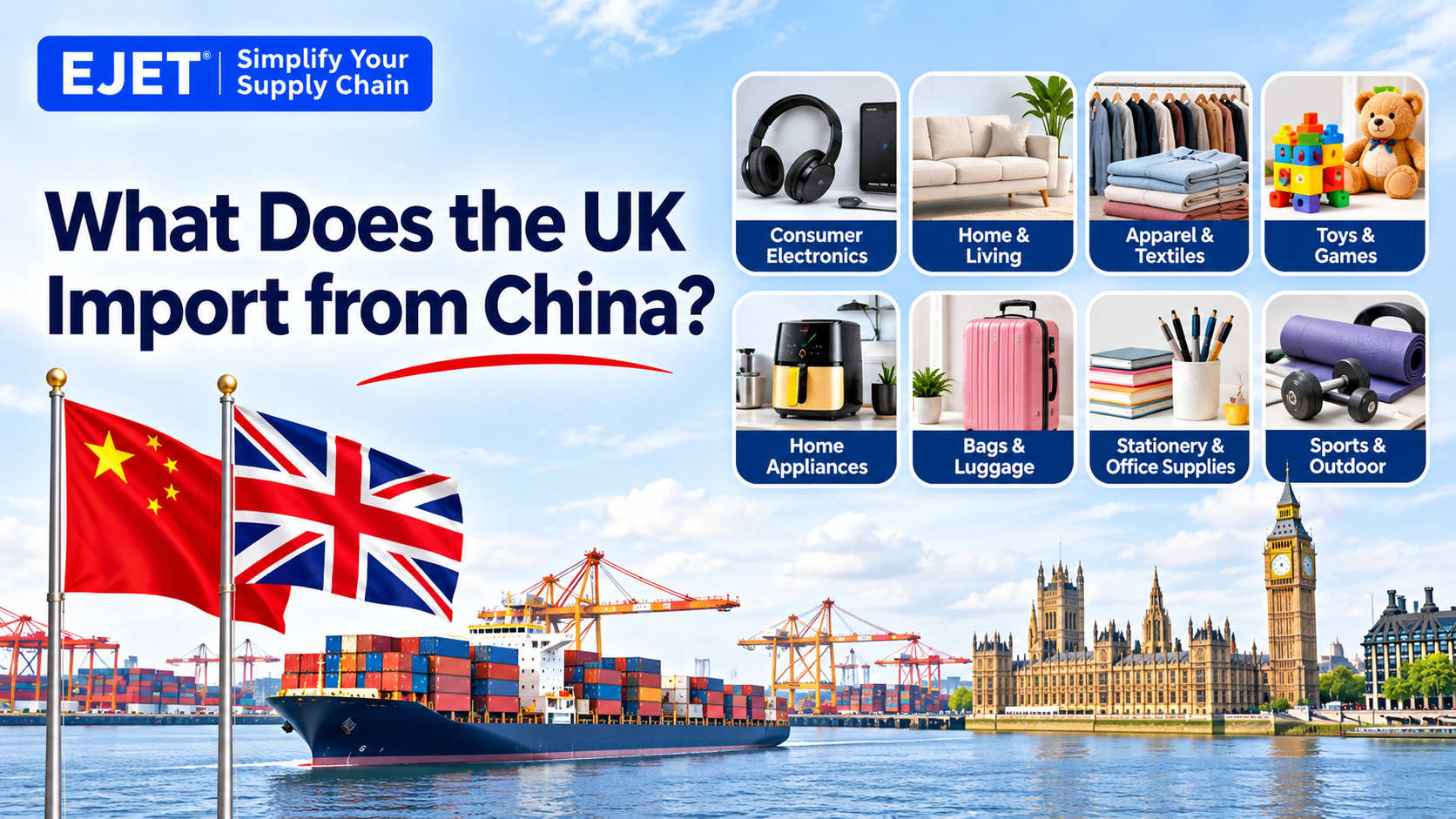
The UK imports electronics, machinery, vehicles, furniture, toys, clothing and other manufactured goods from China. These purchases supply households, retailers and businesses, rather than serving only the market for low-cost consumer products.
Understanding UK imports from China means looking at both the goods crossing the border and the costs, responsibilities and supply-chain decisions behind them.
What does the UK import from China?
The UK imports a broad mix of finished products, equipment and components from China, with electrical equipment, machinery and vehicles among the largest categories.
Furniture, toys, plastics, clothing and scientific or medical instruments also feature in the trade. The important distinction for buyers is between products intended for immediate resale and goods used to run businesses or manufacture something else.
Electronics, machinery and vehicles
HMRC’s comparison of 2025 imports by country of origin identifies electronic equipment and mechanical appliances as the two largest import chapters from China.
Motor vehicles are another substantial category. These broad classifications help show the scale of trade, although an individual importer needs a much more specific product description.
For familiar examples, the Office for National Statistics’ detailed analysis of 2021 trade identified laptops, computers, mobile phones and smartphones within major import categories. That historical breakdown explains what these labels can contain; it should not be mistaken for a current product ranking.
For a prospective buyer, the next step is to narrow the category. “Electronics” is too broad for a sourcing brief. Specify the intended use, materials, performance requirements, accessories and destination market before requesting quotations.
Furniture, toys, clothing and everyday goods
Furniture and bedding, toys and games, knitted apparel and plastic products appear among the sectors listed in parliamentary evidence on 2025 imports. Earlier ONS analysis also identified clothing, games consoles, exercise equipment and toys within consumer manufactures. China-to-UK trade therefore extends well beyond phones and computers.
Treat these categories as starting points for research, not automatic business opportunities. If you are considering storage products, for example, compare dimensions, packaging, durability and likely delivery costs. For clothing, build your specification around sizing, fabric composition, construction and acceptable variation rather than a photograph alone.
Reading UK import statistics without mixing different measures
UK import statistics need a date, a definition and a source. HMRC’s publication dated 28 October 2026 compares 2025 goods imports using both country of origin and country of dispatch. Its selected figures show why the measurement basis matters. (gov.uk)
|
2025 goods category |
China as country of origin |
China as country of dispatch |
|---|---|---|
|
Electronic equipment |
£20.2 billion |
£14.3 billion |
|
Mechanical appliances |
£14.3 billion |
£10.8 billion |
|
Motor vehicles |
£7.1 billion |
£5.7 billion |
Source: HMRC’s origin-and-dispatch comparison. The publication has specific coverage exclusions, so these figures should not be treated as interchangeable with every headline trade series.
Country of origin concerns where goods were produced or substantially transformed. Country of dispatch concerns where the last commercial transaction occurred, which may differ from the manufacturing location. When comparing reports, check whether they measure goods alone or goods and services, and whether their periods and definitions match.
For market research, choose one consistent series before drawing conclusions. Record its reporting period alongside every figure in your sourcing plan. Avoid comparing one calendar year with another report’s rolling twelve-month total without explaining the difference.
What are the best imports from China to the UK?
The best imports from China to the UK are products that fit your customers, budget and ability to manage quality and compliance—not necessarily the biggest national import categories. Start with a clear customer need, then test whether the product still makes commercial sense after delivery, selling expenses and support are included.
Use this shortlist when assessing an idea:
- Demand: Identify the customer, the problem being solved and the alternatives already available. Look for a reason to buy beyond a low price.
- Transport practicality: Request packed dimensions and weight before comparing quotations. Ask the freight provider to price the actual shipment configuration.
- Quality definition: Write measurable acceptance criteria, such as dimensions, materials, finish and packaging requirements.
- Compliance readiness: Identify applicable safety and labelling requirements before committing to production. Importers have responsibilities for demonstrating compliance.
- Commercial resilience: Model discounts, returns, damaged stock and slower sales. Decide how much cash you can leave tied up in inventory.
Compare a few tightly defined candidates rather than building an enormous catalogue. You might assess a textile organiser, a desk accessory and a specialist component using the same cost worksheet. The aim is not to prove that one category is universally profitable, but to identify which proposal survives realistic scrutiny.
Avoid choosing a product simply because a supplier calls it a bestseller. Ask for samples and compare them against your own brief. Keep the initial commitment proportionate to what you have actually verified.
Finding suppliers and comparing wholesale offers
When researching China wholesale UK options, distinguish between buying directly from an overseas supplier and buying stock already held by a UK wholesaler. Ask each seller where the goods are located, which business will invoice you and who will handle the import. Compare the full arrangement rather than assuming similar listings represent identical services.
Prepare one sourcing brief and send it to every shortlisted supplier. Include your required materials, dimensions, packaging, quantities and quality checks. Ask suppliers to identify exclusions or substitutions explicitly, rather than leaving you to discover them later.
Before paying a substantial deposit, consider these checks:
- Confirm the contracting business. Request its registered details and check that payment instructions match the agreed arrangement.
- Approve a representative sample. Record what you approved and whether production will use the same materials and construction.
- Request relevant evidence. Seek documentation tied to the actual model, not an unrelated product with a similar appearance.
- Agree inspection and remedies. Put acceptance criteria, defect handling and replacement arrangements in writing.
- Clarify delivery responsibilities. Ask who arranges each transport stage, customs clearance and final delivery.
Keep a written record of changes after sample approval. If a material, component or packaging design changes, review the effect before authorising production. Build that review into the purchasing process instead of treating the sample as the final conversation.
Importing from China to the UK: the essential checks
Importing from China to the UK involves business registration, product classification, valuation, customs arrangements and any relevant licences or certificates. GOV.UK’s step-by-step process provides the starting framework. Check the destination carefully because Great Britain and Northern Ireland can involve different requirements.
Registration, classification and declarations
For imports into England, Scotland or Wales, the government’s guidance requires an EORI number beginning with GB; movements involving Northern Ireland may require an XI number. You also need a commodity code for the import declaration and a value for the goods. Businesses can appoint someone to handle customs and transport rather than doing everything themselves.
The UK Trade Tariff lets you check commodity codes, duty and VAT information. Classification depends on details such as a product’s use, materials and manufacture, so do not rely on a vague catalogue label. Ask for classification help if you cannot confidently identify the correct code.
Product safety before shipment
Importers placing consumer products on the UK market must address applicable safety requirements, technical documentation, labelling and safe-use instructions. Product-specific rules can apply, and provisions differ between Great Britain and Northern Ireland. A supplier’s assurance is not a substitute for checking the requirements relevant to your product.
Build a compliance file before shipment. Organise product specifications, relevant test evidence, instructions, labels and supplier records in one place. If you cannot establish what evidence is needed, seek product-specific advice before placing a bulk order.
Calculate the delivered cost before judging the margin
When you import from China, assess the complete purchase rather than the factory quotation alone. Build a worksheet that separates buying costs, logistics, tax cash flow and selling expenses. This makes it easier to compare suppliers offering different delivery arrangements.
Include the following lines in your planning model:
- Product cost, samples and any agreed tooling or customisation.
- Inspection, testing and packaging work.
- Freight, insurance, handling and customs-agent quotations.
- Applicable duty and import VAT.
- Storage, fulfilment, customer delivery and returns allowances.
For import VAT, HMRC starts with the customs value and requires additions including relevant incidental expenses and customs duty. Transport and insurance to the first UK destination can be included, as can costs to a further destination known at importation. Do not calculate VAT automatically on the supplier invoice alone.
Keep a separate cash-flow forecast alongside the margin calculation. Ask your accountant how VAT should be handled for your circumstances. Then test a less favourable scenario before approving the order: higher freight, a delayed launch or fewer saleable units.
Building a more resilient UK supply chain
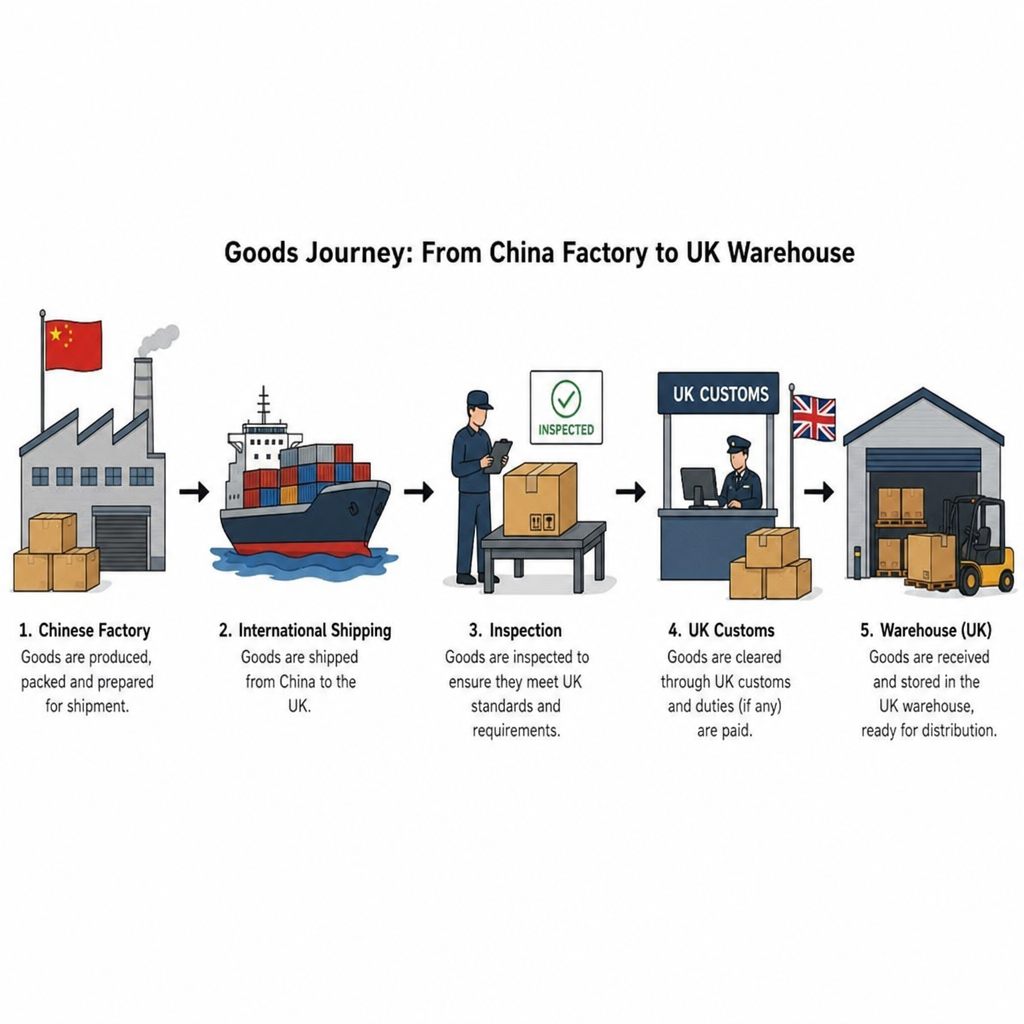
For your UK supply chain, plan around the whole journey from approved specification to saleable stock. Ask for separate production, inspection, dispatch and delivery milestones. Avoid setting a customer launch date around an unconfirmed arrival estimate.
Consider these safeguards:
- Maintain a backup option. Assess whether another supplier can meet the same specification before you urgently need one.
- Set reorder triggers. Base purchasing decisions on stock, expected demand and replenishment assumptions rather than instinct alone.
- Track batches. Keep purchase orders, inspection results and delivery records connected to the stock received.
- Review changes. Require approval before substitutions to materials, components or packaging.
Traceability also supports product-safety responsibilities: government guidance requires businesses selling consumer products to keep records identifying their suppliers. Make those records usable, not merely stored somewhere in an email archive.
For “Made in China” UK sourcing decisions, evaluate the specific product and supplier. Judge an offer against documented requirements, an approved sample and an agreed inspection process, rather than treating the country label as the quality assessment.
UK–China trade also flows in the opposite direction
UK–China trade is not solely about British imports. The government’s market guide lists cars, medicinal and pharmaceutical products, crude oil and intermediate mechanical power generators among the leading UK goods exported to China in the four quarters ending March 2026. These are examples of what China imports from the UK.
The keyword “China crude imports” describes oil entering China, not goods entering Britain. In this bilateral context, crude oil appears on the UK export side. Keeping the direction clear helps avoid confusing two different trade questions.
For a sourcing decision, separate broader UK trade relations from the checks on your actual order. Review relevant requirements when committing to a purchase rather than assuming general trade commentary answers product-specific questions.
The practical takeaway
Use national trade data to understand the market, then narrow your attention to one clearly specified product. Before ordering, verify the supplier, establish the compliance requirements and calculate the delivered cost. A disciplined first purchase is a better foundation than a large order built around an attractive headline price.
Frequently Asked Questions About UK Imports from China
What products does the UK import the most from China?
The UK imports a wide range of products from China, including electronics, machinery, vehicles, furniture, toys, clothing, and medical instruments. The specific product categories can vary year by year.
How can I ensure the quality of products I import from China?
To ensure quality, create measurable acceptance criteria for your products, request samples, and perform inspections before placing bulk orders. Always check for compliance with UK safety standards and regulations.
What are the customs requirements for importing goods from China to the UK?
Importing goods requires registration for an EORI number, classification with a commodity code, and compliance with product safety and labeling requirements. Import VAT and customs duties should also be calculated based on the total cost of the goods.
Is it necessary to have a UK supplier to import from China?
While it’s not required to have a UK supplier, buying from a local wholesaler can simplify logistics, customs, and deliveries. If importing directly from China, ensure that you understand all customs and regulatory requirements.
What should I consider before importing products from China to the UK?
Before importing, consider factors such as market demand, transport practicality, production and inspection milestones, supplier reliability, and total delivered costs, including logistics and compliance with legal requirements.