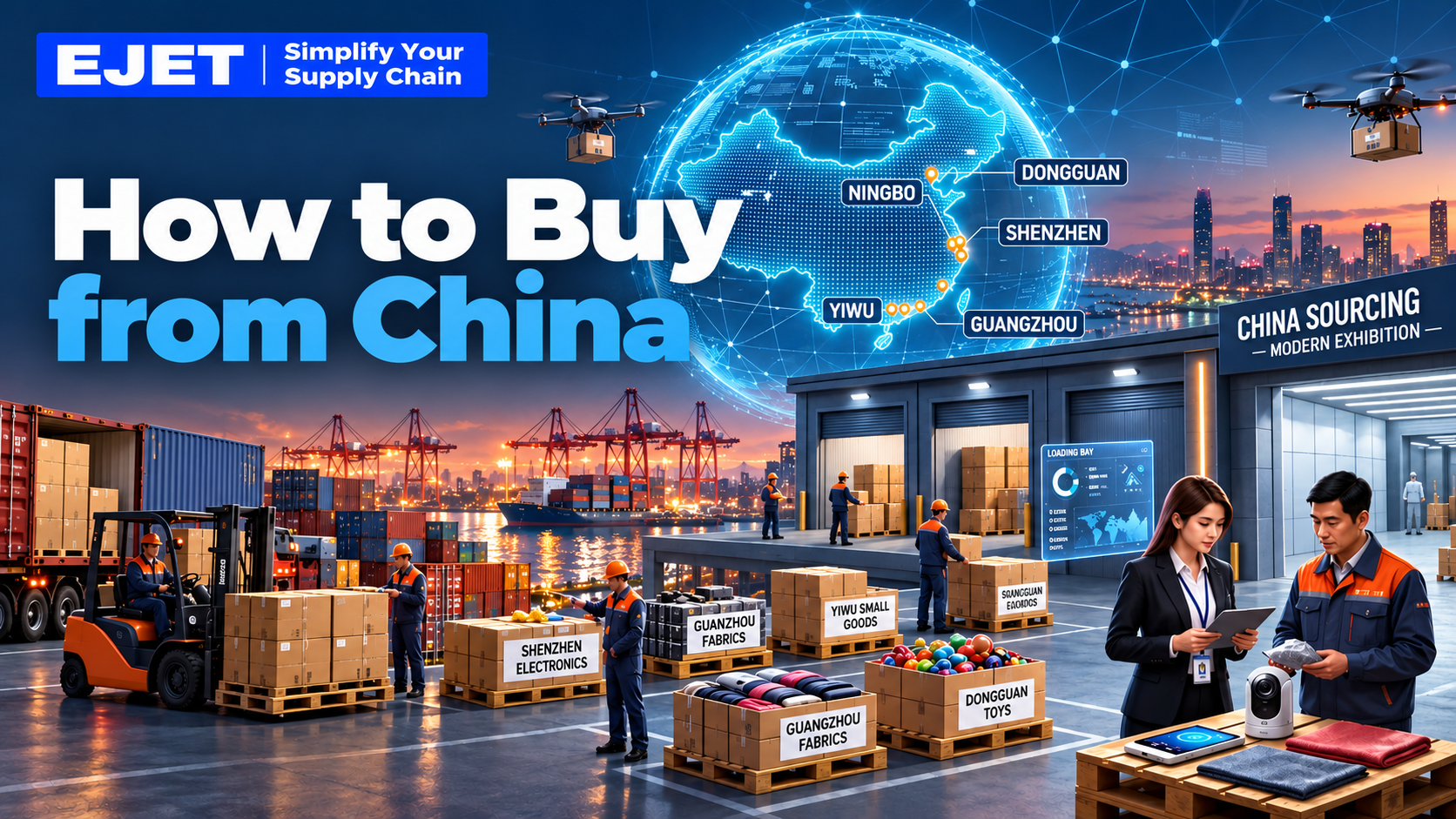











Supply chain management in China plays a critical role in global trade, helping international businesses source products, manage manufacturing, control quality, reduce operational costs, and deliver goods to customers worldwide.
As one of the world's largest manufacturing centers, China offers an extensive network of factories, wholesale markets, logistics providers, and specialized industrial clusters.
However, managing a supply chain in China involves much more than identifying a low-cost manufacturer. Businesses must coordinate supplier selection, product development, procurement, production schedules, quality assurance, inventory management, international shipping, and customs compliance.
An effective China supply chain management strategy connects these activities into a coordinated process that improves efficiency, reduces purchasing risks, and supports long-term business growth.
At EJET, we recognize the importance of integrating sourcing, procurement, production management, quality control, and international logistics into a reliable supply chain.
By approaching each stage systematically, we can help businesses build stronger supplier relationships, improve operational transparency, and make more informed sourcing decisions.
In this comprehensive guide, we explore how supply chain management works in China, the main challenges international buyers face, and the strategies businesses can implement to develop a more efficient and resilient global supply chain.
What Is Supply Chain Management in China?
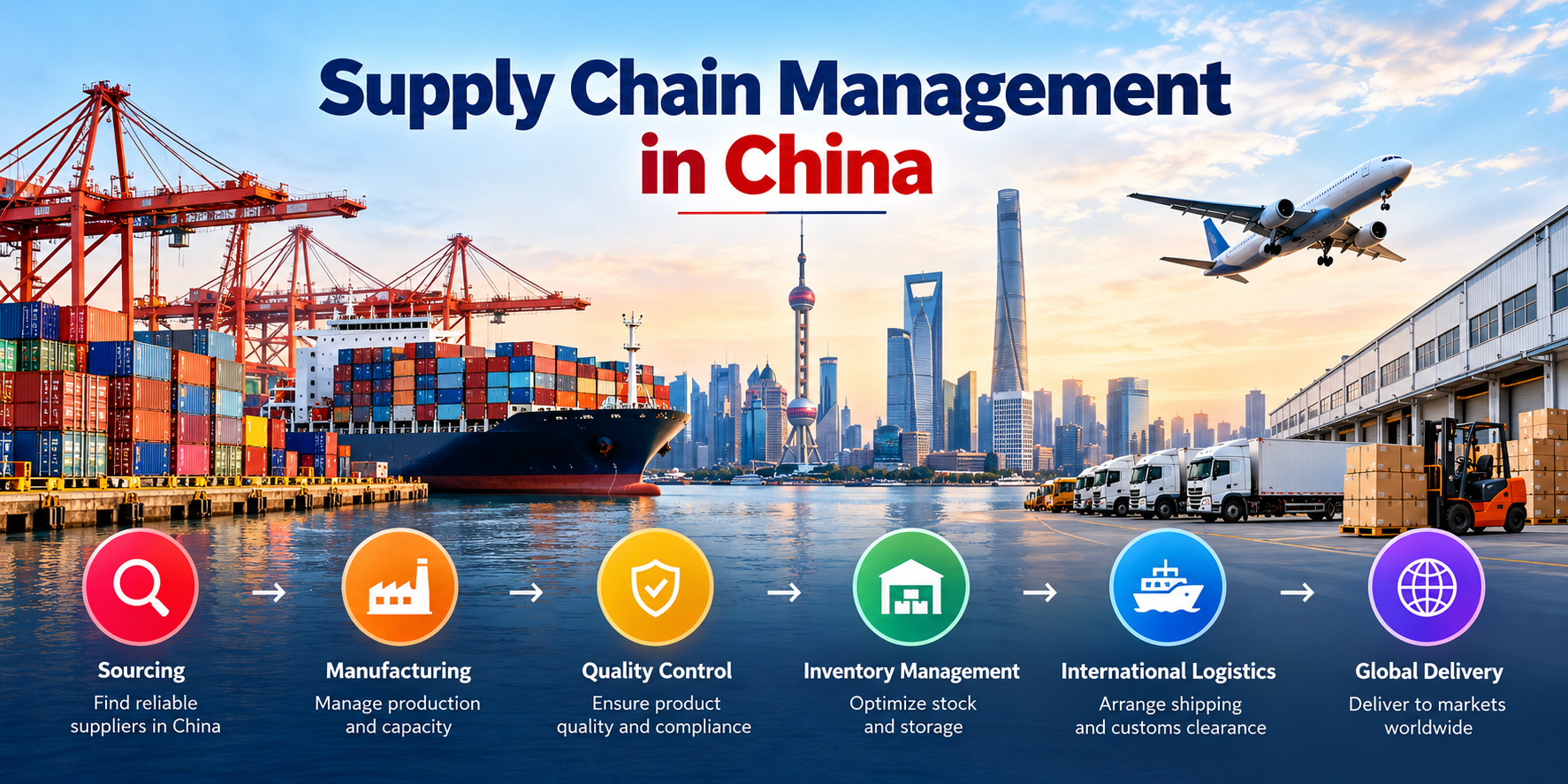
Supply chain management in China refers to the planning, coordination, execution, and monitoring of activities required to source, manufacture, store, and transport products from Chinese suppliers to domestic or international customers.
It covers the complete product journey, beginning with raw material procurement and supplier selection and continuing through manufacturing, inspection, packaging, transportation, customs clearance, and final distribution.
We can divide China supply chain management into several interconnected functions, including supplier management, strategic procurement, manufacturing coordination, quality assurance, inventory planning, logistics management, and supply chain risk control.
For international importers, distributors, wholesalers, retailers, and e-commerce businesses, managing these activities effectively is essential to maintaining consistent product availability and protecting profit margins.
Unlike traditional purchasing, which primarily focuses on buying products at competitive prices, supply chain management considers the total cost, quality, reliability, and efficiency of the entire procurement process.
For example, a manufacturer offering the lowest unit price may not be the most economical option if its production delays, high defect rates, or inefficient packaging create additional expenses.
We therefore evaluate suppliers and manufacturing partners based on their overall contribution to long-term supply chain performance rather than product prices alone.
Why Is China Important for Global Supply Chain Management?
China remains a major destination for international sourcing because of its established manufacturing infrastructure, extensive supplier networks, diverse production capabilities, and access to global shipping routes.
One of China's most significant advantages is its highly developed industrial ecosystem. Manufacturers often operate near suppliers of raw materials, components, packaging materials, machinery, and specialized manufacturing services.
These industrial clusters can reduce material sourcing complexity, improve production coordination, and accelerate product development.
Extensive Manufacturing Capabilities
China manufactures a broad range of products, including consumer electronics, furniture, textiles, toys, stationery, machinery, home decoration materials, automotive components, and household products.
This diversity allows us to source multiple product categories through interconnected manufacturing and wholesale networks.
For international businesses purchasing different types of merchandise, centralized supply chain management can simplify communication, supplier coordination, and shipment planning.
Competitive Production and Procurement Costs
China's established manufacturing networks, production scale, and supplier competition can provide cost advantages for suitable product categories.
However, the lowest factory quotation does not automatically result in the lowest landed cost.
We consider product specifications, manufacturing efficiency, tooling expenses, minimum order quantities, material costs, inspection fees, packaging, freight, import duties, and potential rework when evaluating purchasing decisions.
Established Logistics Infrastructure
China has extensive container ports, airports, rail networks, highways, freight forwarding services, and warehouse facilities supporting international trade.
Major logistics gateways include Shanghai, Ningbo-Zhoushan, Shenzhen, Guangzhou, Qingdao, and Tianjin.
These transportation connections make it possible to organize shipments for businesses importing products into North America, Europe, Southeast Asia, the Middle East, Africa, and other international markets.
Product Development and Customization
Chinese manufacturers support a wide range of product development requirements, from customized packaging and private labeling to original equipment manufacturing (OEM) and original design manufacturing (ODM).
We can work with suitable manufacturers to coordinate prototypes, material selection, product specifications, branding requirements, and production improvements before mass manufacturing begins.
This makes China particularly valuable for businesses developing private-label products or expanding their existing product collections.
Key Components of Supply Chain Management in China
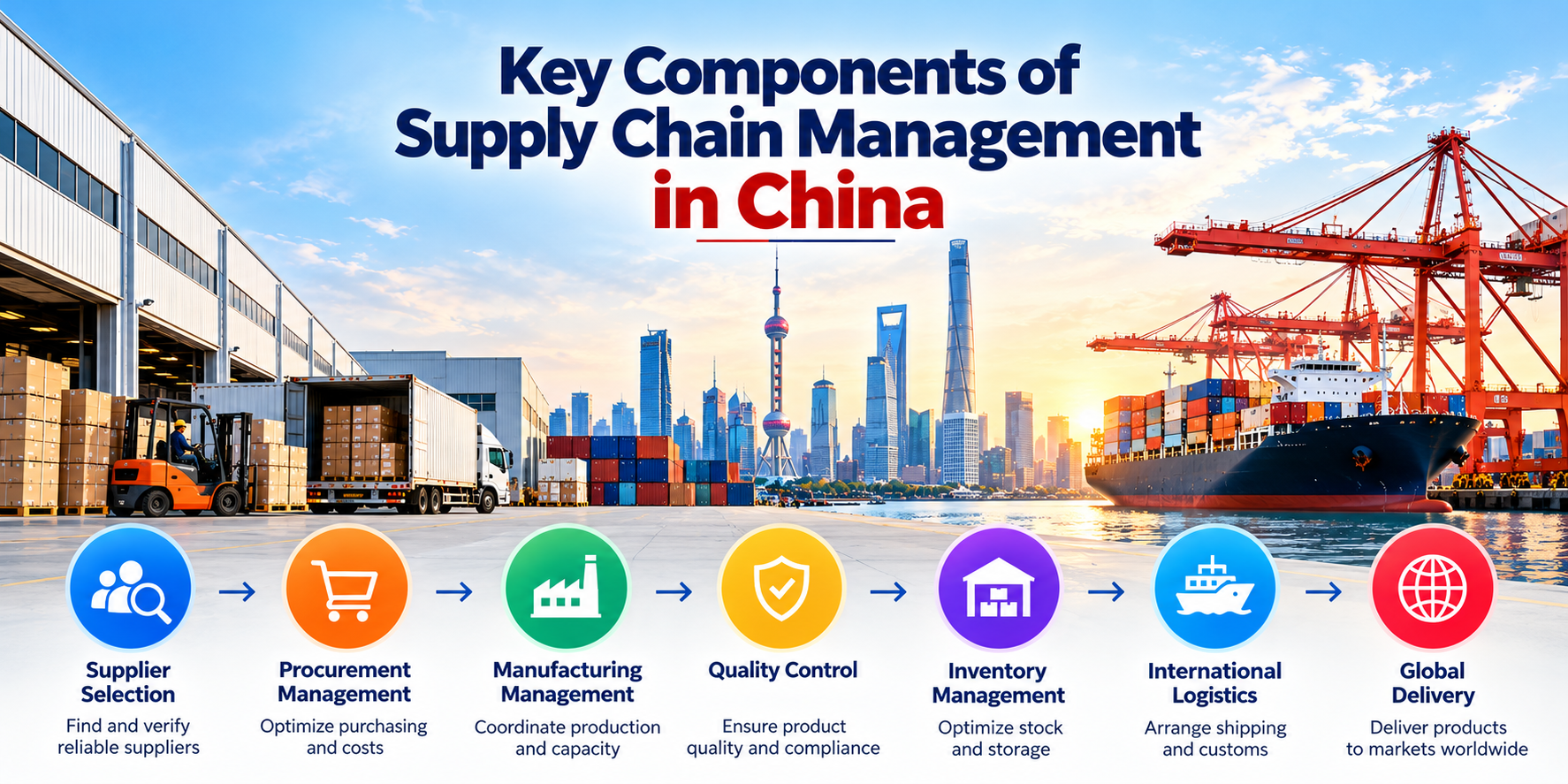
A successful supply chain requires coordination between multiple business functions. We focus on connecting procurement, manufacturing, logistics, and delivery into an integrated operational system.
1. Strategic Sourcing and Supplier Selection
Strategic sourcing is the foundation of effective supply chain management in China. Selecting suitable suppliers influences product quality, pricing, production efficiency, and long-term purchasing stability.
China offers different types of suppliers, including direct manufacturers, trading companies, wholesale distributors, and specialized production partners.
We begin by identifying suppliers that match the buyer's product specifications, purchasing volumes, customization requirements, and target market.
Supplier evaluation should cover business registration, production capacity, manufacturing experience, product specialization, quality management procedures, communication reliability, and relevant certifications.
We also consider whether the supplier manufactures products internally or subcontracts part of the production process.
Supplier verification is especially important when dealing with unfamiliar manufacturers. We recommend checking company registration details, reviewing manufacturing facilities, examining product samples, and conducting independent inspections when appropriate.
Even when a supplier appears in a business directory, independent background research remains essential. The U.S. Commercial Service also recommends due diligence when selecting business service providers in China.
2. Procurement Management and Purchasing Optimization
Procurement management involves purchasing products, raw materials, and manufacturing services while balancing price, quality, delivery requirements, and supplier performance.
A structured procurement process begins with clearly defined product specifications and a request for quotation (RFQ).
We compare supplier quotations based on consistent requirements rather than evaluating prices without considering differences in materials, dimensions, packaging, or quality standards.
Procurement planning must also account for minimum order quantities (MOQs), payment terms, production lead times, tooling costs, and potential price changes.
For businesses purchasing products from multiple factories, consolidating orders and coordinating purchasing schedules can reduce administrative complexity and improve transportation efficiency.
3. Manufacturing and Production Management
Production management ensures that products are manufactured according to agreed technical specifications, quality requirements, and delivery schedules.
We establish manufacturing expectations before production begins, including material grades, product dimensions, finishing requirements, packaging standards, and approved reference samples.
A reliable production management system provides visibility into manufacturing progress and identifies delays before they affect international delivery commitments.
For customized products, we place particular importance on prototype development, sample approval, and final production specifications.
The approved sample should serve as a documented reference for subsequent manufacturing and quality inspections.
4. Quality Control and Product Inspection
Quality control in China is essential for reducing product defects, avoiding customer complaints, and protecting a company's reputation.
We recommend establishing measurable quality requirements before placing an order rather than inspecting products without clearly defined acceptance criteria.
Quality assurance may involve factory audits, raw material verification, production monitoring, laboratory testing, and inspections of finished goods.
A typical inspection process can include incoming material inspection, during-production inspection, pre-shipment inspection, and container loading supervision.
For orders using statistical sampling, an agreed Acceptable Quality Limit (AQL) inspection plan can help determine sample sizes and acceptance criteria. The sampling standard, inspection level, and defect classifications should be agreed upon in advance.
We also ensure that products are evaluated against applicable safety, performance, and labeling requirements for their destination markets.
5. Inventory and Warehouse Management
Inventory management balances product availability against storage costs and working capital requirements.
Maintaining excessive inventory increases warehousing expenses and ties up financial resources, while insufficient stock may lead to lost sales, delayed deliveries, and interrupted customer operations.
We use demand forecasts, supplier lead times, order schedules, and safety stock policies to establish practical inventory targets.
Warehouse management also involves product labeling, carton identification, storage conditions, inventory reconciliation, and preparation for outbound transportation.
For businesses purchasing merchandise from several Chinese suppliers, a consolidation warehouse can provide an opportunity to combine goods into fewer international shipments.
6. International Logistics and Distribution
International logistics connects Chinese manufacturers with customers and distribution centers worldwide.
We evaluate transportation options according to shipment size, destination, delivery urgency, cargo characteristics, and total logistics costs.
Sea freight is commonly suitable for larger commercial shipments where cost efficiency is more important than speed. Full Container Load (FCL) shipping is appropriate when cargo volumes justify dedicated container use, while Less than Container Load (LCL) shipping can accommodate smaller consignments.
Air freight is generally more suitable for urgent shipments, higher-value goods, or products with time-sensitive delivery requirements.
Rail and multimodal transportation may also be suitable for selected international routes, subject to service availability and transit conditions.
How to Build an Efficient Supply Chain in China
Developing a reliable supply chain requires a structured process from initial supplier research to final delivery.
We recommend the following seven-stage approach:
Define procurement requirements: Establish product specifications, target costs, forecast quantities, packaging requirements, quality standards, and delivery deadlines.
Identify and verify suppliers: Research qualified factories, review business credentials, assess manufacturing capabilities, and request comparable quotations.
Develop and approve samples: Confirm materials, dimensions, design details, functional performance, labeling, and packaging before mass production.
Negotiate purchasing agreements: Document prices, payment arrangements, production timelines, inspection requirements, intellectual property protections, and responsibilities for nonconforming products.
Monitor production and quality: Track manufacturing milestones, verify critical production stages, and inspect finished goods against agreed specifications.
Coordinate shipping and customs: Select suitable transport methods, arrange export documentation, confirm applicable Incoterms, and prepare for destination-country import requirements.
Measure and improve performance: Review costs, supplier reliability, quality results, transportation performance, and customer feedback to support continuous improvement.
This approach helps us establish clear responsibilities throughout the supply chain and reduces the likelihood of costly misunderstandings.
Understanding China Supply Chain Costs
Managing purchasing costs requires more than negotiating competitive factory prices.
We calculate the total landed cost of products to understand the actual expense of moving goods from a Chinese supplier to their intended destination.
Depending on the agreed commercial terms and accounting treatment, landed cost may include the manufacturing price, product packaging, inland transportation, freight forwarding, international shipping, cargo insurance, import duties, nonrecoverable taxes, customs clearance charges, and destination handling expenses.
For example, consider a wholesale order with the following illustrative expenses:
|
Cost component |
Amount (USD) |
|---|---|
|
Product manufacturing |
$20,000 |
|
Quality inspection |
$300 |
|
China inland transportation |
$500 |
|
International freight |
$2,000 |
|
Cargo insurance |
$150 |
|
Import duties |
$1,200 |
|
Destination handling |
$450 |
|
Total landed cost |
$24,600 |
In this example, the additional supply chain expenses increase the effective acquisition cost from $20,000 to $24,600.
If the order contains 5,000 saleable units, the resulting landed cost is $4.92 per unit.
Actual costs depend on the products, shipment arrangements, trade agreements, destination-country requirements, and commercial terms.
We therefore recommend evaluating quotations on a consistent landed-cost basis before selecting manufacturing and logistics partners.
Incoterms and Their Importance in China Supply Chain Management
International Commercial Terms, commonly known as Incoterms, establish responsibilities between buyers and sellers concerning delivery, transportation, risk transfer, and specified costs.
The International Chamber of Commerce's Incoterms 2020 rules define 11 internationally recognized commercial terms.
Several terms are particularly relevant when sourcing products from China.
|
Incoterm |
Meaning |
Practical consideration |
|---|---|---|
|
EXW |
Ex Works |
Buyer takes substantial responsibility from the seller's premises |
|
FCA |
Free Carrier |
Seller delivers to the carrier or another nominated party at the agreed location |
|
FOB |
Free On Board |
Seller delivers goods on board the vessel at the named shipment port |
|
CIF |
Cost, Insurance and Freight |
Seller pays freight and specified insurance to the named destination port |
|
DAP |
Delivered at Place |
Seller arranges delivery to the named destination, without unloading |
|
DDP |
Delivered Duty Paid |
Seller assumes import clearance and duty obligations as defined by the rule |
FOB and CIF apply specifically to sea and inland waterway transportation. FCA is often more suitable for containerized cargo handed to a carrier at a terminal before vessel loading.
We select Incoterms based on shipment characteristics, the buyer's logistics capabilities, destination-country import requirements, and the parties' ability to fulfill their contractual obligations.
Importantly, Incoterms do not replace a complete sales agreement and do not, by themselves, determine product ownership or payment conditions.
Common Challenges in China Supply Chain Management
Although China offers extensive manufacturing opportunities, international businesses may encounter operational risks that require careful management.
Supplier Communication and Coordination
Differences in language, business practices, technical terminology, and expectations can create misunderstandings.
We reduce communication risks by documenting product specifications, confirming manufacturing instructions in writing, and maintaining clear approval procedures.
Technical drawings, photographs, reference samples, and standardized specification sheets can be especially useful when communicating complicated product requirements.
Inconsistent Product Quality
Quality inconsistencies may occur when manufacturers change materials, substitute components, increase production speeds, or subcontract work without adequate oversight.
We address these risks through supplier qualification, approved product specifications, contractual quality requirements, and independent inspections.
Production and Shipping Delays
Manufacturing schedules may be affected by raw material shortages, production capacity, seasonal holidays, equipment problems, or transportation disruptions.
Chinese New Year is an important planning consideration because many factories and related logistics services operate with reduced capacity during the holiday period.
We recommend confirming factory closure schedules, placing seasonal orders in advance, and maintaining realistic production buffers.
Unexpected Costs
Unexpected fees may arise from product modifications, inspection failures, storage charges, customs examinations, freight fluctuations, or delivery delays.
A comprehensive purchasing agreement and detailed shipping quotation can improve financial predictability.
Supply Chain Concentration Risk
Relying on a single supplier or manufacturing location can expose buyers to production interruptions and commercial disputes.
We recommend evaluating backup suppliers for critical products and determining which goods would benefit from diversified sourcing.
For certain product categories, a China Plus One strategy may be appropriate, combining established Chinese manufacturing partnerships with additional production capacity in other countries.
Customs Clearance and International Trade Compliance
Customs compliance is a fundamental part of cross-border supply chain management.
Before shipping goods from China, we confirm the documentary requirements, product classification, import restrictions, and applicable regulations of the destination country.
Common international shipping documents include commercial invoices, packing lists, bills of lading or air waybills, and certificates of origin where required. Certain products also require permits, inspection certificates, testing reports, or conformity documentation.
We pay particular attention to accurate product descriptions, quantities, declared values, and Harmonized System (HS) classifications.
Different products may be subject to specific safety and regulatory standards, including electrical safety requirements, chemical restrictions, labeling rules, or product-specific testing requirements.
For the United States, importers remain responsible for complying with applicable customs laws even when they appoint a customs broker.
As a result, we recommend reviewing customs and product compliance requirements before mass production, rather than waiting until cargo arrives at the destination port.
The Role of Technology in China Supply Chain Management
Digital technologies are transforming how international businesses monitor purchasing, manufacturing, inventory, and transportation.
Modern supply chain management systems help integrate information from suppliers, warehouses, freight forwarders, and customers.
Enterprise Resource Planning (ERP)
ERP systems connect purchasing, inventory, sales, finance, and order management.
We use centralized procurement data to reduce duplicate records, improve order visibility, and support more accurate cost calculations.
Warehouse Management Systems (WMS)
Warehouse management software helps track inventory locations, stock movements, picking operations, and outbound shipments.
Barcode scanning and inventory reconciliation can reduce errors when managing multiple products and suppliers.
Shipment Tracking and Visibility
Logistics platforms provide shipment milestones, transportation updates, and delivery information.
By combining freight tracking with purchasing and production records, we can identify potential delays and communicate more accurately with customers.
Data Analytics and Demand Forecasting
Data analysis supports more informed purchasing decisions by revealing historical demand patterns, supplier performance, seasonal fluctuations, and inventory turnover.
Predictive tools may help estimate future stock requirements, although their accuracy depends on reliable data and realistic planning assumptions.
Key Performance Indicators for Supply Chain Management
Measuring supply chain performance allows us to identify operational weaknesses and evaluate the effectiveness of improvement initiatives.
|
Supply chain KPI |
What it measures |
|---|---|
|
Supplier on-time delivery rate |
Percentage of supplier orders delivered by the agreed deadline |
|
Order defect rate |
Percentage of units or orders that fail established quality requirements |
|
Procurement cost savings |
Verified reduction in purchasing costs against an established baseline |
|
Inventory turnover |
Frequency with which inventory is sold or consumed during a period |
|
Order fulfillment cycle time |
Time between order placement and completion |
|
On-time, in-full (OTIF) rate |
Percentage of orders received on schedule and in the required quantity |
|
Freight cost per unit |
Transportation expense allocated to each product unit |
|
Supplier lead time |
Time between purchase order confirmation and agreed delivery milestone |
We use these indicators to compare suppliers fairly, monitor production reliability, and assess opportunities for operational improvement.
For instance, a supplier offering slightly higher prices may provide greater overall value through better delivery consistency, lower defect rates, and fewer production interruptions.
Sustainable and Responsible Supply Chain Management in China
Sustainability and responsible procurement are increasingly important considerations for international supply chains.
We encourage businesses to examine manufacturing practices, material sourcing, packaging efficiency, waste management, and supplier labor standards when developing their procurement strategies.
Environmental requirements differ by product category and destination market. Relevant measures may include responsible material sourcing, reduced packaging waste, improved energy efficiency, and compliance with applicable chemical and environmental regulations.
Supplier declarations and certifications should be evaluated for authenticity, relevance, and scope.
For products marketed with environmental claims, supporting evidence is necessary to avoid misleading customers.
Long-term supplier relationships can support continuous improvement by allowing buyers and manufacturers to establish shared expectations for quality, responsible sourcing, and production efficiency.
China Supply Chain Management vs. Traditional Sourcing
Although sourcing and supply chain management are closely related, their operational scope differs significantly.
|
Factor |
Traditional sourcing |
Supply chain management |
|---|---|---|
|
Main objective |
Purchase products from suppliers |
Optimize the complete product flow |
|
Supplier management |
Supplier identification and negotiation |
Qualification, monitoring, development, and risk management |
|
Production |
Limited manufacturing oversight |
Integrated production planning and control |
|
Quality assurance |
Primarily finished-product inspection |
Quality planning throughout the production process |
|
Logistics |
Shipment arrangements |
Coordinated transportation and distribution |
|
Inventory |
Often managed separately |
Integrated with purchasing and demand planning |
|
Performance measurement |
Product price and delivery |
Total cost, quality, speed, reliability, and resilience |
For businesses importing products regularly, integrated supply chain management provides a more comprehensive framework than transactional sourcing alone.
It connects purchasing decisions with manufacturing capacity, market demand, logistics requirements, and customer expectations.
How a China Supply Chain Management Company Can Help
Managing several Chinese suppliers independently can require significant time, technical expertise, local communication capabilities, and operational resources.
A professional China supply chain management company can help coordinate different stages of the sourcing and delivery process.
Services may include supplier identification, procurement coordination, product development support, factory communication, inspection management, order consolidation, warehouse coordination, and international shipping arrangements.
We believe businesses should evaluate supply chain partners according to their operational transparency, supplier management processes, quality control capabilities, communication standards, and experience with relevant product categories.
A suitable partner should also provide clear service terms, pricing structures, and reporting procedures.
For importers and retailers managing multiple product categories, centralized coordination can reduce the complexity of working with individual factories, inspection providers, and transportation companies.
Frequently Asked Questions About Supply Chain Management in China
What are the main benefits of supply chain management in China?
The main benefits include access to extensive manufacturing networks, coordinated procurement, cost optimization, improved production visibility, stronger quality management, and more efficient international logistics.
A well-managed supply chain also helps businesses establish repeatable purchasing procedures and develop stable manufacturing partnerships.
How can we find reliable suppliers in China?
We recommend beginning with supplier research, company registration verification, manufacturing capability assessments, product sample reviews, and factory audits where appropriate.
We also consider production experience, quality systems, commercial transparency, and the ability to meet required delivery schedules.
What is the difference between a sourcing agent and a supply chain management company?
A sourcing agent generally focuses on finding suppliers, obtaining quotations, negotiating prices, and coordinating purchasing activities.
A supply chain management company may provide a broader range of integrated services covering procurement, production coordination, quality control, inventory management, logistics, and supply chain performance.
The actual service scope depends on the provider and its contractual arrangements.
How can we reduce supply chain costs when importing from China?
We can reduce costs by comparing total landed costs, improving product specifications, negotiating reasonable order quantities, consolidating shipments, reducing defects, optimizing packaging, and improving inventory planning.
We also evaluate freight options and purchasing schedules to identify opportunities for operational savings.
What is the best shipping method for products sourced from China?
The most suitable shipping method depends on shipment volume, product value, delivery urgency, destination, and budget.
Sea freight is generally economical for larger consignments, while air freight is often preferable for urgent or time-sensitive deliveries.
How do we manage multiple suppliers in China?
We recommend using standardized purchase orders, centralized supplier records, consistent quality requirements, production tracking, consolidated reporting, and coordinated shipment schedules.
A local procurement or supply chain partner may also help manage communication and inspections across different manufacturing locations.
How long does manufacturing and shipping from China take?
Lead times vary considerably depending on product complexity, manufacturing capacity, order quantity, customization requirements, transportation method, and destination.
Standard products available from stock may ship relatively quickly, while customized products require additional development and production time.
We confirm production schedules and logistics estimates before committing to customer delivery dates.
Is China still a good location for global supply chain management?
China remains a significant manufacturing and sourcing market because of its industrial networks, product diversity, technical capabilities, and logistics infrastructure.
However, businesses should evaluate individual product economics, regulatory requirements, concentration risk, and alternative sourcing locations before making long-term manufacturing decisions.
Conclusion: Building a Reliable Supply Chain in China
Effective supply chain management in China requires an integrated approach to supplier selection, procurement, manufacturing, quality assurance, inventory planning, international logistics, and risk management.
For international importers, distributors, wholesalers, retailers, and e-commerce businesses, reliable supply chain operations are essential to maintaining product quality, controlling costs, and meeting customer demand.
We believe the strongest supply chains are built through verified manufacturing partnerships, clearly documented production requirements, consistent quality control, transparent communication, and measurable operational performance.
By connecting every stage of the purchasing and delivery process, we can reduce unnecessary complexity and create a more efficient foundation for international business growth.
Optimize Your China Supply Chain with EJET
At EJET, we focus on helping international businesses approach China sourcing and supply chain operations with greater coordination and efficiency.
Whether businesses need support identifying manufacturers, managing procurement activities, coordinating production, or planning international shipments, a structured supply chain strategy can improve visibility and purchasing confidence.
Looking for a reliable supply chain partner in China? Visit EJET to explore sourcing and supply chain solutions for your business.