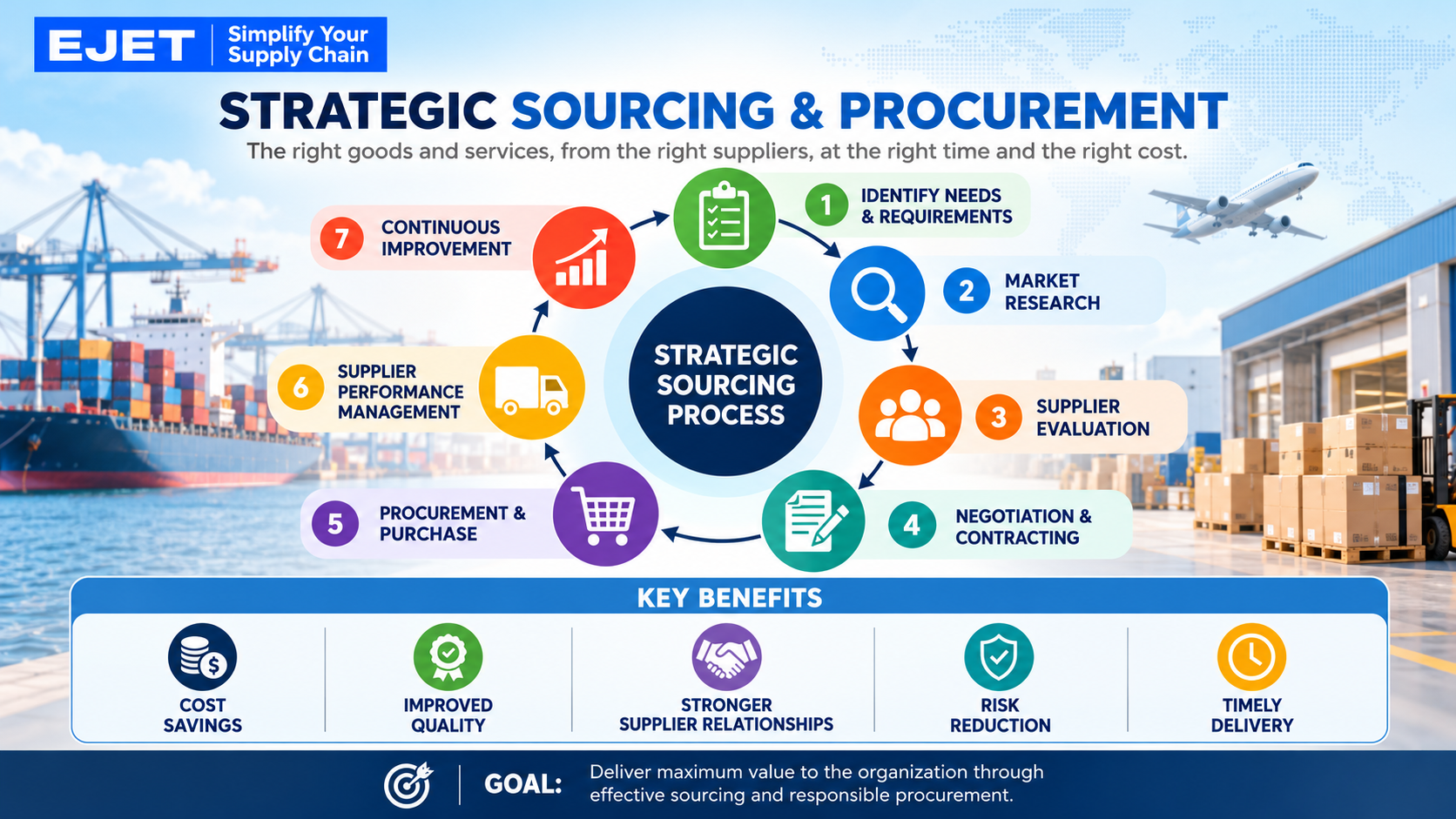
Efficient strategic sourcing is about making better buying decisions with less waste, less guesswork, and more control. It connects supplier selection, vendor management, cost reduction, risk planning, and the procurement process into one disciplined approach.
For teams working with internal buyers, sourcing companies, or a product sourcing agency, the goal is not simply to find the lowest price, but to build a sourcing system that improves value over time.
What does efficiency mean in strategic sourcing?
Efficiency in strategic sourcing means getting the right goods or services from the right suppliers at the right total value, using a procurement process that is clear, repeatable, and measurable. It reduces unnecessary manual work, avoids rushed supplier decisions, and helps procurement teams compare options based on cost, quality, reliability, risk, and long-term fit.
In practice, efficiency is not the same as speed alone. A fast sourcing decision can still be inefficient if it creates quality problems, delivery delays, hidden fees, or supplier instability later. Strategic sourcing and procurement work best when teams balance immediate business needs with the total cost and operational impact of every supplier relationship.
This is why strong supply chain management depends on structured sourcing. When sourcing decisions are fragmented, each department may negotiate differently, track suppliers differently, or miss opportunities to consolidate demand. When sourcing is strategic, procurement has better data, suppliers understand expectations, and the business can make decisions with fewer surprises.
The foundation of an efficient sourcing strategy
A strong sourcing strategy starts before a request for quotation, supplier shortlist, or contract discussion. The first step is understanding what the business actually needs, where money is being spent, what risks exist, and which supplier relationships matter most. Without this groundwork, even experienced procurement teams can end up solving the wrong problem.
Strategic procurement usually brings together several inputs: spend data, supplier performance, market conditions, internal stakeholder requirements, contract terms, and operational priorities. These inputs help teams decide whether they should renegotiate with current vendors, invite new suppliers, combine purchases, change specifications, or work with external sourcing services companies.
A practical foundation includes:
- Clear category ownership: Assign responsibility for major spend areas so sourcing decisions are coordinated rather than scattered.
- Reliable spend visibility: Understand what is being purchased, by whom, from which suppliers, and under what terms.
- Defined business requirements: Separate must-have specifications from preferences that may increase cost without adding value.
- Supplier market awareness: Know the available supplier base, including product sourcing companies, regional vendors, and specialized providers.
- Consistent evaluation criteria: Compare suppliers using a balanced view of price, quality, capacity, service, compliance, and risk.
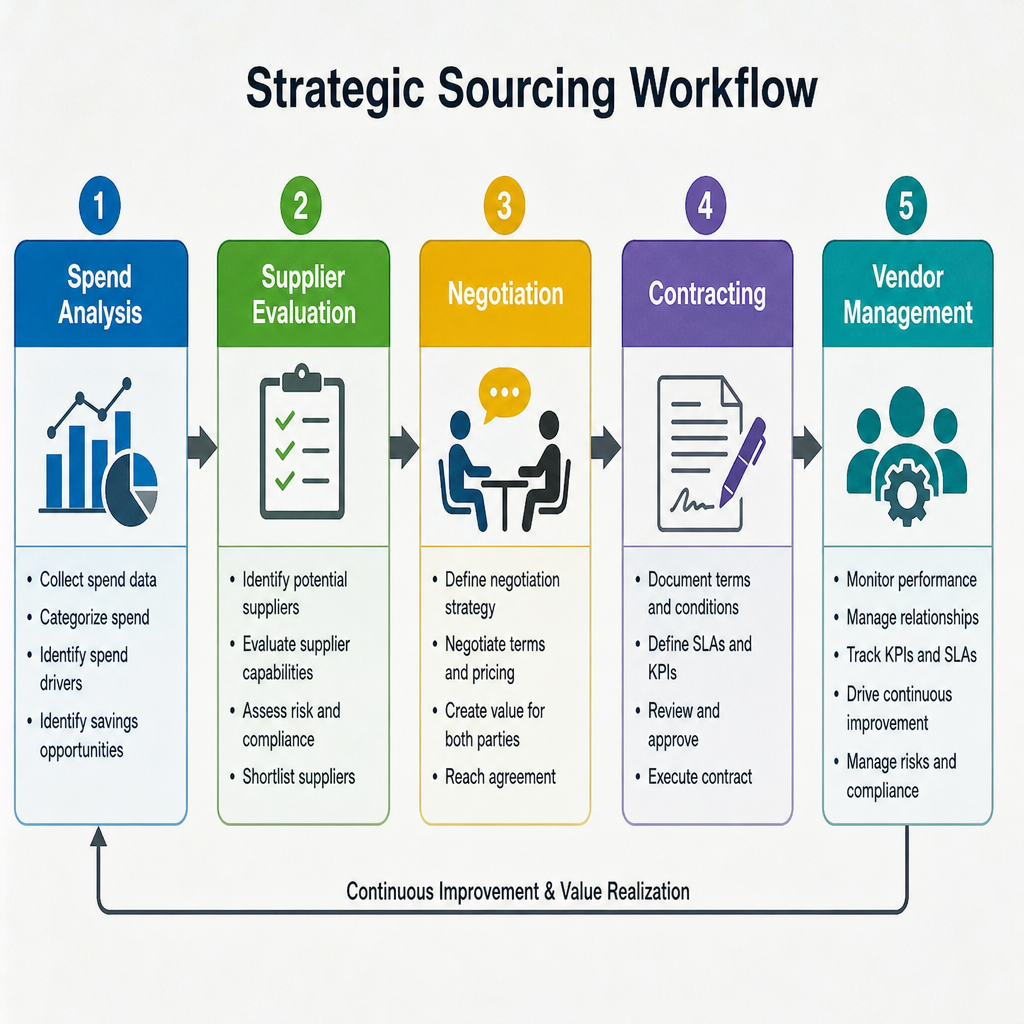
- Documented sourcing workflows: Make the procurement process repeatable so teams do not rebuild it from scratch each time.
Spend visibility turns sourcing into a strategic function
Cost reduction becomes much more achievable when procurement teams can see where money is going. Spend visibility reveals duplicate suppliers, inconsistent pricing, off-contract purchases, underused agreements, and categories where demand could be consolidated. It also helps teams identify which sourcing projects are likely to create the most value.
For example, a business may believe it has a supplier cost problem when it actually has a specification problem. Different departments may be ordering similar products with slightly different requirements, creating unnecessary complexity and reducing buying power. By reviewing spend data and usage patterns, procurement can often simplify requirements before approaching the supplier market.
Spend visibility also supports better conversations with stakeholders. Instead of asking departments to reduce costs in vague terms, procurement can show specific opportunities: overlapping vendors, inconsistent payment terms, low-volume purchases, or contracts approaching renewal. This changes sourcing from a reactive buying function into a business advisory role.
Supplier selection should balance price, risk, and fit
Efficient sourcing requires a disciplined approach to supplier selection. The lowest bid may be attractive on paper, but it can become expensive if the supplier cannot meet quality, service, delivery, or compliance expectations. A sourcing company or internal procurement team should evaluate total value, not just unit cost.
Useful supplier evaluation criteria often include:
|
Evaluation area |
What to assess |
Why it matters |
|---|---|---|
|
Cost structure |
Unit price, freight, payment terms, tooling, minimum order quantities, and lifecycle costs |
Supports realistic cost reduction rather than short-term savings only |
|
Capability |
Production capacity, service coverage, technical expertise, and scalability |
Reduces the risk of supplier failure as demand changes |
|
Quality |
Defect rates, quality processes, certifications if relevant, and inspection practices |
Protects customer experience and operational continuity |
|
Reliability |
Lead times, fulfillment history, responsiveness, and issue resolution |
Keeps the supply chain moving with fewer disruptions |
|
Risk profile |
Geographic exposure, financial stability, compliance requirements, and dependency risk |
Helps prevent avoidable supply chain management problems |
|
Strategic fit |
Innovation potential, communication style, and willingness to collaborate |
Supports stronger long-term vendor management |
This balanced view is especially important when working with product sourcing companies or international suppliers. A supplier may offer a competitive price, but procurement should still examine logistics, communication, production oversight, quality control, and any operational dependencies.
The best sourcing decision is the one that fits the business need and remains reliable after the contract is signed.
How can companies reduce costs without weakening supplier relationships?
Companies can reduce costs without weakening supplier relationships by focusing on total value, process improvement, demand management, and transparent negotiation rather than simply pressuring vendors for lower prices. Sustainable cost reduction often comes from better specifications, smarter order planning, consolidated volume, improved payment terms, reduced waste, and supplier collaboration.
Price pressure alone can damage relationships if it leaves suppliers unable or unwilling to perform well. Strategic sourcing works differently. It looks for savings that remove inefficiency from both sides of the relationship, such as fewer emergency orders, clearer forecasts, simpler product requirements, better inventory planning, or more predictable service levels.
A practical cost reduction plan may include these steps:
- Analyze the total cost of ownership. Look beyond purchase price to include freight, storage, defects, downtime, administration, returns, and contract management.
- Challenge unnecessary specifications. Determine whether custom features, packaging, service levels, or materials are truly needed.
- Consolidate similar demand. Combine purchasing volume where it makes operational sense, while avoiding overdependence on a single supplier.
- Improve forecasting and ordering behavior. Better planning can reduce rush fees, small-order penalties, and inventory imbalances.
- Benchmark supplier options. Compare current agreements against qualified alternatives, including sourcing services companies when internal market knowledge is limited.
- Negotiate with data. Use spend history, performance data, and market insight to create fact-based conversations.
- Track realized savings. Confirm that negotiated savings actually appear in invoices, budgets, or operating results.
The best savings are usually repeatable. A one-time discount can help, but an improved sourcing model can continue producing value across future purchases, renewals, and supplier negotiations.
Vendor management keeps sourcing value from leaking away
Strategic sourcing does not end when a supplier is selected. Many sourcing gains disappear because contracts are not managed, performance is not reviewed, or internal teams continue buying outside preferred channels. Vendor management protects the value created during sourcing by turning supplier commitments into day-to-day performance.
Strong vendor management includes clear expectations, regular communication, performance tracking, issue escalation, and renewal planning. It also helps procurement identify when a supplier deserves more business, when a contract needs to be renegotiated, or when the company should look for alternative suppliers. This is where strategic sourcing and procurement connect directly to operations.
A useful vendor management checklist includes:
- Confirm contract terms are accessible to the people placing orders.
- Track service levels, delivery performance, quality issues, and responsiveness.
- Review pricing against agreed terms and invoice accuracy.
- Schedule supplier business reviews for critical categories.
- Document recurring issues and corrective actions.
- Monitor dependency risk and backup supplier options.
- Align renewal dates with enough time for renegotiation or competitive sourcing.
- Invite supplier ideas for process improvement, innovation, or waste reduction.
The point is not to overmanage every vendor with the same intensity. High-risk, high-spend, or business-critical suppliers deserve deeper oversight, while lower-risk vendors may only require basic monitoring. Efficient vendor management applies the right level of attention to the right relationships.
Technology improves consistency, but process comes first
Procurement technology can make strategic sourcing more efficient, but it cannot fix an unclear process by itself. Tools for spend analysis, supplier onboarding, contract management, e-sourcing, approvals, and performance tracking are most useful when the underlying workflow is already defined. Otherwise, technology may simply automate confusion.
Before investing in or expanding procurement tools, teams should clarify how sourcing events are initiated, who approves supplier choices, what data must be captured, and how savings are measured.
Once those basics are in place, technology can reduce manual work, improve visibility, and make compliance easier. It can also help sourcing teams compare bids more consistently and maintain a searchable record of supplier decisions.
For growing companies, even simple process discipline can create immediate improvement. A centralized supplier list, standard intake form, shared contract calendar, and consistent evaluation template can reduce confusion before more advanced systems are needed. Larger organizations may need integrated platforms, but the same principle applies: technology should support a thoughtful procurement process, not replace one.
Working with external sourcing partners
Some businesses handle strategic sourcing internally, while others work with sourcing companies, product sourcing companies, or a product sourcing agency for certain categories.
External partners can be useful when a company lacks supplier market knowledge, needs support in a specific region, or wants help identifying and qualifying suppliers. They can also support supplier communication, sampling, negotiation preparation, or category research depending on the services offered.
Choosing an external sourcing partner should be treated like any other strategic procurement decision. The business should understand the partner’s process, category experience, supplier qualification methods, reporting practices, and role in quality or compliance checks. It is also important to clarify whether the partner is simply identifying options or helping manage the broader sourcing process.
When evaluating sourcing services companies, consider asking:
- Which categories, markets, or supplier types do they understand best?
- How do they identify and screen potential suppliers?
- What information will they provide for comparison and decision-making?
- How do they handle communication between the buyer and supplier?
- What parts of the procurement process remain the buyer’s responsibility?
- How are fees, incentives, or potential conflicts of interest handled?
- What documentation will the business receive for future vendor management?
An external sourcing company should make the process clearer, not more opaque. The buyer should still own the final decision criteria and maintain enough visibility to manage risk after a supplier is selected.
Measuring efficiency in strategic sourcing
Efficiency should be measured with a mix of financial, operational, and supplier performance indicators. Cost savings matter, but they do not tell the full story. A sourcing project that reduces price while increasing defects, delays, or administrative burden may not be efficient at all.
Useful metrics include negotiated savings, realized savings, sourcing cycle time, supplier performance, contract compliance, purchase order accuracy, stakeholder satisfaction, and risk reduction. The right mix depends on the category. For direct materials, quality and continuity may be critical. For professional services, scope clarity and contract compliance may matter more. For indirect spend, consolidation and process adoption may be the biggest opportunities.
A simple measurement framework can help:
|
Goal |
Example metric |
Practical use |
|---|---|---|
|
Reduce cost |
Realized savings, avoided cost, total cost of ownership |
Confirms whether sourcing decisions improve financial outcomes |
|
Improve speed |
Time from request to award, approval cycle time |
Identifies bottlenecks in the procurement process |
|
Increase compliance |
Spend under contract, preferred supplier usage |
Shows whether stakeholders are following sourcing decisions |
|
Strengthen suppliers |
On-time delivery, quality performance, issue resolution time |
Connects vendor management to business outcomes |
|
Reduce risk |
Number of backup suppliers, renewal readiness, dependency exposure |
Helps protect continuity and negotiation leverage |
The most important rule is to measure outcomes that influence behavior. If procurement only measures negotiated savings, teams may focus too heavily on price. If the business also measures quality, speed, compliance, and supplier reliability, sourcing decisions become more balanced.
Common barriers that slow sourcing teams down
Many sourcing teams lose efficiency because of issues that appear small but repeat across the business. Stakeholders may involve procurement too late, requirements may be unclear, supplier data may be scattered, or approvals may take longer than the sourcing event itself. These problems create rework and make procurement look slower than it actually is.
One common barrier is incomplete intake. If a department requests supplier quotes without clear specifications, expected volume, timing, budget, or decision criteria, procurement has to chase information before it can act.
Another barrier is fragmented vendor management, where contracts, performance notes, and renewal dates live in separate systems or inboxes. In both cases, the problem is not supplier availability; it is process visibility.
To remove friction, procurement leaders can standardize intake forms, define approval thresholds, maintain a supplier database, and create category playbooks for recurring purchases. These steps do not need to be overly complex. The goal is to make the right way to buy easier than the workaround.
How should a company improve its procurement process?
A company should improve its procurement process by mapping the current workflow, identifying where delays or errors occur, standardizing repeatable steps, and measuring whether changes improve sourcing outcomes.
The most effective improvements usually focus on clarity: who needs to be involved, what information is required, how suppliers are evaluated, and how decisions are documented.
Start by reviewing a few recent sourcing projects. Look for patterns: late stakeholder input, unclear requirements, too many approval layers, weak supplier comparisons, missing contract terms, or poor handoff to vendor management. Then prioritize fixes that reduce rework and improve decision quality.
A practical improvement roadmap looks like this:
- Map the current process. Document how requests enter procurement, how suppliers are identified, how bids are compared, and how awards are approved.
- Define decision rights. Clarify who owns business requirements, supplier evaluation, legal review, budget approval, and final selection.
- Create standard templates. Use consistent forms for intake, supplier comparison, negotiation planning, and contract handoff.
- Segment suppliers and categories. Apply deeper sourcing discipline to high-value or high-risk categories and lighter controls to routine purchases.
- Build review points. Check requirements before going to market and review performance after implementation.
- Measure and refine. Track cycle time, savings, compliance, and supplier outcomes, then adjust the process based on evidence.
Process improvement should feel practical, not bureaucratic. If a new step does not improve clarity, reduce risk, create savings, or support better supplier performance, it may not belong.
Strategic sourcing becomes stronger with continuous improvement
The most efficient sourcing teams treat strategic sourcing as an ongoing capability rather than a one-time project. Markets change, supplier performance changes, internal demand changes, and business priorities change. A sourcing decision that was effective last year may need to be reviewed if costs, risks, volumes, or requirements have shifted.
Continuous improvement depends on feedback loops. Procurement should learn from supplier performance, stakeholder experience, contract outcomes, and missed savings. That information should shape future category strategies, supplier shortlists, negotiation plans, and procurement process updates.
Efficient strategic sourcing brings discipline to decisions that can affect cost, quality, continuity, and growth. Whether a business manages sourcing internally or works with a sourcing company, the core principles remain the same: understand demand, evaluate suppliers carefully, manage vendors actively, measure outcomes, and keep improving the process.
When those pieces work together, strategic sourcing becomes more than a purchasing activity; it becomes a practical engine for better business performance.
Frequently Asked Questions About Maximizing Efficiency in Strategic Sourcing
What is strategic sourcing and why is it important?
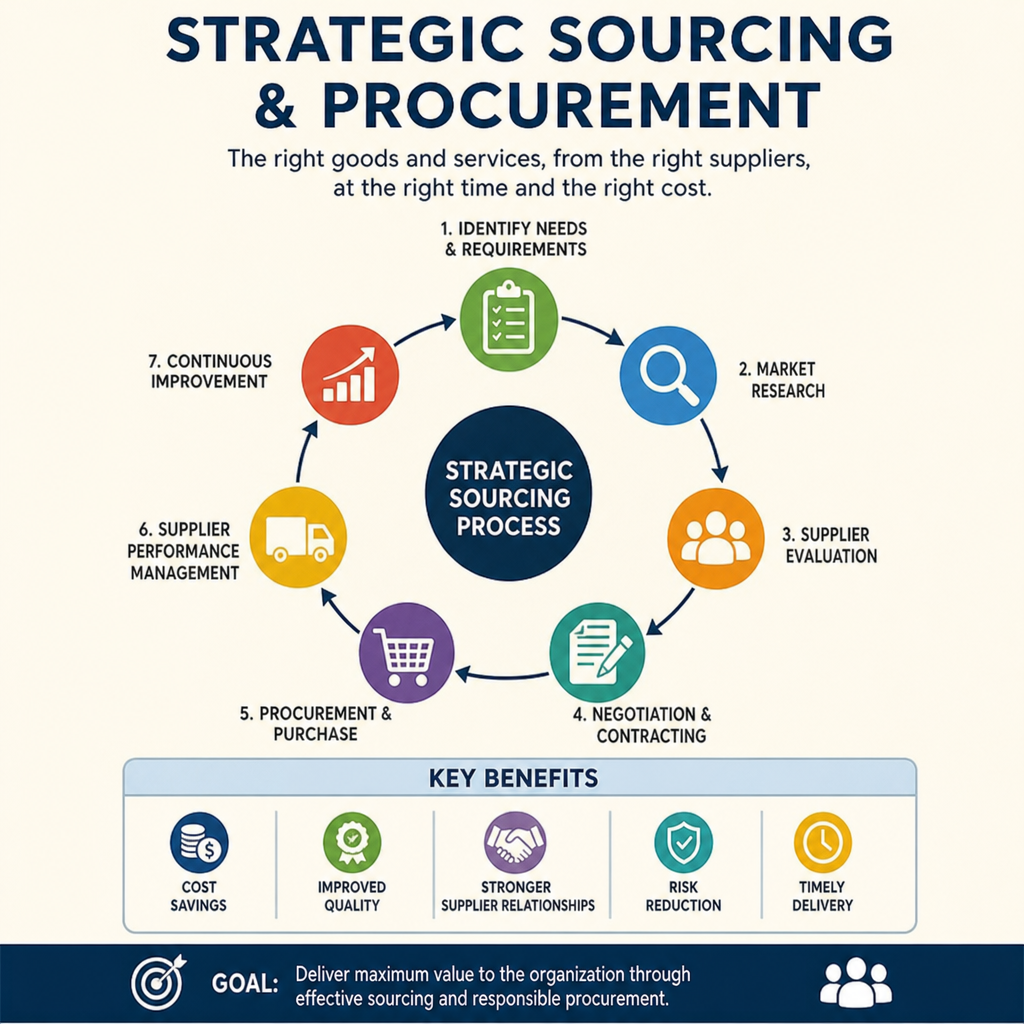
Strategic sourcing is a procurement process that continuously improves and re-evaluates the purchasing activities of a company. It is important because it helps organizations optimize their purchasing decisions, reduce costs, manage supplier relationships, and ultimately deliver better value.
How can spend visibility improve strategic sourcing efficiency?
Spend visibility allows procurement teams to analyze where money is being spent, identify duplicate suppliers, and consolidate purchases. This transparency leads to informed decision-making, better negotiation opportunities, and reduced costs.
What are key factors to consider when selecting suppliers?
When selecting suppliers, it’s crucial to evaluate their cost structure, capability, quality, reliability, risk profile, and strategic fit with your company's needs. A balanced assessment ensures that the chosen supplier meets both financial and operational requirements.
How can companies reduce costs without damaging supplier relationships?
Companies can achieve cost reductions by focusing on total value, improving specifications, consolidating demand, and collaborating openly with suppliers rather than solely negotiating for lower prices, which can strain relationships.
What role does technology play in strategic sourcing?
Technology enhances strategic sourcing by automating processes, improving data visibility, and aiding in supplier evaluations. However, it should only be implemented after a clear procurement process is established to avoid complicating workflows.