











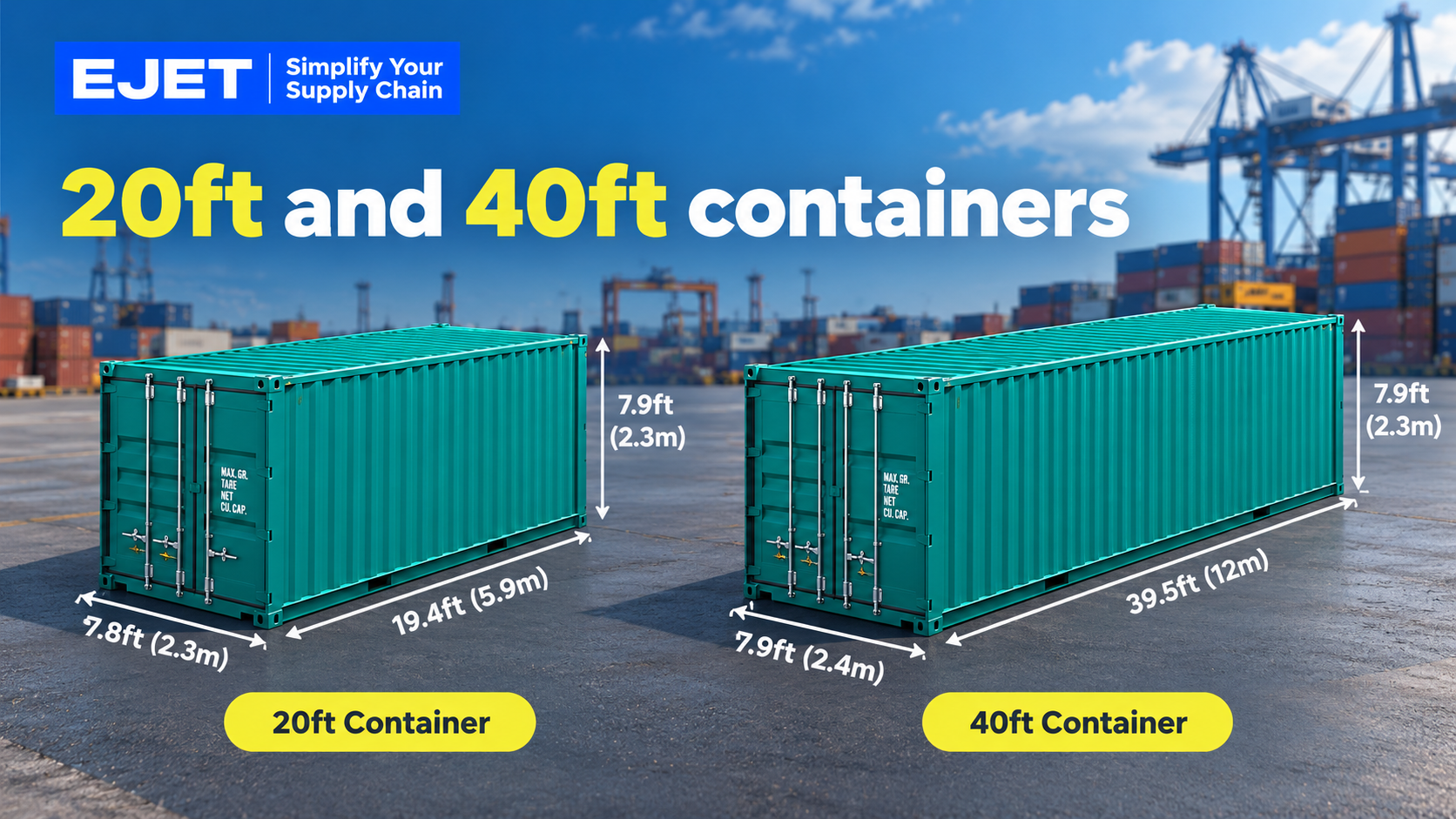
Shipping container dimensions describe three different things: the exterior footprint, the usable interior, and the door opening.
Common options include 20-foot and 40-foot dry containers, plus high cubes that add a foot of exterior height; actual internal measurements vary by manufacturer.
This guide compares container sizes, explains published U.S. purchase-price examples, and shows which measurements to confirm before buying, loading, or planning a conversion.
What are the most common shipping container dimensions?
A standard 20-foot shipping container has external dimensions of 6,058 × 2,438 × 2,591 mm, while a standard 40-foot container measures 12,192 × 2,438 × 2,591 mm. A 40-foot high cube keeps the same length and width but increases exterior height to 2,896 mm, or 9 feet 6 inches. These are outside measurements, not the space available for cargo.
The comparison below combines published exterior specifications with representative internal measurements. Treat it as a planning reference, then request the specification sheet for the actual unit offered. Hapag-Lloyd explicitly notes that container measurements vary by manufacturer.
|
Container size |
External dimensions, L × W × H |
Representative internal dimensions, L × W × H |
Approximate internal volume |
|---|---|---|---|
|
10-foot standard |
2,991 × 2,438 × 2,591 mm |
2,841 × 2,352 × 2,393 mm |
16.0 m³ |
|
20-foot standard |
6,058 × 2,438 × 2,591 mm |
5,900 × 2,352 × 2,395 mm |
33.2 m³ |
|
40-foot standard |
12,192 × 2,438 × 2,591 mm |
12,032 × 2,352 × 2,395 mm |
67.7 m³ |
|
40-foot high cube |
12,192 × 2,438 × 2,896 mm |
12,032 × 2,352 × 2,700 mm |
76.3 m³ |
|
45-foot high cube |
Confirm the supplier’s exterior drawing |
13,556 × 2,352 × 2,700 mm |
86.0 m³ |
Sources: Cleveland Containers, Conexwest, and Hapag-Lloyd. Internal figures represent particular designs rather than guaranteed measurements for every container of that nominal size.
10-foot containers: a compact storage option
Published 10 ft shipping container dimensions are not interchangeable across every storage product. Cleveland Containers’ standard drawing, for example, specifies a 2,991 mm exterior length and approximately 16 cubic meters of internal capacity. A modified unit with a different door arrangement should be checked against its own drawing.
Consider this size when your inventory is modest or the proposed locati0n cannot accommodate a longer box. Before choosing it, sketch shelves, larger equipment, and the standing space needed to retrieve items. Also request a 20-foot quote: compare the actual delivered totals rather than assuming the shorter option offers better value.
20-foot containers: a practical starting point
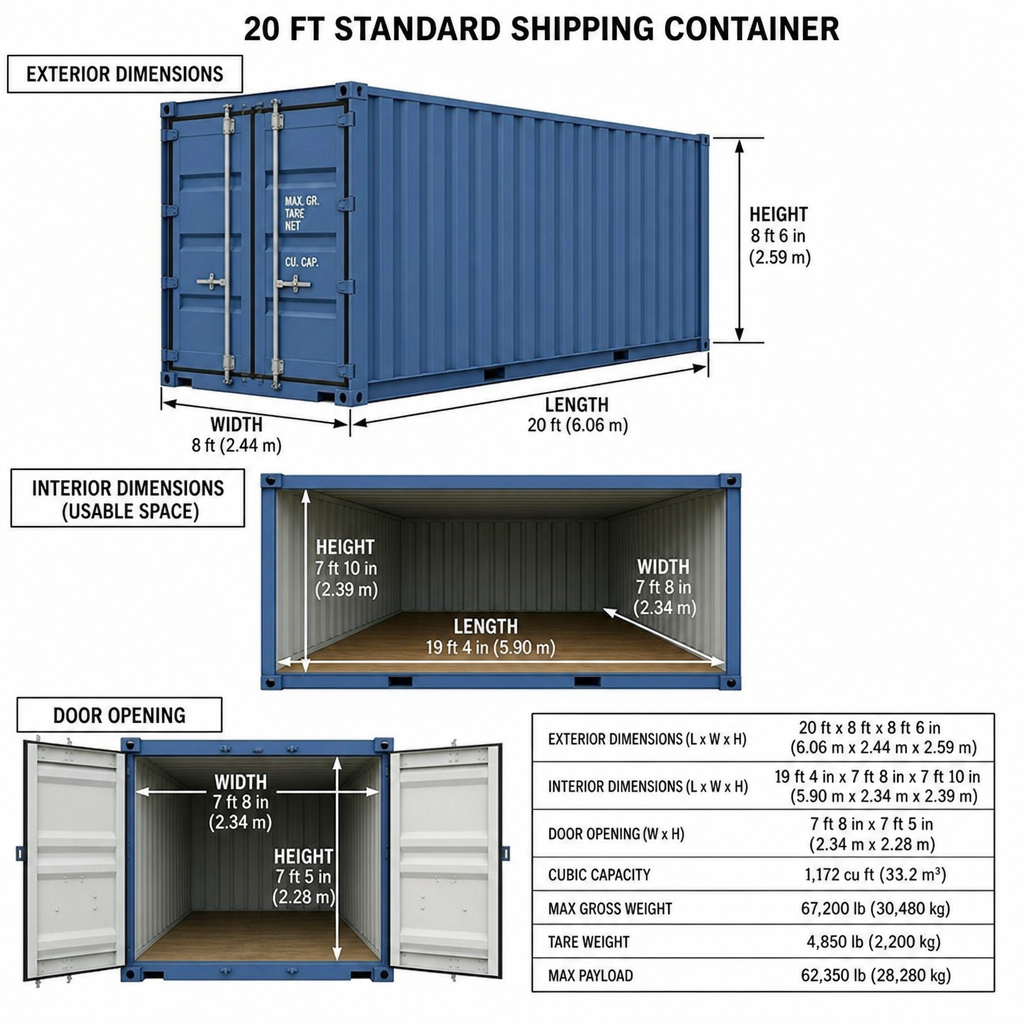
For readers searching for 20 foot shipping container external dimensions 6058 2438 2591 mm, those numbers mean length, width, and height, respectively. Representative internal length is about 5.90 meters, not 6.058 meters. The nominal “20-foot” name should therefore never substitute for a clear internal measurement.
Use the 20-foot model as your first layout test for tools, equipment, household belongings, or compact inventory storage. Draw the largest objects first, then add shelves and access space. If everything fits only when tightly packed, decide whether you need transport capacity or storage that remains convenient to use.
40-foot containers: more length, similar width
Standard 40 shipping container dimensions provide approximately 12.03 meters of internal length, while representative internal width remains about 2.35 meters. Hapag-Lloyd lists approximately 67.7 cubic meters of capacity for its example standard unit. Moving from 20 feet to 40 feet adds length, not a wider doorway or a wider storage aisle.
Test this option when your layout needs longer stock, more shelving, or separate storage zones. Think carefully about what goes at the far end and how frequently you need it. A useful planning exercise is to trace the retrieval path for your least accessible item before approving the arrangement.
High cubes: extra height without extra width
High cube shipping container dimensions are especially relevant when vertical clearance matters. A representative 40-foot high cube has approximately 2,700 mm of internal height, compared with 2,395 mm in a standard-height example. Its published capacity is approximately 76.3 cubic meters, although the exact specification depends on the unit.
Consider the high cube if your layout includes tall equipment, stacked cartons, or a future ceiling assembly. Do not treat its additional height as a solution to every loading problem. Check the door opening separately, and remember that extra height does not increase the available internal width.
45-foot containers: verify the whole transport plan
Hapag-Lloyd’s representative 45-foot high cube provides 13,556 mm of internal length and approximately 86 cubic meters of capacity. Its example internal width and height match those of the listed 40-foot high cube. The gain is additional length rather than a different room shape.
Before selecting one, ask the seller to confirm equipment availability, the delivery method, and the full exterior drawing. Then compare its installed cost with a 40-foot option that already meets your needs. Additional space is valuable only if you can place it, access it, and put it to work.
Read container measurements correctly
Container specifications distinguish between inside dimensions, door openings, weights, and capacity. Those categories answer different questions, so a single length or volume figure is not enough to approve a purchase. Build your comparison around the complete specification rather than the product name alone.
Exterior dimensions establish the footprint
Use exterior measurements to mark the proposed locati0n on a site plan. Then add separate space for opening doors, walking around the unit, and operating any loading equipment. Ask the delivery company to assess access independently; a rectangle that fits on a drawing does not prove its truck can reach that rectangle.
Keep units consistent throughout your plan. Record millimeters or meters for precise equipment comparisons, with feet and inches alongside them if useful. Avoid transferring rounded figures from a marketing description into a close-clearance layout.
Internal dimensions establish usable space
Representative internal width for the dry containers in the comparison is around 2,352 mm, rather than the 2,438 mm external width. Internal length and height are also smaller than their exterior equivalents. Fittings, walls, and the container structure must therefore be accounted for before planning a tight load.
For storage planning, subtract the space you intend to dedicate to racks and circulation. For a conversion, ask the designer to show finished internal dimensions after the proposed construction layers. Keep the original shell dimensions and the finished-room dimensions in separate columns so they cannot be confused.
Door openings can be the deciding measurement
Hapag-Lloyd’s representative standard dry containers have door openings approximately 2,340 mm wide × 2,292 mm high. Its 40-foot high cube example increases door-opening height to approximately 2,597 mm. In both cases, door height is less than the listed internal height.
Measure equipment in the condition in which it will enter: on its pallet, inside its crate, or on handling skates. Include protruding handles, protective packaging, and any lifting arrangement. For a close fit, request written confirmation of the actual clear opening and agree on a loading method before committing.
Match shipping container types to the job
Length is only one part of selecting equipment. Maersk’s published equipment range includes dry containers, high cubes, refrigerated containers, open tops, and flat racks. The right category depends on whether the cargo needs enclosure, temperature control, or an alternative loading arrangement.
|
Container type |
Main reason to investigate it |
Specification to prioritize |
|---|---|---|
|
Standard dry |
General enclosed cargo or storage |
Internal dimensions and door opening |
|
High cube dry |
Additional vertical space |
Clear internal and entrance height |
|
Refrigerated, or reefer |
Temperature-controlled cargo |
Usable loading space and refrigeration requirements |
|
Open top |
Loading through the roof |
Roof opening and loading arrangement |
|
Flat rack |
Cargo requiring an open platform arrangement |
Load-bearing dimensions and weight distribution |
Use this as a shortlist, not a loading approval. Confirm the particular equipment and cargo requirements with the carrier or supplier.
Refrigerated containers have different usable dimensions
Do not apply dry-container cargo dimensions to a refrigerated unit of the same nominal length. CMA CGM lists its example 20-foot reefer at 5,456 × 2,294 × 2,273 mm internally, with a lower usable cargo height under the load line. Its example 40-foot high cube reefer also distinguishes nominal capacity from usable loading capacity.
Ask the supplier to identify the loading limit, required airflow arrangement, power connection, and operating requirements for your application. For temperature-sensitive shipments, consult the carrier’s cargo-handling instructions rather than planning solely around cubic capacity. Hapag-Lloyd specifically emphasizes packaging, product temperature, and air circulation in its reefer guidance.
Open tops and flat racks need a loading assessment
An open top’s roof aperture is not the same as its internal footprint. Hapag-Lloyd’s example 20-foot open top has an internal length of 5,895 mm but a roof-opening length of 5,338 mm. A proposed top-loaded item must therefore be checked against the opening, not just the space below it.
Flat-rack planning also goes beyond overall cargo size. Maersk explains that permissible loading depends on weight distribution and the length over which the load rests on the structure. Give the carrier cargo drawings, total weight, contact points, and center-of-gravity information for an equipment-specific assessment.
How much do shipping containers cost?
Shipping container prices depend on the exact size, condition, locati0n, and product offered, so published figures should be treated as quote references rather than national averages. For example, Conex Depot publishes broad 2026 purchase ranges, while Conexwest displays individual catalog prices that can differ by region. Neither approach replaces a written delivered quote for your address.
The following U.S. catalog examples were available when preparing this guide on October 29, 2026. They illustrate advertised purchase prices, not guaranteed delivered totals. Confirm delivery, taxes, availability, condition, and any other charges before ordering.
|
Advertised container |
Example listed purchase price |
|---|---|
|
20-foot used shipping container |
$1,625 |
|
40-foot used shipping container |
$1,949 |
|
40-foot used high cube |
$2,015 |
|
20-foot new shipping container |
$2,275 |
|
40-foot new high cube |
$3,645 |
|
10-foot refurbished storage container with roll-up door |
$3,769 |
Source: Conexwest’s catalog. These examples cover different products and conditions; they are not a like-for-like national price survey.
Compare equivalent products before comparing totals
Conex Depot’s broader published ranges include approximately $1,800–$3,900 for used 20-foot containers and $2,500–$5,000 for used 40-foot containers. Its new-container ranges are approximately $3,000–$5,000 and $4,500–$7,000, respectively. These supplier estimates differ from the individual listings above, illustrating why one advertised price cannot define the market.
When collecting quotes, specify the same size, height, condition, door arrangement, and delivery address each time. Ask whether the offered price applies to a particular unit or to a unit selected from a condition category. Keep optional accessories separate so an upgraded package does not appear artificially expensive beside a bare container.
The 10-foot refurbished example also costs more than several larger listed units. That does not establish a general rule about small-container pricing; it shows why size alone is an unreliable comparison. Compare the actual configuration and included work rather than calculating value from length alone.
Build a complete acquisition budget
Request an itemized estimate with these categories:
- Container: exact size, height, condition, and door configuration.
- Transport: delivery address, selected depot, and unloading method.
- Site work: any proposed preparation, supports, or access improvements.
- Accessories: locks, ramps, shelving, vents, or other requested additions.
- Conversion work: separately priced openings, finishes, and building services.
- Transaction terms: taxes, payment schedule, quote validity, and cancellation conditions.
Use the completed estimate to compare the project, not just the steel box. Leave uncertain items visibly marked as allowances instead of treating them as zero. Before paying, ask the seller to identify which responsibilities remain yours and which are included in its scope.
Understand condition labels before choosing a price
Condition descriptions distinguish products that may look similar in a search result. A seller’s terms can define one-trip, cargo-worthy, and wind-and-watertight categories differently, including the protections attached to each sale. Read the written condition standard and guarantee rather than relying on the category name.
New or one-trip: Conexwest describes its one-trip containers as units shipped from Asia with a single cargo load. Ask what cosmetic marks are acceptable and whether photographs show the actual unit offered. Do not interpret “new” as an assurance that the container has never traveled.
Cargo-worthy: If the container will return to transport service, request the specific inspection or documentation your carrier requires. Do not assume that a seller’s condition label alone completes that process. Separate the purchase condition from the carrier’s acceptance requirements in your order checklist.
Wind-and-watertight or refurbished: Ask exactly what has been inspected, repaired, replaced, or repainted. Request the exclusions as well as the promises, particularly for the floor, roof, doors, and seals. Seller guarantees may describe weather sealing and structural condition separately, so retain those terms with the invoice.
For any used unit, request clear roof, floor, corner, door, and underside photographs where available. Record concerns in writing and ask how they will be resolved before delivery. If appearance or a particular repair matters to your project, make that requirement part of the order rather than an informal conversation.
Calculate cargo fit, volume, and weight separately
Published cubic capacity and maximum payload describe different limits. Maersk lists approximately 33.2 cubic meters for a standard 20-foot steel container and 67.7 cubic meters for a standard 40-foot unit, but its listed payloads are not in a two-to-one relationship. More cargo volume does not automatically mean proportionally more allowable cargo weight.
Start with packed shipping dimensions
Create a cargo schedule using the outside dimensions of each prepared shipping unit. Include the pallet, crate, wrapping, and protrusions in the measurements. Record whether each item can be rotated, stacked, or placed beneath another item; leave an answer blank rather than guessing.
For a rectangular package, calculate:
Volume in cubic meters = length in meters × width in meters × height in meters.
As a hypothetical example, a crate measuring 1.20 × 1.00 × 1.50 meters occupies 1.80 cubic meters. Ten such crates total 18 cubic meters before accounting for arrangement, securing, or access. Use that result as an initial volume check, then draw the actual packing layout rather than assuming volume alone proves fit.
Distinguish tare, payload, and gross weight
Container specifications commonly list three separate weight figures:
- Tare: the empty container’s weight.
- Payload: the permitted cargo weight for that container.
- Maximum gross weight: the permitted combined weight of container and contents.
Use the particular unit’s markings and documentation, not a generic chart, when finalizing the load. Maersk also notes that applicable weight limits can vary by country, while Hapag-Lloyd warns about inland transport restrictions in its equipment guidance.
Give your hauler or forwarder the planned packed weight early. Ask them to confirm route and equipment suitability before you arrange loading. For concentrated machinery loads, request a specific assessment of support and weight distribution rather than relying only on the total payload figure.
Plan the retrieval path as well as the packing pattern
If the container will serve as working storage, assign space for movement before filling the drawing with inventory. Put frequently retrieved items near an accessible position and identify anything that requires machinery to move. Consider whether you could remove a rear item without unloading everything in front of it.
Try two layouts: one optimized for maximum packing and another for everyday use. Compare how much inventory each holds and how many handling steps retrieval requires. Choose the version that reflects the real purpose of the container, rather than accepting the densest arrangement by default.
Translate shipping container home dimensions into finished space
Shipping container home dimensions begin with the steel shell, but a habitable-building proposal requires a separate design assessment. The International Code Council publishes guidance specifically for ISO containers repurposed as buildings and building components. Purchasing a container and obtaining an acceptable building design are therefore separate decisions.
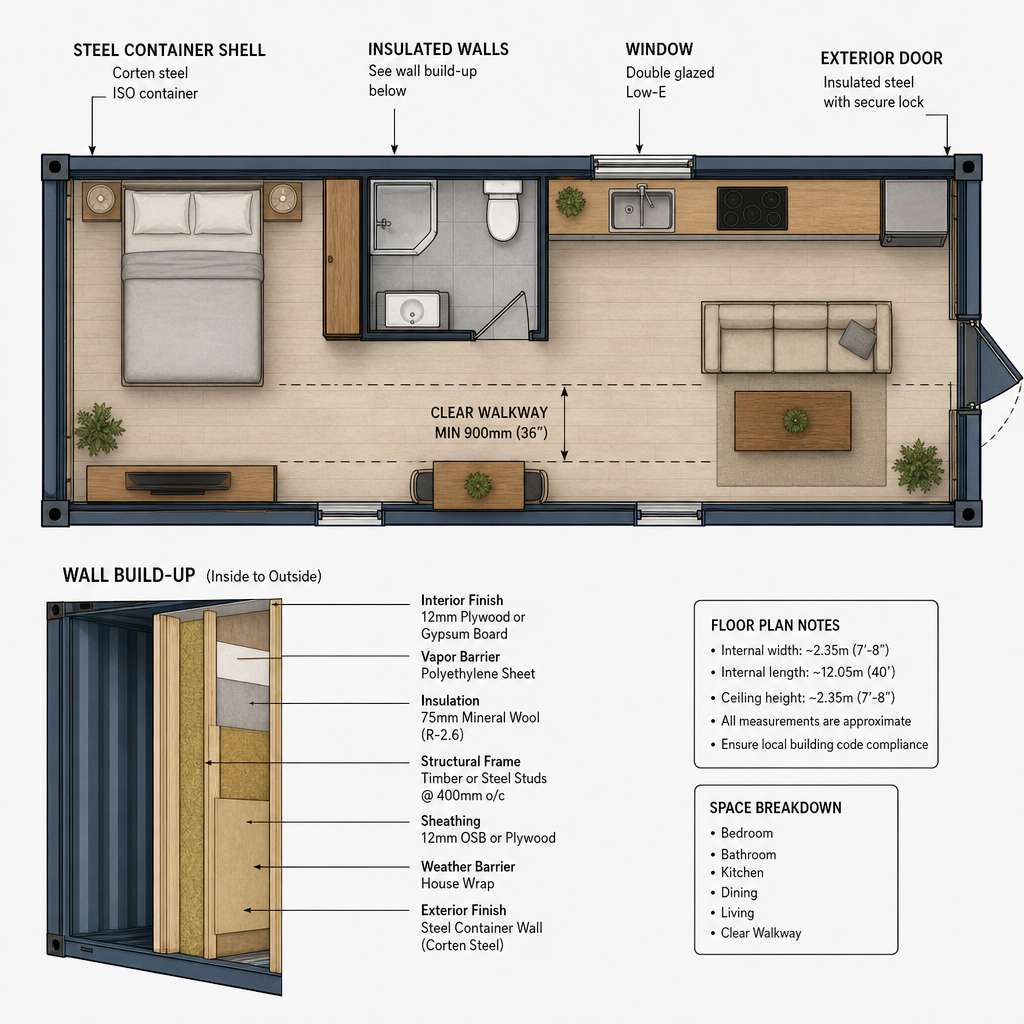
A representative 40-foot dry container has about 12.03 × 2.35 meters of internal floor dimensions before conversion work. The corresponding high cube offers additional internal height, not additional width. Begin your room layout with those internal measurements rather than a nominal “40 × 8 feet” rectangle.
Draw the finished envelope before choosing furniture
Ask your designer to show the proposed wall, floor, and ceiling assemblies on a measured section. Then place furniture, doors, fixtures, and circulation within the resulting finished envelope. This approach makes the space trade-offs explicit before you purchase a shell or commission alterations.
For illustration only, if a chosen wall assembly projects 100 mm inward on each side, the finished width loses 200 mm. That arithmetic is not an insulation recommendation; the appropriate assembly depends on the project design. Have the designer confirm the construction approach before using the example in a budget or floor plan.
Resolve alterations before buying the shell
Tell the project team whether you want large windows, joined containers, removed wall sections, or stacked units. Request a coordinated assessment covering the proposed structure, foundations, weather protection, and building services. ICC’s container-building guidance is a useful reference point, but the project needs review against the requirements applicable to its locati0n.
Avoid comparing a bare-container purchase price directly with a completed-home price. Instead, request separate estimates for the shell, design, site work, alterations, and fit-out. That comparison will show whether the container approach suits your intended space and budget before the purchase becomes a commitment.
Check delivery access before placing the order
Delivery needs more space than the container’s permanent footprint. Conex Depot, for example, states that its 40-foot and 45-foot deliveries need at least 100 feet of straight-line clearance. Treat that as one supplier’s requirement, not a universal allowance: the actual truck, unloading method, and site conditions determine what your delivery needs.
Send the delivery company photographs or video of the approach and placement area. Include turns, gates, slopes, overhead obstructions, and any suspected ground limitations. Ask for written confirmation of the proposed method, required clearances, door orientation, and responsibilities if the driver cannot complete placement.
Use this site-review checklist before accepting a delivery date:
- Measure the narrowest entrance and describe the approach from the road.
- Show where the truck will turn, reverse, unload, and leave.
- Identify overhead wires, branches, roofs, and other obstructions.
- Confirm the proposed bearing surface and preparation with the relevant contractor.
- Mark which end must face the access route and where doors will swing.
- Agree who arranges specialist unloading equipment if required.
- Request failed-delivery, waiting-time, and rescheduling terms in writing.
Do not schedule placement on the strength of the footprint alone. Ask the hauler to explain any unresolved access issue before dispatch, and make sure the site is ready for the agreed method.
How do you choose the right container size?
Choose the smallest container that satisfies your verified cargo or room layout, access requirements, weight constraints, and delivery plan. Compare complete delivered costs only after those requirements are clear. This decision order keeps an attractive purchase price from distracting you from a container that cannot do the job.
Use the following sequence to make a defensible choice:
- Define the purpose. Separate one-time transport, long-term storage, working storage, and building conversion; each needs a different layout test.
- Measure the contents. Record packed dimensions and weights, or commission a finished-space drawing for a conversion.
- Check the entrance. Compare the largest item with the actual clear door or roof opening and proposed handling method.
- Test the layout. Include circulation, securing arrangements, shelving, and realistic retrieval paths rather than relying on volume alone.
- Confirm the unit. Obtain its specification, condition terms, photographs, and any transport documentation your carrier requests.
- Approve delivery. Resolve access, unloading, orientation, preparation, and charges before accepting the delivery date.
- Compare the total. Evaluate equivalent written offers and keep unresolved allowances visible in the budget.
For a straightforward shortlist, test a 20-foot layout first, a 40-foot layout when more length is necessary, and a high cube when verified vertical clearance is the constraint. Investigate specialized equipment when the loading method or cargo requirements demand it.
The best shipping container specs are not the largest numbers on a chart: they are the confirmed measurements and terms that match your actual plan.
Frequently Asked Questions About Shipping Container Dimensions, Sizes, & Prices
What are the standard dimensions of a 20-foot shipping container?
A standard 20-foot shipping container has external dimensions of approximately 6058 mm (length) x 2438 mm (width) x 2591 mm (height).
What is the difference between a standard and a high cube shipping container?
A high cube shipping container provides additional height, typically 300 mm more than a standard container, allowing for more vertical space for cargo.
How much weight can a 40-foot shipping container hold?
The maximum payload for a standard 40-foot shipping container generally ranges between 26,000 kg to 30,000 kg, depending on the manufacturer's specifications.
What are the different types of shipping containers available?
The common types include standard containers, high cube containers, refrigerated containers (reefers), open-top containers, flat rack containers, and tank containers.
How do I measure the interior dimensions of a shipping container for conversion to a living space?
Interior measurements for a standard 40-foot container are approximately 12.03 meters (length) x 2.35 meters (width) with a height of around 2.39 meters. It's essential to account for wall build-ups and insulation when planning your layout.