









The most profitable items to import from China are products that combine a manageable landed cost, a clear customer need, reliable quality, and enough differentiation to support a sustainable selling price.
For an initial shortlist, we would evaluate home organizers, non-powered phone accessories, cosmetic bags, adult stationery, travel organizers, pet accessories, and gift packaging.
These categories offer opportunities to create focused product ranges through better materials, useful bundles, distinctive designs, and private-label packaging.
However, a low factory price does not establish profitability. A product purchased for $2 and sold for $15 can still lose money after freight, duties, fulfillment, advertising, returns, and unsold stock.
In this guide, we compare 20 product opportunities, explain where margins can disappear, and present a practical framework for selecting, sourcing, and importing products from China.
What Are the Most Profitable Products to Import From China?
Our product shortlist prioritizes opportunities for differentiation, practical quality control, and repeatable sourcing. It is an evaluation framework rather than a verified ranking of current sales or guaranteed returns.
| Product opportunity | Potential source of value | Main cost or risk to evaluate | Possible sales channels |
|---|---|---|---|
| Drawer and wardrobe organizers | Coordinated sizes and modular sets | Bulky packaging and poor fit | Home retailers, online stores |
| Non-powered phone accessories | Device-specific fit and useful bundles | Compatibility and price competition | Electronics retailers, marketplaces |
| Cosmetic bags and toiletry pouches | Materials, compartments, and presentation | Zippers, stitching, lining quality | Beauty retailers, gift shops |
| Adult notebooks and journals | Paper quality and distinctive design | Weight and generic positioning | Stationery stores, corporate gifting |
| Pet walking accessories | Coordinated collections and practical features | Hardware and seam failure | Pet stores, specialist brands |
| Packing cubes and travel organizers | Convenient sets and compact packing | Zipper durability | Travel retailers, online brands |
| Hair accessories | Curated colors and giftable sets | Breakage and inconsistent finishes | Boutiques, beauty stores |
| Gift bags and folding gift boxes | Customization and repeat business orders | Freight volume and print errors | Packaging distributors, retailers |
| Desk organizers | Workspace-specific design | Dimensional freight and stability | Office retailers, corporate buyers |
| Cleaning accessories | Demonstrable everyday usefulness | Material performance and durability | Home retailers, distributors |
| Manual beauty tools | Presentation and complementary bundles | Hygiene and unsupported claims | Beauty stores, private-label brands |
| Fashion jewelry | Original styling and coordinated ranges | Material composition and tarnishing | Boutiques, online brands |
| Tote bags and reusable shopping bags | Custom printing and B2B orders | Fabric weight and handle strength | Promotional distributors, retailers |
| Fitness accessories | Targeted kits and functional improvements | Material failure and injury exposure | Fitness brands, specialist stores |
| Craft supplies | Themed assortments and replenishment | Missing parts and inconsistent quantities | Hobby shops, specialist sellers |
| Seasonal decorations | Distinctive collections | Short sales window and leftover inventory | Gift shops, seasonal retailers |
| Educational toys | Original activities and clear age positioning | Testing, certification, and safety | Toy stores, educational suppliers |
| Apparel and shapewear | Fit, fabric, and brand positioning | Sizing returns and SKU complexity | Fashion retailers, private-label brands |
| Small home décor | Coordinated design collections | Breakage and packaging cost | Home boutiques, online retailers |
| Specialty B2B accessories | Precise specifications and repeat orders | Compatibility and concentrated demand | Distributors, direct business sales |
The strongest opportunity is usually a specific product for a defined buyer, such as travel organizers for business travelers or coordinated packaging for jewelry boutiques.
Broad categories help us begin research. Precise customer needs help us build an offer.
1. Home Storage and Organization Products

Home organizers are worth evaluating because their value can be demonstrated through dimensions, capacity, and before-and-after photography.
Potential products include drawer dividers, wardrobe organizers, storage pouches, shelf accessories, and compact countertop organizers.
We would begin with a defined application. A drawer organizer designed around common makeup sizes, for example, offers a clearer proposition than an unspecified plastic storage tray.
How We Would Differentiate Home Organizers
Useful improvements include:
- Dimensions that match a specific storage problem.
- Modular components that work together.
- Non-slip feet or protective surfaces.
- Clear measurement diagrams.
- Coordinated colors across a collection.
- Packaging that protects corners without excessive empty space.
Packed volume is a critical purchasing metric. An inexpensive organizer can become costly if it ships mostly air. We would compare nesting designs, flat-pack construction, and units per master carton before approving an order.
2. Non-Powered Phone and Computer Accessories
Phone and computer accessories offer many possible entry points, but we would distinguish simple mechanical accessories from powered or wireless devices.
Products to investigate include phone stands, laptop sleeves, cable organizers, tablet holders, protective pouches, and selected phone cases.
A useful niche could be a compact desk accessory set for remote workers, combining a stand, cable clips, and a travel pouch.
What Determines Profitability?
Compatibility, material quality, packaging, and customer acquisition costs can outweigh the factory price.
For device-specific products, we would verify:
- Exact model compatibility.
- Button and port clearance.
- Stability or holding strength.
- Surface protection.
- Packaging accuracy.
- Exposure to obsolete inventory when devices change.
A low-cost accessory with an unclear compatibility description can generate expensive returns.
3. Cosmetic Bags and Toiletry Pouches

Cosmetic bags provide several opportunities for differentiation: compartment layout, washable linings, opening style, fabric texture, and gift presentation.
Potential variations include travel toiletry bags, brush pouches, compact makeup bags, and coordinated multi-piece sets.
We would inspect more than the exterior appearance. Common quality concerns include zipper snagging, loose threads, weak handles, uneven seams, and lining that tears under normal use.
A More Defensible Product Offer
Instead of importing a generic pouch in numerous colors, we would develop a small collection for a clear use case:
A structured travel cosmetic bag with removable dividers, a wipe-clean lining, and a matching brush pouch.
The additional components must justify their cost through usefulness and customer willingness to pay.
4. Adult Notebooks, Journals, and Stationery
Stationery can support design-led collections and repeat business purchases. Products include notebooks, journals, memo pads, desk planners, folders, and coordinated stationery sets.
We would focus on details customers can recognize:
- Paper thickness and writing performance.
- Binding strength.
- Lay-flat usability.
- Cover durability.
- Page layout.
- Print consistency.
- Packaging suitable for gifting.
A dated planner introduces an inventory deadline. An undated journal offers a longer selling window, although demand still requires validation.
Paper products are relatively dense, so freight must be calculated using actual packed weights. An attractive factory price can become less competitive once delivery costs are included.
5. Pet Walking and Travel Accessories
Pet accessories can be organized into coordinated ranges rather than isolated products.
Potential items include waste-bag holders, walking pouches, travel organizers, grooming gloves, and selected leads or harnesses.
We would evaluate safety and durability according to the product’s function. A decorative pouch and a load-bearing lead require different inspection priorities.
For leads, harnesses, and similar products, the specifications should address hardware, stitching, attachment points, intended animal size, and relevant performance checks.
Coordinated designs can support cross-selling, but matching colors alone will not compensate for weak buckles or inconsistent sizing.
6. Packing Cubes and Travel Organizers
Packing cubes, shoe bags, electronics pouches, and toiletry organizers offer opportunities to create travel sets around specific journeys.
Possible positioning includes:
- Short business trips.
- Family holidays.
- Carry-on travel.
- Outdoor travel.
- Separate clean and used clothing storage.
We would compare zipper quality, seam strength, fabric weight, compression performance where claimed, and the dimensions of the complete set.
A useful sourcing question is whether the supplier can maintain the same fabric and color across repeat orders. Inconsistent replenishment makes it difficult to build a recognizable collection.
7. Hair Accessories
Hair clips, scrunchies, headbands, and related accessories can fit compact retail assortments.
Their commercial appeal often depends on curation and presentation. A coordinated set for a defined style can be easier to merchandise than a large mixed assortment.
Quality checks should cover spring strength, sharp edges, fabric attachment, finish consistency, and breakage during use.
We would also separate adult accessories from products intended for children when determining applicable requirements.
For this category, the lowest unit price may be less valuable than a supplier that reliably delivers consistent colors and functional hardware.
8. Gift Bags, Gift Boxes, and Retail Packaging

Gift packaging deserves consideration by importers serving retailers, brands, and distributors.
Potential products include paper gift bags, folding boxes, tissue paper, ribbons, and coordinated packaging collections.
The B2B opportunity comes from supplying packaging that fits a customer’s product, brand, and replenishment schedule.
What We Would Specify Before Ordering
A packaging specification should include:
- Internal and external dimensions.
- Paper or board specifications.
- Handle construction.
- Print colors and artwork.
- Surface finish.
- Folding method.
- Load expectations where relevant.
- Quantity per carton.
Rigid boxes may provide attractive presentation but occupy substantial shipping space. Folding designs can improve transport efficiency when they meet the buyer’s presentation requirements.
Printing errors also create concentrated risk: a box with the wrong logo may have little resale value.
9. Desk and Office Organizers
Desk trays, document holders, pen organizers, and workspace accessories can be developed into coordinated collections.
We would choose a particular workspace problem, such as organizing a small home-office desk or storing tools at a reception counter.
Product evaluation should cover stability, usable internal dimensions, finish quality, assembly, and packaging protection.
Oversized designs need careful freight analysis. A compact organizer with a clear purpose may produce better economics than a larger product with a higher apparent retail price.
Corporate gifting and business purchasing may also provide opportunities, provided customization costs and delivery deadlines are controlled.
10. Cleaning Accessories
Cleaning accessories can be evaluated through observable performance rather than appearance alone.
Potential products include microfiber cloth sets, manual brushes, dusting tools, and reusable cleaning pads.
We would specify the intended surfaces and test the product accordingly. Relevant checks may include lint, absorbency, scratching, handle strength, and performance after washing.
A differentiated offer might combine several tools for a defined task, supported by clear instructions.
Claims such as antibacterial, disinfecting, or safe for every surface require appropriate substantiation. Product descriptions should reflect what has actually been verified.
11. Manual Beauty Tools
Non-powered beauty accessories include brushes, sponges, cosmetic spatulas, brush-cleaning tools, and applicators.
We would assess shedding, odor, attachment strength, material consistency, cleanability, and packaging hygiene.
The commercial opportunity often lies in a useful set with clear instructions and consistent presentation.
A brush collection aimed at a specific application, for example, may offer a clearer purchase reason than a large assortment of similar tools.
We would avoid making therapeutic or medical claims without establishing the requirements and evidence applicable to those claims.
12. Fashion Jewelry
Fashion jewelry can support distinctive collections, but material accuracy and finish consistency are central to the buying decision.
Potential products include earrings, bracelets, necklaces, and adjustable accessories.
Before production, we would define:
- Base metal and other materials.
- Plating specification.
- Dimensions and weight.
- Closure type.
- Stone or decorative component attachment.
- Finish consistency.
- Packaging method.
Terms such as hypoallergenic, nickel-free, and waterproof should be supported rather than copied from a supplier listing.
Original design and accurate descriptions are more defensible than products that imitate recognizable branded styles.
13. Tote Bags and Reusable Shopping Bags

Tote bags can serve retail, events, promotional purchasing, and branded merchandise.
We would compare fabric composition, fabric weight, handle reinforcement, stitching, print durability, and packed dimensions.
The B2B value proposition may include reliable artwork reproduction, multiple delivery batches, and consistent repeat orders.
A cheap bag with weak handles can create complaints that outweigh the purchase savings. Conversely, unnecessarily heavy fabric can increase costs without improving the buyer’s intended use.
The specification should follow the application: a lightweight event giveaway and a reusable grocery bag have different performance expectations.
14. Fitness Accessories
Fitness accessories include exercise straps, resistance bands, stretching accessories, and selected recovery tools.
We would assess this category through both product performance and possible consequences of failure.
For load-bearing or elastic products, relevant checks may include resistance consistency, attachment strength, material degradation, and instructions.
Bundling can create a more complete offer, but adding components also increases inspection requirements.
We would prioritize a product we can specify and evaluate properly over an unfamiliar item promoted solely through a high advertised markup.
15. Craft and Hobby Supplies
Craft supplies offer opportunities to serve precise communities with themed assortments and replenishable materials.
Examples include adult journaling accessories, decorative paper, sewing organizers, and selected craft components.
We would verify counts, sizes, color consistency, packaging organization, and whether the assortment contains everything promised.
A carefully selected kit for a specific project can be more useful than a large assortment with many irrelevant components.
Age positioning matters. Products marketed to children may have different requirements from genuinely adult hobby products.
16. Seasonal Decorations
Seasonal decorations can support planned collections, but the selling window introduces substantial inventory risk.
Products might include non-electrical hanging ornaments, tabletop decorations, banners, and gift accessories.
We would build the purchasing schedule backward from the required warehouse arrival date, allowing time for artwork approval, sampling, production, inspection, transport, and contingency.
The profit calculation should include a realistic allowance for markdowns and unsold inventory.
A strong seasonal margin on sold units can conceal a poor result across the entire purchase order.
Reusable designs and coordinated collections may improve merchandising, but order quantity remains critical.
17. Educational Toys and Activity Products
Educational toys require a product-development and compliance plan from the beginning.
Possible products include puzzles, construction activities, and learning kits with clearly defined age positioning.
We would assess play value, instructions, material quality, small components, durability, and the specific requirements of the destination market.
For the United States, children’s products subject to applicable CPSC safety rules generally require third-party testing and a Children’s Product Certificate, with relevant exceptions or determinations considered.
CPSC also identifies an electronic certificate-filing requirement for most regulated imported consumer products beginning July 8, 2026.
Testing, documentation, and production consistency must be included in the commercial model before selecting a toy based on its factory quotation.
18. Apparel, Activewear, and Shapewear
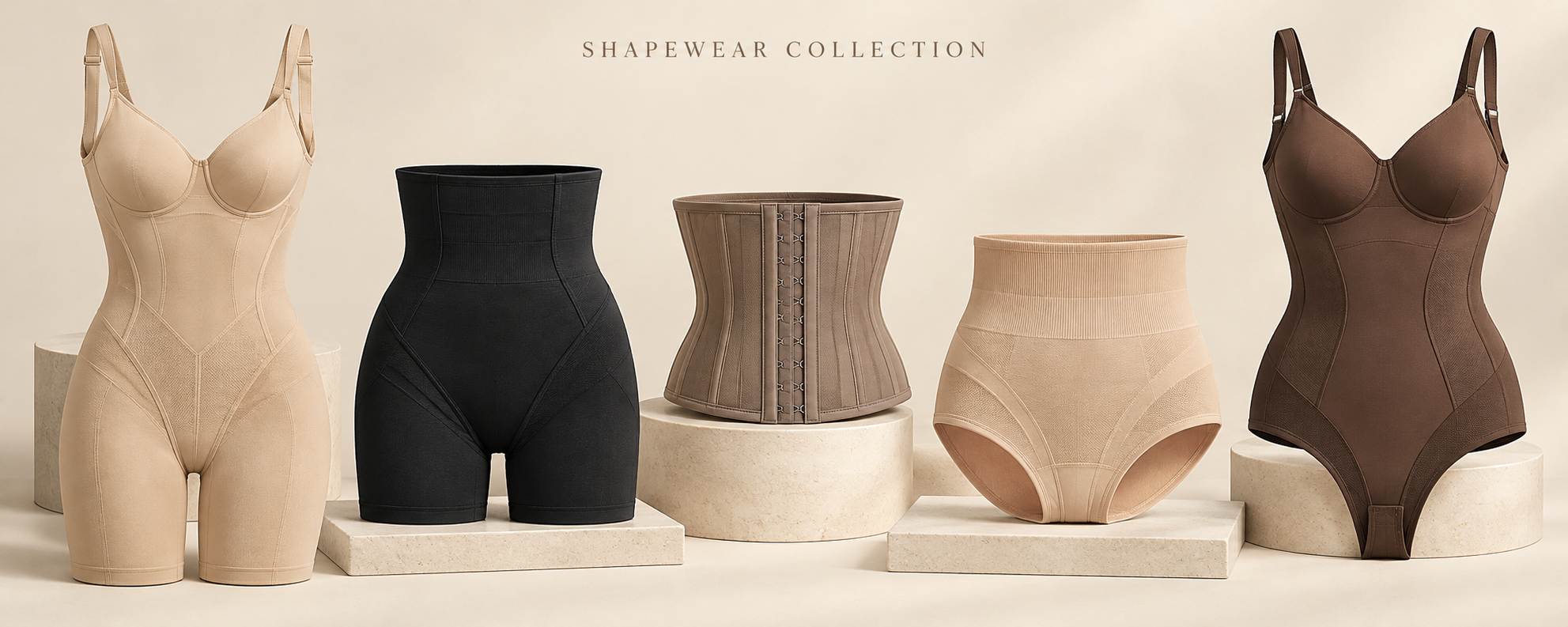
Apparel can support private-label differentiation through fabric, fit, construction, and presentation.
Products to investigate include selected activewear, shapewear, loungewear, and basic garments for a defined audience.
However, a low manufacturing cost can be offset by size-related returns and slow-moving variations.
What We Would Verify
For apparel, we would develop a measurement chart and tolerances rather than accepting size labels alone.
Other checks include:
- Fabric composition.
- Stretch and recovery.
- Shrinkage.
- Colorfastness.
- Seam construction.
- Opacity where relevant.
- Care instructions.
- Performance after washing.
For shapewear, compression, comfort, rolling, and fit deserve particular attention. We would launch with a manageable assortment instead of multiplying sizes, colors, and styles before demand is understood.
19. Small Home Décor
Small décor items can be differentiated through coordinated materials, colors, and styling.
Potential products include selected trays, decorative containers, ornaments, and textile accessories.
We would evaluate the complete delivered product: finish, consistency, protective packaging, breakage, and customer expectations.
Fragile products require packaging trials that reflect the intended distribution channel. Shipping a carton to a retailer and fulfilling individual online orders can expose products to different handling conditions.
The commercial question is whether the design and selling price justify the additional packaging and damage allowance.
20. Specialty B2B Accessories and Consumables
A focused B2B product can be attractive when buyers need consistent specifications and reliable replenishment.
Examples include retail display accessories, document pouches, branded packaging components, and non-critical organizational supplies.
We would begin with a buyer’s purchasing problem:
- Is the current product inconsistent?
- Are replacement orders difficult?
- Does the buyer need customization?
- Can packaging reduce handling time?
- Would consolidated sourcing simplify purchasing?
A repeat order relationship can be valuable, but we would assess customer concentration and payment terms. A profitable order on paper may still create cash-flow pressure if stock must be financed long before payment arrives.
What Makes a Product Profitable to Import From China?
A commercially promising product usually combines several characteristics.
A Clear Customer and Purchase Reason
We should be able to identify who buys the product, what problem it solves, and why our version deserves its price.
“Home storage” is a category. “A compact organizer that fits a narrow bathroom drawer” is a more specific proposition.
Manageable Delivered Cost
Factory cost matters, but so do packed dimensions, handling, damage, and fulfillment.
We would obtain actual carton specifications before comparing suppliers. Estimated dimensions can materially distort the economics of bulky products.
Meaningful Differentiation
Useful differentiation can come from:
- Better fit or dimensions.
- More durable materials.
- Improved instructions.
- A practical bundle.
- Original artwork.
- Better packaging.
- Consistent availability.
- A service tailored to business buyers.
A logo alone rarely resolves a weak product proposition.
Reproducible Quality
The approved sample must translate into repeatable production.
We would document materials, measurements, components, finishes, and packaging so the purchase agreement describes a measurable product.
A Sustainable Inventory Cycle
Profit also depends on how quickly stock sells and how much capital remains tied up.
A product with a lower percentage margin but reliable replenishment demand may generate a better annual return than a slower-moving item with a larger theoretical markup.
How to Calculate Profit When Importing From China
We would separate landed cost, contribution profit, and net profit.
Landed Cost per Unit
For planning purposes:
Landed cost per saleable unit = Total costs to bring inventory to the chosen receiving location ÷ Expected saleable units
Depending on the transaction, the cost model may include:
- Product purchase price.
- Export packaging.
- China inland transport.
- Inspection.
- International freight.
- Cargo insurance.
- Duties and other applicable import charges.
- Customs clearance and destination handling.
- Delivery to the receiving warehouse.
We must check the quotation’s scope to avoid counting the same transport or handling charge twice.
For management analysis, sampling, testing, and setup costs can also be allocated across expected sales. Their accounting treatment should be handled separately.
Contribution Profit per Unit
Contribution profit = Net sales revenue − Landed product cost − Variable selling costs
Variable selling costs can include marketplace fees, fulfillment, advertising, payment processing, and an allowance for returns.
Net Profit
Net profit = Total contribution profit − Fixed operating expenses − Other business expenses
Contribution profit is therefore not the amount the business ultimately keeps.
Example: Factory Price Versus Real Import Profit
The following is a hypothetical planning example, not a supplier quotation or market benchmark.
Assume we sell an organizer set for $24, excluding sales tax.
| Cost item | Illustrative cost per unit |
|---|---|
| Product and retail packaging | $4.00 |
| China inland transport and export handling | $0.30 |
| International freight and insurance | $0.90 |
| Duties and import charges | $1.20 |
| Inspection allocation | $0.20 |
| Destination handling and inbound delivery | $0.40 |
| Landed product cost | $7.00 |
| Marketplace and payment fees | $3.60 |
| Fulfillment and outbound delivery | $4.00 |
| Advertising | $3.00 |
| Returns and defect allowance | $0.80 |
| Total modeled variable cost | $18.40 |
| Contribution profit | $5.60 |
The contribution margin is:
$5.60 ÷ $24 × 100 = 23.3%
The product’s $4 factory price initially appears attractive against a $24 selling price. Once the modeled costs are included, the contribution is $5.60 before fixed overhead and other business expenses.
The import-charge figure above is an assumption for the example. It must be replaced with a product-specific calculation.
Profit Margin and Markup Are Different
If a product costs $10 and sells for $20:
- Markup: ($20 − $10) ÷ $10 = 100%
- Margin: ($20 − $10) ÷ $20 = 50%
Neither figure represents net profit unless all relevant expenses have been included.
Stress-Test the Product Before Ordering
A workable base case should be tested against less favorable conditions.
Using the hypothetical example:
| Scenario | Contribution per unit |
|---|---|
| Base case | $5.60 |
| Advertising increases by $2 | $3.60 |
| Landed cost increases by $1 | $4.60 |
| Selling price falls by $2, with other modeled costs held constant | $3.60 |
| All three changes occur | $0.60 |
The combined scenario leaves little room for fixed expenses or additional problems.
We would also test slower sell-through, higher returns, discounts, storage charges, and the cost of clearing leftover stock.
A product should remain commercially acceptable under realistic pressure, not only under the most favorable assumptions.
How to Research Demand Before Importing
Define the Buyer and Channel First
The same product can produce different results in wholesale, retail, and direct-to-consumer sales.
A distributor may need reliable replenishment and retail-ready cartons. An online brand may need strong photography, individual shipping protection, and enough contribution to fund advertising.
We would establish the channel before finalizing specifications.
Compare Actual Offers
Competitor research should record:
- Effective selling price after discounts.
- Pack quantity.
- Materials.
- Dimensions.
- Delivery promise.
- Included accessories.
- Review complaints.
- Return-related concerns.
A ten-piece set and a two-piece set should not be treated as equivalent merely because their titles use the same keyword.
Use Complaints to Shape Specifications
Reviews can reveal practical improvement opportunities.
For example, repeated complaints about broken zippers can lead to a defined zipper specification, a functional test, and stronger inspection criteria.
We would translate observations into requirements rather than adding vague instructions such as “better quality.”
Validate Willingness to Pay
Depending on the business model, validation may include buyer interviews, sample presentations, retailer feedback, a limited inventory launch, or a carefully measured advertising test.
Expressions of interest are useful. Paid orders and repeat purchases provide stronger evidence.
Where to Source Products From China
We would choose the sourcing route according to product complexity, order size, and the support required.
| Sourcing route | Potential use | What we would verify |
|---|---|---|
| Export-focused online platforms | Initial supplier discovery and quotation comparison | Business identity, actual capabilities, specification match |
| Domestic Chinese platforms such as 1688 | Comparing domestic supply options | Export support, communication, payment and consolidation arrangements |
| Wholesale markets | Reviewing physical assortments and mixed products | Stock availability, repeatability, supplier identity |
| Trade fairs | Comparing samples and discussing development | Production responsibility, follow-up terms, documentation |
| Direct factory sourcing | Stable specifications and repeat production | Capacity, quality systems, customization limits |
| Trading company or sourcing partner | Coordinating several products or suppliers | Fees, responsibilities, transparency, quality control |
The cheapest quoted supplier is not automatically the lowest-cost supply chain.
A capable intermediary may reduce coordination costs on a mixed order. A direct factory may be more suitable for a stable product with sufficient volume. We would compare the complete arrangement.
How to Compare Chinese Supplier Quotations
We should send the same specification to each supplier.
A useful request for quotation includes:
- Product drawings or reference images.
- Materials and dimensions.
- Performance requirements.
- Order quantity by variation.
- Branding and artwork.
- Retail packaging.
- Master-carton requirements.
- Required testing or documentation.
- Delivery location and requested trade terms.
We would then compare quotations on an equivalent basis.
A lower price may reflect thinner material, different packaging, fewer accessories, or an excluded transport cost.
Questions We Would Ask Before Paying a Deposit
- Which company will appear on the contract and invoice?
- Who manufactures the product?
- Which production steps are subcontracted?
- Can the supplier reproduce the approved sample?
- What changes require written approval?
- What happens if inspection fails?
- Which costs are included in the quotation?
- What is the agreed remedy for nonconforming goods?
Written answers reduce ambiguity before money and production time are committed.
Quality Control That Protects Import Margins
Quality control should begin with the specification.
Approve a Production Reference Sample
The reference sample should represent the agreed materials, construction, finish, function, and packaging.
We would record approval clearly so it can be used during production and inspection.
Define Measurable Acceptance Criteria
Instead of “strong packaging,” we would specify the packaging construction and relevant checks.
Instead of “correct size,” we would provide dimensions and tolerances.
For a cosmetic bag, inspection might examine zipper function, seam quality, dimensions, lining, odor, color, and packing quantity.
Inspect Before Shipment
A pre-shipment inspection can identify visible defects and specification failures before dispatch. It does not replace laboratory testing or guarantee every unit.
We would distinguish cosmetic defects from functional failures and safety-critical issues, with an agreed response to each.
Shipping Costs: Compare the Complete Delivery Plan
Shipping should be evaluated using the actual product, packed dimensions, route, urgency, and destination.
| Method | Possible use | Cost considerations |
|---|---|---|
| Express courier | Samples and urgent small shipments | Chargeable weight, clearance, destination charges |
| Air freight | Time-sensitive replenishment | Handling, minimum charges, final delivery |
| Less-than-container-load sea freight | Smaller bulk orders | Origin and destination charges, consolidation handling |
| Full-container-load sea freight | Sufficiently large orders | Container utilization, inland delivery, unloading |
We would request a quotation that identifies inclusions and exclusions rather than comparing a headline freight rate.
A faster shipment can sometimes protect a profitable replenishment cycle. A cheaper shipment can become expensive if it arrives after the sales window.
Import Duties and Product Requirements
The examples in this section focus on the United States. Other destinations require their own classification, tax, labeling, and product-compliance review.
Confirm Classification Before Finalizing the Order
We would confirm the product’s tariff classification and applicable import charges using the current U.S. Harmonized Tariff Schedule and a product-specific review. A supplier’s suggested code is a starting point for verification.
The cost model should use the product’s actual materials, construction, function, origin, and relevant entry details.
A broad category such as “pet accessories” or “home products” is not precise enough to determine the final import cost.
Build Requirements Into Product Development
We would establish the requirements relevant to the product before production, including any necessary testing, labeling, traceability, or certificates.
Supplier documents should correspond to the actual model and specification being purchased.
For children’s products, the U.S. importer’s certification obligations require particular attention; a generic factory certificate does not establish that every item in a shipment complies. CPSC.gov
Keep the Import Arrangement Transparent
Before shipment, we would document who handles clearance, which party is named in the import arrangement, and which charges are included.
An unclear “all-inclusive” delivery price makes it harder to verify costs, responsibilities, and records.
Products That Deserve More Preparation
Some products require more technical, operational, or compliance capability than a first import project can support.
Examples include battery-powered goods, mains-powered products, infant products, ingestible products, products making medical claims, and safety-critical equipment.
These categories may support viable businesses, but their development budgets must account for the work needed to supply them properly.
We would also exclude unauthorized branded goods and copied designs from the sourcing shortlist.
The appropriate product is one we can specify, evaluate, document, and support.
A Practical China Import Workflow
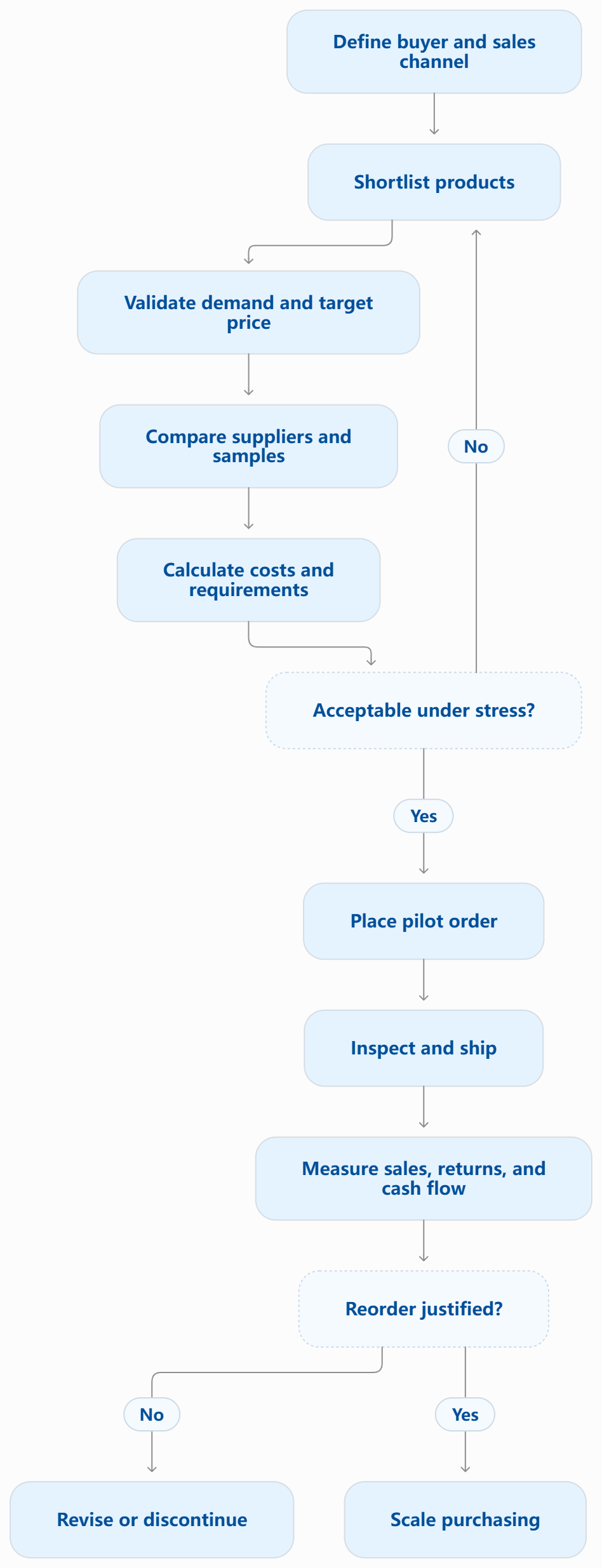
How Much Should We Budget for a First Import Order?
The budget should cover the full buying and selling cycle.
We would allocate funds for:
- Samples and development.
- Testing and documentation where required.
- Production.
- Inspection.
- Freight and import charges.
- Receiving and storage.
- Photography and listing preparation.
- Sales and advertising.
- Returns and contingency.
- Replenishment.
A business can sell profitably and still experience a cash shortage if the next production deposit is due before earlier inventory has converted into available cash.
We would preserve working capital rather than spending the entire budget on the largest possible opening order.
How to Choose an Initial Product Range
A focused launch makes results easier to interpret.
For an online brand, we might begin with one principal product and a few useful variations. For a distributor, we might test a small collection with a clear merchandising purpose.
The initial order should help answer specific questions:
- Will buyers accept the intended price?
- Which variation sells?
- Do customers understand the dimensions?
- What causes returns?
- Can the supplier maintain quality?
- Does the replenishment lead time fit the sales cycle?
A pilot order is valuable when it produces reliable evidence for the next purchasing decision.
Frequently Asked Questions About Profitable Imports From China

What are the most profitable items to import from China?
Our initial shortlist includes home organizers, non-powered phone accessories, cosmetic bags, adult stationery, travel organizers, pet accessories, and gift packaging. The best choice depends on verified demand, delivered cost, selling expenses, quality, and inventory turnover.
What small products can we import from China and resell?
Products to evaluate include hair accessories, cable organizers, cosmetic pouches, selected stationery, and compact travel accessories. Small dimensions can help transport and storage economics, but low selling prices may leave little room for individual fulfillment and advertising.
Which products are suitable for a first import order?
We would favor products with measurable specifications, a manageable number of variations, limited breakage exposure, and requirements the business can properly handle. Adult stationery, selected textile pouches, and simple organizational accessories are possible starting points.
Is a high markup enough to make an imported product profitable?
No. Markup compares selling price with a selected cost base. Import profitability also depends on freight, duties, selling fees, fulfillment, advertising, returns, overhead, and unsold inventory.
Is importing directly from a factory always cheaper?
The factory’s unit price may be attractive, but the complete cost also includes minimum quantities, coordination, inspection, packaging, and logistics. We would compare direct sourcing with other routes using the same specification and delivery scope.
Should we import generic products or create a private label?
Generic products can help test demand. Private labeling can support differentiation when accompanied by useful product improvements, consistent quality, and a clear customer proposition. Branding also introduces artwork, packaging, and potentially larger order commitments.
How do we reduce the risk of a first order?
We would validate the buyer and selling price, approve samples, document specifications, confirm product requirements, calculate complete costs, inspect production, and keep the initial inventory commitment proportionate to the evidence available.
Can we import several products in one shipment?
Consolidation may be practical, but savings should be compared with collection, handling, inspection, documentation, and warehouse charges. Each product still needs accurate specifications and its own applicable import review.
What profit margin should we target?
We would set a target that covers fixed expenses, supports replenishment, and remains acceptable under realistic cost increases or price reductions. A wholesale business and an advertising-dependent online brand may need different contribution structures.
When should we increase order quantities?
We would scale after confirming sell-through, return rates, actual contribution profit, supplier consistency, and available working capital. A volume discount is useful only when the additional inventory can be sold economically.
Build the Import Business Around Repeatable Profit
We would begin with a defined customer, a specific product advantage, and a complete cost model. Then we would validate demand, approve the specification, and use a controlled opening order to measure the real result.
The purchasing decision should answer four questions: Will it sell at the planned price? Can it arrive at the planned cost? Can the supplier reproduce the quality? Will the cash cycle support replenishment?
Products that satisfy those conditions deserve a place on the sourcing shortlist—and evidence from the first orders should determine which ones we scale.