










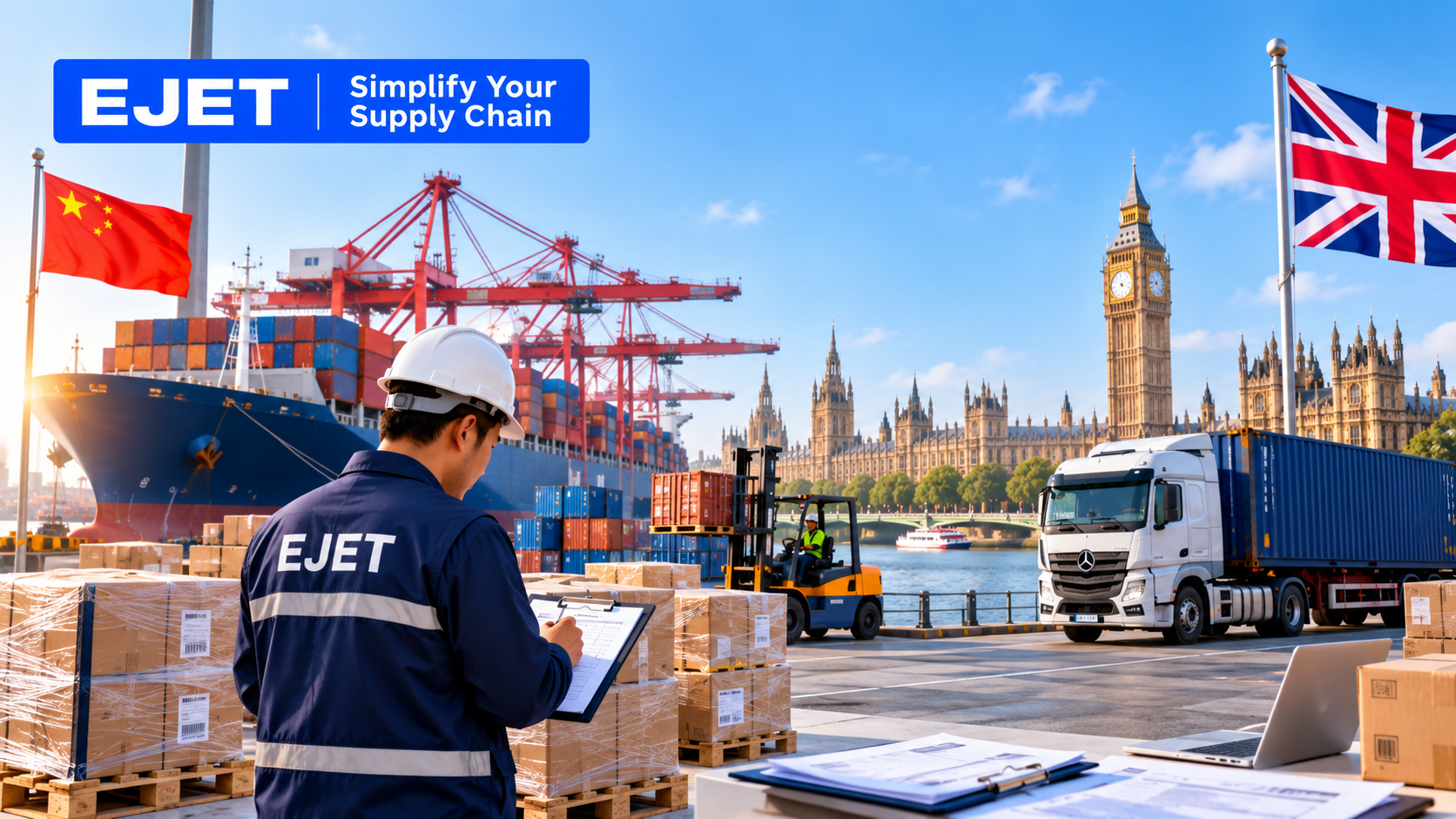
Importing products from China to the United Kingdom offers significant opportunities for businesses seeking competitive manufacturing costs, diverse product ranges, and reliable supply chains.
However, successful importing requires a thorough understanding of UK customs regulations, import duties, VAT, shipping methods, supplier verification, and product compliance.
Whether we are importing products for an established wholesale business, launching an e-commerce store, or purchasing goods for the first time, following the correct procedures helps us minimise costs, avoid customs delays, and protect our investment.
In this comprehensive guide, we explain how to import from China to the UK step by step, including the documents required, shipping costs, customs clearance procedures, and strategies for finding trustworthy Chinese manufacturers.
1. Understanding the Process of Importing from China to the UK
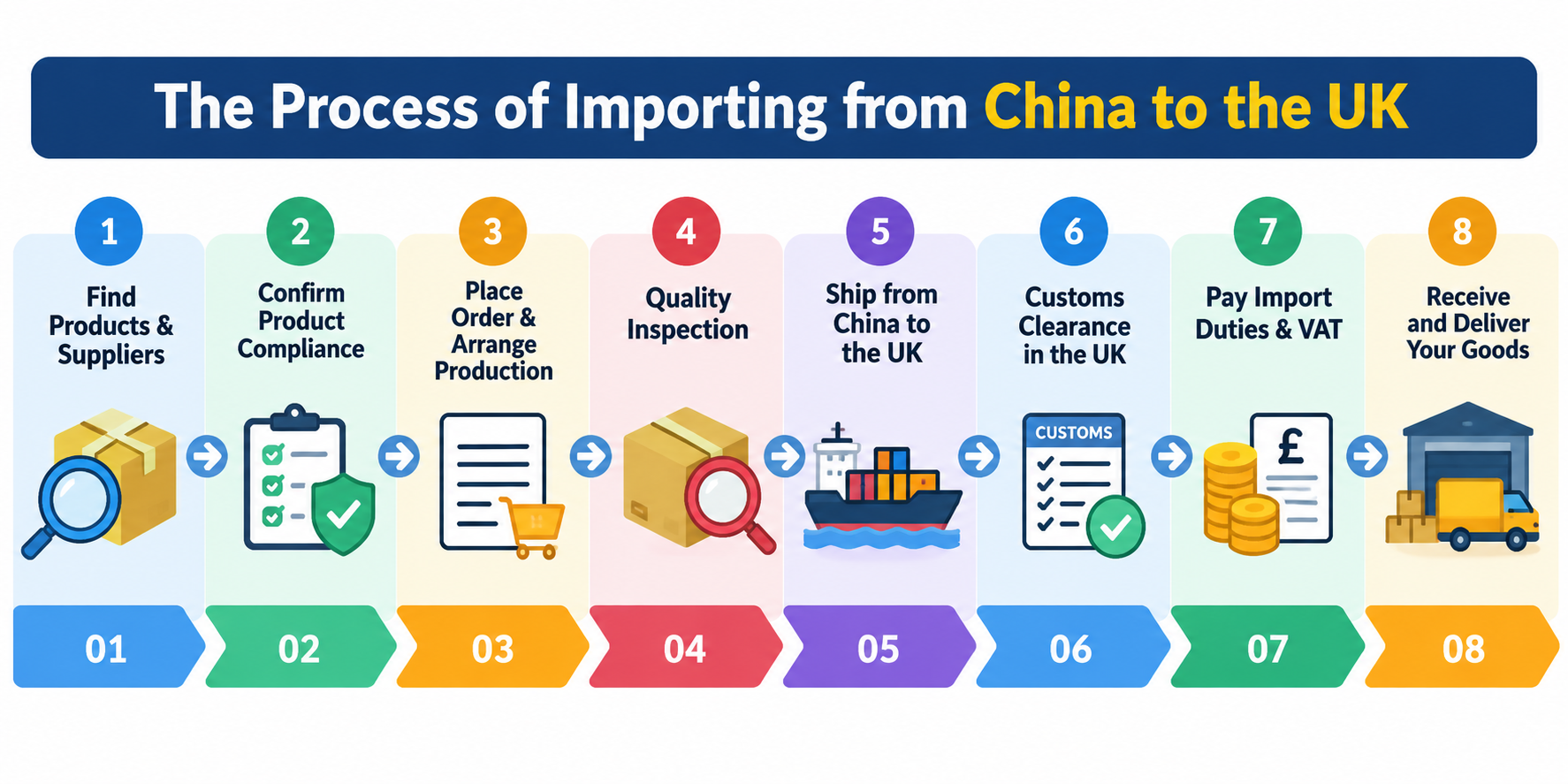
Before importing goods from China, we must understand the essential stages of international trade.
Here are a few ways to structure and refine these combined sentences into a smooth, professional section:
Identifying suitable products and researching UK market demand.
Finding reliable manufacturers or suppliers in China.
Requesting quotations and negotiating purchase terms.
Checking product quality and UK regulatory compliance.
Obtaining a UK Economic Operators Registration and Identification (EORI) number.
Selecting an appropriate international shipping method.
Preparing commercial invoices, packing lists, and shipping documents.
Calculating customs duties and import VAT.
Completing UK customs declarations.
Arranging delivery to our warehouse, fulfilment centre, or business premises.
2. Finding Reliable Suppliers and Manufacturers in China
Choosing the right supplier is one of the most important decisions when importing from China.
China has an extensive manufacturing network covering electronics, clothing, furniture, machinery, household products, packaging materials, and industrial components.
However, supplier quality, manufacturing capabilities, pricing structures, and export experience vary considerably.
Where to Find Chinese Suppliers
Several established sourcing platforms help us connect with Chinese manufacturers.
|
Supplier platform |
Main advantages |
Best suited for |
|---|---|---|
|
Alibaba |
Extensive supplier network and sourcing tools |
Wholesale and bulk purchasing |
|
Made-in-China |
Industrial suppliers and manufacturers |
Machinery and industrial products |
|
Global Sources |
Verified supplier information and trade exhibitions |
Electronics and consumer products |
|
1688 |
Access to China's domestic wholesale market |
Buyers using Chinese-speaking sourcing agents |
|
Canton Fair |
Direct contact with manufacturers |
Businesses seeking long-term suppliers |
Although online sourcing platforms simplify supplier discovery, we should never assume that every listed business is a genuine manufacturer.
How to Verify Chinese Suppliers
Before placing a substantial order, we recommend conducting supplier due diligence.
We should request the supplier's Chinese business licence, verify its registered company name, confirm manufacturing capabilities, and review its export experience.
Where appropriate, we can commission an independent factory audit.
We should also request product samples before committing to mass production.
Product sampling allows us to assess materials, workmanship, packaging, functionality, and overall manufacturing quality.
For high-value orders, a third-party inspection company can examine finished products before shipment.
This reduces the risk of receiving defective or incorrectly manufactured goods.
3. Do We Need an Import Licence to Import from China to the UK?
Most ordinary commercial products can be imported into the UK without a general import licence.
Firearms and certain controlled goods.
Some agricultural products and food products.
Certain chemicals and hazardous substances.
Medicines and regulated medical products.
Products subject to trade sanctions or specific import controls.
Because of these variations, we must verify the precise requirements for our exact product before issuing an order. Fortunately, for most consumer goods, the principal obligation is not securing an import licence, but rather proving compliance with applicable UK product safety and technical regulations.
Official guidance is available through GOV.UK: Import goods into the UK.
4. Obtaining a UK EORI Number
Businesses importing goods into Great Britain generally need an EORI number beginning with GB.
EORI stands for Economic Operators Registration and Identification.
This number identifies businesses when dealing with customs authorities.
How to Apply for an EORI Number
We can apply through the UK government's official website.
The application is free.
Depending on our business structure, we may need information such as:
Registered business name and address.
Company registration details.
VAT registration number, where applicable.
Unique Taxpayer Reference, where applicable.
Contact information.
Once issued, the EORI number can be used for relevant customs activities.
Businesses trading with Northern Ireland may also require an XI EORI number, depending on their circumstances.
We should obtain the appropriate EORI registration before goods arrive to avoid unnecessary clearance delays.
Official application: Apply for an EORI number.
5. Understanding UK Import Duty on Goods from China
One of the most frequently asked questions is:
How much import duty do we pay when importing from China to the UK?
The answer depends on the product's commodity classification, customs value, origin, and any applicable trade measures.
There is no single customs duty rate covering all Chinese imports.
Some products have a zero standard customs duty rate, while others attract higher rates.
How to Find the Correct Commodity Code
Every imported product must be classified using the appropriate commodity code.
The commodity code determines:
Applicable customs duty.
Relevant import restrictions.
Additional trade measures.
Documentation requirements.
Statistical reporting classifications.
We can identify the correct code using the UK Trade Tariff.
For example, clothing, electronic equipment, furniture, and industrial machinery are classified under different tariff headings.
The precise product specification matters. Two products that appear similar may fall under different classifications.
We should avoid relying on a supplier's suggested commodity code without verifying its accuracy.
How Customs Duty Is Calculated
For many imports, customs duty is calculated as a percentage of the customs value.
The customs value generally includes the purchase price and certain additional costs, including qualifying transport and insurance expenses up to the relevant UK border point.
Illustrative example:
|
Cost component |
Amount |
|
Goods purchased from China |
£5,000 |
|
Freight and insurance included in customs value |
£800 |
|
Customs value |
£5,800 |
|
Assumed customs duty rate |
5% |
|
Customs duty payable |
£290 |
In this example:
£5,800 × 5% = £290 customs duty
The 5% rate is illustrative, not a universal rate for imports from China.
Certain products may also be subject to anti-dumping duties, countervailing duties, or other trade remedies.
These measures must be checked separately.
6. Understanding Import VAT from China to the UK
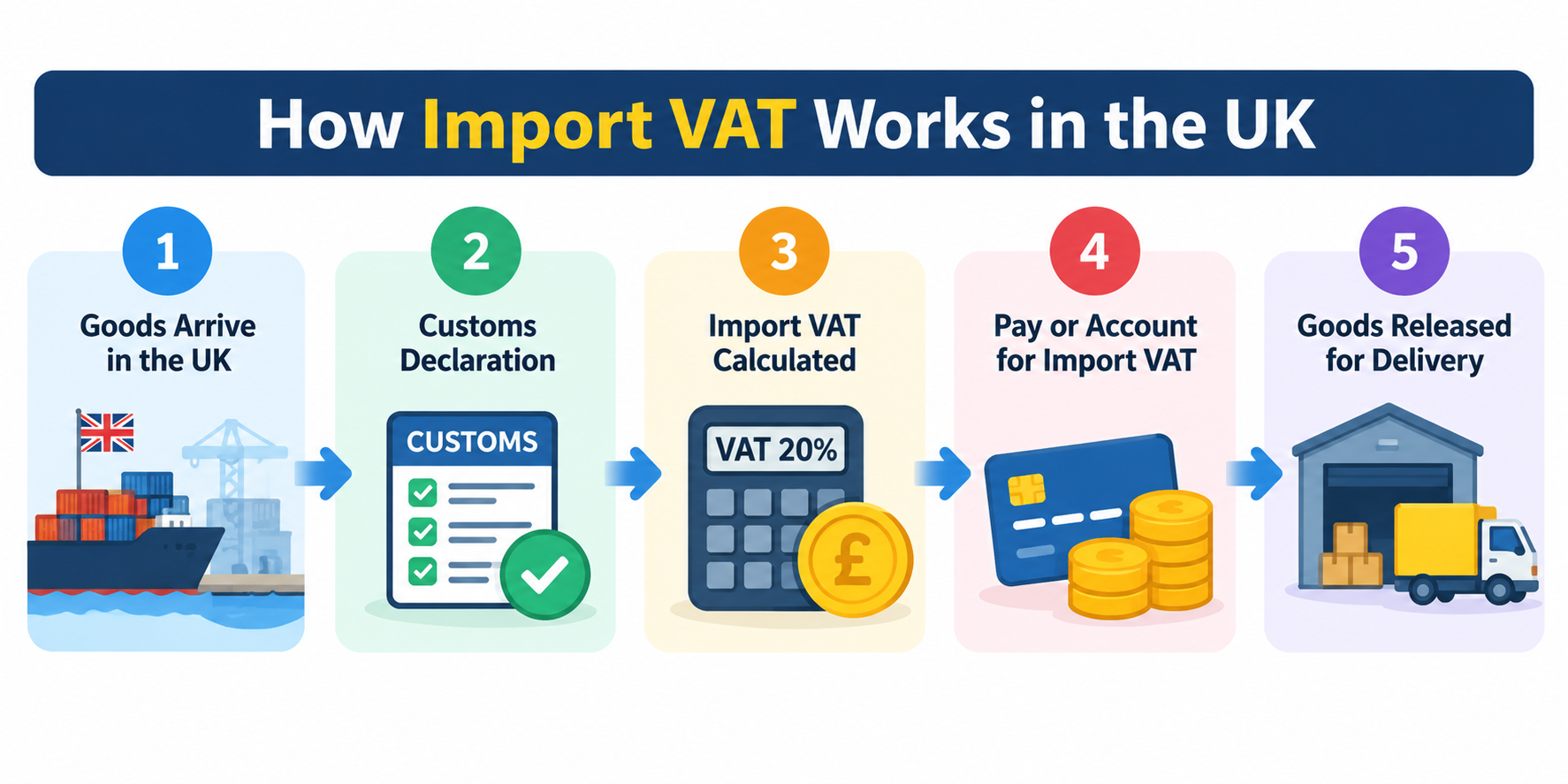
In addition to customs duty, imported goods may be subject to UK import VAT.
The standard UK VAT rate is 20%, although reduced rates or zero-rating apply to qualifying products.
Import VAT is not always calculated solely on the supplier's invoice value.
Its taxable base generally includes the customs value, customs duty, and certain additional incidental expenses.
Example of Import VAT Calculation
Using the previous example, and assuming no additional costs need to be added to the import VAT base:
|
Description |
Amount |
|---|---|
|
Customs value |
£5,800 |
|
Customs duty |
£290 |
|
Import VAT base |
£6,090 |
|
VAT at 20% |
£1,218 |
|
Total duty and import VAT |
£1,508 |
We would therefore pay £290 in customs duty and account for £1,218 in import VAT.
Can We Reclaim Import VAT?
UK VAT-registered businesses may be able to recover import VAT as input tax, subject to normal VAT recovery rules and appropriate evidence.
Eligible businesses can also use Postponed VAT Accounting (PVA) to account for import VAT through their VAT returns rather than paying it upfront at the border.
This can significantly improve cash flow.
However, customs duty is generally a business cost rather than recoverable input VAT.
7. Shipping from China to the UK: Sea Freight, Air Freight, and Courier
Selecting the right shipping method is essential for controlling import costs.
The three principal options are sea freight, air freight, and international express courier services.
Comparison of Shipping Methods from China to the UK
|
Shipping Method |
Estimated Transit Time |
Shipping Cost |
Best For |
Key Advantages |
|---|---|---|---|---|
|
Sea Freight (FCL) |
30–45+ days |
Low per unit for large shipments |
Large-volume orders and full containers |
Cost-effective for bulk goods and heavy cargo |
|
Sea Freight (LCL) |
35–50+ days |
Low to moderate |
Small and medium-sized shipments |
No need to book an entire container |
|
Air Freight |
3–10 days |
High |
Urgent, valuable, or lightweight products |
Faster transportation and shorter replenishment cycles |
|
Express Courier (DHL, FedEx, UPS) |
2–7 working days |
High to very high |
Samples, small parcels, and urgent orders |
Convenient door-to-door service and tracking |
Note: Transit times are indicative and depend on the departure city, destination, shipping route, customs clearance, and carrier schedules.
These times are planning estimates, not guaranteed delivery schedules. Customs clearance, collection, congestion, and final-mile delivery can add time.
Full Container Load (FCL) vs Less Than Container Load (LCL)
For sea freight, we generally choose between two arrangements.
Full Container Load (FCL) means we reserve a container for our shipment. Common container sizes include 20-foot and 40-foot units.
Less Than Container Load (LCL) allows us to share container space with other importers.
LCL can be more cost-effective for smaller shipments, although consolidation and deconsolidation charges can increase handling costs.
We should compare total delivered prices rather than looking only at the initial ocean freight quotation.
8. How Much Does Shipping from China to the UK Cost?
Shipping costs depend on shipment dimensions, weight, origin, destination, transport method, and market conditions.
There is no reliable fixed shipping price applicable to every route.
We should request current quotations from freight forwarders using accurate shipment information.
A comprehensive freight quotation should identify:
Collection and export handling charges.
International freight charges.
Fuel and other applicable surcharges.
Destination terminal and handling fees.
Customs clearance fees.
Delivery to the final destination.
Cargo insurance, where requested.
Any storage or additional inspection charges
For air freight, chargeable weight may be based on volumetric weight rather than actual weight.
For sea freight, LCL pricing commonly uses shipment volume and weight-based charging rules.
The cheapest freight quotation is not necessarily the cheapest total shipping solution.
Unexpected destination charges can make an initially attractive offer significantly more expensive.
9. Understanding Incoterms When Importing from China
Incoterms define key responsibilities between buyers and sellers in international trade.
They establish which party arranges certain transport activities, bears specified costs, and carries transport risk at different stages.
They do not, by themselves, determine ownership of goods or replace the purchase contract.
The following terms are commonly encountered when sourcing from China.
|
Incoterm |
Main arrangement |
Important consideration |
|---|---|---|
|
EXW |
Buyer assumes extensive collection and transport responsibilities |
Can create export clearance complications |
|
FOB |
Seller delivers goods on board the vessel at the named port |
Common for sea freight |
|
CIF |
Seller pays ocean freight and minimum insurance to the named destination port |
Buyer still faces destination costs and import formalities |
|
DAP |
Seller arranges delivery to the named destination |
Buyer normally handles import clearance and duties |
|
DDP |
Seller undertakes delivery with import clearance and applicable duties and taxes |
Requires careful verification of customs and tax arrangements |
Which Incoterm Is Best for Importing from China?
For established importers using sea freight, FOB is often a practical option because it provides greater control over international freight arrangements.
For smaller buyers, DAP may simplify transport coordination while retaining transparency over import taxes.
DDP can appear convenient, but we should verify who acts as importer, how customs declarations are made, and whether VAT documentation will be available.
The chosen Incoterm should be clearly stated in the purchase agreement, including the named location and reference to Incoterms 2020.
10. Documents Required to Import Goods from China to the UK
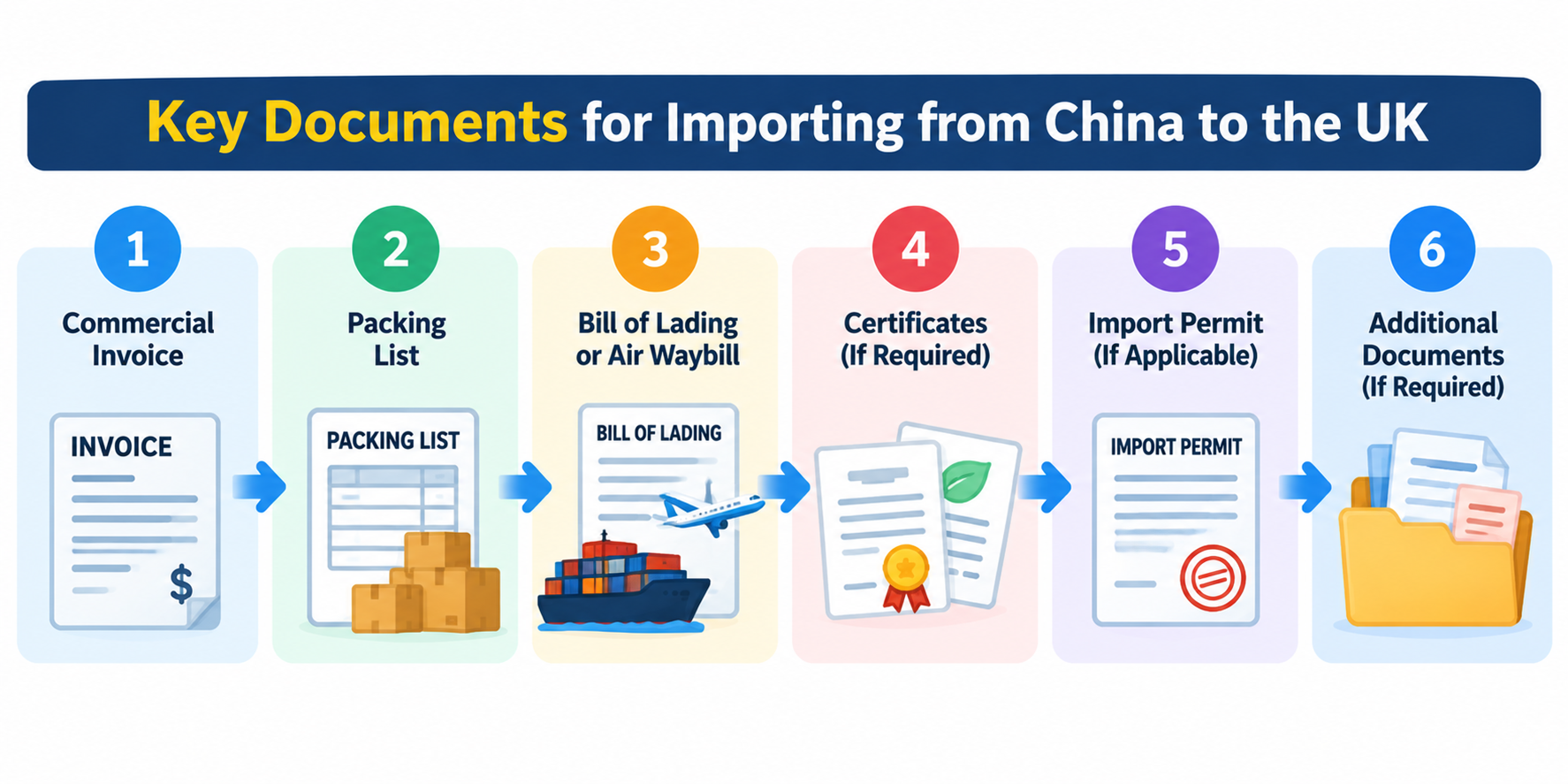
Accurate documentation is essential for successful customs clearance.
The documents required vary according to product type, shipping method, and regulatory requirements.
Commercial Invoice
The commercial invoice provides essential transaction information, including the buyer, seller, product description, quantity, price, currency, and agreed delivery terms.
It should accurately reflect the transaction.
Packing List
The packing list identifies package quantities, dimensions, gross and net weights, and contents.
It assists customs officers, freight forwarders, and warehouse operators.
Bill of Lading or Air Waybill
A bill of lading is commonly used for sea freight.
An air waybill is used for air cargo.
These documents provide transport and shipment information.
Certificates and Compliance Documents
Depending on the product, additional documents may include:
Markdown / Text Version:
Product test reports.
Declarations of conformity.
Relevant safety certificates.
Certificates of origin where required.
Import permits or licences.
Phytosanitary or veterinary documentation.
Technical files and product specifications.
We should establish the documentation requirements before manufacturing begins.
11. UK Product Safety Regulations and Compliance Requirements
Product compliance is one of the most important aspects of importing from China.
Goods legally manufactured and sold in China are not automatically suitable for sale in the UK.
We must check the applicable requirements for the specific product and intended UK market.
UKCA and CE Marking
Certain regulated products require conformity assessment and appropriate markings.
Depending on the product category and applicable legislation, CE marking may continue to be recognised in Great Britain, while UKCA marking is also available under relevant regulatory frameworks.
Northern Ireland has distinct requirements for certain goods.
We must therefore verify the current rules for the particular product rather than assuming that all goods require UKCA marking or that CE marking is always sufficient.
Electrical Products
Electrical goods may be subject to requirements concerning electrical safety, electromagnetic compatibility, hazardous substances, plugs, and labelling.
We should obtain appropriate compliance documentation and verify that the products meet relevant UK standards.
Toys and Children's Products
Toys are subject to stringent safety requirements.
We should assess risks relating to small parts, choking hazards, chemical substances, flammability, and mechanical safety.
Cosmetics and Personal Care Products
Cosmetic products may require safety assessments, responsible-person arrangements, notifications, and compliant ingredient labelling.
Food and Food-Contact Materials
Food products and materials intended to contact food can be subject to additional import controls and safety requirements.
A supplier's claim that a product is certified does not remove our responsibility to verify compliance.
12. How UK Customs Clearance Works
When goods arrive in the UK, they must be dealt with under the appropriate customs procedure.
For a typical commercial import into Great Britain, customs declarations are submitted through HMRC's Customs Declaration Service (CDS).
We may complete declarations ourselves if properly equipped and authorised, or appoint a customs agent.
The clearance process generally involves confirming the importer, commodity classification, customs value, origin, applicable procedure, and any required licences or supporting documents.
Duties and taxes must then be paid, deferred, or accounted for through an authorised arrangement.
Goods can be released once the applicable customs requirements have been satisfied.
Should We Use a Customs Broker?
For businesses unfamiliar with import procedures, using an experienced customs broker can reduce administrative complexity.
However, appointing a broker does not automatically transfer all legal responsibility away from the importer.
We should confirm whether the broker acts as a direct or indirect representative and ensure that declarations use accurate information.
13. Calculating the Total Landed Cost of Goods Imported from China
To determine whether importing a product is commercially viable, we must calculate its total landed cost.
This includes much more than the supplier's selling price.
The calculation should incorporate product costs, international freight, insurance, customs duty, clearance fees, domestic delivery, and other applicable charges.
Example: Importing 1,000 Units from China
|
Expense |
Amount |
|---|---|
|
Product purchase cost |
£5,000 |
|
Freight and insurance |
£800 |
|
Customs duty at assumed 5% |
£290 |
|
Customs clearance and handling |
£150 |
|
UK delivery |
£200 |
|
Total cost excluding recoverable VAT |
£6,440 |
|
Landed cost per unit |
£6.44 |
This example assumes that freight and insurance are included in the £5,800 customs value and that no additional duty adjustments apply.
Import VAT is excluded from the landed cost on the assumption that the business can fully recover it. Businesses unable to recover VAT should account for it as a cost.
If we sell each unit for £12 excluding VAT, our gross profit before selling, storage, marketing, and other operating expenses would be:
£12 − £6.44 = £5.56 per unit
That represents an illustrative gross margin of approximately 46.3%.
We should also allow for defective units, returns, currency movements, and inventory financing.
14. How to Avoid Common Problems When Importing from China
Importing from overseas involves commercial and operational risks.
Fortunately, many common problems can be reduced through effective planning.
Poor Product Quality
We should approve a production sample and provide detailed specifications covering materials, dimensions, tolerances, packaging, and acceptable quality levels.
Independent pre-shipment inspections can help identify defects before goods leave the factory.
Unexpected Customs Charges
We should verify commodity codes, customs valuation, applicable trade remedies, and destination handling fees before ordering.
Shipping Delays
We should allow additional time for peak shipping periods, customs examinations, port congestion, and supplier production delays.
Supplier Fraud
We should independently verify supplier identities and payment instructions.
Bank account changes should be confirmed using a previously verified communication channel.
Incorrect Documentation
Commercial invoices, packing lists, transport documents, and customs declarations should contain consistent and accurate information.
Intellectual Property Problems
We should avoid importing counterfeit goods or products that infringe trademarks, patents, or registered designs.
Where we develop our own branded products, we should consider appropriate contractual protections and intellectual property registration.
15. Importing from China to the UK for Amazon FBA and E-Commerce
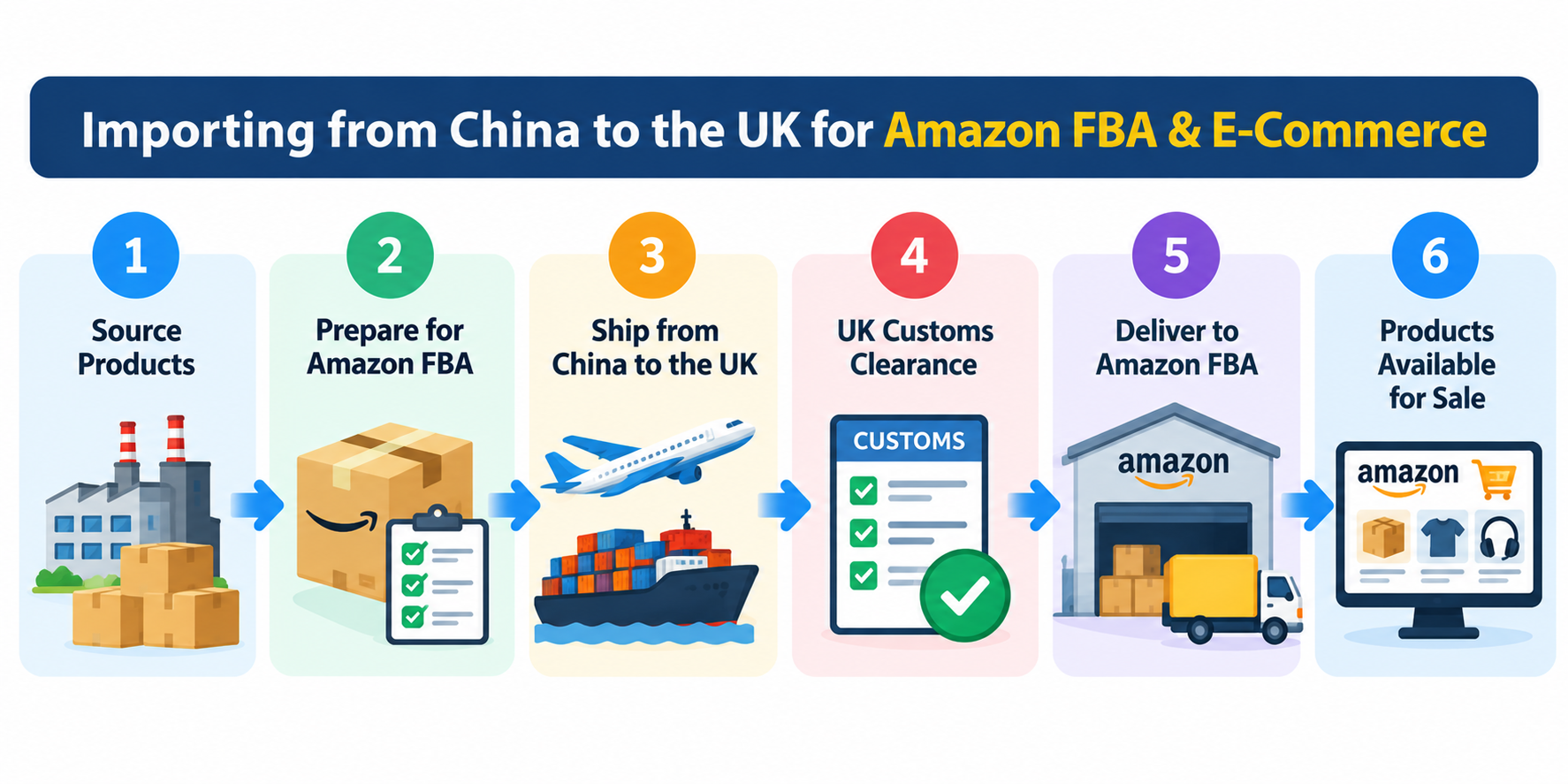
Many UK businesses import Chinese-manufactured products for sale through Amazon, Shopify, eBay, and other e-commerce channels.
This business model requires additional planning.
For Amazon FBA, we must consider packaging requirements, product labelling, fulfilment centre delivery procedures, inventory restrictions, and marketplace compliance policies.
We should also calculate marketplace referral fees, fulfilment fees, storage costs, returns, and advertising expenditure.
A product with a low factory price may still generate poor profit after these expenses.
Can We Ship Directly from China to Amazon FBA?
Yes, direct shipment may be possible when all applicable import, customs, carrier, and Amazon receiving requirements are satisfied.
However, Amazon generally does not act as the importer of record for third-party sellers.
We must establish an appropriate import arrangement and ensure that the shipment is cleared correctly before delivery.
For first-time importers, routing goods through a UK inspection or preparation facility may provide greater control over labelling and quality.
16. How to Negotiate Better Prices with Chinese Suppliers
Successful importing is not simply about obtaining the lowest unit price.
We should negotiate the overall commercial arrangement.
Important factors include production quality, minimum order quantities, payment terms, tooling ownership, lead times, packaging specifications, and defect remedies.
Practical Negotiation Strategies
We can request quotations at different order volumes to identify quantity-based pricing opportunities.
We can also ask suppliers to quote alternative materials or packaging configurations without compromising essential quality or safety.
For repeat orders, we may negotiate more favourable terms after establishing a reliable payment and purchasing history.
When making advance payments, we should consider the supplier's credibility and the protections available through the chosen payment method.
A written manufacturing agreement should clearly define product specifications, inspection rights, delivery deadlines, and procedures for addressing defective goods.
17. How Long Does It Take to Import from China to the UK?
The complete importing timeline includes more than international shipping.
We must account for supplier selection, sampling, manufacturing, inspections, transport, customs clearance, and final delivery.
|
Import stage |
Illustrative planning time |
|---|---|
|
Supplier research and verification |
1–3 weeks |
|
Product sampling and approval |
1–3 weeks |
|
Manufacturing |
2–6 weeks |
|
Pre-shipment inspection |
1–3 days |
|
Sea freight |
30–45+ days port to port |
|
Customs clearance and delivery |
Variable |
These stages may overlap, and actual times depend on the product and supplier.
For a new product sourced by sea, planning several months from initial sourcing to warehouse availability is often sensible.
Repeat orders from established suppliers may be considerably faster.
18. Frequently Asked Questions About Importing from China to the UK
Is it legal to import products from China to the UK?
Yes. Importing goods from China is generally legal, provided the products are not prohibited and all applicable customs, safety, licensing, and regulatory requirements are met.
Do we need a registered company to import from China?
Not necessarily. Individuals and sole traders may import goods, but commercial importing can create customs, tax, product safety, and business registration obligations.
The appropriate arrangements depend on the nature and scale of the activity.
How much customs duty will we pay on Chinese goods?
Customs duty depends on the product's commodity code, origin, customs value, and any applicable trade measures.
We should check the UK Trade Tariff for the precise classification.
Do we pay VAT when importing from China?
Import VAT generally applies unless the goods qualify for an exemption or a reduced or zero rate.
Eligible VAT-registered businesses may be able to recover import VAT or use Postponed VAT Accounting.
What is the cheapest way to ship goods from China to the UK?
Sea freight is generally the most economical option for large or heavy shipments.
For very small consignments, express courier services may offer better overall value because of simplified handling and delivery arrangements.
Can we import goods from China without using a freight forwarder?
Yes, but managing international transport, documentation, and customs procedures independently can be complicated.
A freight forwarder can coordinate transport and associated logistics services.
How do we pay Chinese suppliers safely?
We should verify supplier bank details, use written purchase agreements, and consider secure payment arrangements appropriate to the transaction value.
For larger transactions, documentary letters of credit may offer additional protection when correctly structured.
Are Chinese products subject to additional tariffs in the UK?
Some products may be subject to anti-dumping duties, countervailing duties, or other trade measures.
These are product-specific and must be checked against current UK trade remedy rules.
Can we import branded products from China?
We may import genuine branded products where we have the necessary legal rights and the import complies with applicable intellectual property rules.
We should not assume that a Chinese supplier is authorised to sell products bearing a third party's trademark.
What is the minimum order quantity when importing from China?
There is no universal minimum order quantity.
Each manufacturer establishes its own requirements, which may vary according to product complexity, materials, production processes, and customisation.
Some suppliers accept small trial orders, while others require substantial production volumes.
19. Essential Checklist Before Importing from China to the UK
Before placing our first order, we should complete the following checks:
-
Confirm market demand and calculate realistic selling prices.
-
Verify the Chinese supplier's legal identity and manufacturing capabilities.
-
Approve product samples and written specifications.
-
Check product safety, labelling, and conformity requirements.
-
Identify the correct UK commodity code.
-
Verify import licences, restrictions, and trade remedy measures.
-
Obtain the appropriate EORI number.
-
Agree on Incoterms and shipping responsibilities.
-
Request a complete freight quotation.
-
Calculate customs duty, import VAT, and landed cost.
-
Prepare accurate commercial and shipping documents.
-
Arrange appropriate cargo insurance.
-
Confirm customs clearance and final delivery arrangements.
-
Inspect goods before shipment where commercially justified.
20. Final Thoughts: Building a Profitable China-to-UK Import Business
Importing from China to the UK can provide access to competitive manufacturing prices, extensive product choices, and scalable sourcing opportunities.
However, successful importing depends on more than identifying inexpensive products.
We must establish reliable supplier relationships, verify product compliance, understand UK customs procedures, and calculate every significant cost before committing capital.
The most effective importing strategy combines supplier due diligence, accurate customs planning, quality control, and transparent logistics arrangements.
By approaching each shipment systematically, we can reduce avoidable risks, protect profit margins, and build a dependable supply chain that supports long-term business growth.
For current legal requirements, customs classifications, and tax guidance, we should consult official UK government resources before shipping.