










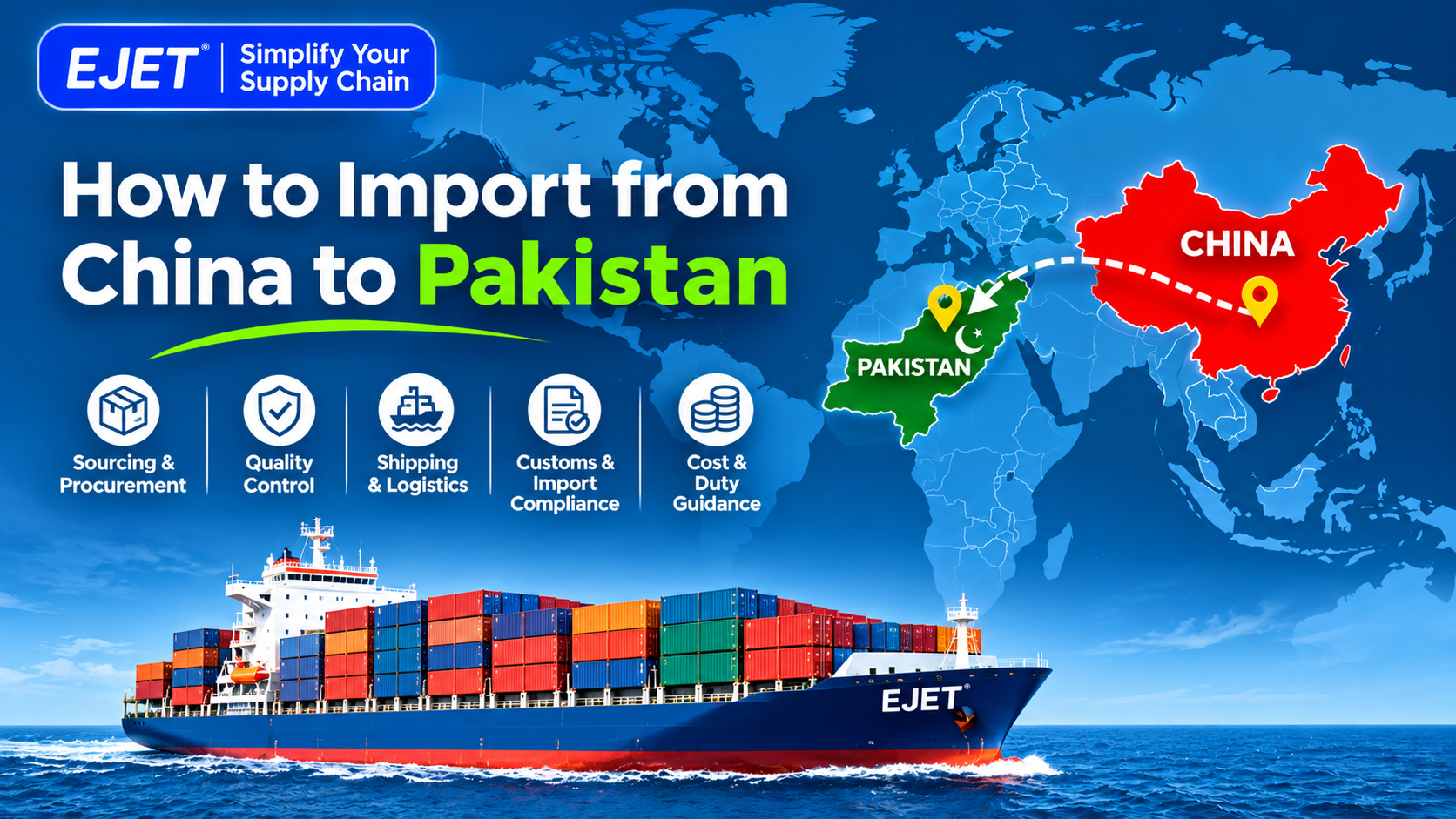
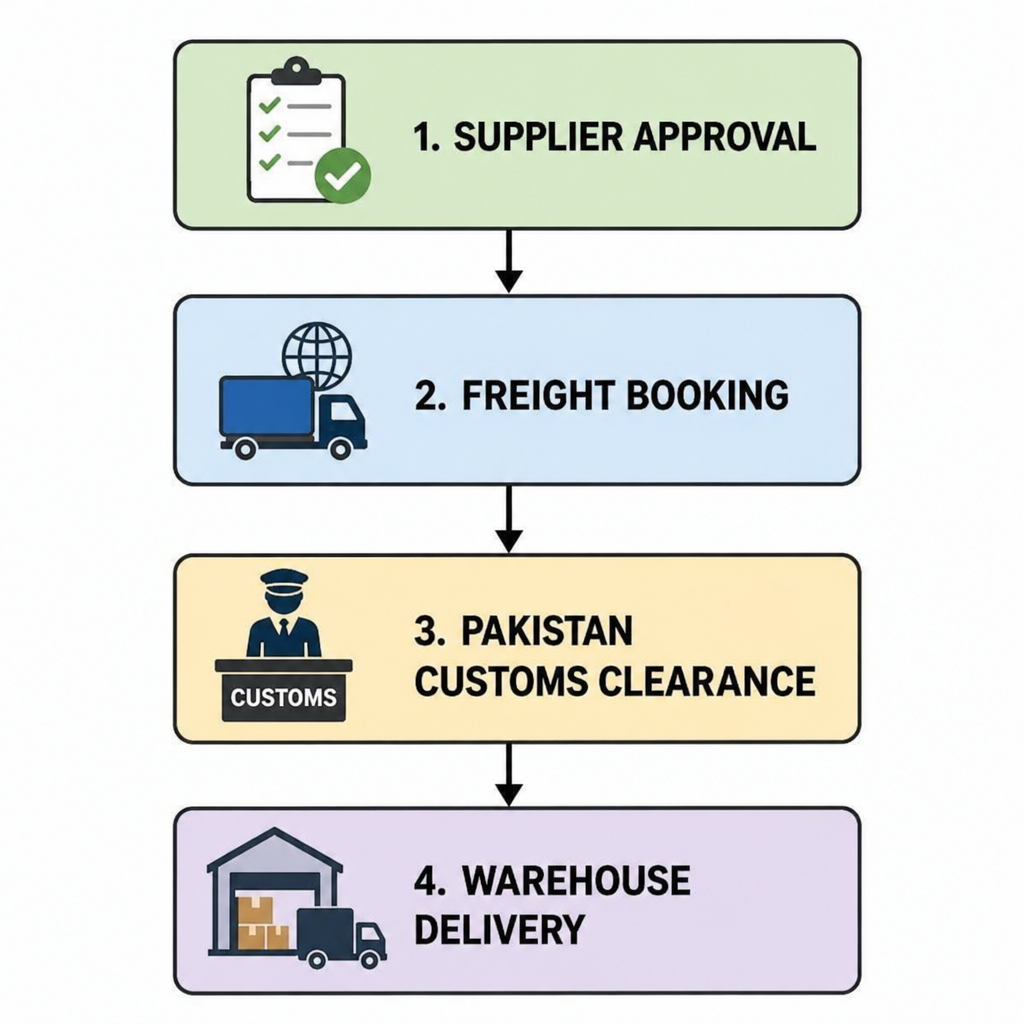
Importing from China to Pakistan involves checking product eligibility, preparing your business registrations, selecting a supplier, arranging payment and freight, and clearing Pakistan Customs.
This China import guide explains how to approach those decisions, estimate your landed cost, and prepare a manageable first order.
Start with the product’s classification and legal requirements—not the supplier’s lowest price.
What do you need to import from China to Pakistan?
For a commercial shipment, prepare your tax and business identification, obtain access to Pakistan Single Window (PSW), establish the required banking profile, and check the rules for your specific goods.
PSW’s subscription process requests details including your CNIC, National Tax Number (NTN), and SECP number where applicable. Filing an import Single Declaration also requires a PSW subscription and an integrated banking profile.
Do not treat registration as permission to import every product. Pakistan’s Import Policy Order distinguishes prohibited goods from restricted goods that must meet specified conditions. Review the applicable order, amendments, and product-specific requirements before committing money.
Use this starting checklist:
- Describe the product precisely: Record its material, function, model, intended use, and whether it is new or used.
- Confirm classification: Search the Pakistan Trade Information Portal (TIPP) for the relevant HS/Pakistan Customs Tariff classification, then ask your clearing agent to review it.
- Check import conditions: Identify any applicable licenses, permits, certificates, testing, or approvals.
- Prepare your trading setup: Complete the relevant PSW, Customs, and banking arrangements before shipment.
Keep these findings in one product file. Ask your agent to identify unresolved requirements in writing rather than relying on “it should clear.” Treat any unresolved approval as a reason to pause the order.
Choose a product and verify the supplier
Before you import from China, build a short commercial brief. Define your buyer, target selling price, acceptable quality, order quantity, and maximum landed cost. Use that brief to reject unsuitable quotations early, even when the unit price looks attractive.
For your first shipment, consider limiting the number of product variations. One clearly specified item is easier to compare, inspect, and cost than a mixed order with different materials, packaging, and compliance questions. Increase variety after reviewing the first shipment’s actual results.
China sourcing tips for comparing suppliers
Send every shortlisted supplier the same specification sheet. Include dimensions, materials, finish, packaging, labeling, quantity, and required documents. Ask each supplier to separate product charges from tooling, customization, and transport costs.
Use these checks before approving an order:
- Business identity: Request the supplier’s registered legal name, business license, address, and contracting details.
- Production responsibility: Ask whether you are dealing with the manufacturer or a trading company, and who handles defects.
- Sample approval: Order a sample and record the characteristics you accept, including packaging.
- Quality controls: Agree on inspection criteria, remedies for defects, and approval before dispatch.
- Payment identity: Query any mismatch between the contracting seller and the proposed bank beneficiary before transferring funds.
Treat badges, photographs, and quick replies as starting points, not your complete verification process. Consider an independent inspection when you cannot assess production yourself. Keep the approved sample, specifications, and written commitments together so you have a clear reference if a dispute arises.
Calculate the cost of importing from China to Pakistan
The cost of importing from China to Pakistan includes more than the supplier’s invoice: budget for freight, insurance, applicable duties and taxes, clearance, handling, and delivery to your premises.
The exact amount depends on the product classification, customs valuation, shipment details, and applicable concessions. Avoid using one blanket duty percentage for unrelated products.
Build a landed-cost worksheet before negotiating your final order:
|
Cost component |
What to obtain or check |
|---|---|
|
Goods and packaging |
Written quotation covering specifications, quantities, and packing |
|
Origin charges |
Confirmation of pickup, export handling, and other inclusions |
|
International freight |
Quote based on the shipment’s packed dimensions and weight |
|
Insurance |
Coverage, exclusions, deductible, and claims requirements |
|
Import duties and taxes |
Product-specific assessment using current official information |
|
Destination charges |
Handling, clearance, storage exposure, and final delivery |
|
Payment costs |
Bank charges and the exchange rate used for budgeting |
Request itemized freight quotations with clear inclusions and exclusions. Accurate cargo measurements, handling charges, insurance, and contingency planning are all part of a sound shipping budget. Keep a reserve for unexpected costs rather than treating the quoted freight rate as your complete logistics bill.
For duties, consult FBR’s current Pakistan Customs Tariff and the relevant notifications. Ask your clearing agent to identify all applicable charges, not just basic customs duty, and explain the calculation basis. Customs can question declared values and request supporting evidence, so retain invoices, contracts, and payment records.
For internal planning, divide your estimated total landed expenditure by the number of sellable units. Then test your margin after local delivery, selling costs, and a reasonable allowance for defects or returns. Keep shipment cash requirements separate from your accountant’s treatment of potentially adjustable taxes.
Check China–Pakistan FTA eligibility
The China–Pakistan Free Trade Agreement provides preferential treatment for eligible goods, subject to the applicable tariff commitments and origin requirements. Shipping a product from China does not, by itself, establish qualifying origin. A preferential claim normally requires the prescribed certificate of origin issued under the agreement’s procedures.
Ask your clearing agent to confirm eligibility before including savings in your budget. Tell the supplier about the certificate requirement when placing the order, not after dispatch. Verify that the descriptions and supporting details align with the shipment documents. (commerce.gov.pk)
Which shipping method should you choose from China to Pakistan?
Choose shipping from China according to cargo size, urgency, handling requirements, and total delivered cost. Compare sea and air quotations using the same packed shipment details; if considering a road service, request its proposed routing, operating availability, and delivery terms. Ask the forwarder for a realistic end-to-end schedule rather than relying only on the international transport leg.
For sea freight, less than container load (LCL) allows smaller consignments to share container capacity. Full container load (FCL) provides a container-level service and pricing structure. Compare both when your cargo volume grows, while checking handling and destination charges rather than assuming either is automatically cheaper.
For air freight, understand chargeable weight. Carriers may charge according to volumetric weight rather than actual weight when the package occupies substantial space. Obtain final carton dimensions after packing; estimates made before packaging or palletization can change the final charge.
For every China to Pakistan quote, request:
- The pickup point, destination, transport mode, and delivery scope.
- The weight and dimensions used to calculate charges.
- Origin and destination handling charges and exclusions.
- Insurance arrangements and special handling requirements.
- Estimated scheduling, storage exposure, and contingency assumptions.
Have the agreed trade term and named locati0n written into the quotation and purchase agreement. Ask the supplier and forwarder to explain their respective responsibilities in plain language. Resolve any gaps before booking. (maersk.com)
Agree on payment before production begins
Discuss your proposed payment method with your bank before accepting the supplier’s terms. Pakistan’s import payment arrangements operate under State Bank of Pakistan foreign-exchange requirements, and banks apply their due-diligence checks. Confirm the documents and transaction conditions your bank requires for the specific purchase.
Do not assume that a supplier’s preferred method will suit your transaction. Ask the bank about available arrangements, their costs, and the evidence you must provide afterward. Advance import payments are subject to due diligence and related compliance obligations.
For your commercial agreement, seek payment milestones that match identifiable deliverables. These might include sample approval, production completion, inspection, and document review, depending on what the supplier accepts. Never treat a payment schedule as a substitute for verifying the seller.
Record the agreed specifications, quantity, trade term, production expectations, inspection arrangements, and defect remedies in writing. If bank details change, independently verify the request using an established contact method. Pause payment until discrepancies are resolved.
Prepare the documents before the goods depart
Build the shipment document checklist with your clearing agent and bank before dispatch. TIPP’s import-clearance procedure lists core records including the shipment invoice, packing list, bill of lading, and relevant contract or letter-of-credit documentation. Your shipment may also require product-specific regulatory documents or origin evidence.
Ask for draft documents early enough to correct errors. Review the commercial invoice, packing list, and transport details together rather than checking each in isolation. Confirm that the consignee, quantities, descriptions, package counts, and weights consistently identify the actual goods.
Use accurate descriptions instead of vague labels such as “accessories.” Keep evidence supporting the declared price and any preferential-origin claim. Pakistan Customs requires full and accurate valuation details and can request further explanations or documents.
Manage customs clearance in Pakistan and final delivery
Customs clearance in Pakistan involves submitting the import declaration, supporting documents, and required payments, followed by the applicable assessment and examination process. PSW’s Single Declaration service provides an interface for entering consignment, financial, and commodity information and uploading documents. Relevant information can also be routed to participating regulatory agencies.
Give your authorized clearing agent the complete file before arrival. Request a written list of missing items, estimated payments, and unresolved classification or valuation questions. Assign someone who can respond promptly when clarification is needed.
Expect Customs to review matters such as classification, value, and duties, with examination where applicable. Do not schedule customer deliveries on the assumption of immediate release. Arrange final transport once release and collection requirements are clear.
At receipt, count packages, inspect their condition, and compare the goods with the approved specification. Photograph discrepancies and retain delivery records. Review any damage or shortage against your supplier agreement, transport terms, and insurance requirements.
Make the first shipment a controlled test
Approach China importing as a repeatable purchasing process, not a search for the cheapest listing. Before approving dispatch, confirm these five points:
- Compliance: Product classification and import conditions have been checked.
- Supplier: The specification, sample, and inspection arrangements are documented.
- Budget: Freight, clearance, taxes, and delivery have been considered together.
- Payment: Your bank has confirmed the proposed arrangement and required records.
- Readiness: Draft documents and responsibilities have been reviewed.
Start with an order you can inspect, finance, and learn from. After delivery, compare actual costs and quality with your estimates before increasing volume. The strongest foundation for importing successfully is a verified product, a documented agreement, and enough cash to complete the shipment—not just place the order.
frequently asked questions (FAQs) that you can include in your article "How to Import from China to Pakistan":
Frequently Asked Questions About How to Import from China to Pakistan
What are the essential steps to import goods from China to Pakistan?
Importing goods involves checking product eligibility, preparing necessary business registrations, selecting a reliable supplier, arranging payment and freight, and ensuring compliance with Pakistan Customs regulations.
How can I find trustworthy suppliers in China?
Use a short commercial brief that defines your requirements, send consistent specifications to shortlisted suppliers, and request samples to assess quality. It's also important to verify their business identity and request references before finalizing an order.
What are the costs associated with importing from China to Pakistan?
Costs include the supplier’s invoice, international freight charges, insurance, customs duties and taxes, clearance fees, and delivery expenses. It is vital to prepare a detailed landed-cost worksheet to account for all potential expenses.
How do I manage customs clearance in Pakistan?
Engage a reputable clearing agent and submit the import declaration along with required documents and payments through the Pakistan Single Window (PSW). Be prepared for an assessment and possible examination of the consignment by customs authorities.
What are some tips for a successful first shipment from China?
Start with a manageable order that allows for inspection and assessment. Confirm product compliance, verify supplier credentials, consider all costs together, ensure payment arrangements are in place, and have all necessary documents prepared before dispatch.