










Importing products from China remains one of the most effective ways for businesses to source competitively priced goods, develop private-label brands, and expand their product offerings.
Whether we operate an e-commerce store, wholesale distribution company, retail business, or manufacturing enterprise, understanding how to import from China allows us to manage purchasing costs, build reliable supplier relationships, and improve profitability.
China offers an extensive manufacturing ecosystem, from electronics and machinery to clothing, furniture, packaging, and consumer goods.
However, successful importing requires more than finding inexpensive products. We must evaluate suppliers, negotiate commercial terms, understand customs regulations, arrange international shipping, and maintain consistent product quality.
In this comprehensive 10-step guide to importing from China in 2027, we explain the entire process, including supplier sourcing, product verification, import duties, freight forwarding, customs clearance, and strategies for reducing international sourcing risks.
Step 1: Identify Profitable Products to Import from China
Before contacting Chinese manufacturers, we must identify products that meet market demand and offer sufficient profit margins.
Choosing the right product is fundamental because low manufacturing costs do not automatically translate into profitable sales. We must account for transportation, customs duties, taxes, packaging, storage, marketing, and potential returns.
How to Find Profitable Products
We can begin by researching product demand through several channels:
-
Google Trends: Identify seasonal demand and long-term consumer interest.
-
Amazon Best Sellers: Examine established product categories and customer preferences.
-
Alibaba: Explore manufacturing capabilities, product specifications, and indicative wholesale prices.
-
Industry trade shows: Discover emerging product categories and establish direct supplier relationships.
-
Competitor research: Compare retail prices, customer reviews, product features, and market positioning.
We should prioritize products with stable demand, manageable shipping dimensions, acceptable regulatory requirements, and opportunities for differentiation.
Calculate Product Profitability Before Importing
Suppose we plan to import 1,000 units of a household product.
|
Cost component |
Estimated amount |
|---|---|
|
Product manufacturing |
$4,000 |
|
Packaging and labeling |
$300 |
|
International freight |
$900 |
|
Import duties and taxes |
$500 |
|
Customs brokerage and handling |
$250 |
|
Domestic transportation |
$200 |
|
Total landed cost |
$6,150 |
|
Landed cost per unit |
$6.15 |
If we sell each unit for $15, our gross difference between selling price and landed cost is $8.85 per unit, before advertising, marketplace commissions, fulfillment, returns, and operating expenses.
These figures are illustrative. Actual costs depend on the product, shipment, origin, destination, and applicable tariff classification.
The most important calculation when importing from China is the landed cost, not simply the supplier's quoted factory price.
Step 2: Find Reliable Chinese Manufacturers and Suppliers
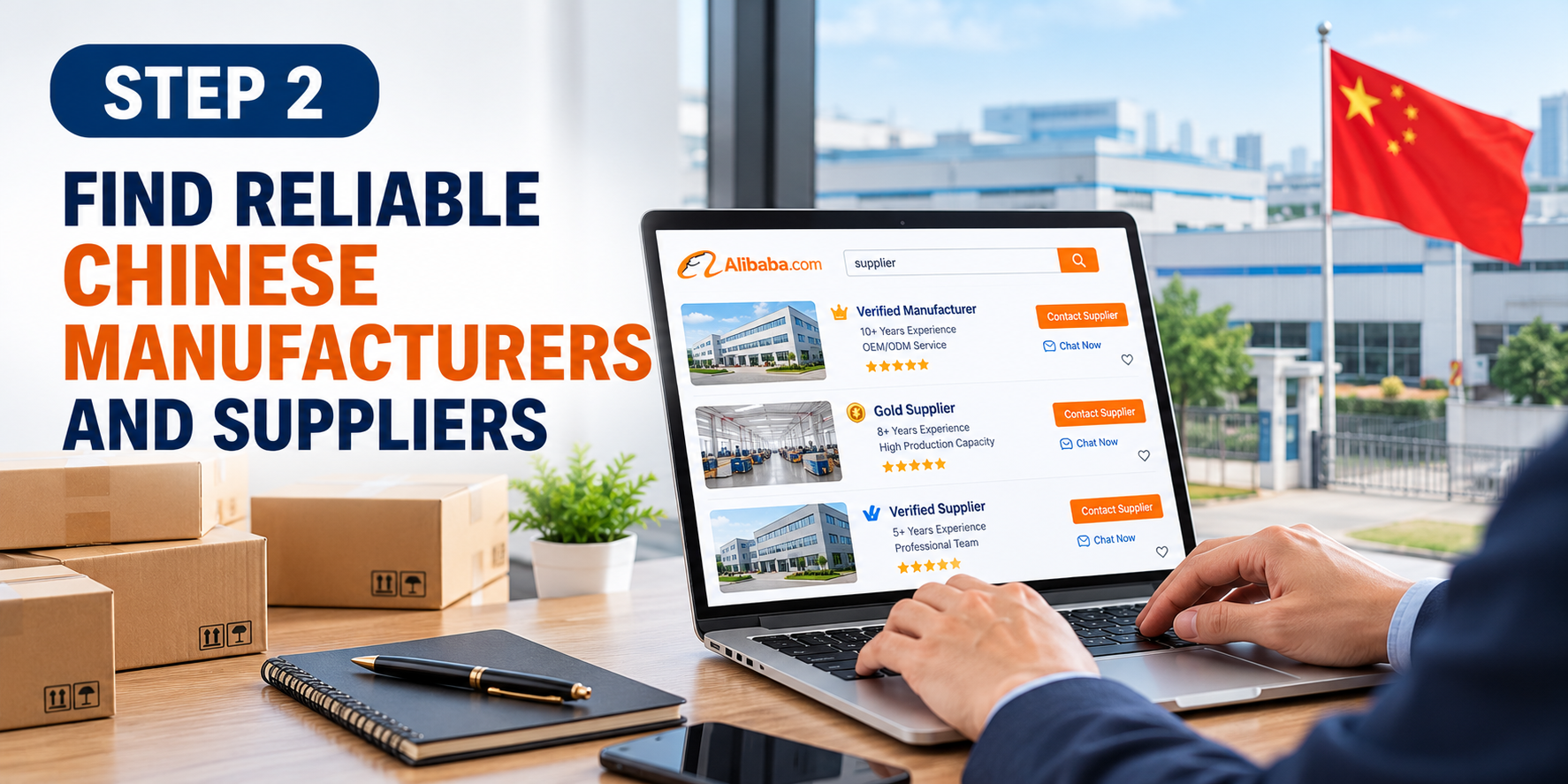
Finding a trustworthy supplier is one of the most important stages of the China import process.
China has thousands of manufacturers, trading companies, wholesalers, and sourcing agents. Although each supplier type offers advantages, we must distinguish genuine production capabilities from unsupported claims.
Best Platforms to Find Suppliers in China
Alibaba
Alibaba.com is a widely used platform for connecting international buyers with Chinese suppliers.
We can compare product listings, review company profiles, request quotations, and communicate directly with potential manufacturing partners.
When sourcing through Alibaba, we should evaluate:
-
Supplier business history and verified company information.
-
Product specialization and manufacturing capabilities.
-
Minimum order quantities (MOQs).
-
Available certifications and test reports.
-
Customization and private-label options.
-
Production lead times.
-
Payment protection and dispute-resolution terms.
Alibaba's Trade Assurance program can provide protections for qualifying orders, subject to the applicable transaction terms. We should not assume that every order or payment arrangement is automatically covered.
Made-in-China.com
Made-in-China.com is another sourcing platform, particularly useful for industrial machinery, electrical equipment, construction materials, and manufactured components.
Global Sources
Global Sources connects international buyers with suppliers across electronics, lifestyle products, and other categories.
1688.com
1688.com primarily serves China's domestic wholesale market. Prices may be attractive, but international buyers can encounter language, payment, invoicing, and export logistics challenges.
Manufacturers vs. Trading Companies
|
Factor |
Manufacturer |
Trading company |
|---|---|---|
|
Pricing |
Potentially lower |
May include intermediary margin |
|
Product customization |
Often direct |
Depends on factory relationships |
|
Product selection |
Usually specialized |
Often broader |
|
Minimum order quantity |
May be higher |
Sometimes more flexible |
|
Production oversight |
Direct access |
Managed through intermediary |
Neither supplier type is automatically superior.
We should choose based on production requirements, order volume, product complexity, communication quality, and demonstrated reliability.
Step 3: Verify Chinese Suppliers Before Placing Orders
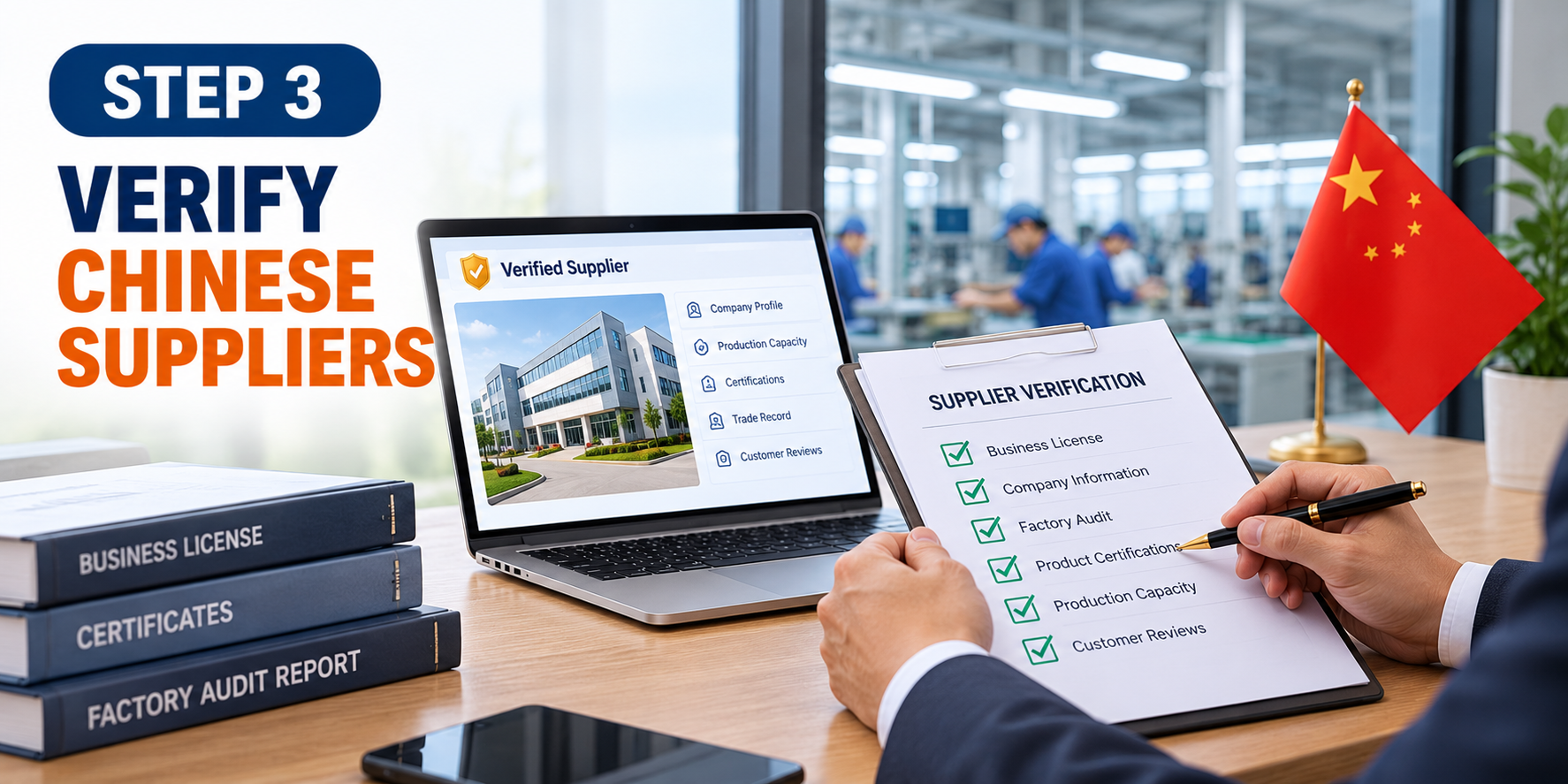
Supplier verification helps us avoid fraudulent transactions, poor-quality products, delayed deliveries, and commercial disputes.
A professional supplier should be able to provide consistent business information and reasonable evidence supporting its manufacturing or trading capabilities.
Essential Supplier Verification Checklist
Before paying a deposit, we should:
-
Request the supplier's Chinese business license and registered legal name.
-
Verify company registration through appropriate official Chinese corporate information channels.
-
Confirm whether the company is a manufacturer, trading company, or sourcing intermediary.
-
Request recent product photographs and manufacturing information.
-
Arrange a live video inspection or independent factory audit when justified.
-
Verify the beneficiary details on the supplier's bank account.
-
Request relevant product certifications and laboratory reports.
-
Obtain references or evidence of previous export experience where available.
We must pay particular attention when a supplier suddenly requests payment to a different bank account.
Any unexpected change in payment instructions should be independently verified through a previously established communication channel.
Conduct a Factory Audit
For substantial orders, a third-party factory audit can evaluate production capacity, quality management, working conditions, equipment, and relevant operational processes.
An audit does not guarantee future performance, but it provides additional evidence before we commit significant capital.
Step 4: Request Samples and Confirm Product Quality
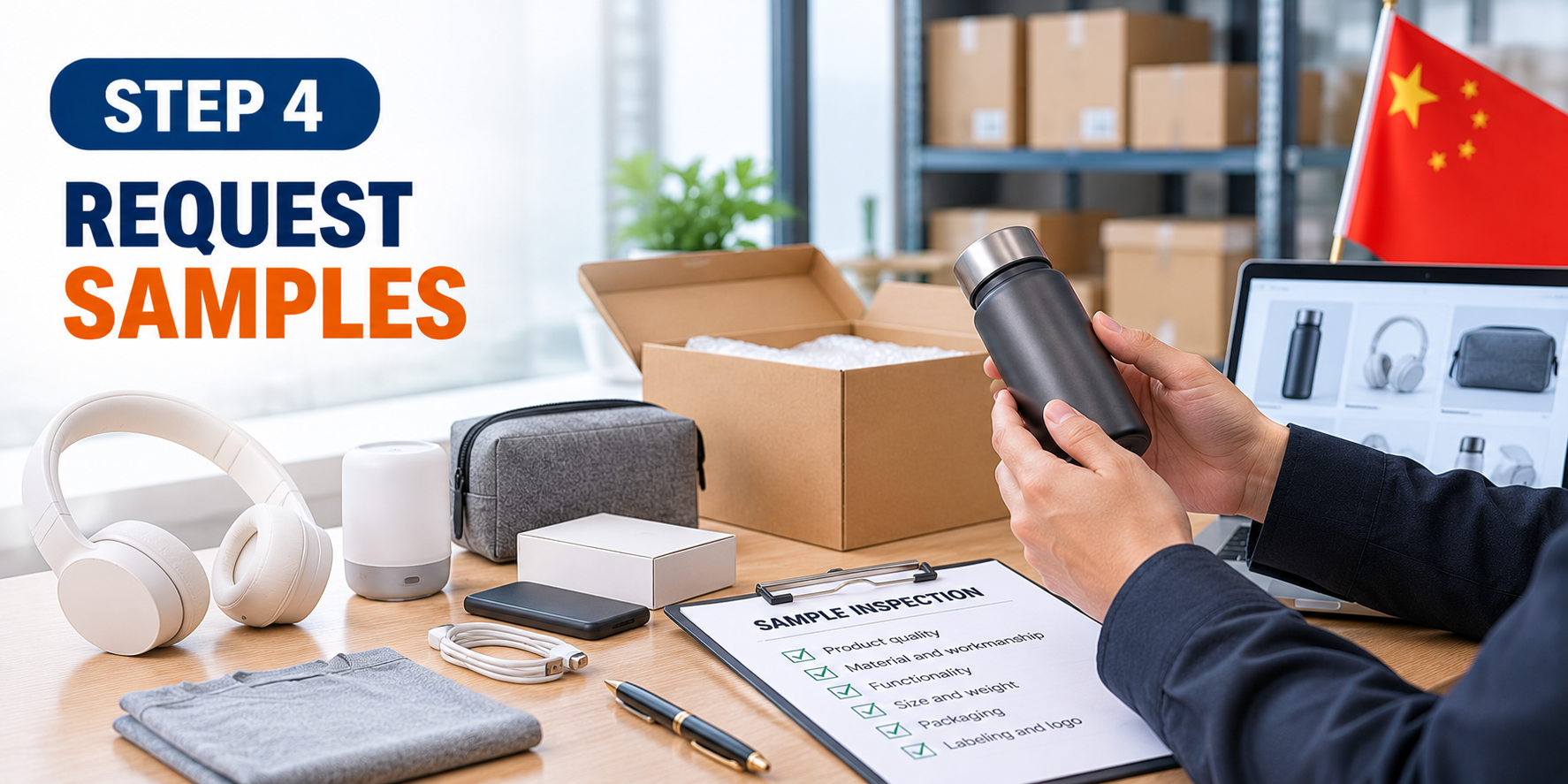
We should never rely exclusively on catalog photographs or marketing descriptions when placing a substantial manufacturing order.
Samples allow us to evaluate materials, workmanship, dimensions, functionality, packaging, and overall product suitability.
Types of Product Samples
Existing product samples demonstrate products that the supplier already manufactures.
Customized samples show how a product performs with our requested specifications, branding, or design modifications.
Pre-production samples establish the agreed standard before mass manufacturing begins.
Production samples are taken from the actual manufacturing batch to verify consistency.
What Should We Inspect?
Depending on the product category, we may evaluate:
-
Material composition and construction.
-
Product dimensions and weight.
-
Functional performance and durability.
-
Color accuracy and finishing.
-
Packaging protection.
-
Labeling and instruction manuals.
-
Electrical safety or chemical compliance.
-
Barcode quality and retail presentation.
For regulated products, visual inspection is insufficient. We may need accredited laboratory testing against applicable destination-market requirements.
We should preserve an approved reference sample and document all agreed specifications.
This reference becomes valuable when evaluating finished production.
Step 5: Negotiate Prices, MOQs, and Payment Terms
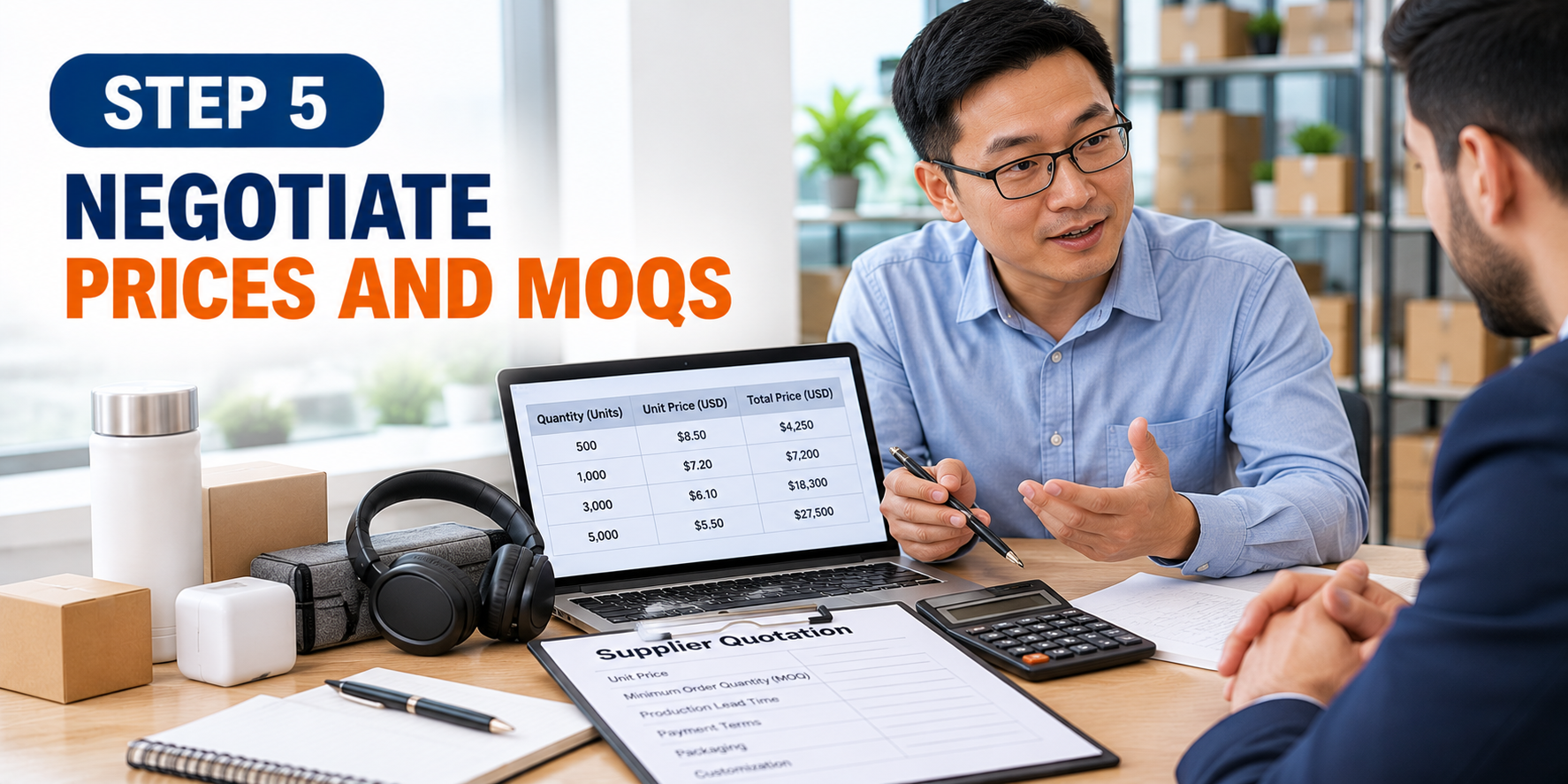
Negotiation is an essential part of importing from China, but the lowest price is not necessarily the best commercial outcome.
Excessive price pressure can encourage material substitutions, reduced inspection standards, or unrealistic delivery promises.
Instead, we should negotiate the complete purchasing arrangement.
Key Terms to Negotiate
Unit price: Confirm pricing at different order quantities.
Minimum order quantity: Determine whether the supplier can accommodate trial orders or smaller production batches.
Tooling and mold fees: Clarify ownership, maintenance, and future access to custom tooling.
Production lead time: Establish realistic manufacturing milestones.
Packaging requirements: Specify cartons, labels, protective materials, and shipping marks.
Quality standards: Define measurable acceptance criteria.
Payment schedule: Agree on deposit requirements and final payment conditions.
Incoterms: Clearly establish responsibility for freight, insurance, risk, and import formalities.
Common Payment Methods
International importers frequently encounter telegraphic transfer (T/T), letters of credit, and platform-supported payment arrangements.
A common negotiated structure is a 30% deposit with the remaining 70% payable before shipment, although actual terms vary.
We should avoid paying the full order value to an unverified supplier unless commercial circumstances and protections justify the arrangement.
For larger transactions, a properly structured letter of credit may help manage documentary payment risk, although it introduces banking costs and administrative requirements.
Step 6: Understand Import Regulations, Customs Duties, and Taxes
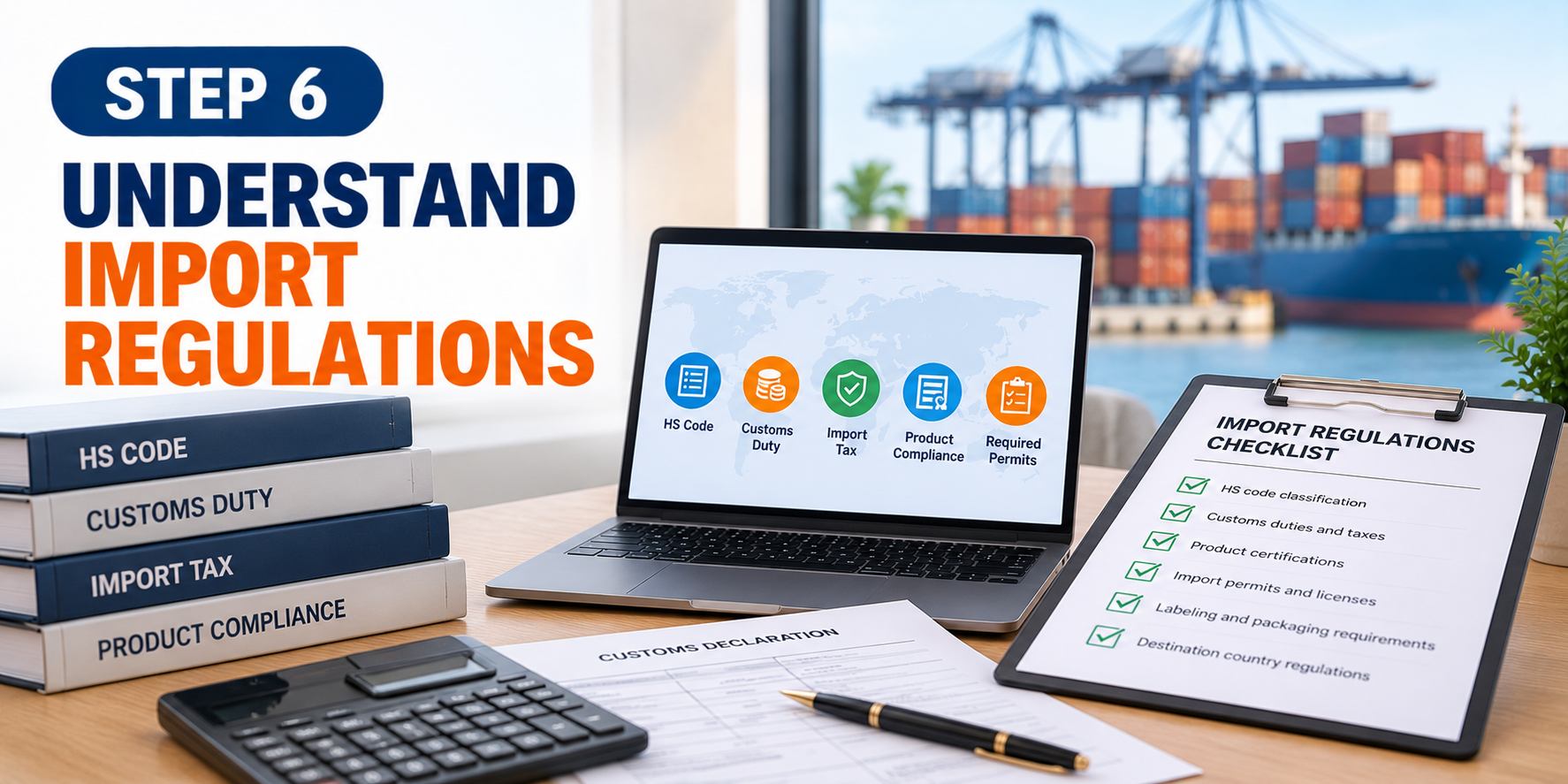
Import regulations depend on the destination country and the type of product being imported.
Before shipment, we must determine whether the product is legally admissible and whether special licenses, certifications, labeling, or inspections are required.
Determine the Correct HS Code
The Harmonized System (HS) classifies internationally traded products using standardized commodity descriptions and codes.
The first six digits are internationally harmonized, while importing countries may use additional digits for national tariff classifications.
An incorrect tariff classification can lead to unexpected duties, penalties, shipment delays, or customs disputes.
We should verify the correct classification using the destination country's official tariff schedule or a qualified customs specialist.
Understand Import Duties
Import duties may depend on:
-
Product classification.
-
Country of origin.
-
Customs value.
-
Trade agreements and preferential origin rules.
-
Anti-dumping or countervailing measures.
-
Additional country-specific tariffs.
For example, products imported into the United States may be subject to ordinary customs duties and additional China-related tariffs, depending on the product classification and rules in force at entry.
We must check the applicable tariff treatment immediately before importing rather than relying on historical rates.
Product Compliance Requirements
Different products face different regulatory obligations.
|
Product category |
Potential compliance considerations |
|---|---|
|
Electronics |
Electrical safety, electromagnetic compatibility, radio equipment approvals |
|
Toys |
Mechanical, chemical, and age-related safety requirements |
|
Cosmetics |
Ingredient restrictions, labeling, registration or notification |
|
Food products |
Food safety rules, importer requirements, sanitary controls |
|
Medical devices |
Product classification, regulatory authorization, quality systems |
|
Textiles |
Fiber labeling, care instructions, flammability requirements |
|
Batteries |
Transport testing, packaging, hazardous goods rules |
Requirements differ by destination and product characteristics. A supplier's claim of certification does not replace our obligation to verify applicable rules.
Step 7: Choose the Best Shipping Method from China
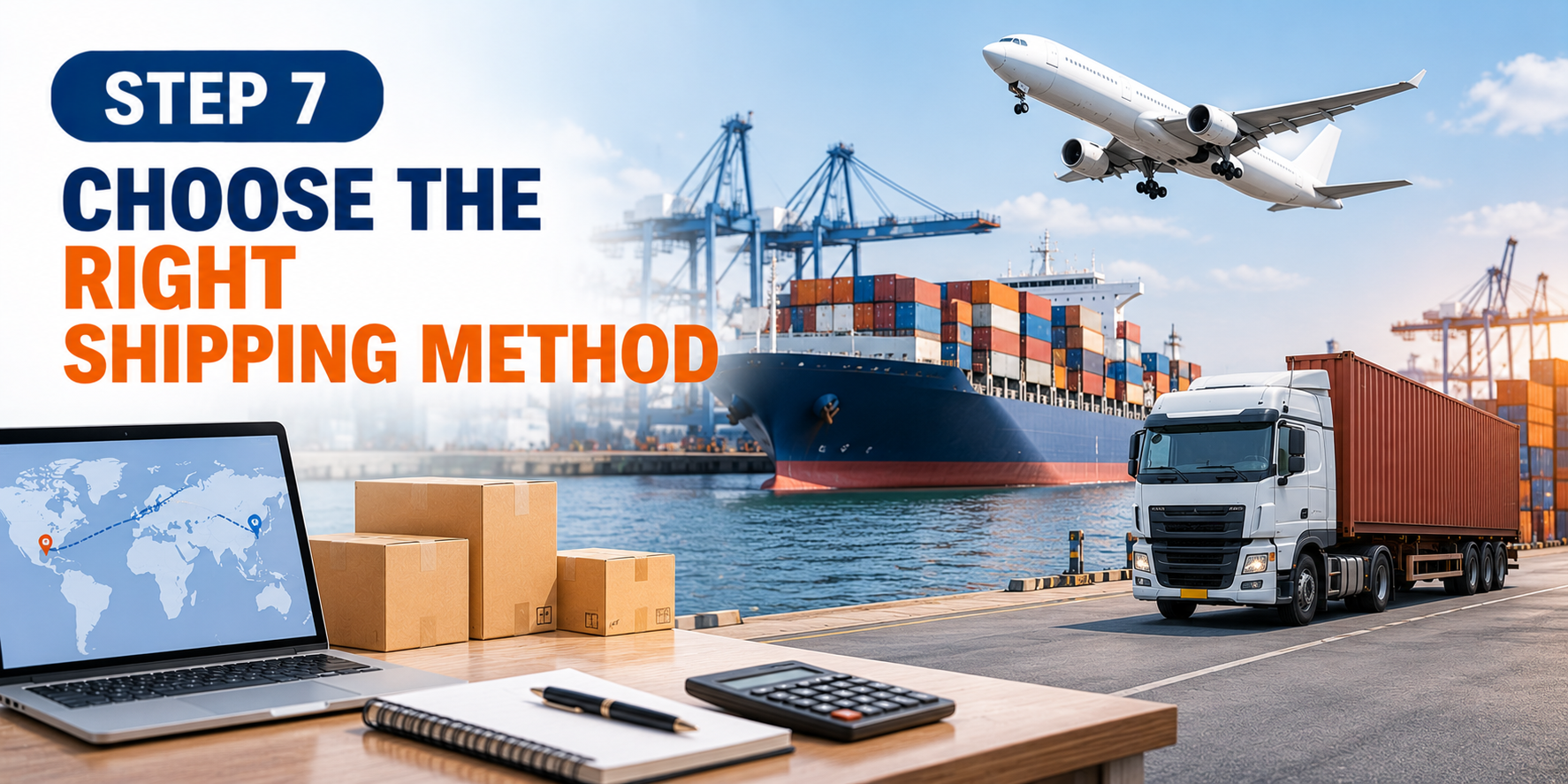
International transportation significantly affects total importing costs and delivery schedules.
The most suitable shipping method depends on cargo size, weight, urgency, destination, and product characteristics.
Sea Freight
Generally suitable for large-volume shipments and heavy cargo. Transit can take several weeks, with additional time for port handling and customs clearance.
Air Freight
Suitable for higher-value, lighter, or time-sensitive goods. Usually faster than sea freight but more expensive per kilogram.
Express Courier
Often practical for samples, documents, and smaller commercial shipments. Door-to-door services may simplify logistics, although customs charges can still apply.
FCL vs. LCL Sea Freight
Full Container Load (FCL) means we book a container for our shipment. It can offer favorable economics for larger volumes and reduce cargo handling compared with shared-container arrangements.
Less than Container Load (LCL) allows us to share container space with other importers.
LCL is useful when our cargo volume does not justify booking an entire container, but consolidation and destination handling charges can affect the total price.
We should compare complete door-to-door quotations rather than freight rates alone.
Understand Incoterms When Shipping from China
Incoterms define specific obligations between buyers and sellers.
|
Incoterm |
Main commercial meaning |
|---|---|
|
EXW |
Seller makes goods available at a named place; buyer takes on extensive responsibilities |
|
FCA |
Seller delivers goods to the carrier or designated party at the agreed place |
|
FOB |
Seller delivers goods on board the vessel at the named shipment port |
|
CIF |
Seller pays ocean freight and minimum required insurance to the destination port |
|
DAP |
Seller delivers to the named destination, with import clearance generally handled by the buyer |
|
DDP |
Seller assumes responsibility for delivery and import clearance, including applicable import duties and taxes |
We should specify the named place and use the relevant edition, such as Incoterms 2020, in our contracts.
FOB and CIF are designed for sea and inland waterway transportation. FCA and CIP may be more suitable for containerized or multimodal shipments, depending on the transaction.
Importers should exercise particular care with DDP quotations. We must verify who acts as importer of record and whether the arrangement is legally and operationally feasible in the destination country.
Step 8: Arrange Quality Inspection Before Shipment
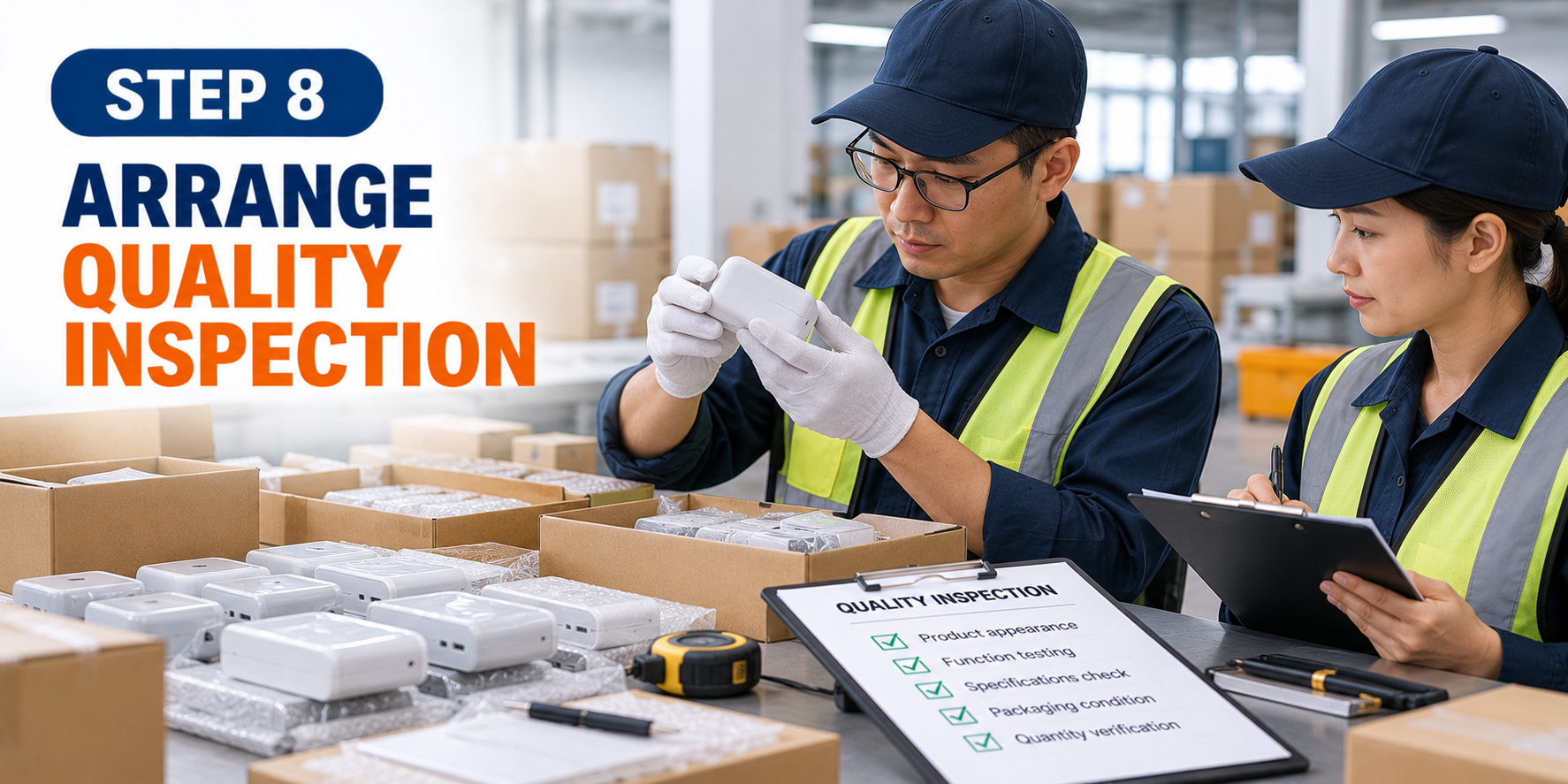
A final inspection helps us identify manufacturing problems before goods leave China.
Discovering defects after international delivery is typically more expensive because corrective actions may require returns, replacement shipments, rework, or customer refunds.
Common Quality Inspection Methods
Pre-production inspection: Verifies materials and manufacturing preparations.
During-production inspection: Evaluates products while manufacturing is underway.
Pre-shipment inspection: Examines finished goods before dispatch.
Container loading supervision: Verifies cargo quantities, packaging, container condition, and loading procedures.
Use AQL Inspection Standards
Acceptance Quality Limit (AQL) sampling is commonly used for evaluating production lots.
Inspection plans can establish different acceptance criteria for critical, major, and minor defects.
However, AQL sampling does not prove that every unit is defect-free. We should select inspection levels and acceptance thresholds appropriate to the product's safety and commercial risks.
For safety-critical products, additional testing or stricter controls may be necessary.
Document Quality Expectations
Our purchase agreement should specify product specifications, inspection methods, defect classifications, corrective action requirements, and conditions for releasing final payment.
This reduces ambiguity when disagreements arise.
Step 9: Prepare Import Documents and Complete Customs Clearance
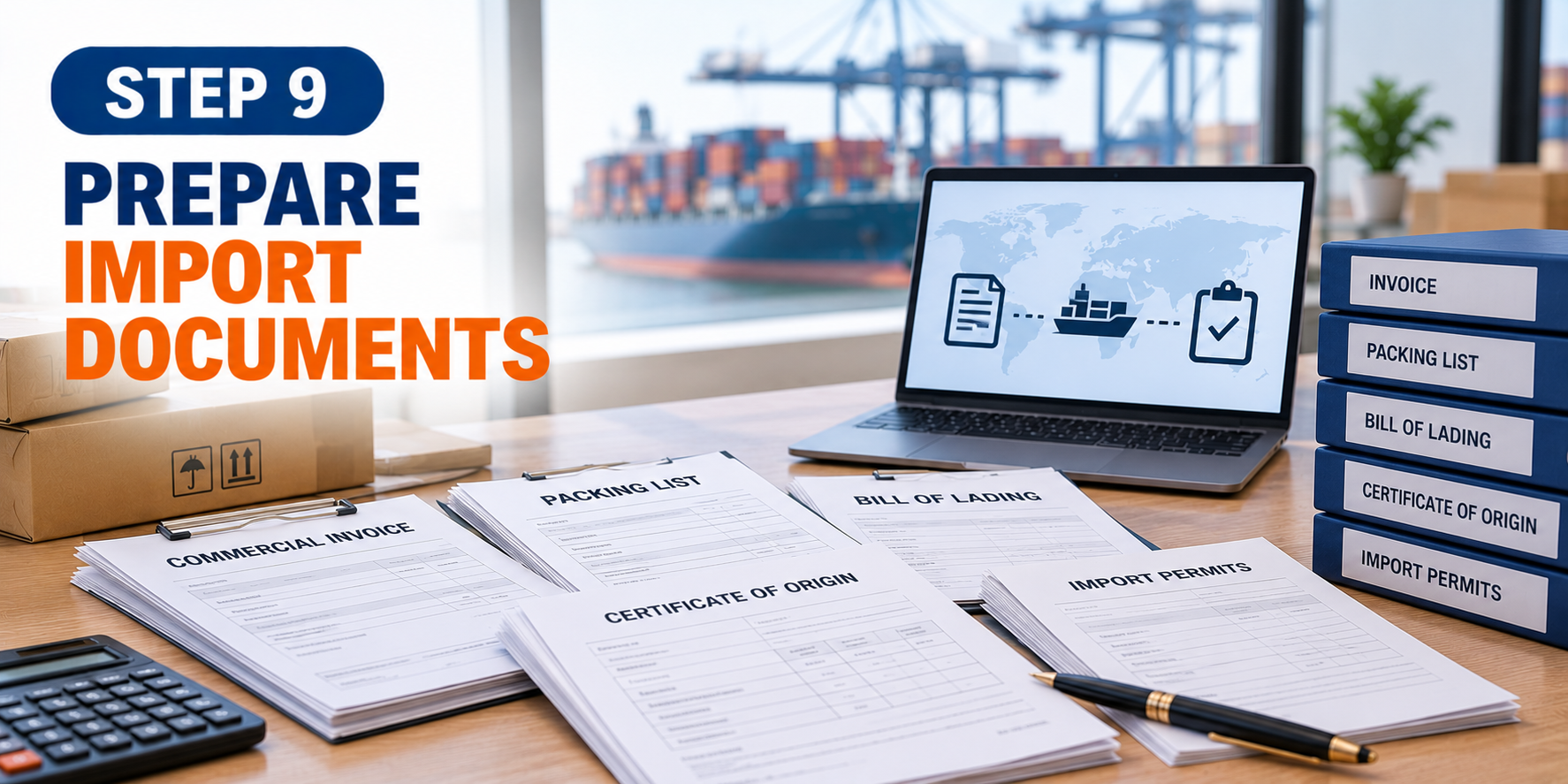
Accurate documentation is essential for efficient customs clearance.
Missing or inconsistent information can cause delays, additional inspections, storage charges, and penalties.
Essential Documents for Importing from China
Commercial invoice: Identifies the seller, buyer, goods, quantities, prices, currency, and commercial terms.
Packing list: Details package counts, weights, dimensions, and shipment contents.
Bill of lading: Used for sea transportation and documents the carriage arrangement. Its legal role depends on the bill type.
Air waybill: Used for air cargo transportation.
Certificate of origin: May be required for customs purposes or preferential tariff claims.
Import permits and certificates: Required for certain regulated products.
Insurance certificate: Documents cargo insurance where relevant.
Customs declaration: Provides the information required by the destination country's customs authority.
Work With a Customs Broker
A licensed or appropriately authorized customs broker can assist with tariff classification, customs declarations, duty calculations, and regulatory documentation.
Nevertheless, depending on local law, the importer remains responsible for the accuracy of declared information.
We should review customs documentation carefully and retain import records for the legally required period.
Step 10: Receive Goods, Evaluate Suppliers, and Scale Your Import Business

The import process does not end when customs releases the shipment.
Once our products arrive, we must verify quantities, inspect packaging, document damage, and reconcile the delivered goods against purchase orders.
Conduct an Arrival Inspection
We should check:
-
Total carton and unit quantities.
-
Visible transportation damage.
-
Product labeling and packaging.
-
SKU and barcode accuracy.
-
Sampled product functionality.
-
Any discrepancies against shipping documents.
We should record damage promptly and preserve evidence needed for carrier, supplier, or insurance claims.
Evaluate Supplier Performance
Long-term importing success depends on consistent execution.
We can measure suppliers using performance indicators such as:
|
Performance indicator |
What we measure |
|---|---|
|
On-time delivery |
Percentage of orders delivered according to agreed milestones |
|
Defect rate |
Proportion of inspected units with identified defects |
|
Order accuracy |
Quantity and specification consistency |
|
Responsiveness |
Speed and quality of supplier communication |
|
Cost stability |
Frequency and magnitude of price changes |
|
Corrective action |
Effectiveness in resolving quality problems |
We should retain strong suppliers, address recurring issues, and diversify sourcing where concentration risk becomes excessive.
As purchasing volume increases, we can negotiate improved prices, production schedules, packaging, and payment terms.
How Much Does It Cost to Import from China in 2027?
Import costs vary substantially by product, shipment size, transportation method, and destination.
The following example illustrates the landed cost of importing 2,000 units of a consumer product.
|
Expense |
Illustrative cost |
|---|---|
|
Manufacturing (2,000 × $5) |
$10,000 |
|
Product testing and inspection |
$400 |
|
Packaging and labeling |
$600 |
|
Origin handling and export charges |
$350 |
|
International shipping |
$1,500 |
|
Cargo insurance |
$100 |
|
Customs duties and import taxes |
$1,200 |
|
Customs brokerage and destination handling |
$450 |
|
Inland delivery |
$300 |
|
Total estimated landed cost |
$14,900 |
|
Landed cost per unit |
$7.45 |
These are hypothetical amounts, not freight quotations or 2027 tariff forecasts.
We should also budget for exchange-rate fluctuations, warehousing, financing, damaged goods, and unexpected logistics expenses.
A practical approach is to obtain multiple freight quotations and model different duty and shipping scenarios before placing an order.
How Long Does It Take to Import Goods from China?
Import lead times depend on manufacturing complexity, factory capacity, shipping schedules, customs requirements, and destination logistics.
Typical planning ranges may include:
|
Import stage |
Illustrative timeframe |
|---|---|
|
Supplier research and verification |
1–3 weeks |
|
Sample development and approval |
1–4 weeks |
|
Manufacturing |
2–8 weeks |
|
Final quality inspection |
1–3 days, excluding scheduling and corrections |
|
Express shipping |
Approximately 3–10 days |
|
Air freight transportation |
Approximately 5–15 days |
|
Sea freight transportation |
Approximately 3–8 weeks |
|
Customs clearance and final delivery |
Several days or longer |
These stages can overlap, and actual schedules can fall outside these ranges.
For first-time imports, we should allow additional time for product development, testing, supplier onboarding, and regulatory approvals.
Common Mistakes to Avoid When Importing from China
Even experienced businesses can incur avoidable losses when sourcing internationally.
Choosing Suppliers Based Only on Price
An unusually low quotation may exclude important services or reflect different materials and specifications.
We should compare equivalent quotations with clearly defined requirements.
Skipping Product Samples
Without approved samples, we have limited evidence that the supplier understands our quality expectations.
Ignoring Import Compliance
A product that can be manufactured or exported from China is not necessarily legal to sell in our destination market.
Using Incorrect HS Codes
Incorrect classification can cause duty underpayments, overpayments, customs disputes, and clearance delays.
Failing to Inspect Goods Before Shipment
Once goods leave China, correcting manufacturing problems becomes significantly more difficult.
Misunderstanding Shipping Terms
A low FOB or EXW quotation may appear attractive until we include origin handling, international freight, destination charges, customs, and inland delivery.
Paying Unverified Bank Accounts
Payment fraud remains a serious commercial risk. We should independently authenticate beneficiary information before transferring funds.
Ordering Excessive Inventory
Large orders can reduce unit prices but increase inventory carrying costs and exposure to unsold products.
We should align purchasing quantities with realistic sales forecasts and working capital.
How to Import from China to the United States
For businesses importing Chinese products into the United States, we must comply with U.S. Customs and Border Protection requirements and any relevant product-specific regulations.
Important considerations include:
-
Establishing the correct importer-of-record arrangement.
-
Determining the applicable Harmonized Tariff Schedule classification.
-
Calculating ordinary duties and any additional tariffs or trade remedies.
-
Checking admissibility, country-of-origin marking, and product safety requirements.
-
Arranging customs bonds where required.
-
Completing Importer Security Filing obligations for applicable ocean shipments.
-
Maintaining documentation supporting origin, valuation, and classification.
Additional requirements may apply through agencies such as the Food and Drug Administration, Consumer Product Safety Commission, and Federal Communications Commission.
For goods potentially affected by forced-labor restrictions, we must also conduct appropriate supply-chain due diligence.
Because tariff measures and customs rules can change, we should verify the requirements in force at the time of entry through official U.S. government sources.
How to Import from China to Malaysia
Businesses importing from China into Malaysia must follow applicable requirements administered by the Royal Malaysian Customs Department and other relevant authorities.
We should begin by determining the correct tariff classification and identifying whether the goods require permits, certificates, or other approvals.
Key Considerations for Malaysian Importers
Import duties and sales tax: We must determine applicable duties and taxes using the correct tariff classification and current legislation.
Preferential tariff treatment: Certain qualifying products may benefit from preferential treatment under relevant trade agreements, subject to origin rules and documentary requirements.
Product approvals: Electrical equipment, telecommunications devices, food, cosmetics, and other regulated goods may require approval from the appropriate Malaysian authority.
Customs declarations: Import declarations must be accurate and supported by appropriate commercial documentation.
Shipping arrangements: We can compare sea freight through Malaysian ports with air freight and courier services according to cargo requirements.
We should not assume that goods shipped from China automatically qualify for preferential duties. Eligibility depends on applicable origin rules and supporting evidence.
Frequently Asked Questions About Importing from China

Can We Import Products from China Without a Company?
In some countries, individuals may import goods under their own names, subject to local customs rules, product restrictions, and tax obligations.
However, regular commercial importing may require business registration, tax registration, licenses, or other formalities.
We should confirm the destination country's requirements before purchasing goods for resale.
What Is the Minimum Order Quantity When Importing from China?
There is no universal minimum order quantity.
Some suppliers accept small orders of existing products, while manufacturers producing customized goods may require hundreds or thousands of units.
MOQ depends on tooling, raw material procurement, production processes, packaging, and supplier policies.
Is Alibaba Safe for Importing from China?
Alibaba can be a useful sourcing channel, but purchasing through a marketplace does not eliminate commercial risk.
We should verify suppliers, request samples, document specifications, use appropriate payment protections, and inspect goods before shipment.
Do We Need an Import License to Buy from China?
Import license requirements depend on the destination country and product category.
Some products can be imported under general customs procedures, while regulated goods require permits or authorizations.
What Is the Cheapest Way to Ship Products from China?
For sufficiently large and heavy shipments, sea freight is often more economical than air freight on a per-unit basis.
However, LCL handling charges, inland transport, inventory financing, and delivery deadlines can affect the comparison.
We should evaluate the total landed cost.
How Can We Avoid Scams When Importing from China?
We can reduce fraud risk by verifying supplier registration, checking bank account ownership, arranging independent inspections, using clear contracts, and avoiding payment requests that bypass agreed protections.
Can We Customize Products Manufactured in China?
Yes. Many Chinese manufacturers offer original equipment manufacturing (OEM) and original design manufacturing (ODM) services.
Customization may include branding, packaging, materials, colors, dimensions, functionality, and entirely new product designs.
We should establish intellectual property ownership, tooling rights, and confidentiality obligations in writing.
What Is the Best Incoterm for First-Time Importers?
There is no single best Incoterm for every importer.
FCA can offer a useful allocation of responsibilities for many shipments, while FOB is commonly used for certain ocean freight transactions.
DAP may simplify destination delivery arrangements, but we must understand our import clearance responsibilities.
We should choose terms according to our logistics capabilities, destination rules, and the exact delivery arrangement.
How Can We Reduce Import Costs from China?
We can reduce costs by consolidating shipments, improving packaging efficiency, comparing freight forwarders, negotiating realistic order quantities, avoiding unnecessary product variations, and planning inventory early.
We should also investigate lawful preferential tariff treatment and ensure that customs declarations are accurate.
Underdeclaring shipment values or misrepresenting product origins is not a legitimate cost-saving strategy.
Final Checklist: How to Import from China Successfully
Before placing an order with a Chinese supplier, we should review the following 10-step China import checklist to ensure that every stage of the importing process is properly managed.
|
No. |
Import Checklist |
Key Actions Required |
Status |
|---|---|---|---|
|
1 |
Product Research |
Identify profitable products, analyze market demand, and calculate estimated profit margins. |
☐ Pending |
|
2 |
Supplier Verification |
Find reliable Chinese manufacturers, verify business licenses, and review supplier credentials. |
☐ Pending |
|
3 |
Product Sampling |
Request product samples, evaluate quality, and approve specifications before mass production. |
☐ Pending |
|
4 |
Price Negotiation |
Confirm product pricing, minimum order quantities (MOQ), payment terms, and production schedules. |
☐ Pending |
|
5 |
Import Regulations |
Verify HS codes, customs duties, import taxes, product certifications, and required permits. |
☐ Pending |
|
6 |
Shipping Arrangements |
Choose sea freight, air freight, or express shipping and agree on appropriate Incoterms. |
☐ Pending |
|
7 |
Quality Inspection |
Arrange pre-shipment inspections and verify product quality, quantities, and packaging. |
☐ Pending |
|
8 |
Customs Documentation |
Prepare commercial invoices, packing lists, shipping documents, and customs declarations. |
☐ Pending |
|
9 |
Goods Receiving |
Track shipments, complete customs clearance, inspect delivered goods, and confirm quantities. |
☐ Pending |
|
10 |
Supplier Performance Review |
Evaluate landed costs, delivery performance, product quality, and opportunities for future orders. |
☐ Pending |
Recommendation: We should complete and verify every applicable checklist item before proceeding to the next stage.
This structured approach helps us minimize importing risks, control costs, and maintain consistent product quality when importing from China in 2027.
Conclusion: Build a Profitable and Reliable China Import Business in 2027
Importing from China offers substantial opportunities for businesses seeking competitive manufacturing, extensive product selection, and scalable supply chains.
However, long-term success depends on a disciplined approach to supplier selection, product quality, regulatory compliance, logistics, and financial planning.
By following these 10 steps to import from China, we can make more informed purchasing decisions, reduce avoidable risks, and develop reliable international sourcing operations.
The strongest importing strategy combines verified suppliers, clear contracts, realistic landed-cost calculations, effective quality controls, and continuous supplier performance monitoring.
With these foundations in place, we can transform China sourcing from a one-time purchasing activity into a sustainable business capability that supports profitable growth in 2027 and beyond.