Finding a reliable sourcing agent in China is one of the most important steps for businesses planning to import products from Chinese manufacturers.
Whether we operate an e-commerce store, wholesale business, retail chain, or international distribution company, working with the right sourcing partner can help us reduce purchasing costs, identify qualified suppliers, maintain product quality, and simplify international shipping.
China remains a major manufacturing destination, offering everything from consumer electronics and furniture to clothing, toys, machinery, packaging, and household products.
However, sourcing directly from Chinese factories can involve communication barriers, inconsistent product specifications, complicated logistics, and supplier verification challenges.
In this comprehensive guide, we explain how to find a sourcing agent in China in 2027, evaluate sourcing companies, understand their service fees, and select a trustworthy partner for long-term business growth.
What Is a Sourcing Agent in China?
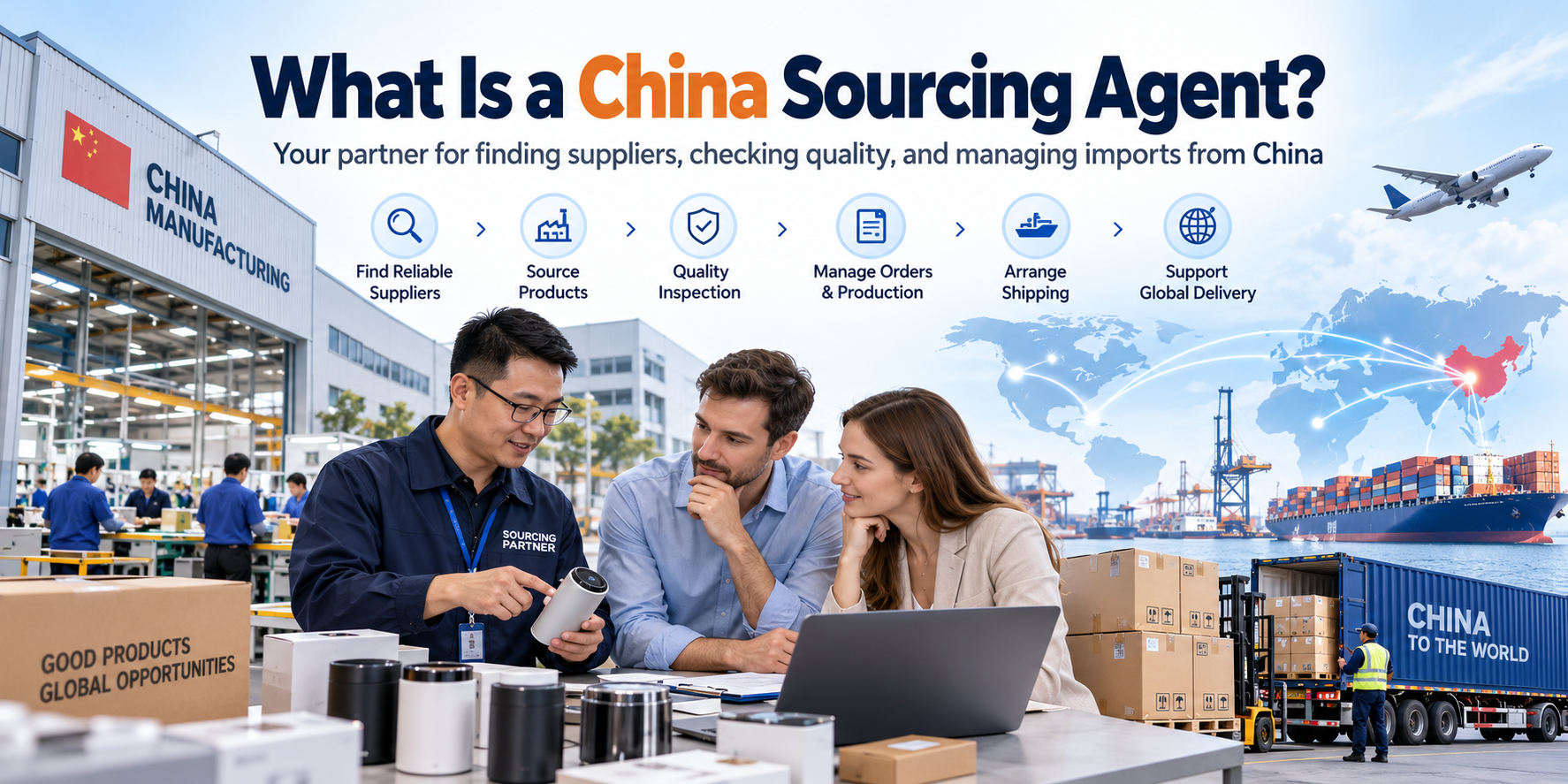
A China sourcing agent is an individual or professional company that helps international buyers find, evaluate, and purchase products from suppliers and manufacturers in China.
A sourcing agent acts as a bridge between overseas importers and Chinese factories, assisting with supplier communication, price negotiation, production management, quality control, and shipping arrangements.
Depending on the service agreement, a professional sourcing agent may handle the entire procurement process, from identifying suitable manufacturers to coordinating product delivery.
The main services typically include:
Supplier identification: Finding manufacturers that match product requirements, order quantities, and budgets.
Factory verification: Checking supplier registration, manufacturing capabilities, and business credibility.
Price negotiation: Obtaining competitive quotations and negotiating purchasing terms.
Product customization: Coordinating private-label manufacturing, packaging design, and OEM/ODM projects.
Quality inspection: Arranging product inspections before shipment.
Order management: Monitoring production schedules and communicating with manufacturers.
Shipping coordination: Organizing consolidation, freight forwarding, and export documentation.
By outsourcing these activities, we can focus more on product development, marketing, sales, and customer relationships.
Why Should We Hire a China Sourcing Agent in 2027?
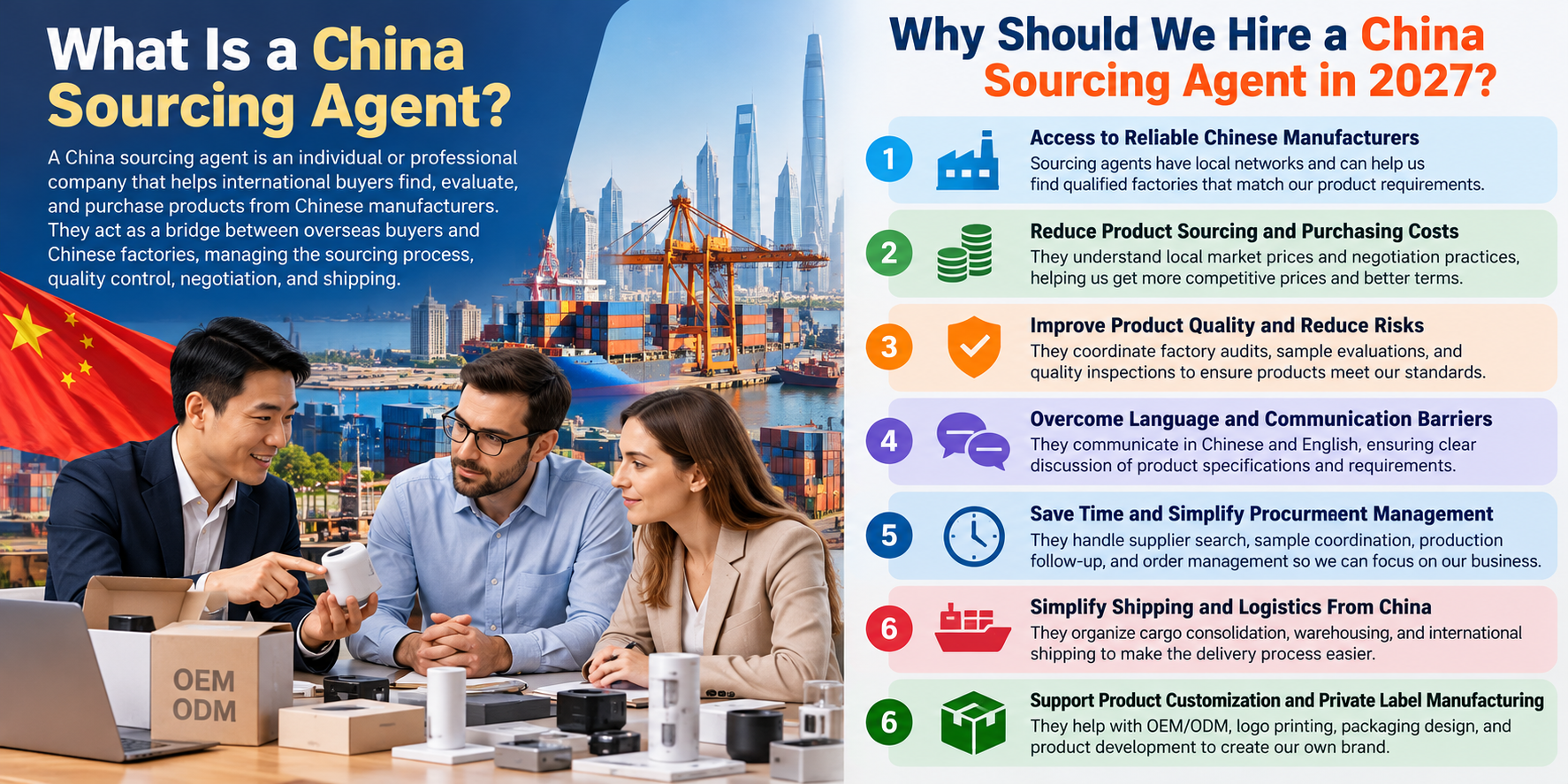
Hiring a sourcing agent offers practical advantages, especially when we lack local purchasing teams or established relationships with Chinese manufacturers.
1. Access to Reliable Chinese Manufacturers
China has extensive manufacturing networks, but not every supplier advertising products online operates its own factory.
Some suppliers are trading companies, distributors, or intermediaries. These businesses may be legitimate, but their operating models can influence product pricing, manufacturing control, and customization options.
A capable sourcing agent helps us distinguish manufacturers from trading companies and identify suppliers that meet our purchasing requirements.
2. Better Product Prices and Purchasing Terms
Experienced sourcing agents understand local manufacturing costs, minimum order quantities, production processes, and common negotiation practices.
They can compare quotations from several manufacturers and negotiate better commercial terms.
However, we should evaluate the complete purchasing cost rather than assume an agent will always obtain the lowest factory price.
3. Improved Quality Control
Product defects can create expensive problems for international importers, including customer complaints, returns, delayed deliveries, and damaged brand reputations.
We can reduce these risks by working with agents who coordinate sample approvals, production inspections, and pre-shipment quality checks.
4. Easier Communication With Chinese Suppliers
Language differences and unclear technical specifications can create misunderstandings during manufacturing.
A bilingual sourcing team can translate product requirements, communicate with factory managers, and provide regular production updates.
5. Simplified Shipping and Order Consolidation
When we purchase products from multiple suppliers, a sourcing agent can coordinate collection, warehousing, packaging, and consolidated shipments.
This is particularly valuable for retailers and wholesalers importing several product categories in one container.
How to Find a Reliable Sourcing Agent in China: 8 Essential Steps
Finding the right purchasing partner requires a structured evaluation process. We recommend following these eight steps before making a final decision.
Step 1: Define Our Product Sourcing Requirements
Before contacting sourcing companies, we should prepare a detailed purchasing brief.
A clear product specification helps sourcing agents identify suitable manufacturers and provide accurate quotations.
Our sourcing brief should contain:
|
Requirement |
Information to provide |
|---|---|
|
Product category |
Electronics, furniture, toys, clothing, etc. |
|
Product specifications |
Materials, dimensions, functions, and finishes |
|
Order quantity |
Estimated units per product |
|
Target price |
Preferred purchasing budget |
|
Customization |
Logo, packaging, colors, OEM/ODM |
|
Quality requirements |
Testing, certifications, and inspection criteria |
|
Destination |
Importing country and delivery location |
|
Delivery schedule |
Required shipment date |
The more accurately we describe our products, the easier it becomes to compare quotations and evaluate suppliers.
Step 2: Search for Sourcing Agents Online
Google is one of the most convenient places to discover professional purchasing companies in China.
We can search using specific keywords, including:
China sourcing agent
Best sourcing agent in China
Reliable China purchasing agent
Yiwu sourcing agent
China product sourcing company
China sourcing agent for Amazon sellers
China sourcing and shipping agent
Factory sourcing agent in China
We should review each company's website, service descriptions, industry specialization, contact information, and published business experience.
For example, EJET (ejet.com) is a China-based sourcing and supply chain service provider that international buyers can include when comparing sourcing partners.
Rather than selecting a company based only on its website appearance, we should request a detailed proposal and evaluate whether its services match our sourcing needs.
Step 3: Use B2B Platforms and Professional Networks
Besides Google, several international business platforms can help us identify sourcing professionals.
Alibaba.com allows us to explore product suppliers and identify businesses that provide sourcing-related services.
LinkedIn helps us research sourcing company employees, management experience, business activities, and professional networks.
Global Sources and Made-in-China.com can also help us understand supplier categories and identify potential manufacturing partners.
These platforms are useful for discovery, but a company profile, positive review, or platform verification badge should not replace independent due diligence.
Step 4: Choose a Sourcing Agent in the Right Chinese City
China's manufacturing industries are distributed across specialized regions. Selecting a sourcing agent with relevant regional experience can improve supplier access and operational efficiency.
|
Chinese city |
Major sourcing categories |
|---|---|
|
Yiwu |
Gifts, toys, stationery, accessories, general merchandise |
|
Guangzhou |
Clothing, fashion accessories, beauty products, leather goods |
|
Shenzhen |
Electronics, smart devices, electronic components |
|
Foshan |
Furniture, ceramics, lighting, building materials |
|
Dongguan |
Electronics manufacturing, plastics, industrial components |
|
Ningbo |
Household products, appliances, hardware |
|
Wenzhou |
Footwear, eyewear, electrical products |
|
Zhongshan |
Lighting products and electrical equipment |
For example, if we need wholesale stationery, toys, gifts, and seasonal products, working with a Yiwu sourcing agent can be particularly convenient.
If we need custom electronics or smart devices, an agent familiar with Shenzhen's manufacturing network may be more suitable.
We should prioritize expertise in our product category over the company's office location alone.
Step 5: Verify the Sourcing Agent's Business Registration
Before placing an order or transferring money, we should verify the legal identity of the sourcing company.
We can request its Chinese business license, official registered company name, and Unified Social Credit Code.
China's National Enterprise Credit Information Publicity System (GSXT) provides public business registration information that can support company verification.
We should compare registration details with the name appearing on the contract, commercial invoices, and receiving bank account. Business registration is an initial verification step, not proof of operational quality.
Step 6: Evaluate Experience and Industry Knowledge
A sourcing company should understand the product category we intend to purchase.
For instance, sourcing furniture requires different technical knowledge from sourcing cosmetics, electronics, or children's toys.
We recommend asking prospective agents about previous sourcing projects, common manufacturing problems, supplier qualification procedures, and product quality standards.
Requesting relevant references and examples of completed purchasing projects can help us evaluate their capabilities.
Step 7: Request Quotations From Multiple Agents
We should contact at least three sourcing companies and provide the same product brief to each.
This allows us to compare their pricing, service coverage, production timelines, and supplier selection processes.
We should ask for a written breakdown of purchasing costs, service fees, inspection charges, warehousing costs, and shipping expenses.
Step 8: Start With a Trial Order
Before committing to a large purchasing agreement, we recommend testing the sourcing agent with a manageable order.
A trial order helps us evaluate communication quality, supplier transparency, manufacturing coordination, quality inspection procedures, and delivery reliability.
A successful trial order provides stronger evidence of performance than promotional claims or unverified testimonials.
How Much Does a Sourcing Agent in China Cost?
The cost of hiring a sourcing agent depends on the order value, product complexity, service requirements, and pricing structure.
Based on publicly advertised 2026 sourcing service rates, commission-based agents frequently quote approximately 3% to 10% of the purchasing value, although rates outside this range are possible. These figures are useful planning benchmarks for 2027, not fixed industry tariffs.
Common China Sourcing Agent Fee Structures
|
Pricing model |
How it works |
Suitable for |
|---|---|---|
|
Commission |
Percentage of agreed purchasing value |
Regular wholesale orders |
|
Fixed project fee |
One predetermined service charge |
One-time sourcing projects |
|
Monthly retainer |
Recurring management fee |
Businesses with continuous purchasing |
|
Per-service charges |
Separate fees for specific activities |
Buyers needing selected services |
|
Product markup |
Supplier or intermediary quotes a resale price |
Buyers purchasing through a trading model |
For example, if our factory order totals $20,000 and our sourcing agent charges a 5% commission, the sourcing fee would be $1,000.
That would bring the combined product and sourcing service cost to $21,000 before additional expenses such as inspections, inland transportation, freight, insurance, customs duties, and taxes.
We should confirm which services are included and whether commissions are calculated on factory prices or a broader invoice amount.
A transparent pricing agreement is more important than choosing the lowest advertised commission.
What Services Should a Professional China Sourcing Agent Provide?
A comprehensive sourcing partner should support our purchasing operations beyond simply providing supplier contact information.
Supplier Research and Factory Audits
We should expect qualified sourcing agents to investigate potential manufacturers, compare production capabilities, and coordinate factory audits where necessary.
Factory verification can include reviewing manufacturing equipment, production capacity, business documentation, quality management systems, and relevant certifications.
Product Sampling and Development
Before approving mass production, we should obtain physical samples and confirm that they meet our specifications.
For customized products, sourcing agents may also coordinate tooling, packaging prototypes, material selection, and revisions.
An approved reference sample should be retained as a standard for production inspections.
Production Monitoring and Quality Inspection
Reliable agents should coordinate production follow-up and communicate potential delays.
Depending on the product, inspection activities may include:
Pre-production material verification.
During-production quality inspections.
Pre-shipment inspections.
Packaging and labeling checks.
Quantity and carton verification.
Container loading supervision.
Independent third-party inspection may be appropriate for high-value or technically complex orders.
Shipping and Logistics Management
Professional sourcing companies can also coordinate freight forwarding and shipment documentation.
We should understand the selected Incoterms rule before approving any quotation.
Common terms include FOB (Free on Board), FCA (Free Carrier), CIF (Cost, Insurance and Freight), and DDP (Delivered Duty Paid).
Each allocates transportation responsibilities, costs, and risks differently. The International Chamber of Commerce identifies Incoterms 2020 as the current edition of these international trade rules.
How to Avoid Unreliable Sourcing Agents in China
Not every sourcing company provides the same level of transparency or professionalism.
We should investigate the following warning signs before signing a sourcing agreement.
Unclear supplier information: An agent who refuses to explain supplier selection methods or disclose relevant manufacturing information may create accountability problems.
Unusually low quotations: A price significantly below competing offers may indicate different materials, incomplete specifications, or excluded costs.
Hidden commissions: Agents should explain whether they receive compensation from suppliers in addition to buyer service fees.
Unverifiable company details: Missing business registration information, inconsistent legal names, or unexplained payment instructions require further investigation.
No documented quality process: A sourcing agent who cannot explain how products will be inspected may be unsuitable for projects with strict quality requirements.
Pressure to transfer money: We should avoid large advance payments without appropriate contracts, verified beneficiaries, and clearly defined purchasing milestones.
A good sourcing relationship depends on transparent communication, documented responsibilities, and reliable purchasing controls.
China Sourcing Agent vs. Trading Company: Which Is Better?
International buyers often confuse sourcing agents with trading companies.
Although both can help us purchase products from China, their business models differ.
|
Factor |
Sourcing agent |
Trading company |
|---|---|---|
|
Main role |
Represents or assists buyers |
Purchases and resells products |
|
Pricing |
Often commission or service fee |
Usually quoted resale price |
|
Factory disclosure |
Depends on agreement |
May be limited |
|
Supplier selection |
Can compare several suppliers |
May rely on established partners |
|
Customization |
Coordinates with manufacturers |
Depends on trading company's capabilities |
|
Quality management |
Service-dependent |
Supplier-dependent |
|
Best suited for |
Buyers needing purchasing representation |
Buyers seeking convenient wholesale purchasing |
Neither model is automatically superior.
A capable trading company may offer efficient purchasing, product availability, and convenient order handling. A professional sourcing agent may offer greater flexibility for businesses managing several manufacturers or complex procurement requirements.
We should evaluate the actual service scope, pricing transparency, and contractual responsibilities.
What Should We Include in a China Sourcing Agent Agreement?
A written sourcing agreement protects both parties and establishes clear expectations.
The contract should identify the service provider, define the purchasing scope, explain the pricing arrangement, and describe how responsibilities are divided.
We recommend including provisions covering product specifications, supplier approval, inspection requirements, confidentiality, intellectual property, payment milestones, delivery schedules, reporting obligations, and dispute resolution.
For custom products, we should establish ownership of product designs, tooling, molds, and technical documentation.
We should also clarify what happens when products fail inspections, manufacturers miss deadlines, or supplied goods differ from approved samples.
Where appropriate, we should obtain legal advice on enforceability and dispute resolution arrangements before entering significant purchasing commitments.
Import Compliance: An Essential Part of China Sourcing in 2027
Finding a reliable sourcing agent is only one part of successful international procurement. We must also ensure that imported products satisfy the requirements of their destination markets.
For European Union imports, applicable product legislation may require conformity assessments, technical documentation, specific labeling, and traceability information. The EU General Product Safety Regulation also establishes obligations for relevant economic operators, including importers.
For products entering the United States, we should confirm customs requirements, applicable tariffs, product safety obligations, and supply chain documentation. U.S. Customs and Border Protection's June 2026 forced-labor enforcement guidance emphasizes supplier due diligence and supporting documentation.
A sourcing agent can assist with documentation and supplier coordination, but we should not assume that hiring an agent transfers the importer's legal responsibilities.
Questions to Ask Before Hiring a China Sourcing Agent
Before selecting a procurement partner, we recommend discussing the following questions:
How many years have you provided sourcing services in China?
Which product categories do you specialize in?
How do you verify manufacturers and suppliers?
Can we review examples of relevant sourcing projects?
Do you disclose factory information to buyers?
How are your sourcing fees calculated?
Do you receive commissions or rebates from suppliers?
How do you manage defective or nonconforming products?
Can you arrange independent quality inspections?
What shipping and consolidation services do you provide?
How frequently will we receive production updates?
What happens if a supplier fails to deliver on time?
The answers should help us determine whether the agent has the operational knowledge and accountability required for our business.
Frequently Asked Questions About Finding a Sourcing Agent in China
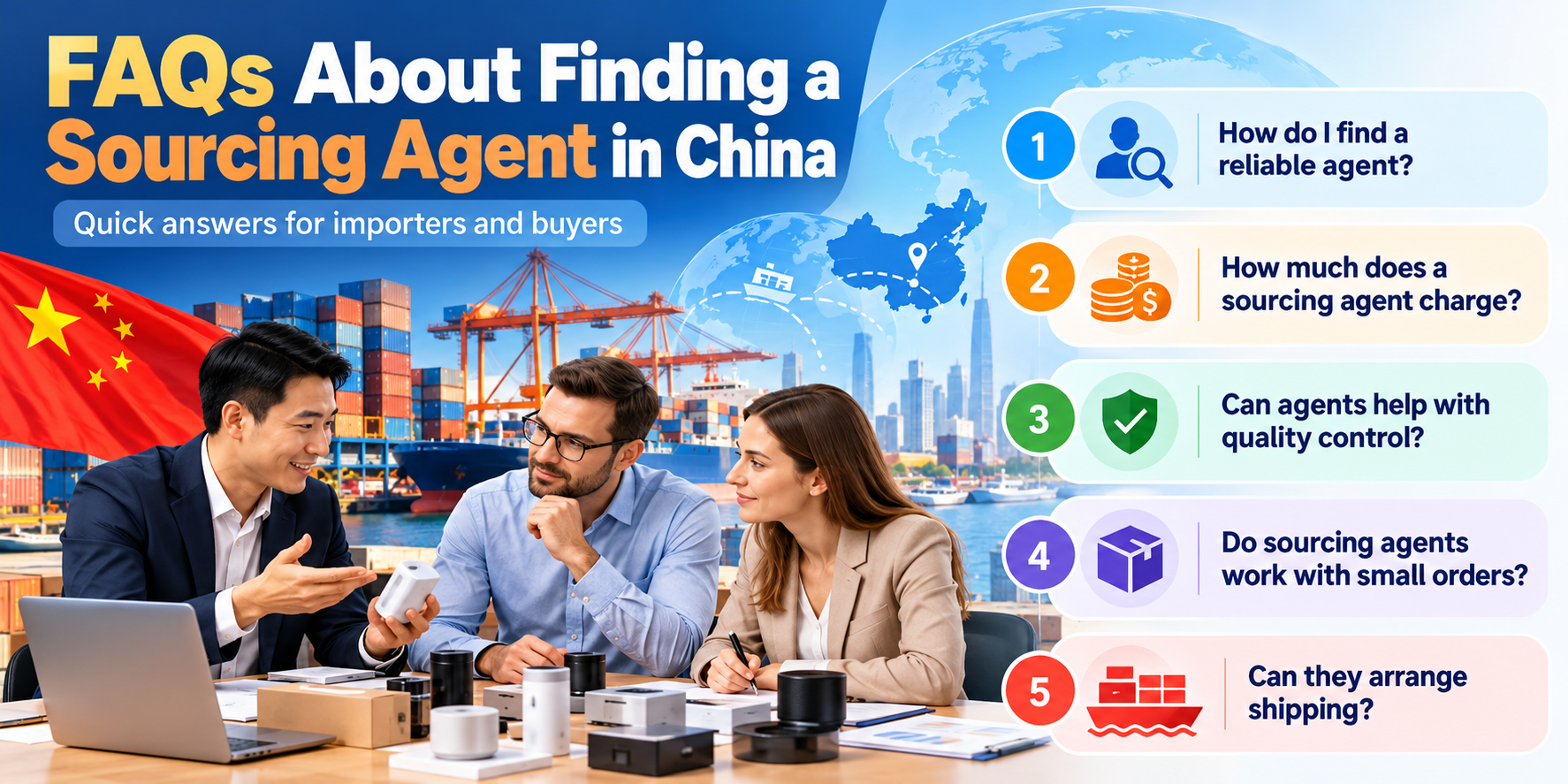
1. How do we find a trustworthy sourcing agent in China?
We can find potential sourcing agents through Google, professional networks, industry referrals, and trade exhibitions. Before hiring an agent, we should verify its business registration, review relevant experience, compare written proposals, and conduct a trial order.
2. Is it cheaper to buy directly from Chinese factories?
Buying directly from factories can eliminate certain intermediary costs, but we may need to manage supplier communication, quality inspections, manufacturing coordination, and logistics ourselves. A sourcing agent may reduce operational expenses or help negotiate purchasing terms, depending on the project.
3. Can a China sourcing agent help with small orders?
Yes. Some sourcing agents specialize in smaller wholesale orders, particularly in trading centers such as Yiwu. However, we should confirm minimum service fees, supplier minimum order quantities, and whether mixed-product consolidation is available.
4. What is the difference between a Yiwu sourcing agent and a China sourcing agent?
A Yiwu sourcing agent generally specializes in products available through Yiwu's wholesale markets and nearby manufacturing networks. A China sourcing agent may operate across several cities and industrial regions. The distinction depends on the company's actual service coverage.
5. Can sourcing agents help with Amazon FBA products?
Yes. Some agents coordinate private-label manufacturing, packaging, barcode labeling, inspections, carton preparation, and shipments to Amazon fulfillment networks. We should confirm that the chosen provider understands the current requirements for our destination marketplace.
6. How long does it take to source products from China?
The sourcing timeline depends on product complexity, supplier availability, sampling requirements, manufacturing schedules, and shipping methods. Standard wholesale products may require less preparation than custom-manufactured goods involving tooling, testing, and multiple sample revisions.
7. Can we hire a China sourcing agent without visiting China?
Yes. Many international buyers manage sourcing projects remotely through email, video meetings, WeChat, shared documents, and inspection reports. We can also arrange independent factory audits and product inspections when an in-person visit is not practical.
Final Thoughts: Choosing the Best China Sourcing Agent for 2027
Finding the right sourcing agent in China in 2027 requires more than comparing commission percentages or selecting the first company appearing in Google search results.
We should focus on supplier verification, industry experience, purchasing transparency, quality management, logistics coordination, and long-term reliability.
A dependable sourcing partner can help us build stronger relationships with Chinese manufacturers, maintain consistent product standards, and manage complex international purchasing operations more effectively.
For international importers, wholesalers, retailers, and growing brands seeking professional support, EJET is one option to consider when evaluating China sourcing and supply chain partners.
By selecting a sourcing company that understands our products, target market, budget, and quality requirements, we can establish a more efficient and dependable procurement strategy for 2027 and beyond.