







China’s fabric wholesale markets range from broad textile trading districts to specialist centers for apparel materials, upholstery, and bedding.
This guide compares six sourcing destinations—Keqiao, Guangzhou’s Zhongda district, Shengze, Haining, Dieshiqiao, and Xiqiao—and explains how to approach each one.
Use it to build a focused shortlist, ask better supplier questions, and evaluate samples before committing to bulk orders.
Which China fabric wholesale markets should you shortlist?
Start with Keqiao for broad textile sourcing, Zhongda for fashion fabrics and accessories, and Shengze for synthetic and silk-related textiles. Consider Haining for decorative fabrics, Dieshiqiao for home textiles, and Xiqiao for another established textile sourcing base in southern China. These destinations serve different needs, so treat this as a category-based shortlist rather than an official ranking.
Before comparing fabric wholesale suppliers, decide what you actually need to purchase:
- Sample yardage: Enough material to assess appearance, construction, and a prototype—not simply a small presentation swatch.
- Repeatable stock: An article the supplier can identify and replenish, with clear information about future availability.
- Custom production: A defined composition, construction, color, print, or finish produced against an approved specification.
- Finished textiles: Completed products such as bedding or curtains, rather than fabric by the roll.
Keep that distinction visible throughout your search. Your first supplier message should name the product, intended use, approximate quantity, and whether replenishment matters. Ask suppliers to confirm those requirements before spending time discussing colors or negotiating price.
1. Keqiao China Textile City, Shaoxing
Keqiao, in Shaoxing, Zhejiang, is home to China Textile City. The surrounding textile ecosystem covers production stages including spinning, weaving, dyeing, garment manufacturing, and industrial fabrics, making it a useful starting point for broad sourcing projects.
Recommended approach: Start here when your brief includes several fabric categories or when you need to explore alternatives before narrowing a specification. Bring a reference swatch and describe what must stay the same: weight, drape, surface texture, stretch, or opacity. Then identify which characteristics you are willing to change.
China Textile City comprises specialized trading areas rather than one simple shopping hall. Market guides identify separate areas for products including knitted fabrics, curtains, suiting, and unfinished cloth. Choose the relevant area before arranging supplier appointments.
For every promising sample, record the supplier, article number, quoted specification, and stock status. Ask whether the displayed material is available immediately or represents a production option. Do not approve a substitute solely because its color looks similar; request enough material to assess its behavior in your intended product.
2. Zhongda Fabric Market District, Guangzhou
Zhongda is a textile trading district in Guangzhou’s Haizhu area, not a single market building. Its wider fashion ecosystem connects fabric and accessories suppliers with design studios, pattern-making services, and garment manufacturers.
Recommended approach: Consider Zhongda when developing an apparel collection that requires coordinated materials. Organize the search around a garment brief—such as a lined dress or a stretch top—rather than browsing without a target. Include the lining, fastenings, and other components on the same sourcing sheet.
Zhongdamen, one development within the district, lists dedicated areas for men’s clothing fabrics, knitted fabrics, textile headquarters, and pattern making. This illustrates why buyers should identify individual buildings and businesses instead of treating “Zhongda” as a complete destination address.
Keep a photograph of each shop sign alongside its samples and contact details. Before leaving a counter, request the article code and written quotation. For a small launch, ask separately about sample cuts, full rolls, and replenishment rather than assuming one minimum order applies to all three.
3. China Eastern Silk Market, Shengze
China Eastern Silk Market is in Shengze, within Suzhou’s Wujiang district in Jiangsu. Despite its name, its sourcing relevance extends beyond natural silk: its listed categories include polyester, nylon, chiffon, satin, stretch materials, and functional fabrics. Shengze’s textile history includes both silk weaving and the development of synthetic textiles.
Recommended approach: Shortlist Shengze when synthetic composition, fabric construction, or finishing is central to your product brief. For lining, lightweight outerwear, or similar projects, specify the required weight, usable width, surface finish, and intended care method. Avoid relying on a fabric name alone to communicate performance.
Ask suppliers to separate the base fabric specification from any coating, lamination, or other treatment included in the quotation. Request supporting test information for performance claims you intend to rely on. Check that the documentation identifies the actual article being offered, rather than accepting a general company presentation.
For custom colors, request an approval sequence covering the color sample, production fabric, and shipment inspection. Put the acceptance criteria in writing before authorizing bulk production.
4. Haining China Home Textile Market, Haining
Haining China Home Textile Market is a destination for home-textile sourcing in Zhejiang. Businesses operating in its Xucun market area offer upholstery materials, including sofa fabrics, while local industry reporting highlights decorative and functional textile development.
Recommended approach: Consider Haining for interiors projects where texture, coordinated colors, and decorative appearance guide the selection. Bring photographs of the intended furniture or room, but use physical swatches for final material discussions. Specify whether the purchase is for loose fabric, finished curtains, cushion covers, or another completed item.
For upholstery, ask for evidence relevant to the intended application, such as abrasion, pilling, and colorfastness testing. For curtains, request a larger hanging sample to assess drape and light transmission. If a supplier proposes a blackout or other functional finish, make the required outcome part of the purchase specification.
Check pattern direction, repeat dimensions, and usable width before estimating consumption. Ask your manufacturer or workroom to calculate the cutting requirement using the actual fabric specification, not just the total area of the finished product.
5. China Dieshiqiao International Home Textile City, Nantong
China Dieshiqiao International Home Textile City is in Nantong’s Haimen district, Jiangsu. It belongs to a wider home-textile cluster centered on Dieshiqiao and the neighboring Zhihong market, with activities spanning design, weaving, printing, dyeing, manufacturing, and logistics. Local reporting also documents bedding collections displayed in Dieshiqiao showrooms.
Recommended approach: Put Dieshiqiao on your shortlist for bedding and coordinated home-textile collections. Be explicit about whether you need finished products or fabric inputs. For fabric-only sourcing, ask contacts to identify relevant material suppliers within the wider cluster before confirming appointments.
When evaluating sheets or duvet covers, write down fiber composition, fabric construction, finished dimensions, closures, and care requirements. Ask suppliers to explain any quality description in measurable terms rather than comparing products through labels such as “premium.” Request a finished sample in the construction you intend to order.
For a private-label collection, include packaging, labeling, and assortment details in the quotation request. Keep material approval separate from finished-product approval so both the cloth and its construction receive attention.
6. Guangdong Xiqiao Light Textile City, Foshan
Xiqiao, in Foshan’s Nanhai district, Guangdong, is an established textile production and trading center. World Bank research describes the development of its specialized wholesale market alongside local manufacturing, while market reporting lists categories including apparel fabrics, denim, cotton goods, and decorative textiles.
Recommended approach: Consider Xiqiao as an additional sourcing stop when evaluating southern China fabric suppliers. Send your specification in advance and ask which businesses can supply the requested construction. Confirm the exact showroom and production locations before arranging visits.
For denim or casualwear materials, request samples in the condition relevant to your finished product. If washing is part of production, ask your manufacturer to assess the fabric after the proposed treatment. Record which finish and sample condition formed the basis of approval.
Compare quotations against a shared specification rather than appearance alone. Include usable width, weight, composition, finishing, packing, and inspection expectations in your comparison sheet. Ask who will take responsibility for resolving discrepancies if the delivered material differs from the approved sample.
Prepare a sourcing brief before contacting suppliers
For fabric sourcing in China, build a one-page brief that every shortlisted supplier receives. Describe the intended product first, then list the material requirements and commercial questions. Mark each item as essential, preferred, or open to alternatives so suppliers know where they can suggest substitutions.
Include these details:
|
Brief item |
What to provide or request |
|---|---|
|
End use |
The garment, furnishing, or textile product you will make |
|
Material |
Target fiber composition and knitted or woven construction |
|
Physical properties |
Weight, usable width, stretch, opacity, and reference hand feel |
|
Appearance |
Color standard, print artwork, pattern repeat, and finish |
|
Quantity |
Sampling requirement, initial order, and possible repeat demand |
|
Quality approval |
Required tests, tolerances, retained samples, and inspection stages |
|
Commercial terms |
Quotation unit, currency, payment stages, packing, and delivery responsibilities |
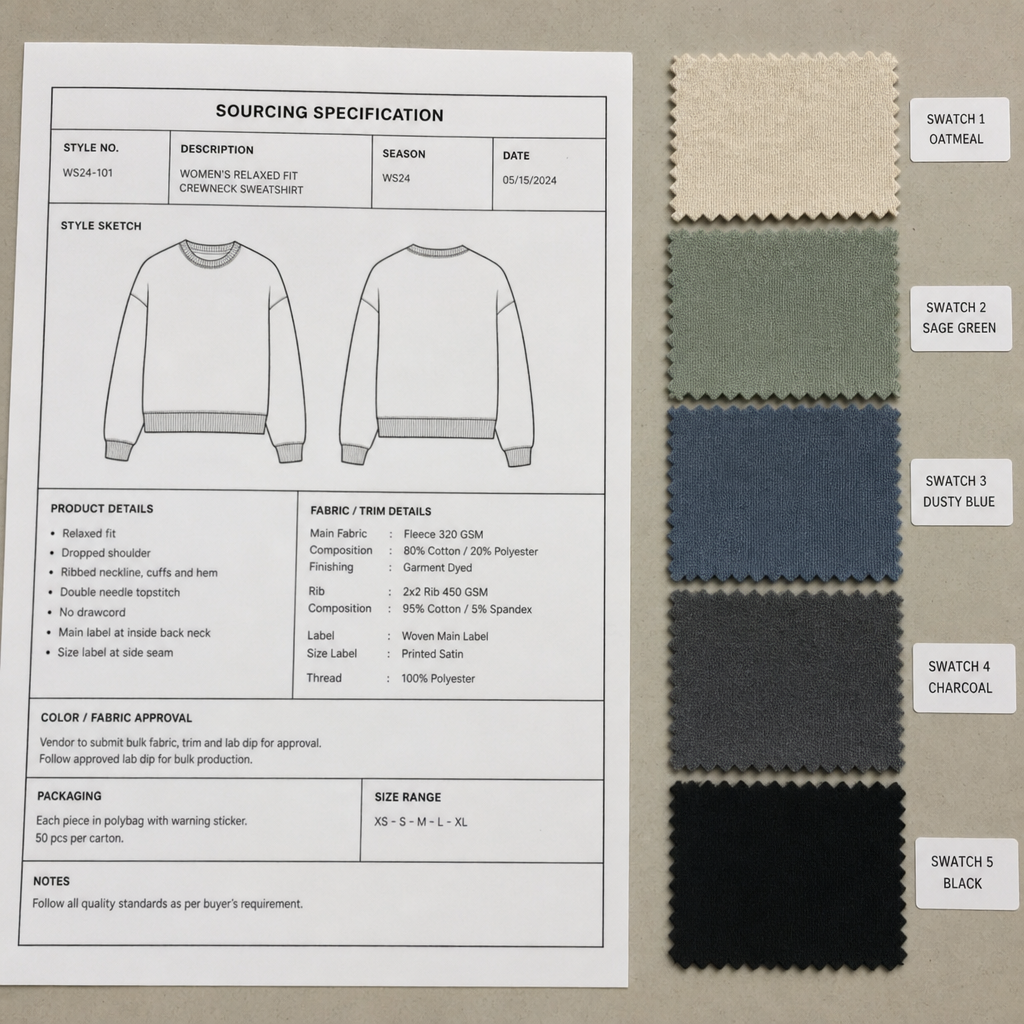
Ask each supplier to flag deviations instead of silently quoting the closest available alternative. Leave room on the sheet for sample codes and unresolved questions. Keep revisions dated so the supplier and your manufacturer work from the same version.
How do you compare suppliers before placing an order?
Compare suppliers using the same approved specification, representative samples, written commercial terms, and an agreed inspection plan. Do not choose solely by the lowest quoted price. For your China fabric wholesale comparison, make unresolved differences visible before deciding which offer represents the better purchase.
Use this approval sequence:
- Identify the contracting business. Request its legal business details and clarify whether it manufactures, trades, or arranges production. Confirm who will issue the quotation and accept responsibility for the order.
- Match the quotation to the sample. Record the article code, composition, weight, usable width, finish, color, and quantity. Ask the supplier to identify any difference between the sample and proposed bulk fabric.
- Evaluate material in context. Request enough fabric for a prototype and appropriate testing. Ask your manufacturer or testing provider to recommend checks for the product’s intended use.
- Agree on production approvals. Define which color samples, print samples, or production cuttings require acceptance. Retain a clearly labeled reference and require written approval for substitutions.
- Document shipment acceptance. Agree how quantity, defects, shade variation, packing, and other requirements will be checked. Specify who receives the inspection findings and how discrepancies should be handled.
For wholesale fabric from China, request a full cost breakdown rather than comparing headline prices. Ask each supplier to separate material, sampling, development, finishing, packing, and delivery charges. Have your logistics provider confirm transport-related costs before you finalize the purchase budget.
If you cannot visit, use the same approval process remotely. Request labeled samples, arrange independent checks where appropriate, and keep approvals in a shared order file. Do not let a video call replace the material evaluation your product requires.
Choose the market that fits the product
Use these six destinations as starting points, not substitutes for supplier evaluation. Build your China fabric industry contacts around a specific product brief, then narrow the search through samples, documented specifications, and clear responsibilities.
The strongest sourcing outcome is a material you can approve, purchase, and reorder with confidence—not simply the busiest market or the cheapest roll.
Frequently Asked Questions About Top 6 China Fabric Wholesale Markets
What are the main fabric wholesale markets in China?
The main fabric wholesale markets in China include Keqiao, Zhongda in Guangzhou, Shengze, Haining, Dieshiqiao, and Xiqiao. Each market specializes in different types of fabrics and sourcing needs.
How do I choose the right market for fabric sourcing in China?
To choose the right market, consider the specific type of fabric you need, such as apparel materials, home textiles, or decorative fabrics. Each market serves different needs, so align your project requirements with the specialties of each market.
What should I prepare before visiting a fabric market in China?
Prepare a sourcing brief that includes your intended product, material requirements, commercial questions, and any specific fabric properties or testing needs. Bring reference swatches and a clear idea of your quantity and quality expectations.
How can I ensure the quality of fabric from suppliers in China?
To ensure quality, compare suppliers using a well-documented specification, request representative samples, and agree on a clear inspection plan. It’s essential to communicate your quality approval criteria to the suppliers.
Are there any specific terms I should know when dealing with Chinese fabric suppliers?
Yes, some important terms include "minimum order quantity (MOQ)," which refers to the smallest amount a supplier will sell; "lead time," the time taken to produce and ship the fabric; and "sample cut," the process of evaluating material before making a bulk order.