











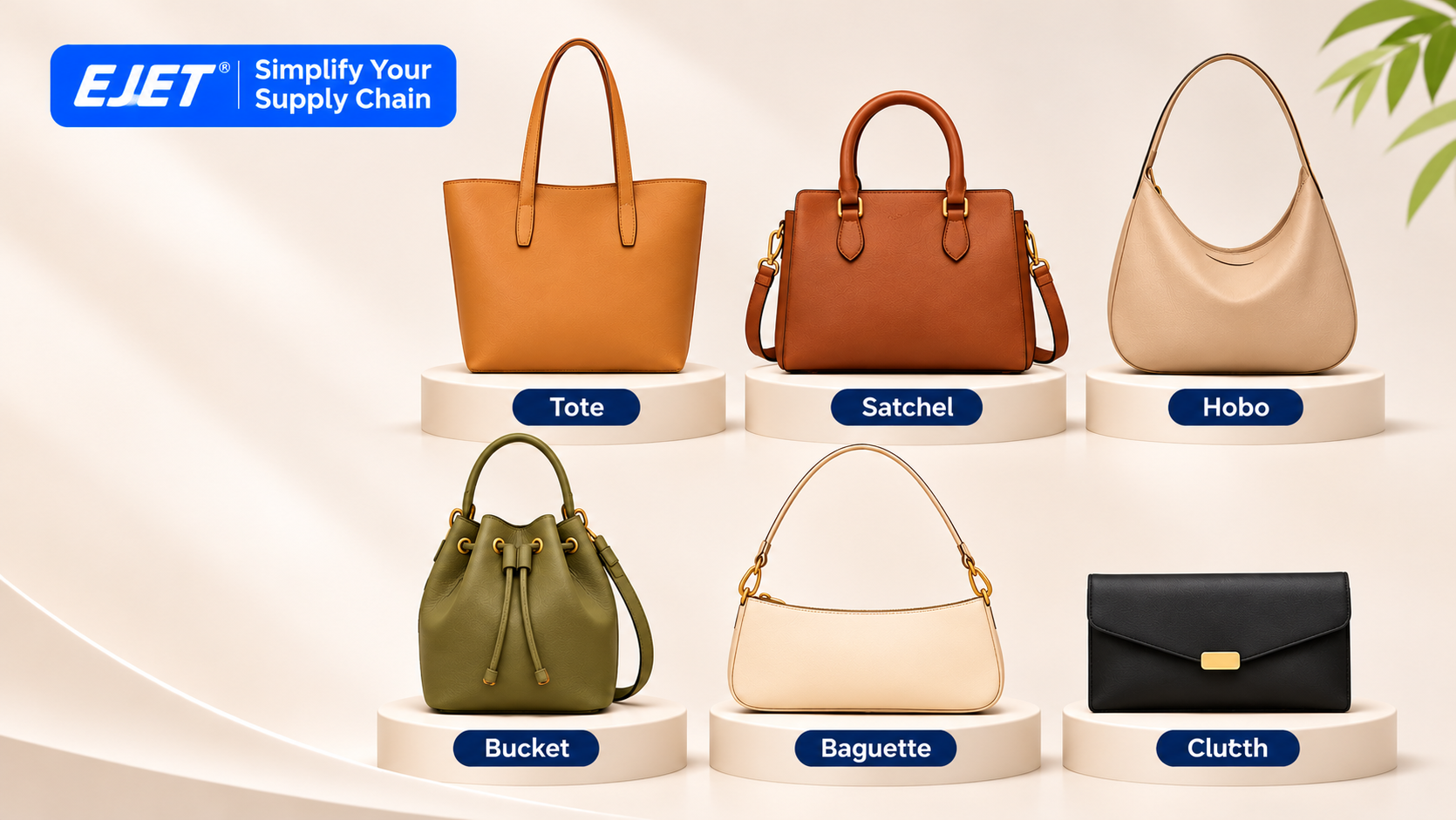
Handbag categories make more sense when you separate what a bag looks like, how it is carried, and what it is designed to hold.
For shopping or catalog planning, use those distinctions to compare products without treating every descriptive term as a separate bag type.
This classification and product taxonomy guide combines a practical vocabulary of purse types with a proposed framework for organizing them consistently.
How are handbag categories classified?
A useful approach is to classify a handbag by its primary type, then describe its shape, carrying options, size, material, and features separately. This allows one product to have several accurate descriptions without requiring several competing identities.
Treat the framework below as a working model for shopping and catalog organization, rather than a universal naming standard.
For example, Coach describes top-handle bags with detachable straps that also allow shoulder or crossbody wear. The extra carrying option does not erase the top handle; it adds another way to use the same product. That distinction is especially helpful when comparing convertible handbag styles.
Use these layers when evaluating a bag:
- Primary type: The main recognizable category, such as tote, satchel, bucket bag, or clutch.
- Carrying method: How it can be worn or held, including shoulder, crossbody, handheld, or backpack carry.
- Shape: Its outline or proportions, such as rectangular, rounded, crescent, or cylindrical.
- Construction: Whether it is structured, softly structured, or unstructured.
- Attributes: Material, dimensions, closure, pockets, strap details, and decorative treatments.
- Use case: A shopping context such as commuting, evenings, errands, or travel.
For a catalog, record each layer in its own field. For shopping, use the same layers as a comparison checklist. Either way, avoid expecting a category name to tell you everything about capacity or comfort.
The main handbag types and their defining features
Start with familiar names, but read the product details before drawing conclusions. The descriptions below explain common distinctions; the accompanying checks help turn those distinctions into useful buying or merchandising decisions.
Everyday carriers: totes, shoulder bags, hobos, and satchels
Tote bags commonly have two handles and a relatively open, roomy body. Shoulder bags are identified by shoulder carry rather than one fixed outline. Hobo bags add a softer, slouching profile, while satchels are commonly associated with a more defined body and short handles.
These labels describe different aspects of a bag, so some overlap is unsurprising.
When comparing these purse types, focus on the following checks:
Tote: Confirm the opening, handle clearance, and internal dimensions. Do not assume that a roomy exterior guarantees a laptop will pass through the opening.
Shoulder bag: Try the strap over the clothing you normally wear. Check whether you can reach the closure without removing the bag.
Hobo: Look for a layout that suits your organizing habits. If you carry several small items, inspect the pockets or consider a removable pouch.
Satchel: Check both the handle grip and any included long strap. Decide whether you actually want handheld carry or merely like the appearance.
These checks also suggest useful product photography. Show the tote opening, the shoulder bag being worn, the hobo interior, and the satchel with every supplied strap attached. Let the images answer practical questions that the category label cannot.
Hands-free options: crossbody bags, backpacks, and belt bags
Crossbody bags use a long strap worn diagonally across the body. Backpacks use two shoulder straps, while belt bags are designed around waist or body-mounted carry. Their shared appeal is hands-free use, but they should remain distinct choices rather than interchangeable labels.
For a crossbody, check the adjustable strap range and where the bag sits when worn. Test access while standing and seated, especially if a flap or stiff zip opening needs extra clearance. A removable strap is useful only if the alternative carrying method also works for you.
For a backpack, inspect the opening and pocket placement rather than judging it solely by exterior size. For a belt bag, confirm the fastening range and the manufacturer's intended carrying options. If you plan to wear it across the chest, check that configuration rather than assuming every waist-oriented design supports it.
In a catalog, record supported carrying methods explicitly. Avoid tagging a product as convertible simply because a strap appears long enough in a photograph.
Shape-led options: bucket, baguette, camera, and top-handle bags
A bucket bag typically has a rounded base and a drawstring or cinched opening. Coach also describes versions that support handheld, shoulder, or crossbody carry, illustrating why shape and strap configuration deserve separate fields. Check the opening as well as the body depth when assessing what fits.
The baguette is associated with a compact, elongated rectangular form carried close under the arm. Fendi's Baguette offers a recognizable example, with a front flap and short shoulder strap. Use the shape term to describe proportions, not to imply that an unrelated product belongs to that branded collection.
A fashion camera bag commonly presents a compact, boxy silhouette, often worn crossbody. Do not interpret the name as proof that it includes protective equipment storage. Inspect the actual compartments before assigning any specialist function.
Top-handle bags are identified by their upper carrying handle or handles; some also include longer straps. For catalog purposes, decide whether top-handle is the primary customer-facing category or an attribute within another category.
Apply that decision consistently across comparable products.
Compact options: clutches, wristlets, minaudières, and mini bags
A clutch is designed around handheld carry, although some include a detachable strap. A wristlet adds a wrist loop. These distinctions concern carrying method, so inspect the included hardware rather than grouping every small bag under one label.
A minaudière is a small, structured evening clutch, often with a hard case and sometimes a chain or shoulder strap. It is a more specific description than simply calling something an evening bag. Check the usable interior carefully before expecting it to hold your phone and essentials.
For a working taxonomy, treat mini as a size label unless your store deliberately maintains a mini-bag collection. This preserves the underlying identity: a mini bucket bag remains a bucket bag. Always publish dimensions alongside the size name, and avoid promising that an item fits unless that fit has been verified.
Handbag shapes, designs, and styles describe different things
For clearer comparisons, use handbag shapes to describe outlines and proportions, handbag designs to describe construction and detailing, and purse styles to describe the broader visual impression. These are useful editorial distinctions for this guide, not rigid rules every retailer must follow. Their purpose is to make descriptions more precise.
A proposed attribute vocabulary might look like this:
|
Dimension |
Example labels |
What to inspect |
|---|---|---|
|
Outline |
Rectangular, square, rounded, crescent |
Front and side views |
|
Proportions |
Wider than tall, taller than wide |
Published width and height |
|
Structure |
Structured, softly structured, unstructured |
Whether the body holds its form |
|
Surface treatment |
Quilted, woven, embroidered, embossed |
Close-up images and material details |
|
Closure |
Zip, flap, drawstring, magnetic fastening |
How the main compartment closes |
|
Visual style |
Minimal, decorative, casual, formal |
Overall appearance and intended styling |
Keep these dimensions independent. In your catalog, quilting should not replace the primary bag type, and a rectangular shape should not automatically determine the carrying method. This makes it possible to compare products on one meaningful feature at a time.
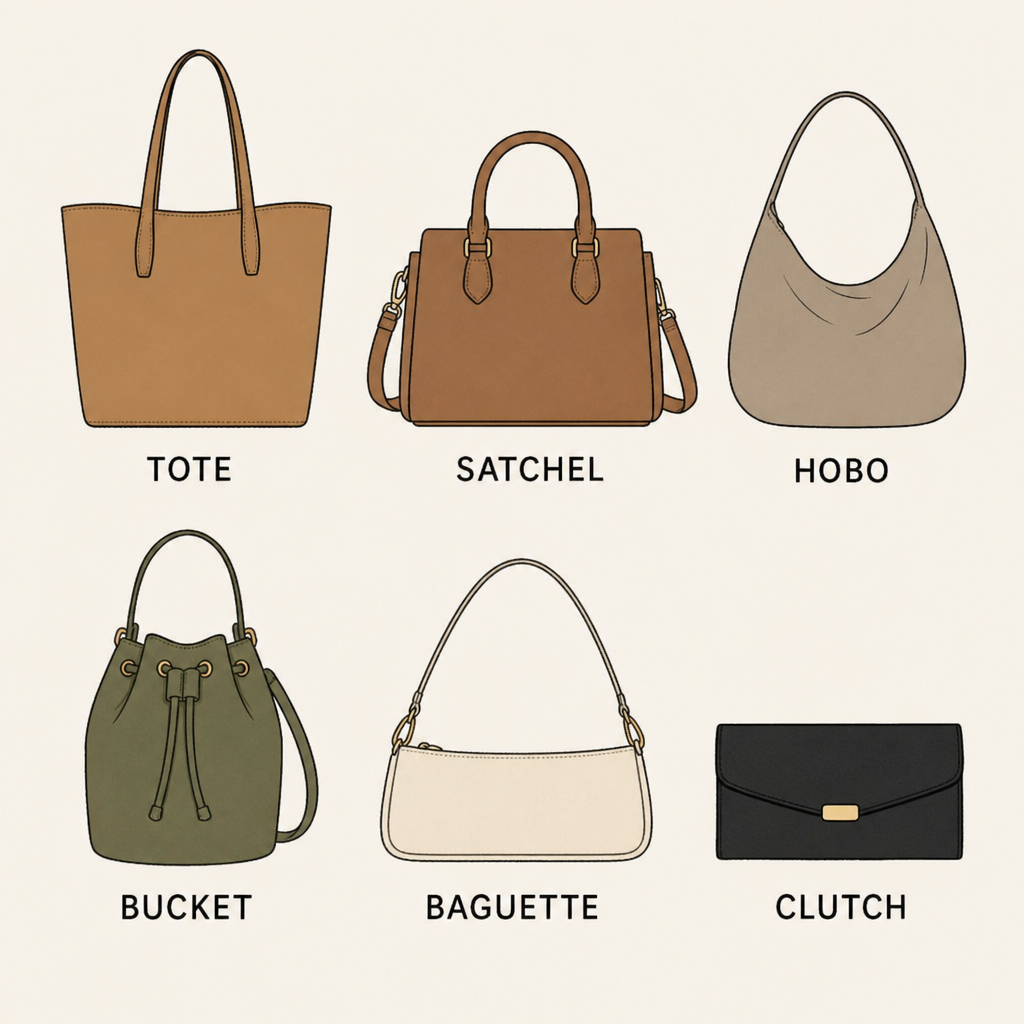
For shoppers, the practical lesson is straightforward: start with the look you like, then inspect the construction you need. A silhouette image helps with recognition, but interior photographs, measurements, and strap details should guide the final decision.
Which handbag type fits your everyday needs?
The best starting category is the one that supports your actual contents, preferred carrying method, and access needs. Begin with those requirements, then compare individual products rather than choosing from appearance alone. Use the following process to turn a broad preference into a manageable shortlist.
- List your normal contents. Include your phone, wallet, keys, glasses, medication, notebook, and any other regular essentials. Distinguish everyday items from things you carry only occasionally.
- Measure the least flexible item. Check the dimensions of a device, rigid case, or notebook that must fit. Include its protective cover where relevant.
- Choose your preferred carrying method. Decide whether you want your hands free, prefer short handles, or regularly switch between methods.
- Inspect access and organization. Consider how you will retrieve frequently used items. Look at pocket openings, compartment placement, and the main closure.
- Test the complete setup. Where possible, try the bag with your usual contents and clothing. Check it while walking, sitting, opening doors, and reaching for essentials.
For a commute, you might shortlist totes, satchels, or backpacks, then eliminate products that fail your device-fit or access checks. For an evening event, you might begin with clutches or small shoulder bags, then verify the space needed for essentials. These are starting points, not restrictions on who should carry which bag.
If shopping online, use a paper template matching the stated dimensions to visualize the footprint. Treat this as an approximation rather than a capacity test: it cannot reproduce the opening, lining, internal dividers, or the way the bag changes shape when filled.
How do you build a useful handbag product taxonomy?
Build a handbag product taxonomy by choosing a manageable set of primary categories, defining their boundaries, and storing overlapping characteristics as attributes. The hierarchy should help people browse without forcing every combination of size, material, shape, and carrying method into a separate branch. The structure below is a proposed starting point, not a marketplace requirement.
Start with a simple category tree
A compact assortment could begin with these primary categories:
- Bags & AccessoriesHandbagsTote Bags
- Shoulder Bags
- Crossbody Bags
- Satchels
- Bucket Bags
- Hobo Bags
- Clutches & Evening Bags
- Backpacks
- Wallets & Small Accessories
- Travel Bags
Adapt the hierarchy to your inventory and customer vocabulary. A specialist evening-bag store may need separate clutch and minaudière categories, while a smaller assortment may work better with one combined category. Do not create a branch merely because a descriptive term exists.
Write a short inclusion rule for every primary category. State what belongs there, what should be handled through an attribute, and which category wins when a product qualifies for more than one. Test those rules against several ambiguous products before applying them across the catalog.
Keep filters separate from category branches
Use attributes for combinations such as black, leather, small, zip closure, and detachable strap. A proposed path like Handbags > Bucket Bags can then work alongside filters for those details. This avoids creating separate branches for every possible combination.
Keep curated collections separate too. Labels such as “Work Bags” or “Evening Edit” can bring together products from multiple primary categories. In this proposed model, the collection expresses a shopping theme while the primary category preserves the product's identity.
Distinguish your hierarchy from external feed categories
Google Merchant Center separates the merchant-defined product_type attribute from the predefined google_product_category taxonomy. Your internal hierarchy therefore does not need to reproduce Google's category tree. Use the appropriate field for each purpose rather than submitting a custom category as though it were a Google-defined value.
For product_type, Google recommends including the full hierarchy and separating levels with spaced greater-than symbols. An illustrative store-defined value could be Bags & Accessories > Handbags > Bucket Bags. Check the destination platform's current documentation before mapping or submitting product data.
Product attributes that make classification useful
Once the primary category is assigned, use a consistent attribute template to describe the product. Start with fields your team can verify reliably, rather than collecting impressive-looking detail with no dependable source. The following template is a practical proposal for handbag records.
|
Attribute |
Suggested information |
Recording rule |
|---|---|---|
|
Primary type |
Tote, satchel, bucket, clutch |
Choose one agreed primary value |
|
Carrying methods |
Handheld, shoulder, crossbody |
Record all supported methods |
|
Dimensions |
Width, height, depth |
Use consistent units and measurement conventions |
|
Strap details |
Adjustable, detachable, drop or length |
Distinguish included straps from optional accessories |
|
Materials |
Outer, lining, trim |
Preserve verified composition details |
|
Closure |
Main fastening and secondary fastening |
Describe the main compartment first |
|
Interior |
Pockets, dividers, compartments |
Record the actual layout |
|
Appearance |
Color, pattern, surface treatment |
Use controlled labels plus descriptive copy |
Keep size labels and measurements together. “Small” may be useful as a store-defined browsing label, but dimensions provide the specific information needed for comparison. Establish your own size-label rules and apply them consistently rather than presenting them as an industry standard.
Separate shell material from visual finish. If the supplier describes an embossed surface, preserve that description without inferring a different underlying composition. Likewise, do not turn a material name into an unsupported performance claim.
Treat terms such as “waterproof,” “anti-theft,” or “fits a laptop” as claims requiring verification. If the available information does not support them, leave them out or request clarification. A missing field is preferable to a confident but unreliable product promise.
Finally, distinguish stable attributes from merchandising copy. Store the verified dimensions and materials in structured fields, then write the description from those records. This gives editors a clear reference when updating titles, filters, or collection pages.
A worked classification example
Imagine a hypothetical bag with a rounded base, cinched opening, short handle, detachable long strap, and soft body. Assume its supplier confirms that the long strap supports crossbody wear. The aim is to represent those features without creating several conflicting product identities.
Under the proposed framework, its record could read:
- Primary category: Bucket Bags.
- Carrying methods: Handheld and crossbody.
- Construction: Soft or unstructured, following the store's defined vocabulary.
- Closure: Drawstring or cinched closure, matching the actual mechanism.
- Strap: Detachable; record adjustability only if confirmed.
- Size: Verified dimensions, plus any store-defined size label.
- Collections: Everyday Bags or another relevant editorial grouping.
A factual title might be Soft Bucket Bag with Detachable Crossbody Strap. Add material, color, or a collection name only when those details are supplied. There is no need to pack every attribute into the title if the product page already presents them clearly.
If another editor classifies the same hypothetical item differently, review the category rules rather than silently changing the record. The disagreement may reveal that “bucket” and “crossbody” need a clearer precedence rule. Resolve the rule once, then check other affected products.
Classification mistakes to prevent
Use a final review to catch problems that survive otherwise careful data entry. Focus on consistency and customer understanding, not merely whether every field contains a value. A completed record is useful only when its labels accurately describe the item.
- Duplicating a convertible product: Keep one product record and capture its supported carrying methods. Do not create separate identities solely because it can be worn two ways.
- Turning every descriptor into a category: Keep color, material, finish, and size available as attributes unless there is a deliberate reason to create a collection.
- Inferring features from photographs: Verify detachable straps, pocket closures, and composition through dependable product information.
- Overloading product names: Lead with the primary type and a few distinguishing details. Put secondary information in specifications and descriptive copy.
- Using inconsistent synonyms: Maintain a preferred label and a small synonym list for internal reference. Decide whether similar terms represent the same feature before merging them.
- Assigning occasions too rigidly: Let use-case collections support discovery without overriding the underlying bag type.
Before publishing, compare the title, photographs, category, and attribute fields together. Ask whether they tell the same story and whether a shopper can identify the carrying options, opening, and usable dimensions. Flag uncertainty for review instead of smoothing it over with generic promotional language.
The takeaway: classify clearly, then compare the details
Handbag categories are most useful as a starting point, not a complete product description. Separate primary type from shape, carrying method, construction, and attributes to make different bag types easier to compare.
For shoppers, that means checking fit and function beyond the style name; for catalog teams, it means defining clear rules and applying them consistently. Start with a simple framework, test ambiguous products, and expand only where the detail genuinely helps.
Frequently Asked Questions About Handbag Categories, Types, and Classification
What are the main categories of handbags?
Handbags can be categorized into several main types, including totes, shoulder bags, hobos, satchels, crossbody bags, and clutches. Each category has its unique design and intended use, making it easier for consumers to choose based on their needs.
How do I determine the right handbag type for my lifestyle?
Consider your typical contents, preferred carrying method, and occasions for use. For example, if you often carry a laptop, a tote or satchel may be best, while a clutch might be more suitable for formal events.
What should I look for when choosing a handbag?
Evaluate the bag's dimensions, carrying methods (handles, straps), and interior organization (pockets and compartments). Also, consider the material and closure type, as they affect durability and ease of access.
What is the difference between handbag shapes and styles?
Handbag shapes refer to the outline and proportions of the bag (e.g., rectangular, round), while styles describe the overall visual impression and design elements (e.g., casual, formal). Understanding both can help in making a more informed purchase.
How can I organize my handbag collection for selling?
Build a handbag product taxonomy by defining primary categories and using clear attributes like type, shape, material, and carrying methods. This helps customers browse easily and compare products effectively.