Combs and brushes serve different jobs: some loosen tangles, others create precise parts, and others shape a finished style.
This guide explains 15 common types of hair combs and brushes, what their designs do, and where they fit into a practical routine.
Start with the task you need to accomplish rather than collecting every tool on the shelf.
Which types of combs and brushes do you need?
Choose hair care tools according to your hair’s texture, density, condition, and styling goal. A wide-tooth comb helps with gentle detangling, a paddle brush covers broader sections for smoothing, and a round brush creates bend during blow-drying.
These tools are not interchangeable: removing knots and shaping a blowout require different designs and techniques.
Use these starting points to narrow your options:
- For knots: Consider a wide-tooth comb or purpose-built detangling brush, using gentle pressure rather than pulling through resistance.
- For precise sections: Choose a tail comb when you need controlled partings for styling.
- For blowout shape: Compare paddle brushes for broad smoothing with round brushes for lift and curved ends.
You will notice some overlap among brush types. “Paddle” describes a shape, “boar bristle” describes a material, and “thermal” describes a heat-retaining construction; one brush can fit several categories. Read the construction details, not just the product name.
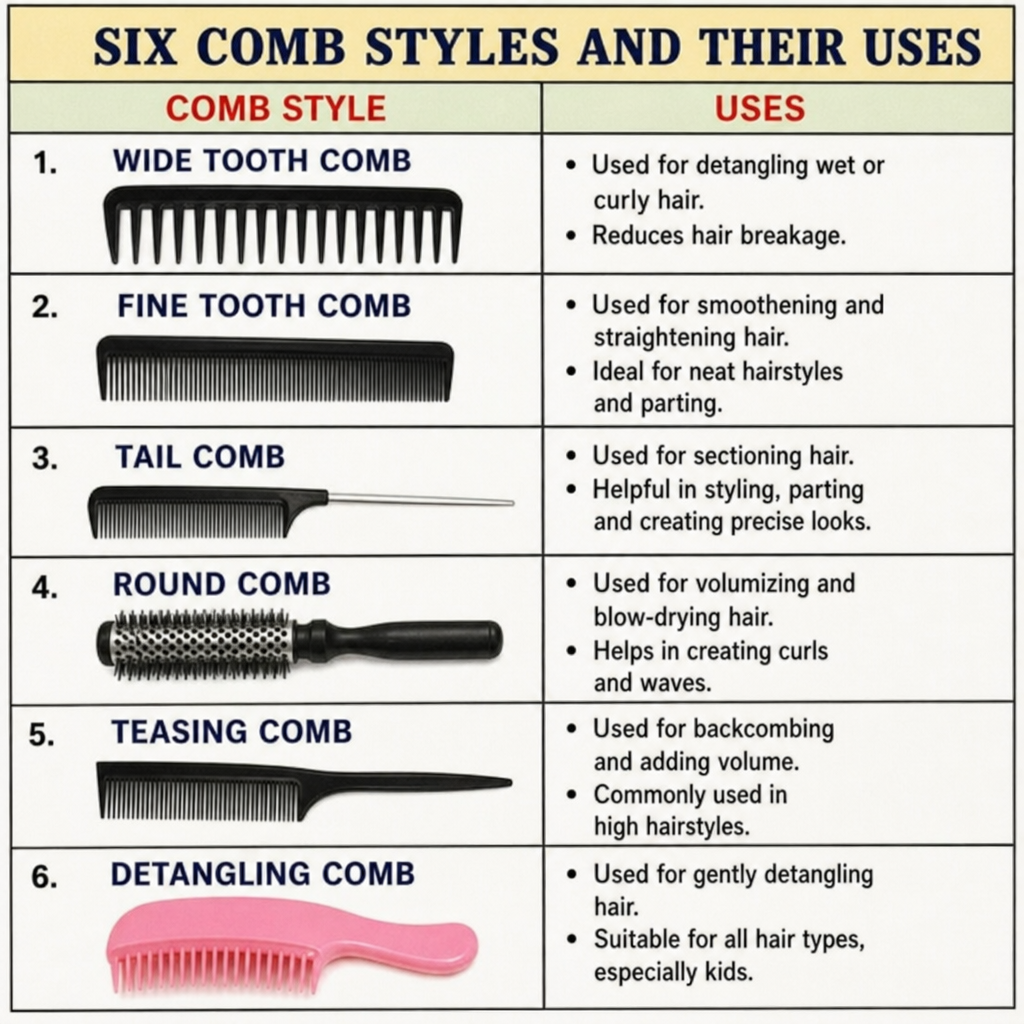
Six comb styles and their uses
1. Wide-tooth comb
Widely spaced teeth leave room between strands, making this a practical choice for gentle detangling. The American Academy of Dermatology recommends letting straight hair dry somewhat before combing, while textured hair or tight curls should be combed damp. Use the comb gently; wider spacing does not make forceful pulling harmless.
2. Fine-tooth comb
Closely spaced teeth provide control for neat styling and detailed finishing. Reach for this comb after larger tangles are removed, rather than expecting its narrow gaps to tackle a knot. Among different types of combs and brushes, it serves a precision role rather than replacing a detangling tool.
3. Rat-tail comb
A rat-tail comb pairs a toothed section with a long, narrow handle used for sectioning. It is useful when creating deliberate parts or separating hair before styling. Think of the tail as a placement tool and the teeth as the grooming surface, rather than dragging the pointed end through tangles.
4. Cutting comb
A cutting comb typically combines finer and wider tooth spacing for controlled section handling. Hairdressers use it to organize hair during cutting and scissor-over-comb work. For home hair grooming, its main appeal is versatility: the two tooth sections offer different levels of control without switching between separate hair combs.
5. Afro pick
An Afro pick has long, spaced teeth designed for lifting and shaping textured hair. Its useful role is adding height and adjusting the outline of a style, rather than automatically combing every curl from root to tip. Choose it when your goal is a fuller silhouette rather than a tightly smoothed finish.
6. Beard and mustache comb
A compact beard comb offers control around facial contours and smaller areas such as the mustache. Rounded teeth help with shaping, tidying edges, and directing facial hair into place. Match the comb to the area you are grooming: a small design can be easier to position precisely than a full-size scalp comb. (
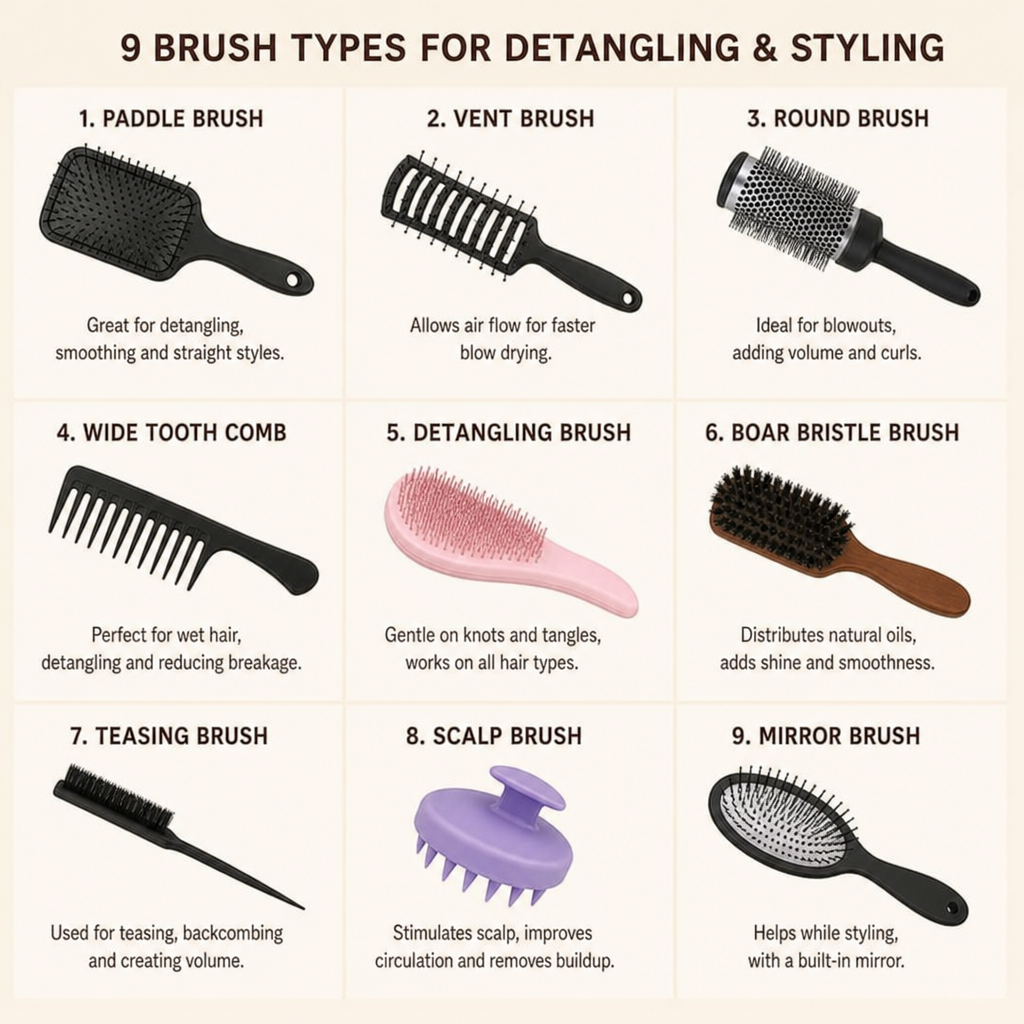
Nine brush types for detangling and styling
7. Paddle brush
A paddle brush has a broad head that works across larger sections of hair. It is useful for guiding and smoothing lengths during a blow-dry, especially when you want a straighter finish rather than pronounced curls. Consider the head width and pin design together; shape alone does not determine how it handles hair.
8. Vent brush
Openings in a vent brush allow dryer airflow through its head. This design suits airflow-focused styling and creating lift rather than detailed, polished shaping. It is a useful option to compare when your routine involves drying and directing hair before moving to another tool for the final finish.
9. Round brush
A round brush uses a cylindrical shape to create movement, volume, and curved ends during blow-drying. Smaller barrels generally create a tighter bend, while larger barrels produce broader curves. Choose the diameter according to your hair length and desired shape, not simply because the largest brush looks more substantial.
10. Thermal round brush
A thermal round brush adds a heat-retaining barrel to the round-brush design. It is intended for shaping hair with a dryer, including creating lift and curved finishes. This is a styling tool, not a shortcut around heat precautions: use the lowest practical heat setting and limit unnecessary heat exposure.
11. Cushion brush
A cushion brush sets its pins or bristles into a yielding pad rather than a rigid base. It is an option for everyday grooming when a softer brushing feel matters. Look beyond the cushion itself, though: bristle material, spacing, and stiffness still influence how the brush moves through your hair.
12. Detangling brush
Detangling brushes use designs intended to loosen knots, often incorporating flexible bristles. Choose one suited to your hair texture and whether you intend to use it wet or dry. Work gently, particularly on wet or fine hair; a detangling label does not remove the possibility of breakage from rough handling.
13. Boar-bristle brush
Boar-bristle brushes help distribute natural oils and smooth the hair’s surface. Their finishing role makes them worth considering when your goal is polish rather than working through substantial knots. Bristle material is only part of the choice: the brush’s shape also determines whether it is intended for smoothing lengths or shaping a blowout.
14. Mixed-bristle brush
Mixed-bristle brushes commonly combine boar and nylon bristles, bringing different grooming characteristics into one tool. They are often used for smoothing medium or thick hair, with nylon bristles helping the brush engage the hair. Compare the actual construction with your needs rather than assuming every mixed-bristle brush provides the same feel.
15. Loop brush
A loop brush has looped, tip-free bristles intended to move around extension attachment points. It is a specialized option for extensions, wigs, and similar hairpieces, rather than simply another everyday detangler. Follow the care guidance for your particular installation or hairpiece when deciding how to brush around its attachments.
How can you improve your combing techniques?
Gentle handling matters as much as choosing among different types of hair brushes and combs. Begin detangling at the ends and gradually work upward instead of pushing a tool through the full length immediately. For curly or coily hair, dermatologists recommend detangling wet hair with conditioner and fingers, a wide-tooth comb, or a suitable brush.
Keep these practical habits in mind:
- Match the technique to texture. Let straight hair dry somewhat before gentle combing; detangle textured hair or tight curls while damp.
- Use conditioner for curly detangling. It helps make the process more manageable without relying on extra pulling.
- Separate detangling from styling. Loosen knots before focusing on shaping or finishing your look.
- Skip the stroke count. Hair does not need 100 brush strokes a day; brush and comb only as needed for styling.
Keep pet grooming tools in a separate category
Searching for types of dog brushes and combs introduces another set of designs. Slicker brushes, undercoat rakes, and rubber grooming brushes are selected according to a dog’s coat, not human hair texture. For example, rubber brushes suit short coats, while undercoat rakes require an appropriate pin length for the coat being groomed. Similar names do not mean identical uses.
Build a smaller, more useful toolkit
Use this overview of different types of combs and brushes to identify your main task first. Then choose a detangling tool and add styling tools only for finishes you actually create. The goal is a manageable routine, not a drawer containing all 15 options.
Frequently Asked Questions Related to Combs And Brushes
What is the difference between a comb and a brush?
Combs and brushes serve different purposes. Combs are typically used for detangling hair and creating precise sections, while brushes are designed for smoothing and styling hair. The choice between the two depends on the hair type and the desired hairstyle.
How do I choose the right comb or brush for my hair type?
Selecting the right tool depends on your hair’s texture and condition. For example, a wide-tooth comb is best for detangling wet or curly hair, while a paddle brush is ideal for straightening hair during blow-drying. Always consider your hair's needs when choosing grooming tools.
Can I use a brush on wet hair?
It’s generally not recommended to use a regular brush on wet hair, as it can lead to breakage. Instead, opt for a detangling brush designed for use on wet hair or a wide-tooth comb for gentle detangling.
What are the benefits of using a boar-bristle brush?
Boar-bristle brushes help distribute natural oils throughout the hair, giving it a smooth and shiny appearance. They are excellent for finishing and smoothing hair, particularly for those with fine to medium-textured hair.
How often should I clean my combs and brushes?
It's advisable to clean your combs and brushes regularly, ideally once a week, to remove hair, product buildup, and dirt. This helps maintain the hygiene of your grooming tools and prolongs their lifespan.