Choosing a cn marketplace starts with matching the platform to your order: custom manufacturing, wholesale inventory, or individual products for evaluation.
This guide compares nine China sourcing platforms and explains how to evaluate suppliers, compare quotations, and prepare a first order. It is a planning shortlist for 2027, based on information available on November 6, 2026—not a prediction of future platform features or performance.
Which China sourcing platform should you choose?
For an initial shortlist, consider Alibaba.com for international wholesale sourcing, 1688 for domestic Chinese wholesale research, and AliExpress for individual product purchases.
These platforms serve different buying models, so compare them against your purchasing requirements rather than treating them as interchangeable. Alibaba Group identifies Alibaba.com as an international wholesale marketplace, 1688 as a domestic wholesale marketplace, and AliExpress as a consumer-facing retail platform.
Before opening dozens of supplier tabs, define four things:
- Product requirements: Specify materials, dimensions, performance, packaging, and acceptable variations.
- Order purpose: Separate exploratory purchases from resale inventory and custom production.
- Operational support: Decide who will handle supplier communication, inspections, consolidation, and shipping.
- Budget boundaries: Set a target delivered cost, not just a target listing price.
The nine selections below are organized by sourcing use case. Their order is editorial, not a measured ranking of price, reliability, or supplier quality. Use the suggested applications as starting points for research, then judge each seller and quotation independently.
Nine Chinese marketplaces to shortlist for 2027
1. Alibaba.com: International wholesale sourcing
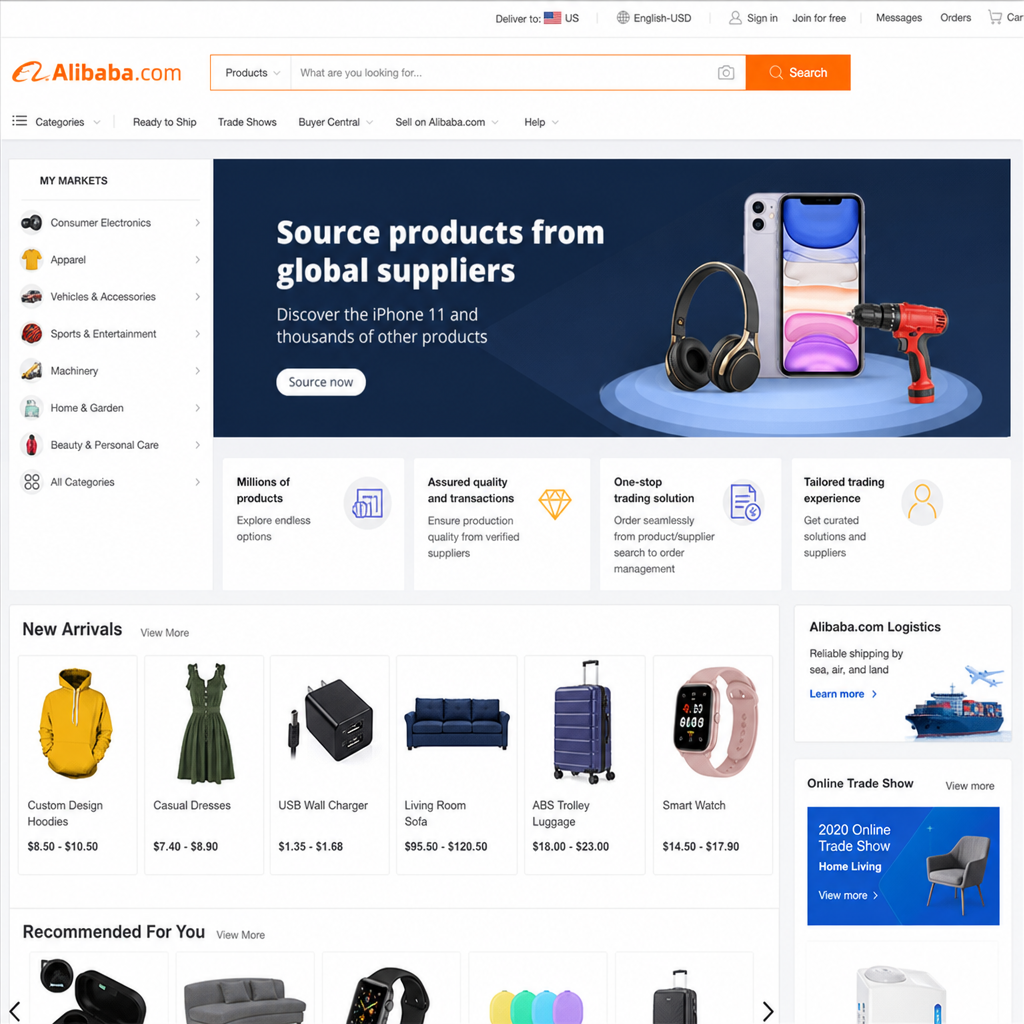
Alibaba.com combines international wholesale supplier discovery with purchasing tools. Its Verified Supplier program involves third-party assessments of areas including company profiles and production capabilities.
Trade Assurance provides purchase protection for eligible platform orders, subject to the applicable terms.
Suggested use: Build an initial supplier shortlist for a product you intend to purchase repeatedly or customize. Send the same specification to each candidate so differences in quotations are easier to investigate.
Review the assessment behind a supplier badge rather than stopping at the badge itself. For an eligible protected order, put measurable requirements into the agreement and follow the platform’s payment process. Alibaba’s guidance emphasizes precise terms, platform payment, documented communication, and inspection against the agreement.
2. Made-in-China.com: Technical product research
Made-in-China.com lists categories including manufacturing machinery, industrial equipment, electrical products, and consumer goods. Its Audited Supplier program uses third-party organizations to verify suppliers and produce audit reports, giving buyers documentation to examine during selection.
Suggested use: Shortlist suppliers when your purchase requires detailed technical conversations. For equipment, request a quotation against your required output, operating conditions, accessories, and maintenance expectations.
Read the audit report for the specific business you are considering. Then ask separate questions about the proposed product: what is included, what requires additional payment, and how acceptance will be demonstrated. Treat company verification and product approval as two distinct purchasing decisions.
3. Global Sources: Online discovery alongside trade shows
Global Sources connects online sourcing with its trade-show ecosystem. Its supplier information distinguishes verification categories, including verified suppliers that also exhibit at Global Sources trade shows. That connection gives buyers another route for researching and meeting prospective partners.
Suggested use: Develop a shortlist online before arranging more detailed discussions or attending a relevant sourcing event. Prepare questions that go beyond the catalog, including customization limits, production arrangements, and responsibility for quality checks.
If you meet a supplier, use the conversation to clarify unresolved details rather than simply collecting brochures. Request written follow-up covering the product version discussed, sample arrangements, quotation assumptions, and next steps. Keep those records with the supplier’s online profile for later comparison.
4. 1688: Domestic wholesale research
1688 is Alibaba Group’s domestic Chinese wholesale marketplace, with suppliers across multiple industries. Its domestic focus distinguishes it from Alibaba.com’s international wholesale model; a listing should therefore be investigated in the context of your overseas purchasing requirements.
Suggested use: Research domestic wholesale options when you can arrange the communication and purchasing support your order needs. Ask suppliers to confirm payment arrangements, delivery destination, documentation, and any export-related services before proceeding.
Avoid assuming a lower displayed price represents a lower delivered cost. Request a complete purchasing plan, including any intermediary, domestic transport, inspection, and international freight charges. Compare the final proposal with an export-oriented quotation using identical product specifications and quantities.
5. DHgate: Comparing standard-product offers
DHgate describes its marketplace as supporting both business-to-business and business-to-consumer transactions. Its product range includes electronics, fashion, and home goods, making it another place to investigate standard-product offers rather than limiting your search to manufacturing-focused directories.
Suggested use: Explore an existing product when the seller’s available quantities and purchasing terms fit your trial order. Confirm the precise model, included accessories, packaging, and shipping arrangement before checkout.
Ask for clarification wherever a listing leaves room for interpretation. For example, specify whether a pictured accessory is included and whether all units will have the same finish. Keep the first purchase focused on evaluating the seller and product, rather than committing your entire inventory budget.
6. AliExpress: Individual product evaluation
AliExpress is a global retail marketplace that enables consumers to buy from manufacturers and distributors in China and elsewhere. It belongs in this comparison as a retail purchasing option, not as an equivalent to a negotiated wholesale manufacturing relationship.
Suggested use: Purchase an individual item for hands-on evaluation when the listing permits the quantity you need. Examine its dimensions, finish, packaging, and usability against your intended product brief.
Treat that purchase as evidence about the item received—not automatic approval of a future wholesale batch. If you later seek customization or repeat inventory, request a separate commercial proposal. Confirm who will supply the goods and how the agreed specification will be maintained.
7. HKTDC Sourcing: Expanding supplier discovery
HKTDC Sourcing provides product and supplier discovery through the Hong Kong Trade Development Council. Its sourcing resources cover businesses in Hong Kong, mainland China, and other regions, so buyers should not assume every listed supplier is a mainland Chinese manufacturer.
Suggested use: Broaden a shortlist when you want to compare potential partners beyond one marketplace. Review the business locati0n and ask where the proposed goods will actually be manufactured.
Clarify the supplier’s role early: manufacturer, exporter, distributor, or another intermediary. Ask which entity will issue the quotation, receive payment, and handle production problems. Use those answers to decide whether the arrangement matches the level of direct factory involvement you want.
8. Yiwugo: Small-commodity sourcing
Yiwugo connects online product discovery with the physical Yiwu commodity market. The platform describes itself as an official Yiwu market platform and offers shop information alongside services such as sourcing, translation, warehousing, and inspection. Confirm the scope and availability of any service before engaging it.
Suggested use: Investigate a mixed assortment of small commodities while planning how purchases from different sellers will be coordinated. Build a product-by-product order sheet before requesting quotations.
For each item, record color, material, quantity, packing format, and delivery expectations. Ask who will check incoming goods and resolve shortages before consolidation. This creates a clearer handoff between supplier selection and the practical work of assembling your shipment.
9. Chinagoods: Yiwu market-linked discovery
Chinagoods is developed and operated by CCC Group, which also manages physical Yiwu markets. The platform states that its stores have booths in those markets, connecting online listings with an offline trading presence.
Suggested use: Research Yiwu-based merchants and compare their proposed products with other quotations. Use booth and business information as part of your supplier file, then request evidence relevant to your actual order.
Confirm stock availability, production requirements, packaging, and delivery responsibilities in writing. A physical trading presence is useful context, but make your purchase decision around the specific commercial proposal. For a mixed shipment, ask how separate orders will be identified and checked before dispatch.
10. Ejetspark: trending wholesale products
EJET Spark is your trusted partner for sourcing trending wholesale products from China. With access to 10,000+ products, reliable suppliers, and global sourcing solutions, we help retailers, wholesalers, and brands discover innovative products, expand their collections, and grow their businesses with confidence.
How do you compare suppliers beyond the listing price?
Compare suppliers against the same specification, quantity, delivery destination, and acceptance criteria. Request itemized quotations that distinguish product costs from packaging, transport, inspection, and other services. Make your decision only after identifying what each quotation includes and which responsibilities remain with you.
For sourcing in China, I recommend using a single comparison sheet with these fields:
|
Comparison field |
What to request |
|---|---|
|
Product specification |
Materials, dimensions, components, finish, and tolerances |
|
Order quantity |
Minimum order and quantity breaks for the exact specification |
|
Customization |
Logo, packaging, tooling, and sample charges listed separately |
|
Timing |
Sample schedule, production schedule, and dispatch assumptions |
|
Quality acceptance |
Inspection method and agreed response to nonconforming goods |
|
Delivery scope |
Named destination, included services, and excluded charges |
For U.S. imports, verify product-specific requirements and applicable duties with current official guidance or a qualified customs broker. CBP emphasizes understanding import requirements, and the importer of record retains responsibility for the accuracy of customs entries. Do not rely on a marketplace listing as your compliance assessment.
As a practical comparison exercise, ask each shortlisted supplier to explain every exclusion. If one proposal omits retail packaging or final delivery, request those costs before comparing totals. Keep unresolved items visible rather than filling gaps with optimistic assumptions.
Build a repeatable first-order process
Use this recommended workflow to move from browsing to a purchase decision. Keep one folder per supplier, with quotations, specifications, sample photographs, and written approvals. The goal is to make every commitment traceable to an agreed requirement.
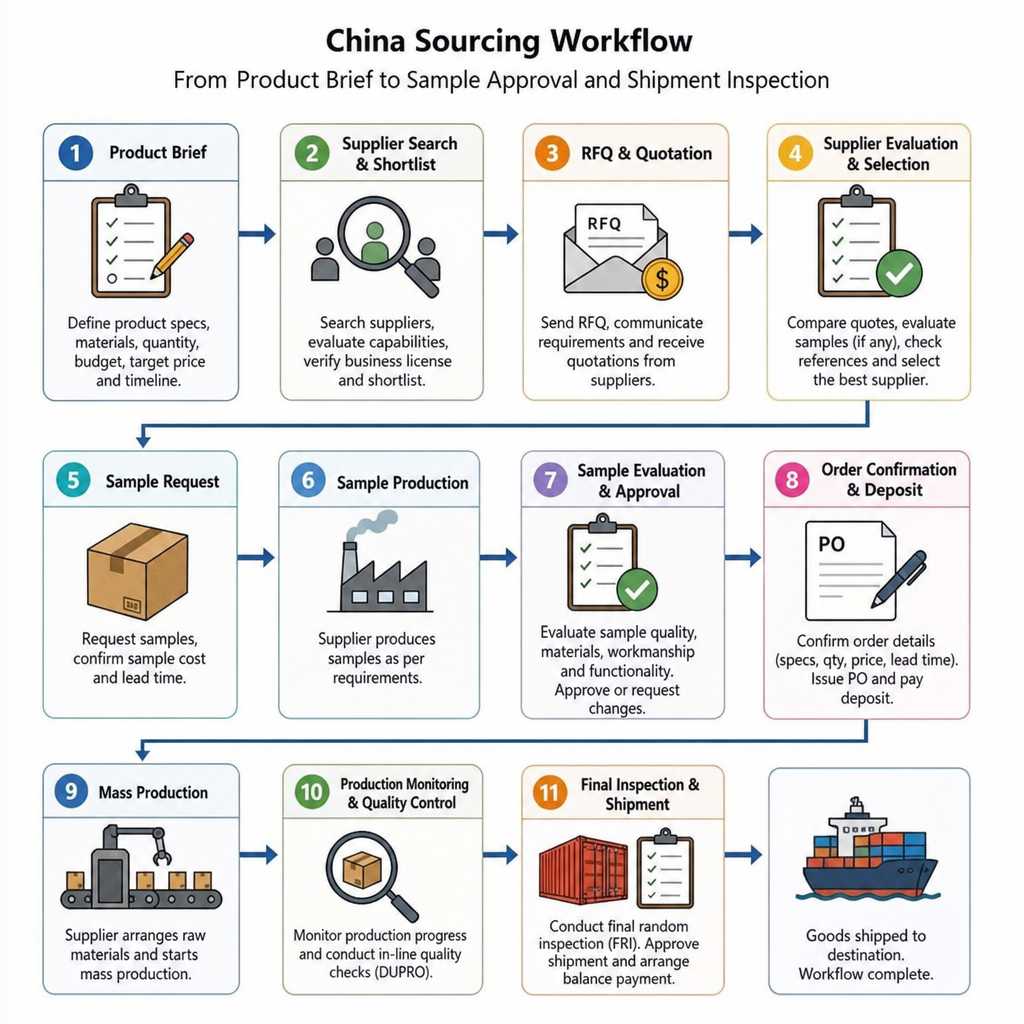
- Write one purchasing brief. Describe the product, intended use, quantities, packaging, and required delivery destination. Separate mandatory requirements from preferences so suppliers know where alternatives are acceptable.
- Shortlist a manageable group. Start with suppliers that answer the brief directly. Ask follow-up questions about missing details before spending time on extended negotiations.
- Document the business relationship. Request the legal business name and clarify which entity will quote, contract, receive payment, and supply the goods. Investigate inconsistencies before proceeding.
- Evaluate samples against a checklist. Record what passes, what fails, and what must change. Approve a defined version rather than sending a vague message that the sample “looks good.”
- Agree on production acceptance. Specify the checks, supporting evidence, and response to defects before committing to the order. Consider independent inspection where the purchase warrants it.
- Use the applicable purchasing safeguards. Read current payment and dispute terms. For Alibaba.com Trade Assurance orders, follow the documented platform process and preserve the agreed order requirements.
For an initial order, prioritize learning as well as margin. Record the questions you had to ask repeatedly, the changes made after sampling, and any quotation gaps. Use that record to improve your next purchasing brief rather than restarting the process from memory.
Choose for fit, then verify the order
The most useful cn marketplace is the one that fits your buying model and the support you can provide. Start with a focused shortlist, compare equivalent proposals, and approve a clearly defined product before expanding the commitment.
For your 2027 sourcing plan, choose two platforms to investigate first and send suppliers the same purchasing brief. Let the quality of their answers—not the appeal of a listing—guide your next step.
Frequently Asked Questions About CN Marketplace
A CN marketplace refers to online platforms that facilitate the sourcing and purchasing of products from China. They differ from other marketplaces in that they are primarily focused on connecting international buyers with Chinese suppliers, offering various features tailored to wholesale and manufacturing needs.
How do I choose the right sourcing platform for my needs?
Choosing the right platform involves assessing your specific requirements, such as whether you are looking for bulk purchases, custom manufacturing, or individual items. Key factors to consider include product categories, supplier verification processes, shipping options, and pricing structures.
What should I consider when evaluating suppliers on these platforms?
When evaluating suppliers, focus on their credibility, product quality, communication effectiveness, and overall reliability. Review supplier ratings, customer feedback, and ask for product samples and certifications to ensure they meet your expectations.
How can I ensure a safe purchasing process when using a China sourcing platform?
To ensure a safe purchasing process, use platforms that offer buyer protection programs, such as Alibaba's Trade Assurance. Additionally, have clear contracts, verify suppliers through third-party audits, and maintain written communication to document agreements and expectations.
What are the common challenges when sourcing products from China?
Common challenges include language barriers, cultural differences, quality control issues, and navigating import/export regulations. To mitigate these, it's essential to conduct thorough research, establish clear communication with suppliers, and familiarize yourself with relevant legal requirements for importing goods.