


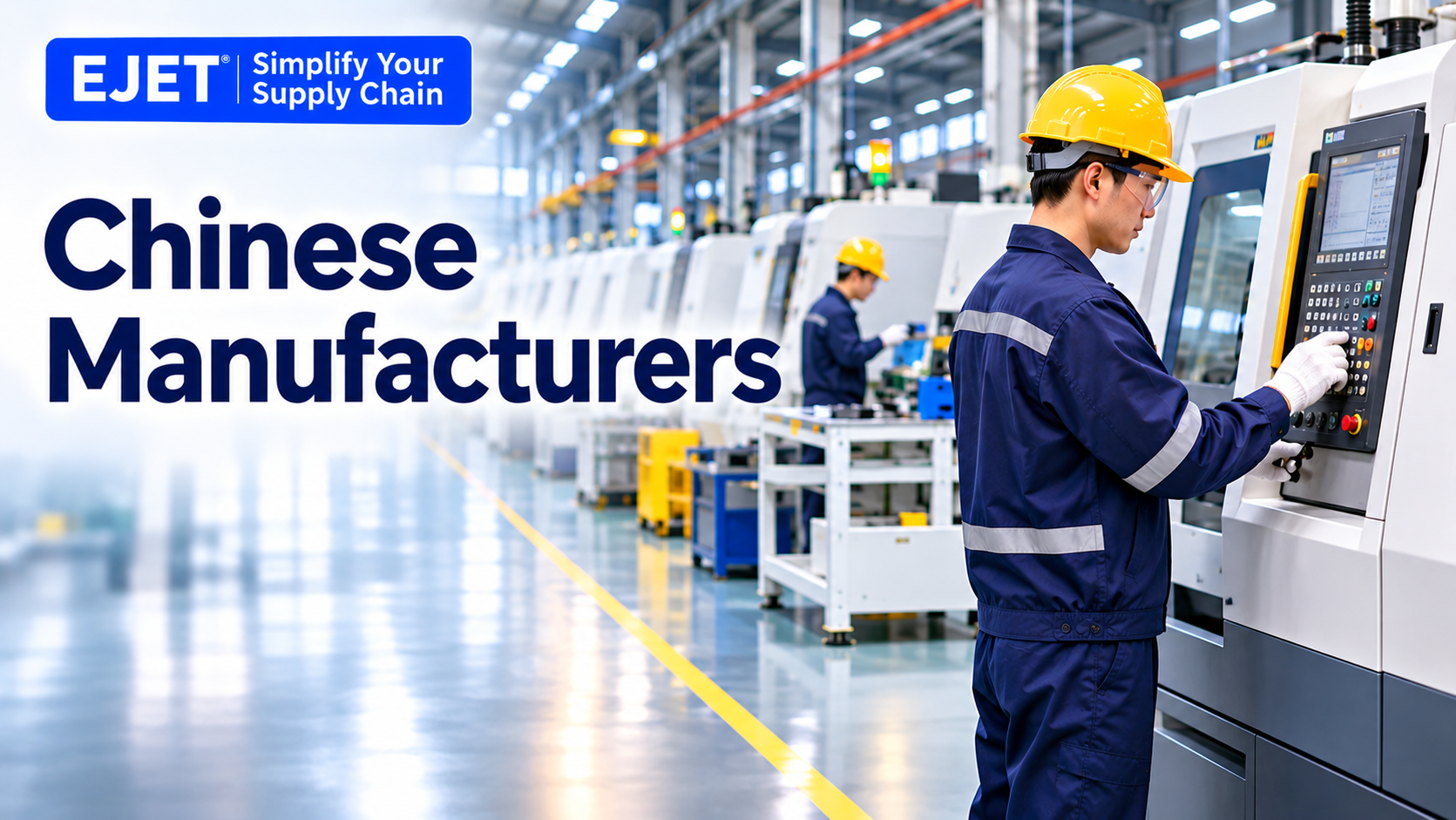
Chinese manufacturers have built their global position through more than competitive pricing: scale, connected supply chains and technical capability also matter.
Their rise now stretches from everyday consumer products to electric vehicles, batteries and industrial equipment.
For businesses considering manufacturing in China, understanding those strengths—and testing individual suppliers carefully—is more useful than treating the country as one enormous, uniform factory.
Why have Chinese manufacturers become so influential?
Chinese manufacturers have become influential because production scale, established supply networks, domestic demand and industrial expertise reinforce one another.
In clean technology, the International Energy Agency identifies economies of scale, a large home market and integrated supply chains as important sources of China’s competitiveness. These advantages help explain why the story extends well beyond inexpensive labour.
The scale is substantial. According to the World Trade Organization’s March 2026 report, Chinese exports of merchandise reached US$3.77 trillion in 2025, increasing by 5.5% in value terms. That figure covers merchandise rather than manufacturing alone, but it illustrates the breadth of China’s involvement in international goods trade.
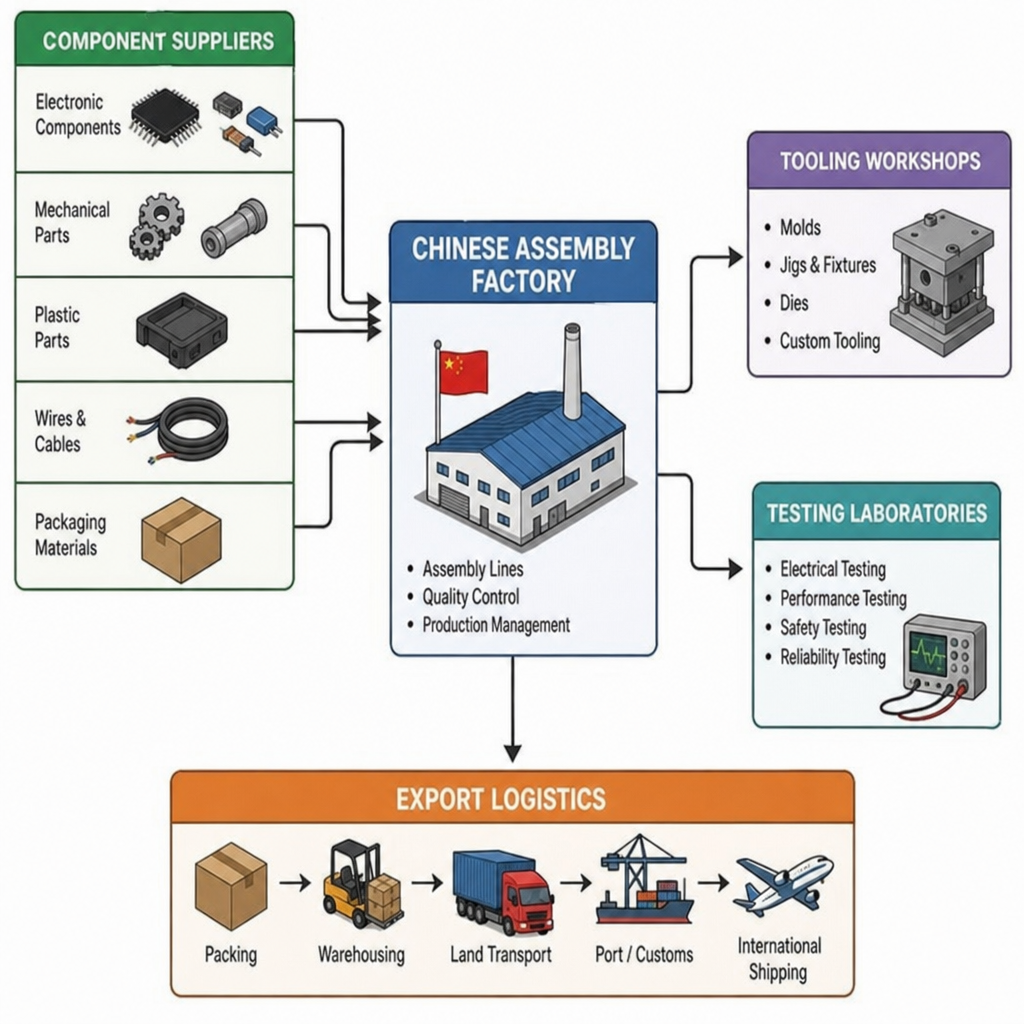
For buyers, the important point is how a production network works. A finished product depends on components, tooling, materials, packaging and transport—not simply an assembly line. When evaluating a potential manufacturing partner, examine the surrounding supply chain as carefully as the factory itself.
Consider a business developing a rechargeable appliance. Its sourcing task includes the housing, electronics, battery, charger and packaging, alongside final assembly. A useful supplier discussion therefore explores who coordinates those elements, which operations are subcontracted and how design changes reach everyone involved.
This perspective changes the purchasing question. Rather than asking only who offers the lowest unit price, ask which production arrangement can deliver the required specification consistently, with manageable costs and clear accountability.
Scale and specialisation strengthen the production network
China manufacturing is better understood as a collection of specialised production networks than as a single capability. Research into Chinese industrial clusters describes buyer–supplier relationships across production stages, alongside shared networks and supporting services. The practical lesson is to investigate the ecosystem around a supplier, not just its individual facilities.
For clean technologies specifically, the IEA’s analysis highlights highly integrated firms and facilities as a competitive strength. Its assessment also identifies infrastructure, skills, market access and policy support as factors influencing manufacturing investment. No single explanation captures the whole picture.
For procurement teams, specialisation provides a useful research framework. Start with the process your product needs: precision machining, electronics assembly, battery integration or food-production equipment, for example. Then investigate whether shortlisted suppliers have relevant machinery, engineering knowledge and supporting partners.
Avoid assuming that a strong reputation in one category transfers to another. A supplier experienced in simple household products should still demonstrate its suitability for a technically demanding electrical product. Treat each new manufacturing process as a fresh qualification exercise.
Which industries show the breadth of Chinese manufacturing?
Electric vehicles and batteries provide clear evidence of China’s manufacturing scale, while categories such as cutting tools, industrial lasers, agricultural equipment and off-road vehicles demonstrate the range buyers may investigate. These sectors should not be assessed using one generic checklist. Each calls for different evidence about performance, safety, production control and support.
Electric vehicles and batteries
Chinese electric car manufacturers sit within a substantial production ecosystem. The IEA’s Global EV Outlook 2026 identifies China as the largest hub for electric-car manufacturing and trade, supported by a closely connected supply chain extending from mineral refining to components, batteries and vehicle assembly.
The battery industry illustrates why locati0n and company ownership should be considered separately. The IEA reports that China accounted for more than 80% of global battery-cell production in 2025, while Chinese producers supplied almost 75% of batteries deployed in electric cars worldwide. These are different measures: one concerns where cells are made; the other concerns the producers supplying the market.
When evaluating Chinese battery manufacturers, distinguish cell production from module assembly and complete battery-system integration. Ask which organisation controls each stage, what testing supports the proposed application and how production batches are traced. Specify operating conditions and expected service requirements before comparing quotations.
For vehicle purchases, extend the assessment beyond the vehicle itself. Request a clear plan for spare parts, diagnostics, software support and warranty handling in the intended market. A fleet buyer should evaluate how the vehicles will be maintained throughout their working life.
Knives and cutting tools
Businesses researching Chinese knife manufacturers should translate the intended use into a measurable specification. A kitchen knife, workshop blade and outdoor cutting tool need separate assessment criteria. Begin with material identification, dimensions, handle construction, finish and packaging rather than relying on product photographs.
Ask suppliers to explain their material verification and production checks. Where hardness, edge performance or corrosion resistance matters, agree on suitable test methods with a qualified specialist. Keep an approved reference sample and record which characteristics must remain unchanged in production.
Fibre lasers and industrial machinery
When assessing Chinese fiber laser manufacturers, start with the job the machine must perform. Specify the material, thickness, part geometry, finish and intended operating pattern. Request a demonstration using representative workpieces rather than accepting a demonstration chosen solely by the seller.
Build the comparison around a complete installation proposal. Ask what is included for extraction, cooling, guarding, software, training and commissioning, and have relevant safety arrangements reviewed by a competent specialist. Require an acceptance test that demonstrates the agreed work before final sign-off.
ATVs and off-road equipment
Buyers approaching Chinese ATV manufacturers should define the intended application before discussing engine size or styling. Set out expected terrain, loads, operating conditions and maintenance arrangements. Ask the supplier to identify the exact model configuration being quoted and the documentation available for the destination market.
Give spare parts their own evaluation. Request parts diagrams, component references, service instructions and a proposed replacement-parts package. For commercial use, make repair support and parts availability explicit purchasing criteria rather than leaving them for discussion after delivery.
Poultry and agricultural equipment
For Chinese poultry equipment manufacturers, prepare a system brief rather than a shopping list. Explain the housing layout, production method, utilities, cleaning arrangements and expansion plans. Ask the supplier to identify assumptions behind its proposed feeding, watering, ventilation or handling equipment.
Require drawings and a clear description of installation responsibilities. Have the proposal reviewed against local operating conditions and relevant professional guidance. Before ordering, agree who will commission the equipment, train operators and resolve problems between connected systems.
Chinese inverter manufacturers in the Americas market in 2026
Assessing Chinese inverter manufacturers in the Americas market in 2026 requires a country-specific and project-specific approach. UL Solutions describes inverter evaluation across local, national and international standards, covering matters including safety, performance, electromagnetic compatibility and grid-code compliance. A broad claim of international certification is therefore not enough to evaluate a particular installation.
For distributed-energy equipment, UL identifies standards including UL 1741 and grid-code requirements such as IEEE 1547 within its testing services. These references are useful starting points for technical discussions, not substitutes for confirming the requirements applicable to the actual project.
Build the shortlist around evidence for the exact inverter model and intended locati0n:
- Product identity: request the complete model designation, hardware version and relevant firmware details.
- Certification evidence: obtain applicable documents and verify their scope with the issuing organisation.
- Project compatibility: have the installer or engineer confirm electrical, battery and control-system compatibility.
- Local acceptance: confirm relevant utility and installation requirements before committing to an order.
- Service arrangements: establish who handles commissioning, replacement units, warranty claims and technical support.
Keep market-growth claims separate from purchasing evidence. A manufacturer’s international presence may justify further investigation, but the decision should rest on the proposed product, verified documentation and a workable support arrangement.
How can buyers assess Chinese suppliers effectively?
Buyers should assess Chinese suppliers by verifying the business, examining production capability, testing representative samples and agreeing measurable acceptance criteria before scaling an order. Canada’s Trade Commissioner Service recommends checking registration, representative authority, financial standing, intellectual property claims and relevant compliance risks when conducting due diligence in China.
The objective is not to accumulate paperwork. It is to establish who will perform the work, which claims have been verified and what happens when production does not match the agreement. Organise the assessment around those decisions.
Verify the business and production site
Request the supplier’s registered Chinese company name and business licence details. The Canadian guidance identifies China’s National Enterprise Credit Information Publicity System as a resource for checking registration information, including business scope, address and licence validity. Use qualified assistance where language or interpretation creates uncertainty.
Separately, map the commercial arrangement. Identify the contracting company, manufacturing site, payment recipient and organisation responsible for warranty support. Ask for explanations where those parties differ, and resolve inconsistencies before transferring funds.
Establish capability against the actual product
Arrange a factory assessment proportionate to the order’s complexity and risk. Ask to see the processes relevant to your product, including incoming-material checks, critical production stages and final inspection. Where subcontracting is proposed, request visibility of the affected operations and associated controls.
Make the assessment specific. For a moulded housing, investigate tooling, dimensional checks and material control. For electrical equipment, ask about assembly instructions, testing records and traceability. A general factory presentation should not replace evidence about the work you are commissioning.
Approve the specification before the order
Create a specification pack that both parties can use without relying on memory or informal messages. Include drawings, materials, tolerances, finish, packaging, labelling and relevant test requirements. State how proposed substitutions and design changes must be approved.
Use the following sequence to keep the decision controlled:
- Define the intended use. Record the application, destination market and conditions the product must withstand.
- Issue a consistent quotation pack. Give shortlisted suppliers the same specification and ask them to identify exclusions.
- Evaluate representative samples. Record the results and resolve shortcomings before approving production.
- Run a pilot order. Use it to assess repeatability, packaging, documentation and communication.
- Set inspection checkpoints. Agree what will be checked, when it will be checked and what constitutes acceptance.
- Review delivery performance. Use inspection findings, defects and service responses to decide whether to scale.
Treat the pilot as a decision point, not a ceremonial step towards a larger order. If it reveals unclear instructions or inconsistent output, correct those issues and verify the changes first.
The difference between sourcing, wholesale and contract production
Before contacting China factories, decide what you actually need to buy. For procurement planning, separate three routes: purchasing existing products, commissioning an adapted design, or developing a product to your own specification. Each route needs a different brief and approval process.
A China wholesale search should begin with questions about the exact stock item, available quantities, packaging and reorder consistency. Ask whether the quoted goods are already produced or will be manufactured after the order. Confirm how a later batch will be matched to the approved product.
For adapted designs, list every requested change. Branding, colour, materials, accessories and packaging should appear in the quotation and approval records. Do not leave the supplier to infer whether an earlier sample or a later message takes priority.
For custom production, add development milestones and ownership questions. Establish who controls drawings, tooling, software and production files, and seek appropriate professional advice on the agreement. Ask what information and equipment would be available if production needed to move elsewhere.
China sourcing should therefore begin with the business model, not the marketplace listing. A business testing demand for an existing item needs a different purchasing process from one building a distinctive product intended for repeated production.
The quoted price is only one part of the cost
Compare quotations using a common cost worksheet. Alongside the product price, request separate figures or assumptions for development, tooling, samples, packaging, inspection and transport. Add your own estimates for storage, financing, servicing and handling unsuccessful units.
Use the worksheet to expose missing information, not to create false precision. If freight or another variable has not been confirmed, mark it as an assumption and test how the decision changes under different scenarios. Keep the date and basis of each quotation visible.
For imports into the United States, Customs and Border Protection explains that the importer of record is responsible for using reasonable care in entering, classifying and valuing goods. Involve a qualified customs professional when establishing the treatment of a proposed shipment rather than relying solely on the supplier’s description.
A practical comparison should cover:
|
Cost area |
Information to establish |
|---|---|
|
Development |
Which drawings, samples, tooling and revisions are included? |
|
Production |
What quantity, specification and packaging does the price cover? |
|
Quality control |
Who pays for inspection, retesting and corrective work? |
|
Delivery |
What delivery terms, freight assumptions and handling charges apply? |
|
Import preparation |
Who will verify classification, documentation and applicable charges? |
|
After-sales support |
Who pays for replacement parts, labour, returns and unsuccessful claims? |
Compare Chinese goods with alternative sources on the same basis. Avoid presenting a factory quotation beside a fully delivered local price and treating the difference as a confirmed saving. First establish what each offer includes and which responsibilities remain with the buyer.
Resilience and responsible purchasing belong in the brief
China’s manufacturing depth should be considered alongside concentration risk. The IEA’s Energy Technology Perspectives 2026 identifies highly concentrated clean-energy supply chains, with China the main supplier across many stages. That is a reason to understand dependencies, not an automatic argument for accepting or rejecting a source.
For important products, ask shortlisted suppliers to map critical materials, components and subcontracted processes. Identify which items lack approved alternatives and which changes would require further testing. Keep this information current as the design and order volume develop.
Use that map to decide where a backup source would be worthwhile. Give priority to components whose interruption would stop production or make a finished product difficult to service. If an alternative is essential, qualify it before treating it as available capacity.
Responsible purchasing also needs evidence. Include questions about material origin, labour practices, environmental controls and subcontracting in your due diligence brief, and seek specialist support where necessary. State what records you expect and how concerns will be investigated.
For connected equipment, add questions about software updates, remote access, data handling and support after the warranty period. Ask who controls configuration changes and whether essential functions depend on an ongoing supplier service. Make the answers part of the approval decision rather than postponing them until installation.
A stronger basis for the next sourcing decision
The rise of Chinese industry is a story of connected capabilities as well as production volume. Electric vehicles and batteries show how extensive those connections can become; smaller purchasing decisions still deserve equally clear thinking about specifications, accountability and support.
For buyers, the useful conclusion is neither that manufacturing in China is always the best option nor that another location is inherently safer. Build a precise brief, verify the proposed supplier and test the arrangement before expanding it. The strongest sourcing decision is the one supported by evidence about the product you need—not assumptions about the country on its label.
Frequently Asked Questions About The Rise of Chinese Manufacturers
Why have Chinese manufacturers gained prominence in global markets?
Chinese manufacturers have gained prominence due to their competitive pricing, large-scale production capabilities, well-connected supply chains, and technical expertise. These strengths allow them to offer a wide range of products, from consumer goods to advanced technologies like electric vehicles and industrial equipment.
What should companies consider when sourcing products from China?
Companies should assess the entire production network surrounding potential suppliers, including component sourcing, tooling, materials, and logistics. It is essential to evaluate not only the factory’s capabilities but also the reliability and efficiency of the supply chain involved in manufacturing.
How do electric vehicle and battery production illustrate China's manufacturing capabilities?
China is the largest global hub for electric vehicle manufacturing, supported by a comprehensive supply chain that spans from mineral refining to component production. The country accounts for a significant portion of the world's battery-cell production and has established itself as a leader in the electric vehicle market.
What are the risks associated with relying solely on Chinese manufacturers?
Relying solely on Chinese manufacturers can lead to concentration risks, including dependency on specific suppliers or materials. Companies should identify potential backup sources and assess supply chain vulnerabilities to mitigate the impact of disruptions.
How can buyers effectively evaluate Chinese suppliers?
Buyers should conduct thorough due diligence by verifying the supplier's business credentials, assessing production capabilities, and testing product samples against agreed specifications. Establishing clear acceptance criteria and maintaining open lines of communication are also crucial for successful partnerships with Chinese manufacturers.