China procurement services help businesses outsource purchasing tasks while retaining control over product requirements, budgets, and supplier decisions.
The practical goal is not simply a lower factory price: it is a lower total cost for goods that meet your requirements and arrive when needed.
This article explains how to define the service, evaluate providers, and build purchasing controls that make savings measurable rather than assumed.
Outsourcing should begin with a clear brief, not a search for the cheapest intermediary. Decide which work you want someone else to perform, what evidence they must provide, and which approvals remain with your team.
What do China procurement services include?
China procurement services support the purchasing activities you choose to delegate, potentially from supplier research through delivery follow-up. Define the scope explicitly: finding a factory, managing production, inspecting goods, and arranging transport are separate assignments.
Canada's Trade Commissioner Service identifies both direct purchasing and intermediary-based sourcing as options, while emphasizing specifications, supplier checks, and quality control.
For a service proposal, request deliverables rather than broad promises:
|
Activity |
Deliverable to request |
Decision to retain |
|---|---|---|
|
China product sourcing |
Candidate list with capability evidence |
Which suppliers advance |
|
Supplier selection |
Verification findings and assessment |
Which supplier receives the order |
|
Quotation comparison |
Comparable costs, terms, and exclusions |
Which offer meets your priorities |
|
Negotiation |
Written proposed commercial terms |
Acceptance of commitments |
|
Order management |
Milestone tracker and exception reports |
Approval of changes |
|
Quality inspection |
Results against agreed criteria |
Shipment release |
|
Shipping coordination |
Booking plan and document checklist |
Transport and budget approval |
Do not assume that an agent, trading company, inspection firm, and freight forwarder perform interchangeable roles. Ask who contracts with the factory, who invoices your business, and who takes responsibility for each deliverable. Record those answers in the agreement rather than relying on a service description.
You may need only supplier research and verification. Alternatively, request a coordinated service covering purchasing, inspection, and logistics, with named specialists responsible for each stage.
Where do the cost savings actually come from?
The right measure of savings is the total cost of receiving usable inventory, not the difference between two factory quotations.
Build a baseline covering the purchase price, procurement fees, testing, inspections, transport, import charges, and delivery. For U.S. imports, classification and valuation also require attention because the importer of record has reasonable-care responsibilities in the customs entry process.
Use this working calculation when evaluating proposals:
Total purchasing cost = goods + procurement fees + development and tooling + quality checks + logistics + applicable import charges + internal handling.
Then divide the relevant total by the number of usable units received. Keep estimated defect, rework, and delay allowances visible rather than treating them as known costs. After delivery, replace assumptions with actual results.
Look for outsourcing benefits in specific decisions:
- Better purchasing comparisons: Require equivalent materials, quantities, packaging, and delivery terms before judging price.
- Less avoidable customization: Ask whether a standard component can meet the requirement before approving custom tooling.
- More disciplined ordering: Review demand before accepting a larger order solely to unlock a discount.
- Earlier problem detection: Set approval checkpoints before production decisions become difficult to reverse.
- More deliberate logistics: Compare the full delivery plan instead of selecting transport from the headline freight charge.
For example, consider two quotations for the same storage container. Before accepting the cheaper offer, confirm that both include the required material, lid fit, retail packaging, and inspection access. If those details differ, you do not yet have a price comparison.
Avoid accepting a promised percentage reduction without its calculation. Ask which costs are included, which assumptions support the estimate, and how the provider will report the result after delivery.
How should you choose a procurement partner?
Choose a procurement partner by evaluating category knowledge, transparency, reporting quality, and accountability against your actual purchasing needs. Ask every candidate to explain how they would handle the same product brief, supplier problem, and missed milestone. Treat a polished presentation as an introduction; base the decision on the work they can demonstrate.
When comparing sourcing agents in China, request anonymized examples of a supplier assessment, quotation comparison, inspection report, and order tracker. Look for clear conclusions supported by evidence. A document that identifies an unresolved issue is more useful than a report that marks everything satisfactory without explanation.
Test category knowledge and verification methods
Ask how the provider would verify the processes your product needs. For molded products, discuss tooling and dimensional requirements; for textiles, discuss fabric specifications and construction checks. These questions should test whether the provider understands your brief, not whether they can repeat industry terminology.
Request the proposed verification method for each shortlisted supplier. The Trade Commissioner Service recommends supplier due diligence, checking qualifications and export experience, and visiting factories where possible. Use that guidance as a starting point, then request evidence suited to your product and order.
Make compensation and access explicit
Ask for a written explanation of all compensation arrangements, including any supplier-paid amounts. Require disclosure of relationships that could influence recommendations. If the provider resells goods rather than acting solely as your representative, clarify that commercial structure before comparing its offer with an agency proposal.
Review these points before signing:
- Fee basis: Define whether charges apply per project, order, period, or purchase value.
- Included work: Specify samples, visits, translations, inspections, and follow-up.
- Extra charges: Require approval before additional work creates additional fees.
- Supplier access: State what factory identities, quotations, and records you receive.
- Exit arrangements: Define the handover of files, contacts, samples, and open orders.
Evaluate proposed China sourcing solutions against this checklist. Choose the arrangement whose responsibilities you understand, rather than the proposal with the longest list of services.
Build a procurement process with clear approval points
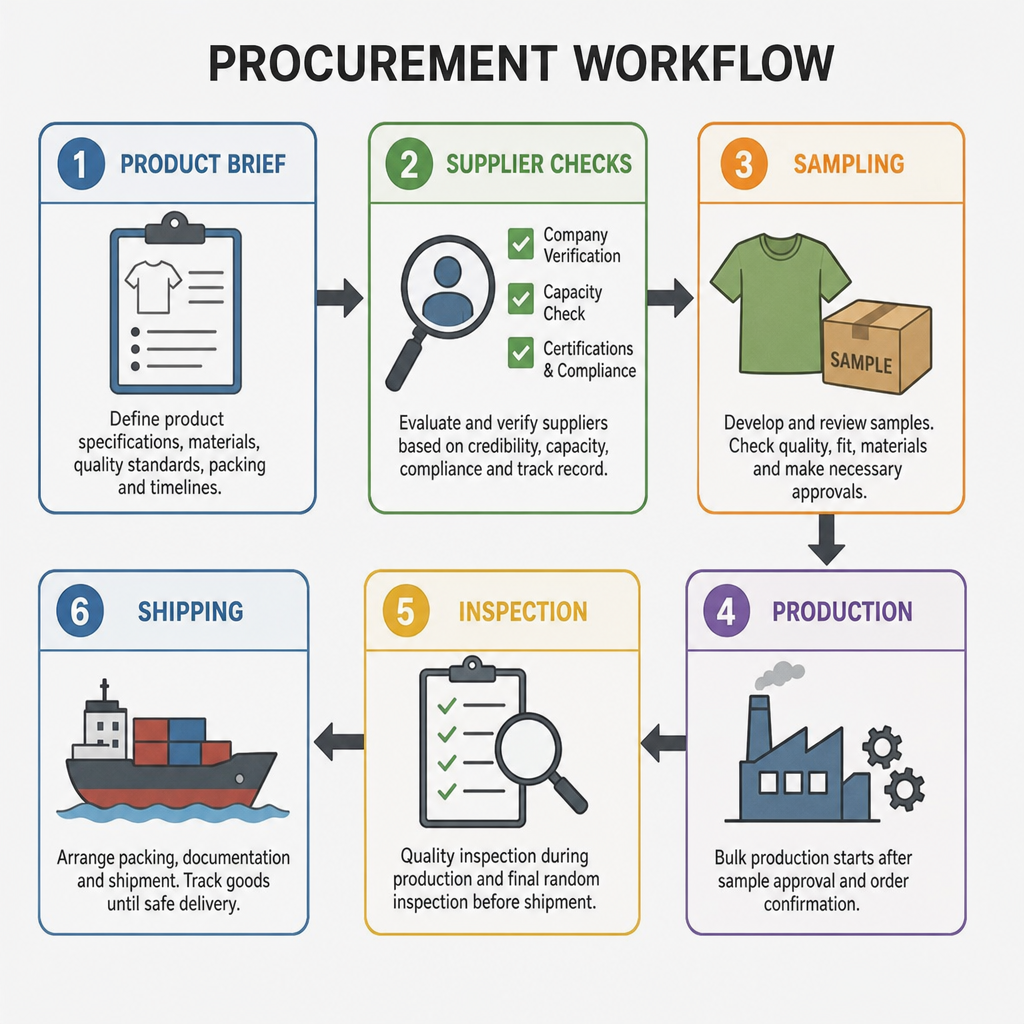
Set up the procurement process before the first purchase order. Give each stage an owner, a required output, and an approval condition. Use one shared product brief so that suppliers, the procurement partner, and your internal team work from the same requirements.
1. Create a purchasing brief that suppliers can quote
Describe the product precisely enough to expose differences between offers. Include drawings or reference samples where available, and distinguish mandatory requirements from preferences. Set a revision number so later changes do not silently replace the specification used for the quotation.
Your brief should address:
- Materials, dimensions, tolerances, finish, color, and required performance.
- Packaging, labels, barcodes, and carton requirements.
- Initial order quantity and realistic reorder expectations.
- Target delivery locati0n and required availability date.
- Required testing, documentation, and approval steps.
- Ownership expectations for designs, tooling, and development files.
If you cannot yet define a requirement, label it as unresolved. Ask suppliers to explain their assumptions rather than allowing each one to fill the gap differently. Resolve critical uncertainties before approving production.
2. Shortlist suppliers against the same criteria
Create a supplier selection scorecard before reviewing final prices. Choose criteria relevant to the purchase, such as demonstrated process capability, capacity evidence, sample results, communication, and commercial terms. Set minimum conditions that a low price cannot override.
Ask the provider to identify the proposed manufacturing locati0n and any outsourced production steps. Request an explanation of how it will verify important claims and report gaps. For significant commitments, consider a separate assessment rather than relying entirely on the party recommending the supplier.
Keep a backup candidate where practical, but do not describe an untested factory as a ready alternative. Record what remains necessary before it could receive an order. That distinction makes contingency planning more realistic.
3. Normalize quotations and negotiate the full package
Put quotations into a common comparison sheet. Align the specification revision, order quantity, currency, packaging, tooling charges, payment schedule, and delivery basis. Mark missing information prominently and ask suppliers to confirm exclusions in writing.
Use negotiation to resolve the whole commercial arrangement. Discuss minimum quantities, sample charges, tooling ownership, inspection access, production changes, and remedies for nonconforming goods. Ask for price breaks tied to realistic purchasing scenarios rather than offering unsupported volume promises.
If a supplier proposes a cheaper material or simpler finish, treat it as a design change. Have the relevant person review the effect on performance and appearance. Approve the change explicitly before incorporating the revised price into your savings estimate.
4. Approve samples and document the production agreement
Create a sample approval record identifying the version reviewed, tests performed, and any outstanding issues. Keep a reference sample or a controlled record of it. Require production to follow the approved specification, not an informal description such as “same as sample.”
Document the order quantity, price, schedule, inspection arrangements, payment milestones, and change-approval procedure. For contracts involving significant value, intellectual property, or complex remedies, obtain qualified legal advice. Make sure the procurement partner's service agreement and the supplier's obligations do not leave important tasks unassigned.
Before payment, establish an independent verification procedure for bank details and any subsequent changes. Name the people authorized to approve payments and exceptions. Do not let urgency replace the verification process you agreed at the start.
Make quality inspection a purchasing control
Plan quality inspection around the product's requirements and the consequences of failure. The Trade Commissioner Service cautions that a good sample does not remove the need for production quality control and recommends checking goods before shipment. Build inspection into the order rather than requesting it only when concerns appear.
Write an inspection brief covering the characteristics to check, the method, the reporting format, and the acceptance criteria. Ask a qualified inspector or quality specialist to recommend a sampling approach appropriate to the goods. Clarify whether the assignment checks appearance, dimensions, function, packaging, quantity, or other requirements.
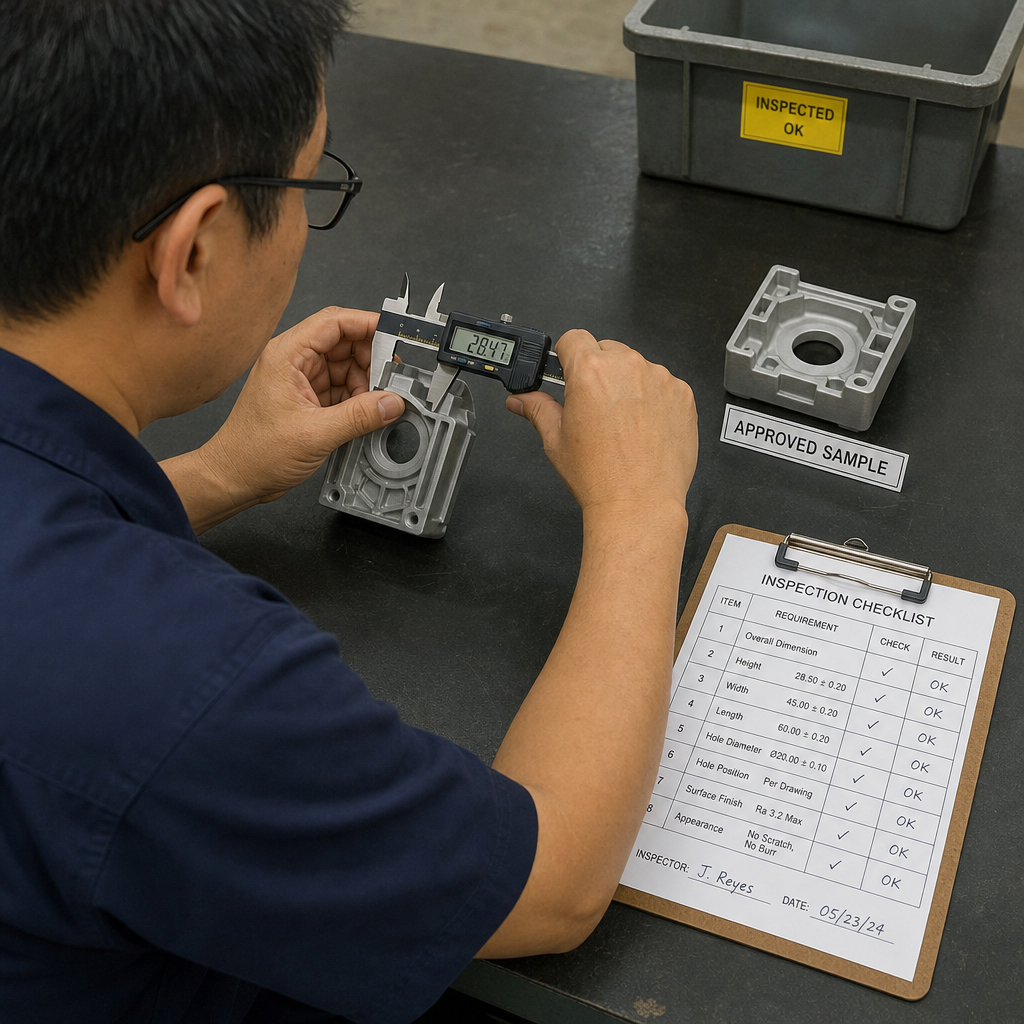
Specify what happens when a result fails. Your procedure should identify who reviews the finding, whether rework is permitted, who authorizes reinspection, and who can release the shipment. Avoid leaving those decisions to a hurried conversation after goods are packed.
Also separate inspection from any required product testing or certification. Ask the appropriate specialist to identify applicable requirements for the destination market; do not assume an inspection report satisfies them. CBP advises importers to ensure their merchandise meets requirements administered by other relevant agencies.
After delivery, compare receiving results with the inspection report. Record discrepancies and investigate their cause before approving repeat orders. Use that feedback to improve the specification or inspection brief, not simply to assign blame.
Coordinate shipping without losing sight of import responsibilities
Define shipping coordination as a documented handoff between the supplier, procurement partner, transport provider, and receiving team. Incoterms allocate important buyer and seller responsibilities, costs, and risks, but they do not settle every contract issue. They do not, for example, determine payment timing, ownership transfer, or remedies for nonconforming goods.
Specify the agreed Incoterm, named place, and version in the commercial documents. Ask your forwarder to review whether the arrangement fits the shipment and your intended responsibilities. Do not compare freight proposals until you understand where each service begins and ends.
Request a shipping plan that identifies:
- The point at which goods will be ready and authorized for collection.
- The transport mode, proposed route, and estimated delivery schedule.
- Responsibility for booking, packing checks, and shipment documents.
- Included charges, exclusions, insurance arrangements, and destination services.
- The process for reporting missed departures, damage, or document discrepancies.
Review packing, labeling, documentation, and insurance needs with the logistics provider. These are among the international shipping considerations highlighted by the International Trade Administration. Ask for written confirmation of the agreed arrangements rather than assuming a freight quotation covers every requirement.
For U.S.-bound purchases, outsourcing does not allow the importer of record to contract away its ultimate responsibility for accurate customs entries. Define who will act as importer of record, engage appropriate customs expertise, and establish how product and transaction information will be checked.
Before committing to a landed-cost estimate, ask your customs broker to verify classification and applicable duties using current official information. The U.S. Harmonized Tariff Schedule and USTR's Section 301 resources are relevant starting points, not substitutes for a shipment-specific review. Avoid reusing an old tariff assumption without checking it.
Keep order management visible after the deposit
Design order management around evidence and exceptions rather than repeated requests for reassurance. Ask the procurement partner to maintain a shared tracker with planned dates, actual dates, supporting records, blockers, and next actions. Give every unresolved item an owner and a decision deadline.
Include milestones for material approval, production start, completion, inspection, corrective action, shipment release, and dispatch. Tailor the list to the product rather than adding checkpoints that nobody uses. Require an explanation when dates change, including the proposed recovery action and any effect on cost.
Set escalation rules before problems occur. A proposed material substitution, manufacturing-site change, failed inspection, or payment-detail change should receive explicit review. State which events require an immediate alert and which belong in the routine update.
Keep your own business involved in approvals. Assign internal responsibility for technical requirements, purchase commitments, payments, and shipment release, even when the provider prepares the supporting work. Outsourcing should make those decisions easier to manage, not make responsibility harder to trace.
For ongoing China supply chain management, maintain a supplier record alongside individual order files. Record approved specifications, recurring issues, corrective actions, and unresolved risks. Review that history before increasing order volume or authorizing a new product at the same factory.
Start with a pilot and measure the outcome
Use a manageable pilot to evaluate the working relationship before expanding the scope. Select a purchase important enough to test the provider's methods without making the entire business dependent on its first performance. Agree beforehand which results will determine whether you continue.
Create a baseline using the best available information from your current purchasing approach. If no previous order exists, compare proposals and clearly label estimates. Separate procurement fees from the supplier price so you can see what the outsourced service actually costs.
Track a small set of meaningful measures:
- Cost per usable unit: Reconcile purchasing, service, quality, and logistics costs after receipt.
- Delivery performance: Compare the agreed schedule with actual milestones and arrival.
- Quality outcomes: Record receiving discrepancies, rework, and rejected goods.
- Internal workload: Track the time your team spends clarifying, approving, and correcting work.
- Reporting quality: Assess whether updates arrive with evidence and actionable next steps.
Review the pilot with the provider and distinguish execution problems from weaknesses in your own brief. If requirements changed repeatedly, improve change control before judging the entire model. If the provider withheld information or ignored approval rules, address that directly before placing another order.
Expand only the responsibilities that have been demonstrated successfully. A provider that performs supplier research well has not automatically proven its ability to manage production or china import services. Add scope deliberately, with revised deliverables and clear ownership.
Reduce costs by improving purchasing decisions
The strongest approach to sourcing from China is to outsource defined work while keeping specifications, approvals, and performance records under control. Compare complete costs, verify suppliers, document commercial terms, and make inspection and shipping responsibilities explicit.
Start with one clear purchasing brief and a controlled pilot. Use the results to decide whether the service delivers better economics and a more manageable procurement process. The objective is not to delegate every task; it is to build a purchasing arrangement you can understand, measure, and improve.
Frequently Asked Questions About China Procurement Services
What are China procurement services?
China procurement services involve outsourcing purchasing tasks to specialized firms that manage supplier selection, order management, quality inspection, and shipping coordination, allowing businesses to reduce costs and improve efficiency in their procurement process.
How can I ensure quality when sourcing products from China?
To ensure quality, businesses should establish clear specifications for products, request quality inspections at different production stages, verify supplier capabilities, and maintain open communication with the procurement partner throughout the process.
What are the potential cost savings from using procurement services?
Cost savings can arise from better negotiation of prices, reducing procurement fees, lowering logistics costs, minimizing quality-related issues, and streamlining the overall supply chain processes, leading to a reduction in the total cost of goods received.
How do I choose the right procurement partner?
When choosing a procurement partner, evaluate their expertise in your product category, assess their transparency and reporting practices, request evidence of past performance, and confirm their ability to meet your specific procurement needs effectively.
What should I include in a purchasing brief for suppliers?
A purchasing brief should clearly outline product specifications (materials, dimensions, tolerances), packaging requirements, expected delivery timelines, required testing and documentation, and any ownership expectations for designs and tooling.
This ensures that suppliers can provide accurate quotes and meet your needs effectively.