A Certificate of Conformance (COC) is a document stating that identified goods or services meet specified requirements, such as those in a purchase order, drawing, or contract.
It connects a supplier’s declaration to what was supplied, but it does not automatically mean an independent organization tested or certified the product.
This guide explains what a COC establishes, what to look for, and how to check it before accepting a delivery.
What does a Certificate of Conformance (COC) mean?
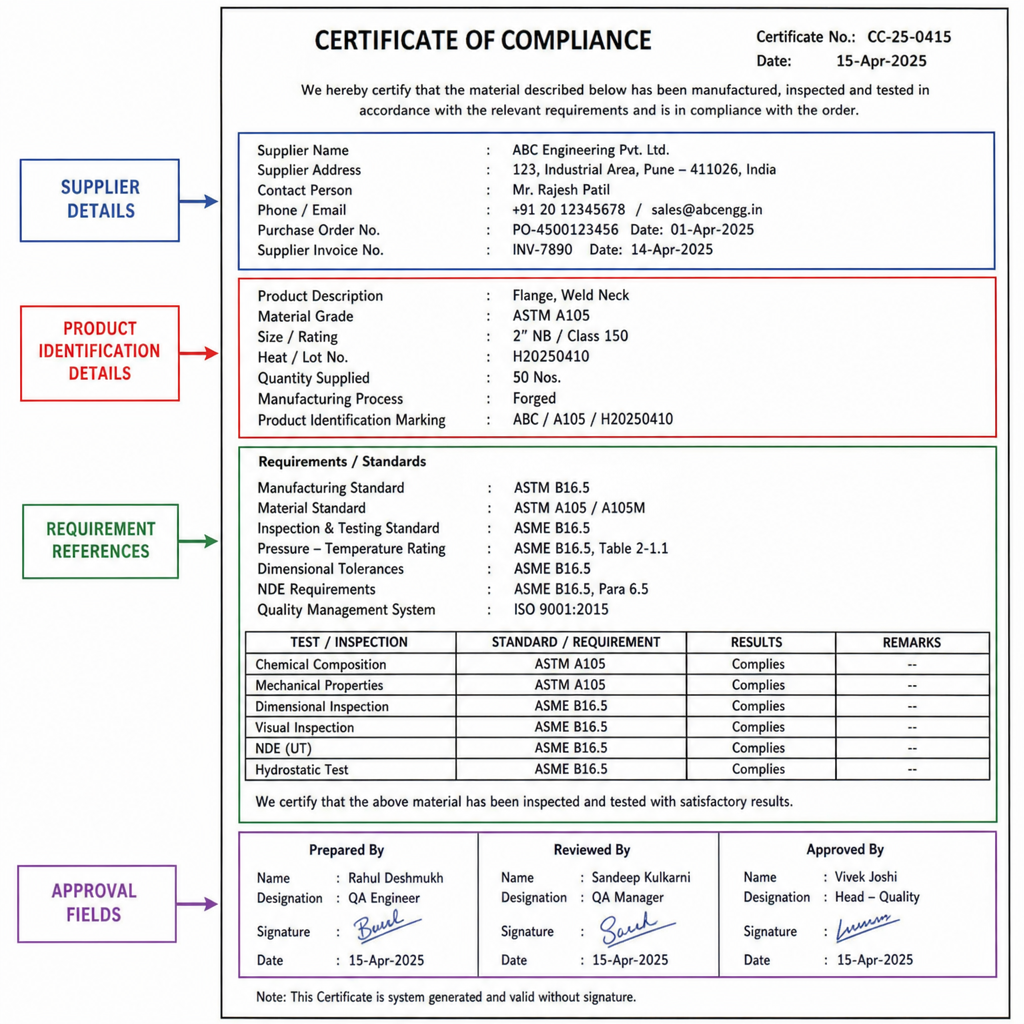
A Certificate of Conformance means that the issuing party declares the identified supply meets the requirements stated in the document. The key is specified requirements: a certificate is meaningful only when readers can identify both what it covers and the criteria against which conformance is claimed. NIST describes conformity assessment as demonstrating that specified requirements are fulfilled.
For example, imagine a buyer orders machined brackets against a particular drawing revision. A useful COC would identify the brackets and state that they conform to that drawing and the applicable order requirements. A statement that merely says “high-quality products supplied” would not give the buyer the same clear basis for review.
Treat the certificate as a defined claim, not an unlimited guarantee. Conformance assessment evaluates fulfillment of requirements; it does not establish that one product is better than competing products.
The requirements behind COC standards
Rather than assuming there is one universal set of COC standards, identify the requirements governing the transaction. In federal procurement, for example, the prescribed certificate refers to contract requirements, including specifications, drawings, packaging, marking, and physical item identification. Other certification programs have their own requirements and documentation rules.
Before requesting a certificate, build a short requirements list:
- Product identity: Specify the part number, model, material, or service being purchased.
- Technical criteria: Identify the drawing, specification, or standard and its required revision.
- Order conditions: Include relevant packaging, marking, documentation, and delivery requirements.
- Assessment method: Establish whether supplier declaration, inspection, testing, or independent certification is expected.
- Acceptance evidence: Agree on which supporting records the buyer needs to review.
This approach gives the supplier a clear target. It also prevents a common purchasing mistake: requesting “a certificate” without explaining what that certificate must demonstrate.
Who issues a COC certificate?
A COC certificate may be issued by the supplier responsible for the declaration; independent certification is a different assessment arrangement. NIST distinguishes supplier declarations from other conformity assessment activities, including testing, inspection, and certification. The appropriate issuer depends on the applicable contract or certification program.
For supplier declarations, the supporting basis can include quality controls and testing or inspection performed internally or commissioned from another organization. Using an external laboratory does not, by itself, turn the supplier’s declaration into independent product certification.
A regulated example shows why responsibility matters. For certain general-use consumer products subject to CPSC requirements, the manufacturer or importer must issue a General Certificate of Conformity, based on product testing or a reasonable testing program. Assistance from a laboratory does not transfer the issuer’s responsibility.
Essential information to request
Use the following as a practical review checklist, not a universal mandatory form. Match the final document to the purchase contract and any applicable program requirements. Federal contract certificates and CPSC certificates illustrate why different contexts require different details.
|
Information |
What to check |
|---|---|
|
Issuing organization |
Confirm the responsible business is clearly identified. |
|
Product or service description |
Match the description and identifiers to the order. |
|
Traceability reference |
Request a lot, batch, serial, shipment, or other suitable reference. |
|
Applicable requirements |
Look for identifiable specifications, drawings, rules, or contract references. |
|
Declaration |
Check that the statement explains what conforms to which requirements. |
|
Issue and approval details |
Check dates and the approval or signature required by the governing requirements. |
|
Supporting evidence |
Request relevant test or inspection references when needed. |
Avoid accepting broad wording when the order requires specific evidence. If a certificate references an attachment, obtain that attachment before completing your review. Keep the certificate with the corresponding order and receiving records so another reviewer can reconstruct the acceptance decision.
How do you perform certificate validation?
Certificate validation should establish whether the document is authentic, applies to the delivered goods, and addresses the requirements you actually need satisfied. Treat these as separate checks: a genuine certificate can still cover the wrong product or an irrelevant specification. The workflow below is a practical review method, not a substitute for a mandatory assessment procedure.
- Match the delivery. Compare product identifiers, quantities where relevant, and traceability references against the goods and shipping documents. Investigate discrepancies rather than assuming they are clerical.
- Check the requirement references. Compare the listed specifications and revisions with your purchase order. Ask for clarification if the certificate cites only an unexplained internal code.
- Verify the issuer. Use independently established contact details to resolve concerns. Where an independent certification scheme provides a verification service, use that service rather than relying solely on a logo.
- Review the supporting basis. Request relevant inspection or test records when your contract, risk assessment, or certification program calls for them. Confirm that those records cover the identified product and claimed characteristics.
- Record the decision. Document acceptance, clarification requests, or escalation. Keep unresolved goods out of normal release until the responsible team decides how to proceed.
For an illustrative mismatch, suppose the delivered brackets are marked with one batch identifier while the certificate lists another. Ask the supplier to reconcile the records and explain the connection. A corrected PDF alone should not replace an explanation of why the original traceability failed.
COC versus other quality documents
Document titles can sound interchangeable while serving different purposes. Before accepting a substitute, compare its issuer, scope, requirements, and supporting evidence with what the order requests. The distinction between supplier declaration, testing, and certification is especially important.
Test reports and inspection records
Testing evaluates conformance against defined criteria and produces evidence about the characteristics assessed. A declaration may rely on those results, but the declaration and the underlying evidence perform different roles. If measured results are required, request the relevant report instead of assuming a COC contains them.
Management-system certification
ISO 9001 certification concerns an organization’s quality management system, not certification of an individual product. It does not mean every supplied item is certified against a product specification. A supplier’s management-system certificate therefore should not replace shipment-specific conformance evidence requested by the buyer.
Conformity and compliance terminology
Labels such as compliance certification or quality assurance certificate need context. Ask what requirements are covered and whether the document represents a supplier declaration or another assessment arrangement. ISO distinguishes a supplier’s declaration from third-party certification; the word “certificate” alone does not resolve that distinction.
Common mistakes and practical safeguards
A COC should support an acceptance process, not bypass it. In the federal contract example, authorization to ship with a Certificate of Conformance does not remove the government’s inspection rights or its right to reject defective supplies. That is a useful reminder to separate documentation review from the condition of the goods themselves.
Build these safeguards into your purchasing workflow:
- Define documentation before ordering. Agree on the required certificate and supporting evidence before shipment, rather than negotiating after receipt.
- Avoid unsupported substitutions. Do not accept a management-system certificate when the order calls for product-specific evidence.
- Challenge vague claims. Ask suppliers to identify the requirements behind statements such as “fully compliant.”
- Resolve discrepancies transparently. Request corrected records and an explanation; preserve the original review trail.
- Control repeat orders. Check that each delivery is covered by appropriate evidence instead of reusing an earlier certificate without review.
Making a COC useful in practice
The strongest review question is simple: can you connect the supplied item, the declared requirements, the responsible issuer, and the supporting evidence? If any connection is missing, seek clarification before relying on the document. A professional layout is helpful, but a traceable, specific claim is what makes the certificate useful.
For your next purchase, define the evidence you need in the order, review it against the delivery, and retain the acceptance record. That turns a COC from routine paperwork into a practical part of supplier quality control.
Frequently Asked Questions About Certificate of Conformance (COC)
What is a Certificate of Conformance (COC)?
A Certificate of Conformance is a document that confirms that the goods or services provided meet the specified requirements, such as those outlined in a purchase order, contract, or drawing. It serves as a declaration from the supplier regarding the conformity of the supplied products.
Who issues a COC certificate?
A COC certificate can be issued by the supplier responsible for the declaration. In some cases, independent certification entities may also issue certificates based on testing or inspections performed on the product.
What are the main requirements for a COC?
The key requirements for a COC include product identity, technical criteria, order conditions, assessment methods, and acceptance evidence. These elements must be clearly defined to ensure the certificate is meaningful and satisfies the buyer's needs.
How do I validate a Certificate of Conformance?
To validate a COC, you should match the delivered products against the certificate, check the requirement references, verify the issuer, review supporting evidence, and document your decision regarding acceptance or clarification requests.
What distinguishes a COC from other quality documents?
A COC serves a specific purpose as a declaration of conformity for particular products, while other quality documents, like management-system certificates or test reports, serve different functions. It's important to understand these distinctions to ensure that the appropriate documentation is provided for a specific purchase.