



The best bakery equipment matches your menu, batch sizes, workspace, and production schedule—not simply the largest machine you can afford.
This list covers 25 equipment categories, from commercial ovens and dough mixers to pastry tools and cleaning essentials. Use it to separate everyday necessities from specialized upgrades and build a purchasing plan around the products you actually sell.
What bakery equipment do you need first?
Start with equipment for weighing, mixing, baking, cooling, storage, and cleaning. Add specialized baking machines only when your menu or workload justifies them.
A bread bakery, custom cake studio, and pastry shop should not automatically buy the same equipment package.
Before requesting quotes, prepare these details:
- Menu and batch sizes: List your main products, smallest batches, and busiest production periods.
- Space and access: Measure work areas, doorways, delivery routes, and equipment clearances.
- Utilities: Ask suppliers to confirm electrical, gas, water, drainage, and ventilation needs.
- Compatibility: Check that pans fit your ovens, refrigerators, proofers, and racks.
- Ownership costs: Include installation, cleaning, maintenance, attachments, and replacement parts.
For commercial purchases, ask about sanitation certification for the specific model. NSF certification evaluates factors including cleanability, food-contact material safety, and applicable performance requirements; it is not simply a general endorsement of a brand.
1. Commercial Convection Oven
A convection oven uses circulating hot air and deserves consideration for a mixed bakery menu. Manufacturers offer bakery ovens with different airflow arrangements, so compare the actual design rather than treating every convection model as interchangeable. Doyon, for example, describes models with reversing airflow and circulating racks.
Request a demonstration using your cookies, cakes, or pastries before purchasing. Check usable pan capacity, shelf spacing, controls, and loading access.
Ask whether airflow can be adjusted for delicate products. Choose capacity around your busiest baking period, but leave enough room elsewhere for preparing, unloading, and cooling each batch.
2. Commercial Deck Oven
Deck ovens are worth evaluating when hearth-style bread is central to your menu. Depending on the model, features can include steam and independently controlled decks. Baxter’s selection guide describes this combination, while WP identifies radiant heating in its electric deck oven range.
Compare usable baking area rather than counting decks alone. Bring your largest loaves and loading tools into the purchasing discussion, and ask how successive batches affect the production schedule. A deck oven and convection oven are alternatives for some businesses, complementary tools for others. You do not need both simply because both appear on this list.
3. Planetary Mixer
A planetary mixer is a versatile candidate for bakeries producing batters, frostings, whipped preparations, and compatible doughs. Hobart offers planetary mixers alongside spiral mixers and provides accessories for different preparation tasks. The important distinction is versatility versus specialization—not a universal winner between the two formats.
Compare approved attachments, usable batch capacity, bowl handling, and cleaning access. Ask the supplier to assess your actual recipes rather than recommending a mixer from bowl volume alone. Include your smallest regular batch in that conversation. An oversized machine is not automatically the most practical choice for a bakery making many different preparations.
4. Spiral Dough Mixer
Spiral dough mixers are specialized machines for mixing and kneading dough. Their rotating bowl works with a spiral hook, and capacity is commonly expressed by dough batch weight. Hobart’s guidance also emphasizes that dough formulation affects appropriate capacity, making recipe-specific selection more useful than a simple size comparison.
Shortlist this equipment when bread or similar dough production dominates your schedule. Provide the supplier with hydration levels, flour types, batch weights, and intended mixing frequency. Ask for both minimum and maximum working quantities. Before committing, arrange a dough trial and consider how staff will remove finished dough and clean the mixing area.
5. Dough Proofer or Retarder-Proofer
A proofer provides a controlled environment for proofing, while a retarder-proofer combines refrigeration and proofing functions in one system.
Baxter offers both categories, including equipment intended to accommodate different production and space requirements. Confirm the functions of the particular model rather than assuming every cabinet offers the same control.
Plan capacity around the dough waiting for your next available oven load. Ask about temperature and humidity controls, rack compatibility, cleaning, and installation requirements. For overnight scheduling, discuss the complete process with the supplier. A larger cabinet is useful only if its operating cycle fits your recipes and staffing pattern.
6. Commercial Refrigerator
A commercial refrigerator belongs on the shortlist wherever your menu requires chilled ingredient or product storage. Available configurations include reach-ins, undercounter cabinets, and refrigerated preparation equipment; these serve different layout needs rather than representing interchangeable purchases. Traulsen’s product range illustrates these distinct formats.
Bring your actual trays, ingredient containers, and tallest cake boxes into the sizing discussion. Check shelf adjustment, door clearance, cleaning access, and where staff will stand while loading. Plan separate space for ingredients and finished work where practical. Do not choose solely by advertised internal volume: usable arrangement matters just as much during a busy shift.
7. Commercial Freezer
Commercial freezers are a separate equipment category from refrigerators, and suppliers offer different cabinet arrangements to suit storage needs. Before buying one, specify exactly what you intend to freeze, how it will be packaged, and how frequently staff will retrieve it.
Ask for a demonstration using your usual trays or containers. Check access to lower shelves, door swing, and the space needed to organize stock clearly. Include labeling and stock rotation in your storage plan rather than treating them as later decisions. For products you have not previously frozen, test quality after thawing before building your production schedule around freezer capacity.
8. Dough Sheeter
A dough sheeter is a specialized option for bakeries repeatedly rolling dough to a selected thickness. Somerset describes sheeting applications including pastry production and dough lamination, but suitability still depends on the machine and dough being processed.
Evaluate working width, thickness adjustment, guarding, cleaning, and the full operating footprint. Include space for feeding and receiving dough—not just the machine’s storage dimensions.
Bring your own dough to a demonstration and assess handling between passes. Prioritize a sheeter when rolling is a demonstrated production constraint; occasional pastry batches may not justify dedicating substantial floor or bench space to one.
9. Dough Divider
A dough divider portions dough into selected quantities. Equipment differs in portion range, operation, and compatibility with other machines; Somerset’s divider documentation, for example, identifies portioning options and pairing with a separate rounder. Dividing and rounding should therefore be evaluated as distinct requirements.
Record the portion weights you use most often before comparing models. Ask for trials with your actual dough, including your smallest and largest portions. Assess setup, cleaning, and changeover time alongside output.
A machine that suits one high-volume bread line may be less convenient for a bakery switching frequently between several dough recipes and product sizes.
10. Commercial Food Processor
A commercial food processor can support preparations beyond mixing. Robot-Coupe identifies pastry applications such as chopping nuts, processing dried fruit, blending, and emulsifying, with blade choice affecting the intended task.
Check those capabilities against your recipes instead of assuming one attachment handles everything equally well.
When comparing the best food processing equipment for bakery efficiency, start with recurring preparation jobs. List the quantities, textures, and ingredients involved, then request a demonstration.
Ask about small-batch performance, removable components, blade replacement, and cleaning instructions. Consider where the processor will live during use so that retrieving and setting it up does not become another unnecessary task.
11. Digital Ingredient Scale
Put a digital scale near the top of your baking supplies checklist. Choose it around the quantities you actually weigh: a large flour batch and a small addition of yeast present different measurement needs. Ask suppliers about capacity, resolution, calibration checks, and cleaning instructions before selecting a model.
Test readability with a mixing bowl on the platform. Check whether the display remains visible and whether the controls are comfortable to use repeatedly. If small ingredient quantities exceed the practical resolution of your main scale, consider a separate precision model. Standardize units across recipe sheets so staff do not have to interpret inconsistent instructions.
12. Commercial Worktable
Choose worktables as deliberately as powered kitchen appliances. Set out a trial workstation with your largest tray, mixing bowl, and commonly used tools before deciding on dimensions. Include the space a person needs to work comfortably, not merely enough surface area to hold equipment.
Ask about load ratings, stability, adjustable feet, undershelves, and cleaning access. Where food contacts the surface, discuss suitable construction and sanitation certification with the supplier; cleanability and material safety are central considerations in NSF equipment evaluation.
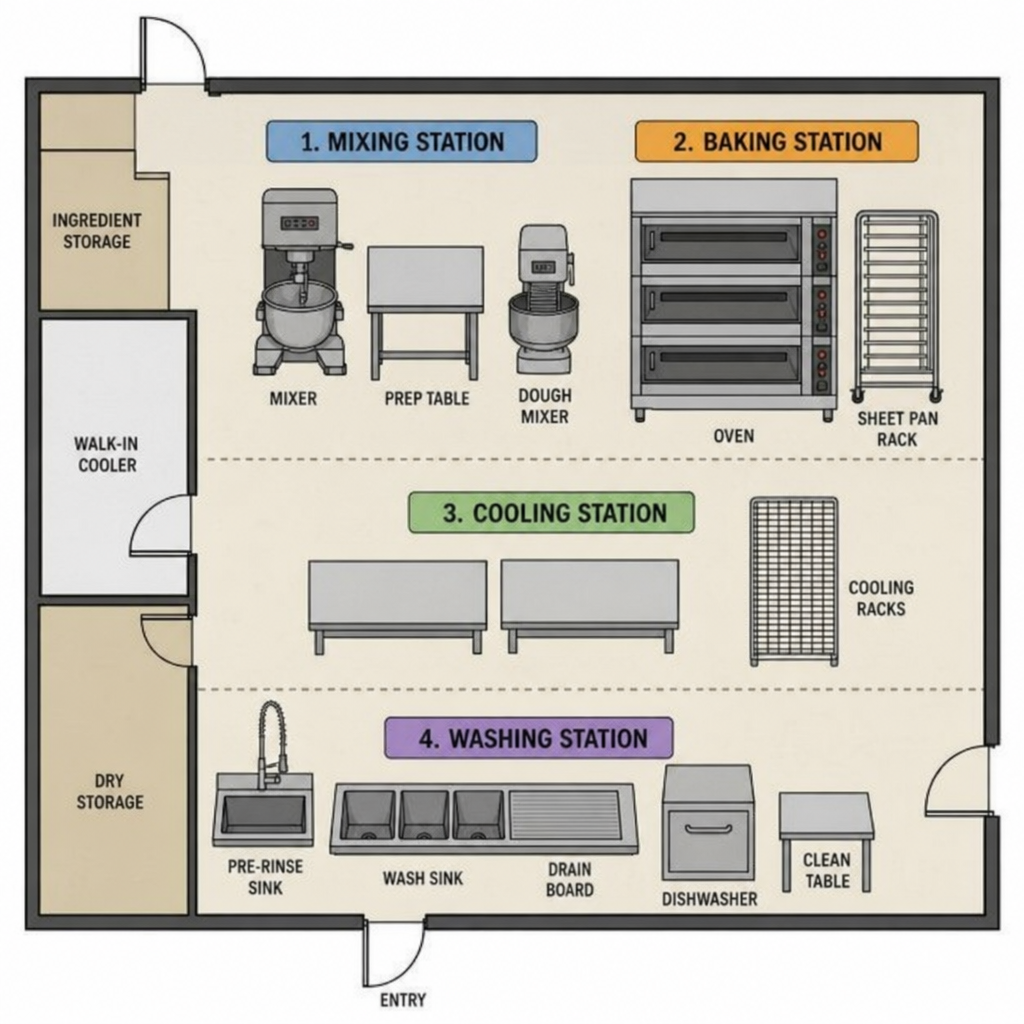
Avoid filling every available wall with tables before planning movement between mixing, baking, storage, and washing stations.
13. Commercial Sheet Pans
Sheet pans are foundational bakery tools, but a coordinated set is more useful than a collection of incompatible sizes. Manufacturer ranges include different pan formats, finishes, covers, and accessories, so select the combination your products and equipment need.
Check fit in every oven, rack, refrigerator, and proofer where the pans will travel. Calculate quantities across a complete production cycle: some pans may be preparing, baking, cooling, or awaiting washing simultaneously.
Test new pans with your recipes before replacing the entire set. Record the selected specification so future purchases match, rather than introducing slightly different pans that complicate everyday handling.
14. Cake, Loaf, and Specialty Pans
Specialty bakeware includes cake, pie, and loaf pans, each supporting a different product format. Build your collection from the menu outward instead of buying every shape available. Start with the sizes you expect to use regularly and document which recipes belong in each.
Check dimensions, depth, cleaning instructions, and compatibility with your storage and baking equipment. Purchase matching multiples where you need to bake repeated batches together.
For seasonal designs, consider whether expected orders justify the storage space. Before scaling production, test fill quantities and finished portions in the chosen pan rather than transferring assumptions from a different size or shape.
15. Cooling Racks
Cooling racks deserve their own place in the equipment plan, not whatever counter space remains after installation. Wire grates are available alongside sheet pans and bakeware accessories. Choose a format that supports your products and fits the trays you intend to use underneath.
Plan around the largest oven unload you expect to handle. Check stability, cleaning instructions, product support, and the space needed between batches. Keep the cooling area out of the main traffic path and away from splashes. Give staff a clear place to move finished baking before the next batch is ready, rather than improvising with occupied preparation benches.
16. Rolling Bakery Rack
A rolling bakery rack is worth considering when pans must move between production stages. Oven manufacturers also supply racks designed for particular equipment, so compatibility needs to be confirmed rather than assumed. A general storage rack should not automatically be treated as an oven rack.
Measure the entire route, including corners, thresholds, and door openings. Ask about load ratings, caster suitability, brakes, and slide spacing for your tallest products.
Decide whether racks will hold raw dough, cooling products, or completed orders. Assigning clear uses can make the layout easier to manage than moving one overloaded rack between several competing tasks throughout the day.
17. Ingredient Storage Bins
Ingredient bins are available in mobile formats that bring supplies closer to the point of use. Baxter includes rolling ingredient bins in its bakery equipment range.
Choose sizes around the quantities you store and the space available beneath or beside your worktables.
Before ordering, check lid access, scoop storage, maneuverability, and cleaning instructions. Leave room to open the bin fully without moving surrounding equipment. Create a labeling and replenishment routine that staff can follow consistently.
Avoid buying oversized bins simply to accommodate bulk purchasing; first assess ingredient turnover, handling, and whether the proposed storage arrangement fits your bakery’s actual operating pattern.
18. Mixing Bowls and Measuring Tools
Mixing bowls, measuring jugs, spoons, and whisks belong on the smallwares list even when powered mixers handle most production. Commercial smallwares ranges include measuring and preparation tools intended for everyday kitchen work.
Select enough pieces for your workflow rather than relying on one shared set.
Check bowl stability, pouring control, clear markings, and storage space. Assign consistent measuring tools to documented recipes where needed, and use weighing instructions when your process calls for them.
Include containers for preweighed ingredients in your planning. This keeps preparation needs visible instead of discovering during service that every suitable bowl is already occupied or awaiting washing.
19. Scrapers, Spatulas, and Whisks
Build a practical hand-tool set around the jobs your team performs daily. Include bench scrapers, bowl scrapers, spatulas, and whisks in sizes suited to your bowls and work surfaces. Avoid buying an assortment simply because it contains many pieces; inspect whether each tool has a useful role.
Check handles, edges, material suitability, and cleaning instructions before purchasing. Keep separate tools available for dough handling and finishing work where your process calls for them. Order a few duplicates of heavily used items rather than many rarely used variations. During a trial shift, note which tools staff repeatedly wait for, borrow, or replace with awkward substitutes.
20. Rolling Pins and Pastry Cutters
Manual pastry equipment remains worth planning even when a sheeter is on your shortlist. Choose rolling pins and cutters around your actual products, working dimensions, and preferred handling. Begin with the shapes and sizes used in regular production instead of collecting novelty tools without a menu application.
Try handles and grips before buying large quantities for a team. Check how cutters will be cleaned, dried, and stored, especially if the set contains many small pieces. Keep a record of the cutters assigned to each product so replacements match. For repeated shapes, test portion size and appearance before making the tool part of your standard process.
21. Cake Decorating Turntable
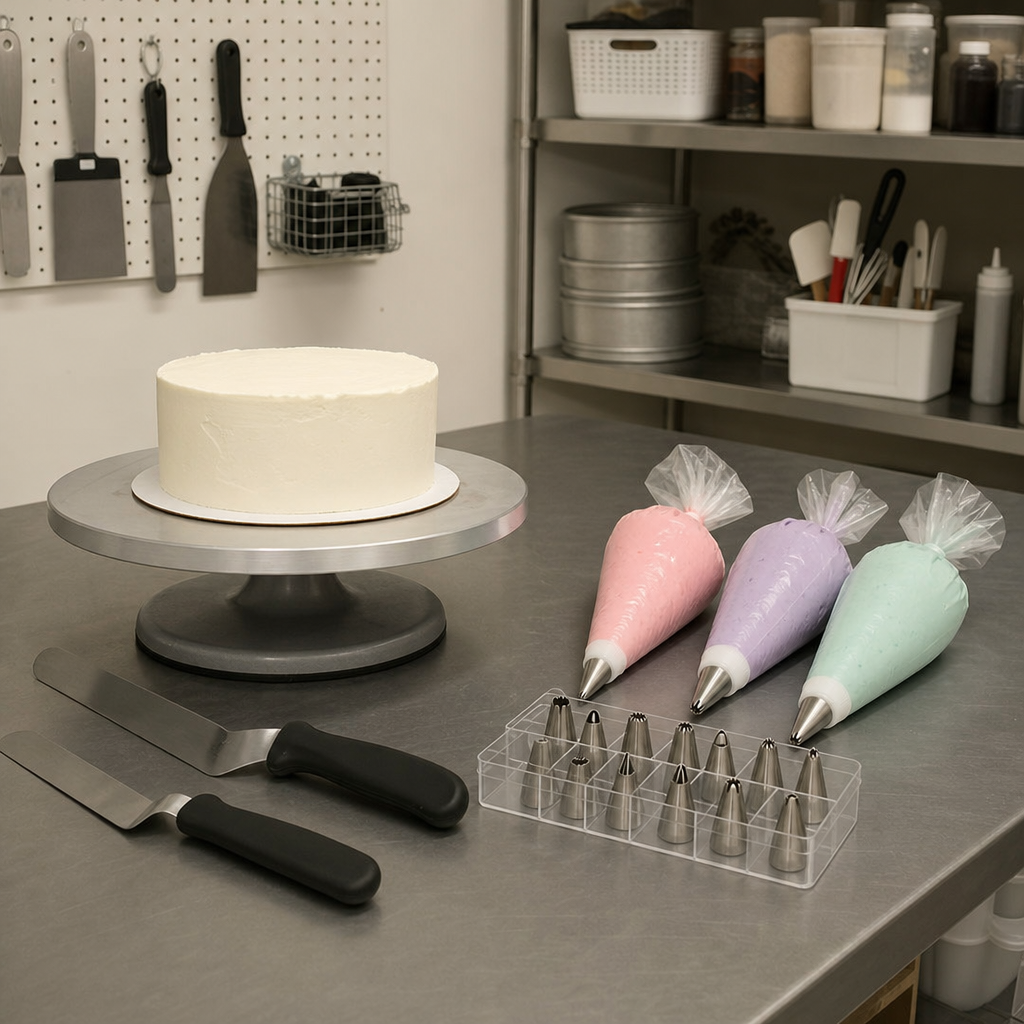
A turntable lets cake decorators rotate a cake while icing and finishing it. Wilton identifies turntables, icing smoothers, and angled spatulas as complementary decorating tools.
Evaluate them together as a workstation rather than expecting one tool to solve every finishing problem.
Check rotation, stability, working height, and the platform’s suitability for your cake boards. Test the setup with a representative cake size before purchasing multiples. Leave space beside the turntable for frosting, tools, and the finished cake’s next destination.
For a cake-focused bakery, a comfortable finishing station may deserve priority over specialized machinery that supports only occasional menu items.
22. Piping Bags, Tips, and Couplers
Piping bags and tips support decorative work, while couplers provide a compatible connection within the decorating setup. Wilton offers these tools in multiple formats and sets.
Select pieces around the borders, writing, fillings, and finishes your menu requires rather than purchasing the largest assortment available.
Check compatibility before ordering bags, tips, and couplers separately. Give small components a defined storage locati0n and include cleaning and drying in the workflow for reusable pieces.
Start with frequently used shapes and expand when an actual product requires something different. Keep duplicates of essential tips so one unfinished cleaning task does not interrupt a scheduled decorating session.
23. Thermometers and Timers
Include temperature measurement and timing tools in the equipment budget, not as last-minute extras. Select instruments for the specific checks in your recipes and procedures. Ask about measurement range, probe suitability, calibration checks, cleaning, and whether the display is easy to read in its intended position.
Avoid assuming one thermometer suits every task. Match the instrument to what you need to measure and follow its instructions. For timers, consider how staff will distinguish several simultaneous batches.
Clearly labeled timers or a consistent station-based system can be easier to manage than unidentified alarms. Document which checks belong to each recipe so measurements lead to consistent decisions.
24. Commercial Bread Slicer
Bread slicers are specialized equipment for producing repeated slices from finished loaves. Oliver offers commercial machines with different formats and features, including models intended for varied bread types.
Ask for a demonstration with your own products instead of relying on a general claim of versatility.
Compare loaf dimensions, slice options, guarding, crumb removal, cleaning instructions, and blade servicing. Include counter space for receiving and packaging the sliced loaf. Estimate actual slicing demand before choosing capacity.
A bakery selling mostly whole artisan loaves has a different purchasing case from one supplying sliced sandwich bread throughout the day. Train staff using the selected model’s instructions.
25. Warewashing Equipment
Finish the list with a realistic plan for washing equipment and utensils. Identify the largest bowl, tray, and removable machine component you need to clean. Then discuss sink or dishwasher options, workspace, utilities, and applicable requirements with your supplier and local reviewing authority before finalizing purchases.
Ask how items move from dirty collection through washing to clean storage. Check access for cleaning the warewashing equipment itself. Commercial sanitation certification addresses hygienic design and, where applicable, equipment performance, making the specific model’s certification worth reviewing.
Protect this area in the layout instead of sacrificing it to fit another production machine.
Build Your Equipment Shortlist Around the Menu
Treat these 25 categories as a planning framework, not a requirement to buy everything at once. Mark each item essential now, needed for a specific product, or future upgrade. Then identify the production step that currently limits your output before adding another machine.
When comparing the best bakery equipment brands, request evidence relevant to your operation: a product trial, model-specific capacity guidance, installation requirements, cleaning instructions, warranty terms, and local service arrangements.
Compare complete quotations rather than machine prices alone.
Your final shortlist should connect every purchase to a menu item, a workable location, and a clear operating need. That is a stronger foundation for an efficient bakery than a room full of impressive equipment that does not fit the way you bake.
Frequently Asked QuestionsAbout Bakery Equipment
What is the most essential equipment for starting a bakery?
The most essential equipment for starting a bakery includes commercial ovens, mixers, refrigerators, proofers, and baking utensils. It's important to tailor your equipment choices to the specific products you plan to offer.
How do I choose the right commercial oven for my bakery?
When choosing a commercial oven, consider factors such as the types of products you will be baking, oven capacity, energy efficiency, and features like steam injection. It’s advisable to request demonstrations to see how the oven performs with your recipes.
What should I look for in a dough mixer?
Look for a dough mixer with the appropriate bowl capacity for your batch sizes, versatility for different types of dough, and ease of cleaning. Assess the available attachments and ensure that it can handle your specific dough formulations.
How do I maintain and clean my baking equipment?
Regular maintenance and cleaning are crucial for the longevity of baking equipment. Follow manufacturer guidelines for cleaning and maintenance schedules, including routine checks on parts and proper storage to avoid damage.
Is it worth investing in specialized pastry tools?
Investing in specialized pastry tools can enhance productivity and improve the quality of your products, especially if your bakery focuses on pastry items. Consider the volume of work you’ll be doing with these tools to determine if they are worth the investment.