












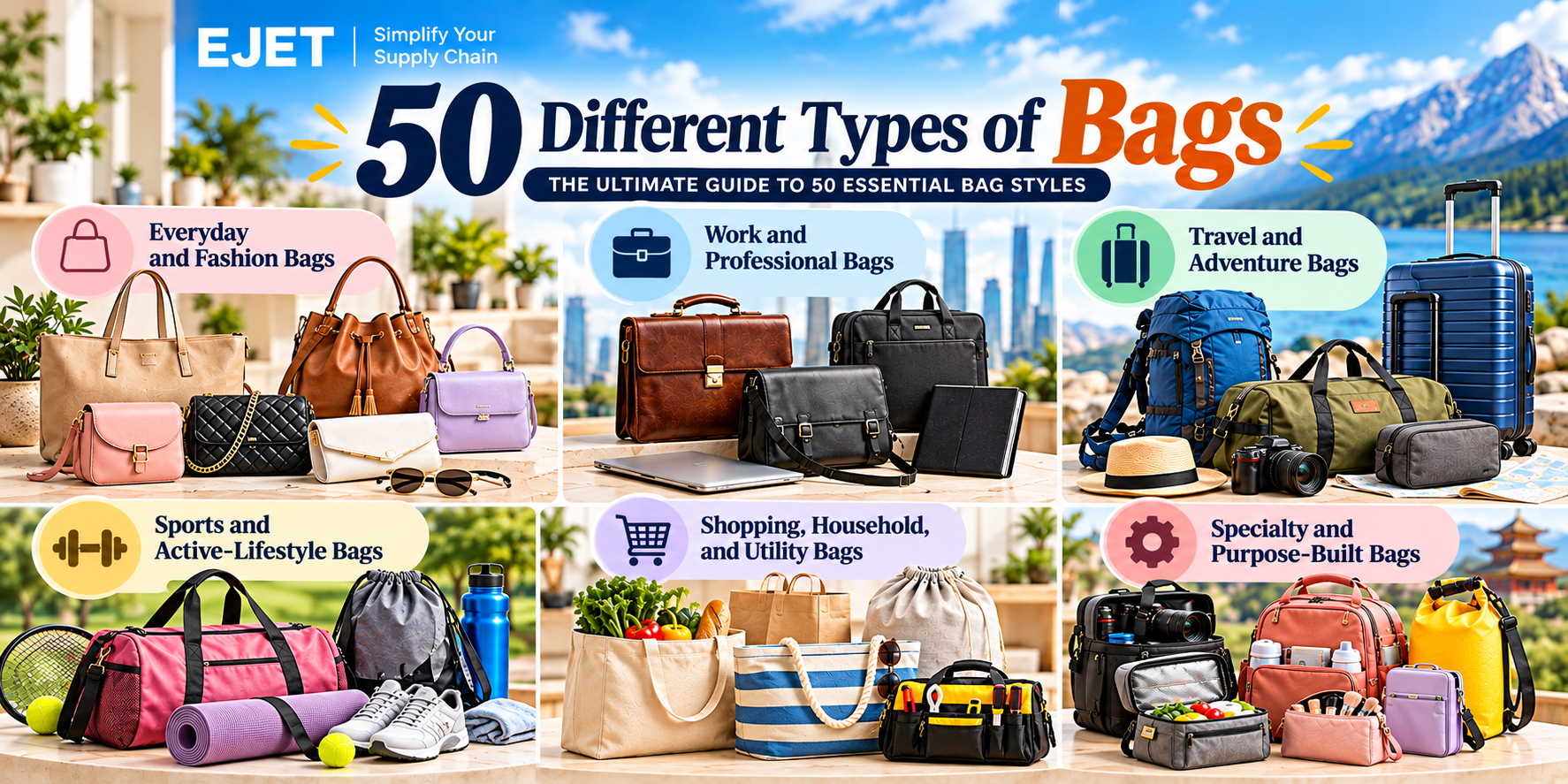
Bags are much more than simple containers for carrying belongings. They’re practical tools, fashion accessories, travel companions, and sometimes even status symbols.
Understanding the different types of bags can help you choose the right design for your lifestyle, outfit, profession, or next adventure.
From a compact clutch for an evening event to a spacious duffel for a weekend away, every bag has a purpose. Some designs focus on organization.
Others prioritize comfort, security, durability, or style. And, of course, many modern bags manage to combine several of these qualities.
This guide explores 50 different types of bags, including handbags, travel bags, work bags, sports bags, shopping bags, and specialty designs.
Whether you're building a versatile bag collection, researching fashion terminology, or simply wondering what a certain style is called, you'll find the essentials here.
Understanding the Different Types of Bags
Before exploring individual designs, it helps to understand why there are so many different types of bags in the first place.
People carry different things in different situations. Someone commuting to an office may need a structured laptop compartment, while a traveler needs lightweight luggage with secure closures. A person attending a formal dinner may only need room for a phone, cards, and keys.
Bag designs have therefore developed around several basic factors: purpose, carrying method, capacity, construction, and appearance.
A shoulder bag hangs from one or two straps. A backpack distributes weight across both shoulders. A crossbody bag uses a longer strap to sit across the torso. Meanwhile, a clutch usually doesn't have a substantial strap at all.
Materials also make a big difference. Leather may offer structure and a polished appearance, while nylon can provide low weight and good resistance to everyday wear. Canvas is popular for casual designs, while synthetic technical fabrics often appear in outdoor and travel bags.
There's no single "best" bag. The best choice is the one that matches what you need to carry and where you're going.
Everyday and Fashion Bags
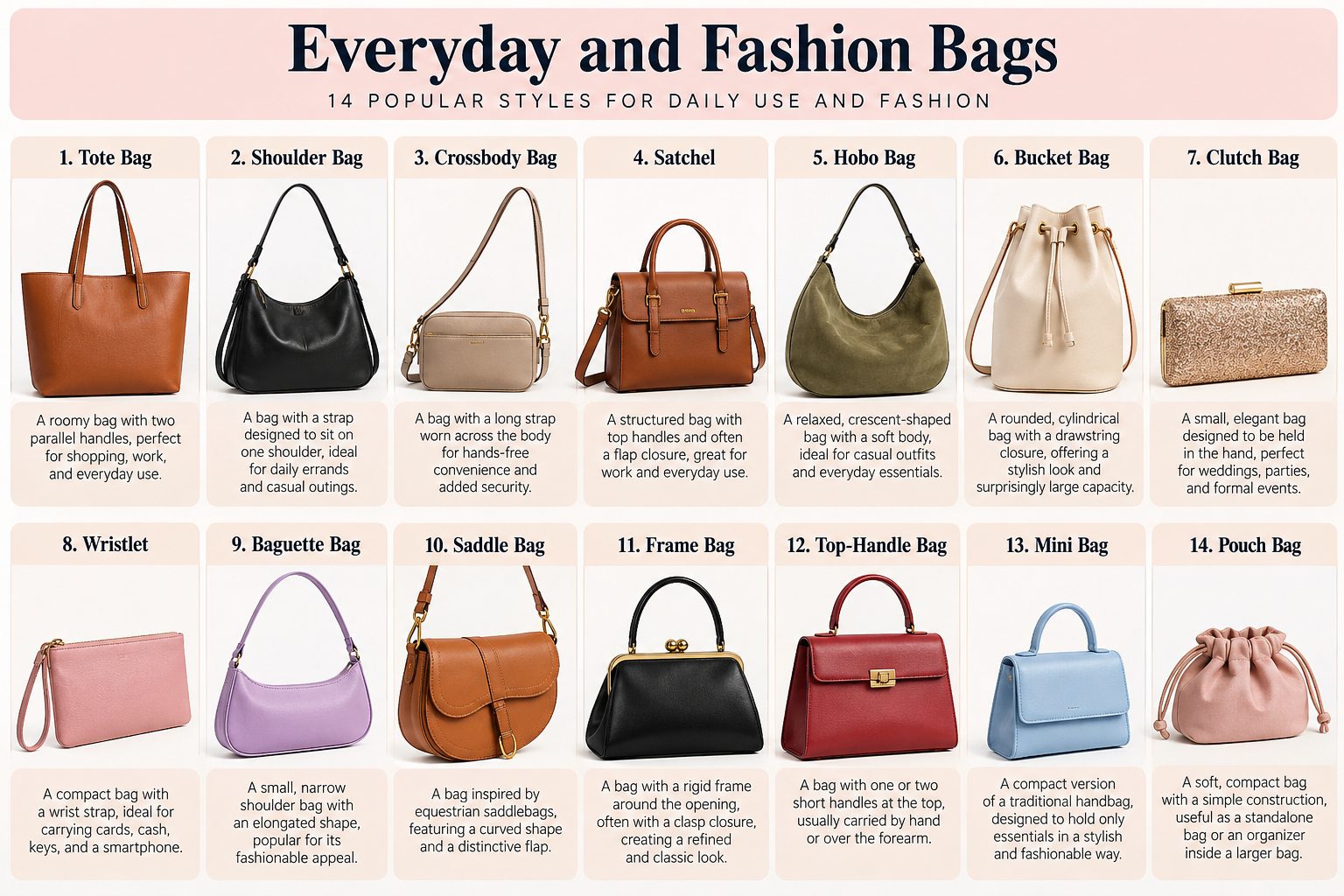
Fashion bags combine practical storage with personal style. They're among the most recognizable bag categories and can range from relaxed everyday designs to sophisticated evening accessories.
1. Tote Bag
A tote bag is a roomy bag with two parallel handles and, traditionally, an open or simply fastened top. Its straightforward design makes it one of the most versatile bags around.
Totes work well for shopping, commuting, studying, casual outings, and carrying daily essentials. Modern versions may include zippers, internal pockets, laptop sleeves, and reinforced bases.
Canvas totes are relaxed and easy to carry, while structured leather totes can look polished enough for professional environments.
2. Shoulder Bag
A shoulder bag has a strap designed to sit comfortably over one shoulder. The category covers many shapes, from compact fashion purses to large everyday carryalls.
Because they're easy to access without removing them completely, shoulder bags are practical for daily errands and social occasions.
3. Crossbody Bag
A crossbody bag features a long strap worn diagonally across the body. This arrangement helps keep your hands free while distributing the bag's weight more securely than a conventional one-shoulder design.
Crossbody bags are especially useful for sightseeing, shopping, festivals, and busy city environments.
4. Satchel
A satchel is generally a structured bag with a flat bottom, top handles, and often a shoulder strap. Many designs have a flap closure.
Satchels offer a classic look that sits somewhere between a handbag and a work bag. They're often spacious enough for notebooks, tablets, and everyday essentials.
5. Hobo Bag
The hobo bag is known for its curved, crescent-like shape and relaxed silhouette. It usually has a single shoulder strap and a soft body that slouches slightly when carried.
This style is ideal for casual outfits and anyone who prefers an unstructured handbag with plenty of interior room.
6. Bucket Bag
As the name suggests, a bucket bag has a rounded or cylindrical shape resembling a bucket. Many versions use a drawstring closure.
Bucket bags can hold surprisingly large amounts while maintaining a fashionable appearance. They're available in everything from leather to canvas and woven materials.
7. Clutch Bag
A clutch is a small handbag traditionally designed to be held in the hand. It often has no handles, although some models include removable straps.
Clutches are popular for weddings, dinners, parties, and formal occasions because they hold small essentials without overwhelming an outfit.
8. Wristlet
A wristlet is a compact purse with a small loop that fits around the wrist. Think of it as a convenient middle ground between a wallet and a clutch.
It's useful when you only need cards, cash, keys, and a smartphone.
9. Baguette Bag
The baguette bag is a small, narrow shoulder bag with an elongated shape. It became particularly associated with late-1990s and early-2000s fashion.
Its short strap usually allows it to sit close beneath the arm. Today, the style appears in minimalist, luxury, vintage-inspired, and casual collections.
10. Saddle Bag
A saddle bag takes inspiration from equestrian saddlebags. Fashion versions commonly have a curved lower edge and a prominent flap.
The distinctive silhouette works particularly well as a shoulder or crossbody design.
11. Frame Bag
A frame bag uses a rigid frame around its opening, often with a clasp closure. Traditional purses and vintage-inspired handbags frequently use this construction.
The frame helps the bag maintain its shape and creates a refined, structured appearance.
12. Top-Handle Bag
A top-handle bag has one or two short handles positioned at the top. It is generally carried by hand or over the forearm.
Many structured handbags fall into this category. Some modern versions also include detachable shoulder straps for greater versatility.
13. Mini Bag
A mini bag is an intentionally small version of a conventional handbag. Some are practical enough for a phone and cards, while others emphasize fashion more than storage.
They're best suited to occasions when you want to travel light.
14. Pouch Bag
A pouch bag is a soft, compact bag with a relatively simple construction. It may use a zipper, drawstring, snap, or gathered closure.
Pouches can function as standalone fashion accessories or organizers placed inside larger bags.
Work and Professional Bags
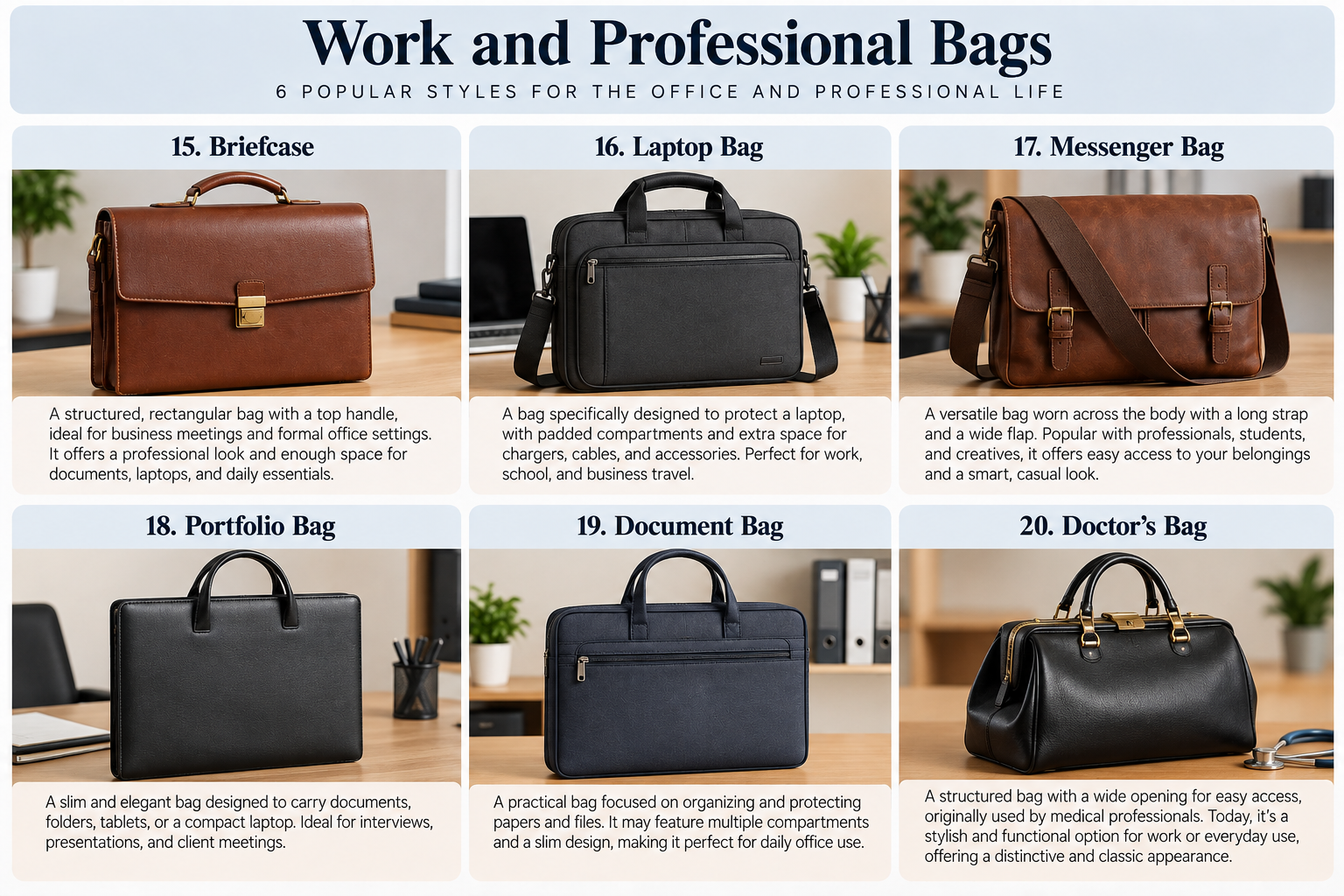
Work bags need to do more than look good. They often carry expensive electronics, documents, chargers, notebooks, and personal belongings. As a result, organization and durability matter.
15. Briefcase
The briefcase is one of the most recognizable professional bags. Traditional versions are rectangular, structured, and carried by a handle.
Modern briefcases are lighter and less rigid than many older designs. They may include padded laptop sections, shoulder straps, organizer panels, and secure zipper closures.
A briefcase works especially well in formal offices and business settings where a polished appearance matters.
16. Laptop Bag
A laptop bag is designed specifically to protect a notebook computer. Its defining feature is usually a padded compartment that reduces movement and helps protect the device from bumps.
Many laptop bags also provide space for a charger, mouse, cables, documents, and other work accessories.
When choosing one, always check the compartment dimensions rather than relying solely on the advertised screen size.
17. Messenger Bag
A messenger bag is worn across the body using a long strap. It usually has a wide flap covering the main compartment.
The style has practical roots but is now widely used by students, commuters, creatives, and office workers. It's easy to swing the bag forward when you need quick access to its contents.
18. Portfolio Bag
A portfolio bag is a slim professional carrier designed for papers, folders, tablets, or compact laptops.
It has less storage than a briefcase but creates a clean, minimalist appearance. It's useful for interviews, presentations, client meetings, and conferences.
19. Document Bag
A document bag focuses on protecting and organizing papers. It may resemble a slim briefcase, zippered folder, or expanding file case.
It's particularly helpful when documents need to remain flat and organized during transportation.
20. Doctor's Bag
The traditional doctor's bag has a structured body and a wide frame opening that provides excellent visibility into the main compartment.
Although historically associated with medical professionals, its distinctive construction has inspired many modern handbags and work bags.
Travel and Adventure Bags
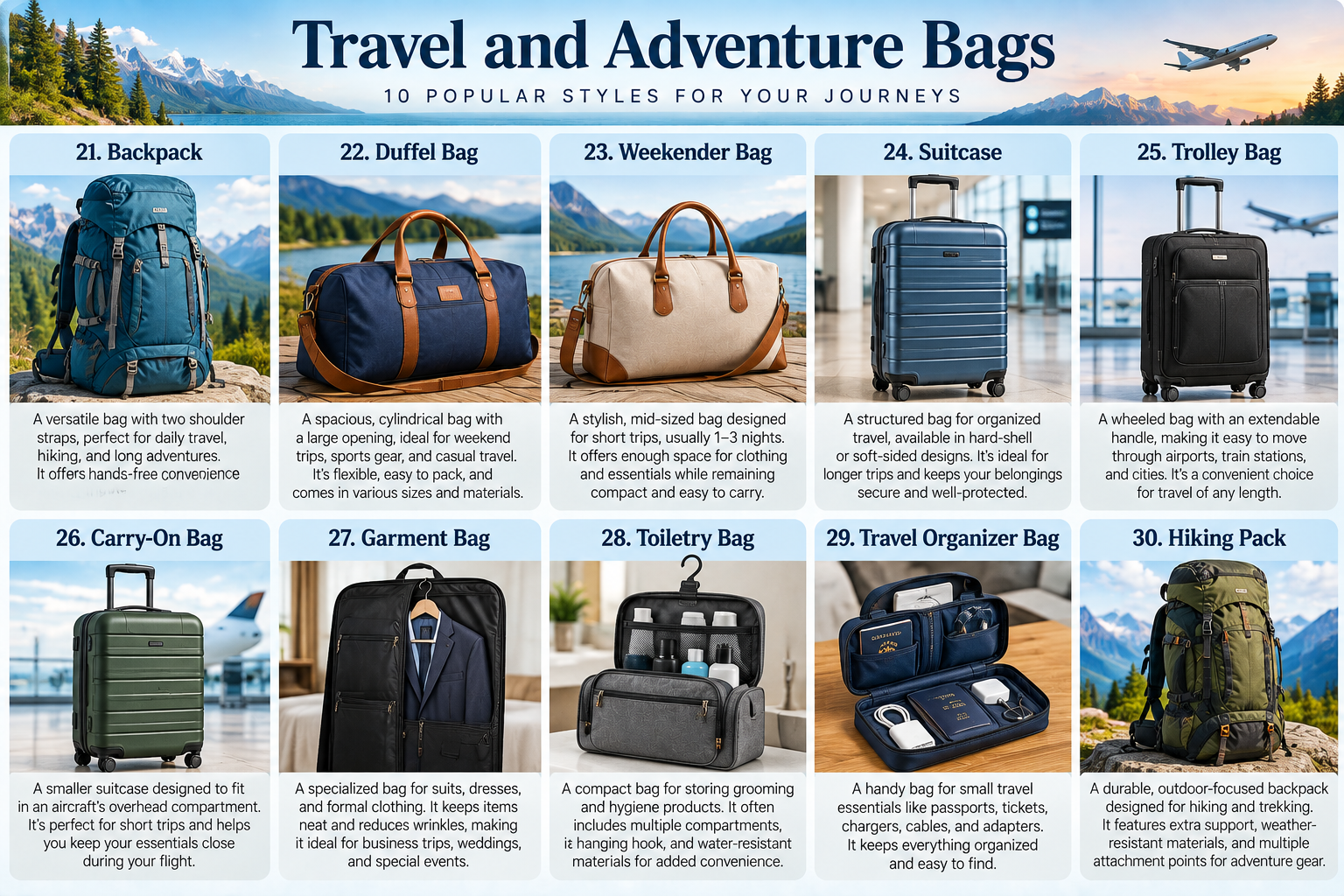
Travel introduces a different set of challenges. Your bag may need to survive crowded terminals, vehicle transfers, changing weather, and long hours of carrying.
Consequently, good travel bags balance capacity, weight, organization, security, and mobility.
21. Backpack
A backpack is carried using two shoulder straps and is one of the world's most versatile bag styles.
Small backpacks work for daily commuting, while larger designs can support hiking, backpacking, and extended travel. Using two straps can also distribute weight more evenly than carrying a similarly loaded bag on one shoulder.
Look for padded straps, suitable back support, secure closures, and compartments that match your needs.
22. Duffel Bag
A duffel bag typically has a long, cylindrical or rectangular body with a large central compartment.
It's popular for sports, road trips, overnight stays, and casual travel because the wide opening makes packing straightforward.
Some travel duffels now include backpack straps and separate compartments for shoes or laundry.
23. Weekender Bag
A weekender is designed for short trips, generally lasting one to three nights. It's usually more compact than a full suitcase but more spacious than an everyday handbag.
Weekenders often combine the broad opening of a duffel with more stylish materials and detailing.
24. Suitcase
A suitcase is structured luggage designed for transporting clothing and personal belongings.
Modern suitcases commonly have wheels, telescopic handles, internal compression straps, dividers, and zippered compartments. Both hard-shell and soft-sided versions are widely available.
25. Trolley Bag
A trolley bag is wheeled luggage with an extendable handle. The term can apply to cabin-size luggage as well as larger checked bags.
Its biggest advantage is obvious: instead of carrying all the weight, you can roll it across suitable surfaces.
26. Carry-On Bag
A carry-on bag is luggage intended to travel with a passenger in an aircraft cabin rather than in checked baggage.
Carry-on rules vary among airlines, so travelers should check the dimensions and weight limits specified by their carrier before flying.
27. Garment Bag
A garment bag carries suits, dresses, jackets, and other clothing in a way that helps reduce folding.
Some hang vertically, while travel-oriented versions fold into a more compact shape. They're especially useful for business trips, weddings, and formal events.
28. Toiletry Bag
A toiletry bag keeps grooming and hygiene products organized during travel.
Useful models may include water-resistant linings, separate compartments, hanging hooks, and easy-clean surfaces.
29. Travel Organizer Bag
A travel organizer stores smaller items such as passports, tickets, charging cables, memory cards, adapters, and travel documents.
It prevents little essentials from disappearing into the bottom of larger luggage—a small benefit that can save a lot of hassle.
30. Hiking Pack
A hiking pack is a backpack designed for outdoor use. Depending on capacity, it may support anything from a short day hike to a multi-day trek.
Outdoor packs often feature adjustable harnesses, hydration compatibility, compression straps, equipment attachment points, and weather-resistant materials.
Sports and Active-Lifestyle Bags
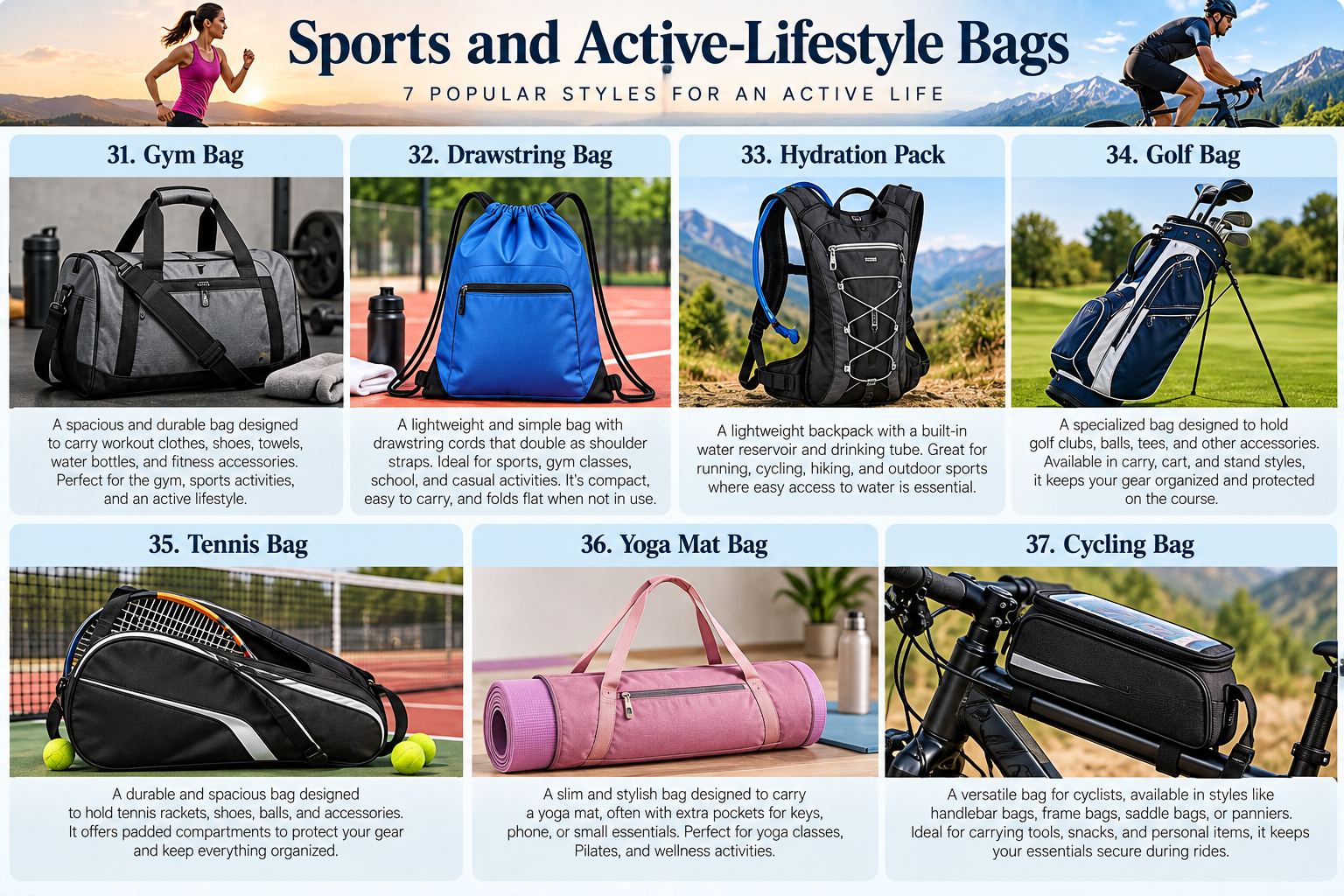
Sports equipment can be bulky, damp, dirty, or oddly shaped. That's why athletic bags frequently include ventilation, specialized compartments, and durable fabrics.
31. Gym Bag
A gym bag carries workout clothing, towels, shoes, water bottles, and training accessories.
Many models resemble compact duffels. A separate shoe or wet-item compartment can be particularly useful after a workout.
32. Drawstring Bag
A drawstring bag uses cords to close the opening and often uses the same cords as shoulder straps.
It's lightweight, inexpensive, and easy to flatten when not in use. That makes it popular for gyms, schools, events, and light sports activities.
33. Hydration Pack
A hydration pack is a lightweight backpack designed to carry a water reservoir with a drinking tube.
It's commonly used for running, cycling, hiking, and endurance activities where convenient access to water is important.
34. Golf Bag
A golf bag is specifically designed to hold golf clubs along with balls, tees, gloves, and other equipment.
Different versions are optimized for carrying, using with a push cart, or attaching to a golf cart.
35. Tennis Bag
A tennis bag includes space shaped to accommodate tennis rackets. Larger versions may also hold shoes, balls, clothing, bottles, and accessories.
Some racket compartments may include added padding or protective materials.
36. Yoga Mat Bag
A yoga mat bag is shaped to carry a rolled yoga mat. Designs range from simple slings to full zippered carriers with additional pockets.
It's an easy solution for keeping a mat contained while commuting to a studio.
37. Cycling Bag
A cycling bag can refer to several bike-oriented designs, including handlebar bags, frame bags, saddle bags, panniers, and cycling backpacks.
The ideal type depends on the ride. A small saddle bag can hold repair tools, while panniers can carry much more gear for commuting or touring.
Shopping, Household, and Utility Bags
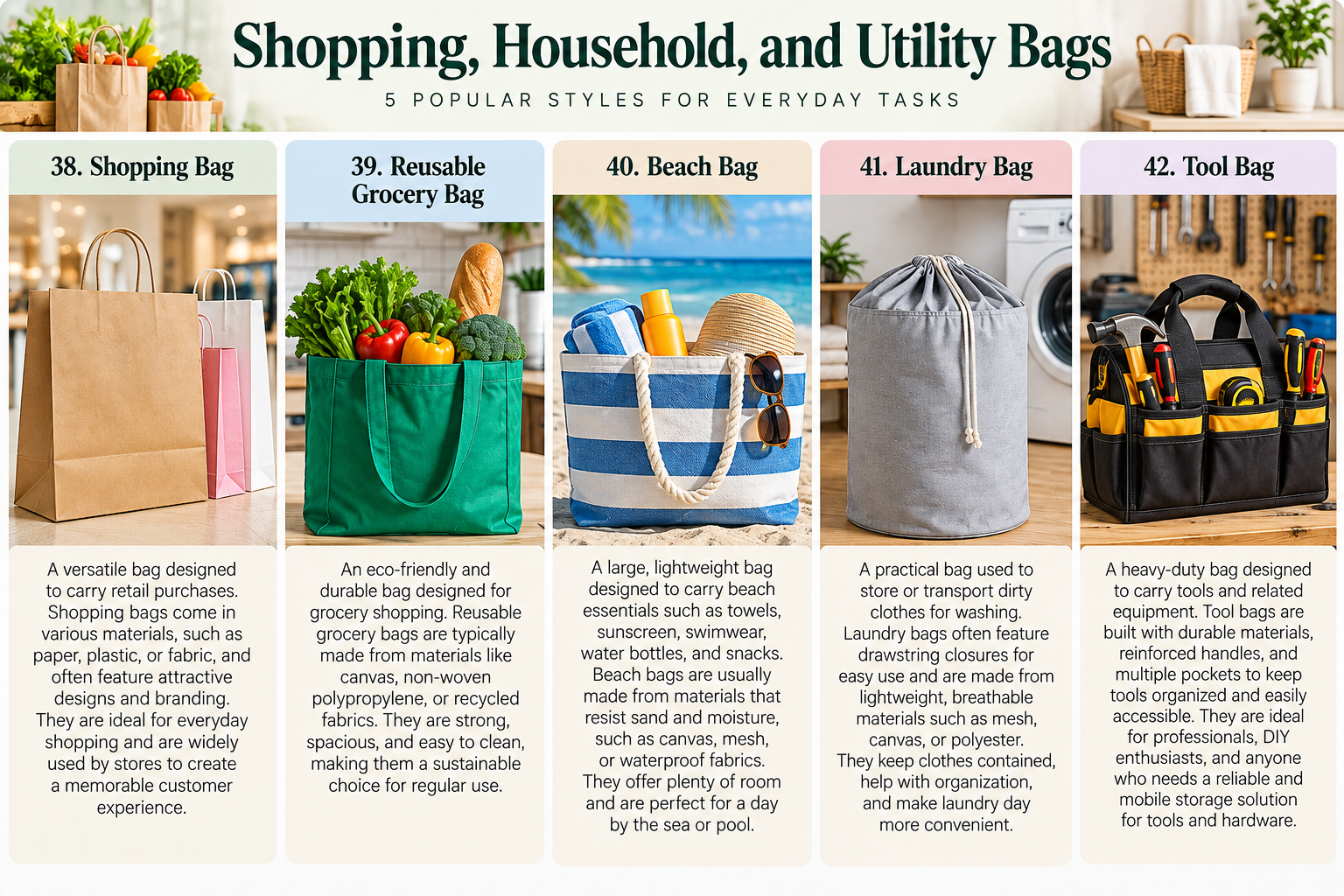
Not every bag needs to make a fashion statement. Some designs exist mainly to make everyday jobs easier.
38. Shopping Bag
A shopping bag is designed to carry retail purchases. It may be made from paper, fabric, plastic, or other materials.
Shopping bags have also played a role in branding and graphic design, turning an everyday container into a visible part of retail identity.
39. Reusable Grocery Bag
A reusable grocery bag is designed for repeated shopping trips. Common materials include woven polypropylene, recycled textiles, canvas, and other durable fabrics.
A good grocery bag should be easy to clean, comfortable to carry, and strong enough for the loads you regularly purchase.
40. Beach Bag
A beach bag is typically large enough for towels, sunscreen, swimwear, water, and other seaside essentials.
Materials that resist sand, moisture, or stains can make cleanup considerably easier.
41. Laundry Bag
A laundry bag stores or transports clothing for washing. It may use mesh, canvas, cotton, polyester, or other lightweight materials.
Drawstring versions are common because they're simple and can be folded away when empty.
42. Tool Bag
A tool bag is built to carry tools and related equipment. Unlike fashion bags, these products emphasize durability, organization, load capacity, and easy access.
Reinforced handles, abrasion-resistant bases, and numerous pockets are common features.
Specialty and Purpose-Built Bags
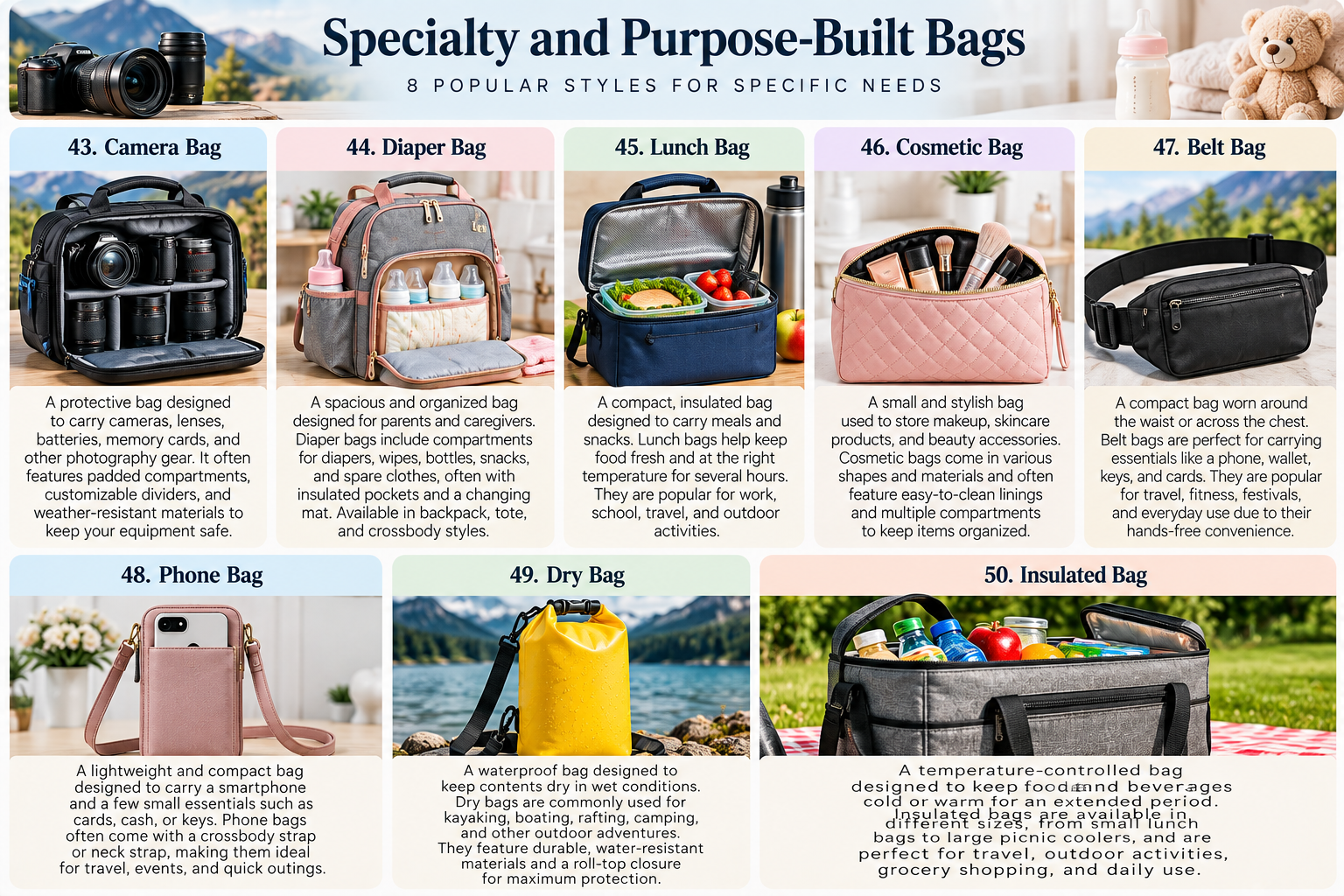
Some bags solve highly specific problems. Their specialized compartments and construction can make them far more useful than a general-purpose alternative.
43. Camera Bag
A camera bag protects cameras, lenses, batteries, memory cards, and related photography equipment.
Quality models often use padded dividers that can be rearranged to fit different equipment. Weather protection and secure closures are also valuable, particularly for outdoor photographers.
44. Diaper Bag
A diaper bag helps parents and caregivers organize diapers, wipes, bottles, spare clothing, snacks, and other baby essentials.
Useful features can include insulated bottle pockets, changing mats, wipe-clean interiors, and multiple easy-access compartments.
Backpack-style diaper bags are popular because they keep both hands free.
45. Lunch Bag
A lunch bag is a compact carrier for meals and snacks. Many use insulated construction to help maintain food temperature for a period of time.
Reusable lunch bags are common for workplaces, schools, picnics, and day trips.
46. Cosmetic Bag
A cosmetic bag, sometimes called a makeup bag, stores cosmetics and beauty accessories.
Because spills happen, easy-clean linings and secure zipper closures are particularly useful.
47. Belt Bag
A belt bag is worn around the waist or hips. It's also widely known as a waist bag or fanny pack.
Modern versions are frequently worn across the chest as well. Their compact size and hands-free design make them practical for walking, travel, festivals, and everyday errands.
48. Phone Bag
A phone bag is a small crossbody or neck pouch designed primarily to carry a smartphone.
Some include extra slots for identification, cards, or cash. They're ideal when a full handbag feels unnecessary.
49. Dry Bag
A dry bag is designed to help protect its contents from water. Many models use waterproof materials and roll-top closures.
They're widely used for kayaking, boating, rafting, camping, and other outdoor activities. However, water protection varies by construction, so buyers should check whether a specific product is designed for splashes, temporary exposure, or submersion.
50. Insulated Bag
An insulated bag helps slow temperature change for food and beverages.
These bags range from small lunch carriers to large picnic and grocery bags. Their effectiveness depends on insulation quality, closure design, ambient conditions, and how they're packed.
Quick Comparison of 50 Different Types of Bags
| Bag Type | Best For | Typical Carry Style |
|---|---|---|
| Tote | Everyday essentials | Hand/shoulder |
| Shoulder Bag | Daily use | Shoulder |
| Crossbody | Hands-free use | Across body |
| Satchel | Work/everyday | Hand/shoulder |
| Hobo | Casual use | Shoulder |
| Bucket | Fashion/everyday | Shoulder/crossbody |
| Clutch | Formal events | Hand |
| Wristlet | Small essentials | Wrist |
| Baguette | Fashion | Shoulder |
| Saddle | Casual fashion | Crossbody |
| Frame Bag | Classic styling | Hand |
| Top-Handle | Smart occasions | Hand |
| Mini Bag | Light essentials | Hand/shoulder |
| Pouch | Small belongings | Hand |
| Briefcase | Business | Hand |
| Laptop Bag | Electronics | Shoulder/hand |
| Messenger | Commuting | Crossbody |
| Portfolio | Documents | Hand |
| Document Bag | Paperwork | Hand |
| Doctor's Bag | Professional/everyday | Hand |
| Backpack | Daily/travel | Back |
| Duffel | Sports/travel | Hand/shoulder |
| Weekender | Short trips | Hand/shoulder |
| Suitcase | Travel | Rolling/carrying |
| Trolley | Travel | Rolling |
| Carry-On | Air travel | Rolling/carrying |
| Garment Bag | Formal clothing | Hand/shoulder |
| Toiletry Bag | Grooming products | Packed |
| Travel Organizer | Small travel items | Packed |
| Hiking Pack | Outdoor trips | Back |
| Gym Bag | Fitness | Hand/shoulder |
| Drawstring | Light sports | Back |
| Hydration Pack | Outdoor exercise | Back |
| Golf Bag | Golf equipment | Shoulder/cart |
| Tennis Bag | Racket sports | Shoulder |
| Yoga Mat Bag | Yoga | Shoulder |
| Cycling Bag | Cycling | Bike/body |
| Shopping Bag | Purchases | Hand |
| Grocery Bag | Groceries | Hand/shoulder |
| Beach Bag | Beach essentials | Shoulder |
| Laundry Bag | Clothing | Hand/shoulder |
| Tool Bag | Tools | Hand |
| Camera Bag | Photography | Shoulder/back |
| Diaper Bag | Baby essentials | Shoulder/back |
| Lunch Bag | Food | Hand |
| Cosmetic Bag | Makeup | Hand/packed |
| Belt Bag | Small essentials | Waist/chest |
| Phone Bag | Smartphone | Crossbody/neck |
| Dry Bag | Water activities | Hand/shoulder |
| Insulated Bag | Food and drinks | Hand/shoulder |
How to Choose the Right Type of Bag
With so many choices available, buying a bag can feel surprisingly complicated. A beautiful design isn't necessarily a practical one, while the largest bag isn't automatically the most useful.
The trick is matching the bag to your real habits.
Start With the Bag's Main Purpose
Ask yourself what you'll use the bag for most often.
If you're commuting, you may need room for a laptop, charger, water bottle, and lunch. If you're sightseeing, a smaller crossbody might be more convenient. For weekend travel, a weekender or duffel may offer enough capacity without the bulk of larger luggage.
Buying for your actual routine is usually smarter than buying for an imagined one.
Consider the Right Size
Think about what you carry on an ordinary day.
A bag that's too small becomes frustrating because you're constantly trying to squeeze things inside. Yet an oversized bag can encourage overpacking and become unnecessarily heavy.
Measure larger essentials such as laptops, tablets, cameras, documents, or sports equipment before purchasing a specialized bag.
Check the Material
Different materials suit different situations.
Leather can provide structure and a professional appearance. Canvas is durable and casual. Nylon and polyester are commonly used when low weight and practical performance are priorities.
For outdoor use, pay close attention to the manufacturer's claims about water resistance or waterproofing. Those terms aren't always interchangeable.
Examine the Straps and Handles
Comfort becomes increasingly important as weight increases.
Wide shoulder straps can spread pressure over a larger area. Adjustable straps help you find a better fit, while padded backpack straps can improve comfort during longer periods of carrying.
Also inspect the attachment points. Strong material means little if the straps are poorly connected to the bag.
Think About Organization
Some people love one enormous compartment. Others want a pocket for absolutely everything.
Neither approach is automatically better.
If you carry electronics, look for padding. If you travel often, secure pockets can help organize important items. Bottle pockets, key clips, cable compartments, and quick-access sections may also be worthwhile.
Evaluate Closures and Security
Open totes provide quick access but relatively little enclosure. Zippers, buckles, flaps, clasps, and roll-top closures offer different combinations of convenience and security.
For crowded environments and travel, a securely closing bag may be preferable to an open design.
Match the Style to Your Wardrobe
Practicality matters, but you should still enjoy carrying the bag.
Neutral colors and simple shapes can be easier to combine with many outfits. Statement bags, on the other hand, can become the focal point of an otherwise understated look.
Ideally, your bag should fit both your practical needs and your personal style.
Why Knowing Bag Types Makes Shopping Easier
Learning the names of the different types of bags makes it much easier to search for exactly what you need.
Instead of looking for a vague "small handbag," for example, you might realize you want a wristlet, mini crossbody, or clutch. Instead of searching for "travel luggage," you can decide whether a weekender, duffel, carry-on, or garment bag actually fits your trip.
Understanding bag terminology also makes comparison easier. You can focus on products designed for the same purpose rather than comparing completely different categories.
Most importantly, it can prevent unnecessary purchases. Once you understand the role each bag plays, you can build a smaller but more useful collection.
Frequently Asked Questions About Different Types of Bags
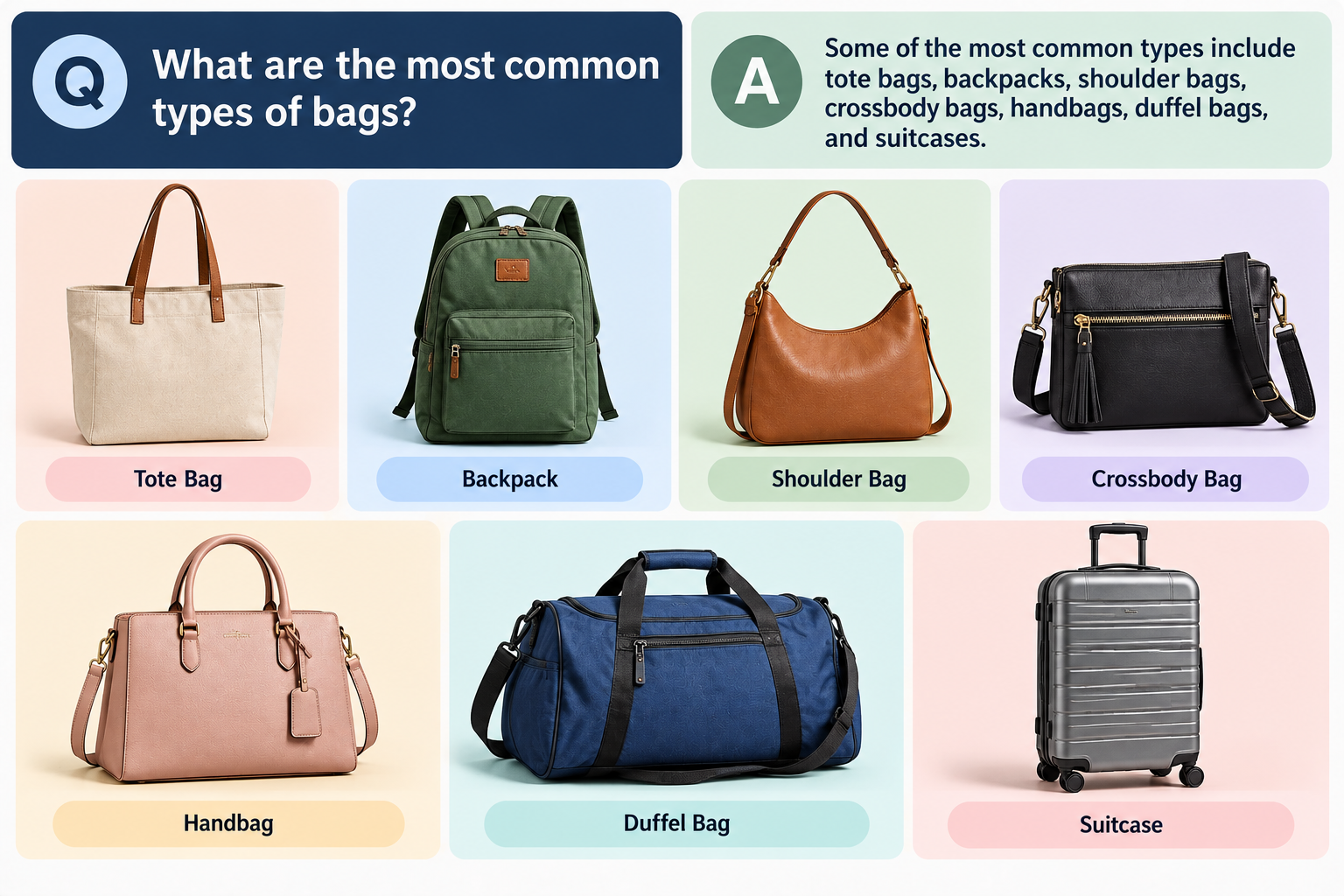
What Are the Most Common Types of Bags?
Some of the most common types include tote bags, shoulder bags, crossbody bags, backpacks, handbags, clutches, duffel bags, briefcases, messenger bags, and suitcases.
The popularity of each type depends on its purpose. Backpacks and totes are highly versatile, while specialized bags such as camera bags and garment bags serve narrower needs.
What Is the Difference Between a Handbag and a Purse?
The terms often overlap in everyday English, and their usage can vary by region.
"Handbag" commonly describes a bag used to carry personal belongings, while "purse" may describe the same item in some regions. In other places, purse can mean a smaller container specifically used for money.
For practical shopping purposes, retailers frequently use the terms interchangeably.
What's the Difference Between a Tote Bag and a Shoulder Bag?
A tote usually has two parallel handles and a relatively open, roomy structure. A shoulder bag is a broader category defined mainly by the way it's carried.
In fact, some totes have handles long enough to sit on the shoulder, meaning a single design can reasonably fit both descriptions.
Which Type of Bag Is Best for Everyday Use?
For many people, totes, crossbody bags, backpacks, and medium-size shoulder bags are excellent everyday options.
The right choice depends on how much you carry. A crossbody works well for a few essentials, while a backpack or large tote is more suitable for laptops, notebooks, bottles, and other bulky belongings.
Which Bag Is Best for Travel?
There's no universal answer because the best travel bag depends on the trip.
Suitcases are practical for longer journeys. Carry-on luggage can work well for short flights. Duffels and weekenders are convenient for road trips and short stays, while backpacks are useful when mobility matters.
Many travelers combine a suitcase with a smaller backpack or crossbody bag.
What Type of Bag Is Best for Work?
A laptop bag, briefcase, structured tote, messenger bag, or professional backpack can all work well.
Choose based on your workplace, commute, and equipment. Someone carrying a large laptop may prioritize padding and protection, while a professional attending client meetings may place greater importance on a structured appearance.
What Is the Most Versatile Type of Bag?
The tote, backpack, and crossbody are among the most versatile designs.
A tote provides excellent capacity, a backpack offers hands-free carrying and balanced weight distribution, and a crossbody provides convenient access in a compact format.
If you want a small collection, owning one of each can cover a large number of situations.
What Type of Bag Should I Use for a Formal Event?
A clutch, wristlet, mini bag, or small structured top-handle bag usually works well for formal occasions.
Choose a design large enough for your essentials but small enough to complement formal clothing rather than dominate it.
Are Backpacks Better Than Shoulder Bags?
It depends on what you're carrying.
A backpack uses two shoulder straps and can distribute a heavier load more evenly. A shoulder bag, however, provides faster access and may be more convenient when carrying lighter belongings.
For laptops, books, and long commutes, a well-fitted backpack can be particularly practical.
How Many Bags Does a Person Really Need?
There's no magic number.
A practical collection might include an everyday bag, a work or school bag, a travel bag, and a smaller bag for occasions when you don't need much. Your hobbies or profession may require additional specialized designs.
Rather than chasing a certain number, choose bags that perform genuinely different jobs.
Conclusion
The world of bags is remarkably diverse. From tote bags and clutches to hiking packs and rolling luggage, each design has developed around a particular combination of function, comfort, capacity, and style.
Understanding these 50 different types of bags makes choosing the right one far simpler. A crossbody offers hands-free convenience. A tote provides flexible everyday capacity. A backpack distributes a larger load across both shoulders. A briefcase creates a professional appearance, while a suitcase or duffel makes traveling with larger belongings easier.
The key is to consider how you'll actually use your bag. Look at capacity, material, organization, closures, carrying comfort, construction, and style before making a decision.
You don't need every type of bag in this guide. Instead, build a collection around your lifestyle. Choose pieces that solve real problems, suit the occasions you regularly encounter, and feel comfortable to carry.
When function and style come together, the right bag doesn't merely hold your belongings—it makes everyday life a little easier.

.png)