China remains one of the world's most important sourcing destinations, but finding a product in China and finding the right supplier in China are two very different jobs.
A search can produce thousands of factories, trading companies, wholesalers, Yiwu merchants, and cross-border sellers. The challenge is working out which platform matches your order size, product category, customization requirements, quality expectations, and tolerance for sourcing complexity.
The good news is that buyers now have far more options than the familiar Alibaba search box. Some China wholesale websites are designed for serious factory sourcing and OEM manufacturing. Others specialize in low-MOQ merchandise, electronics, ready-to-ship products, Yiwu commodities, or small-business purchasing.
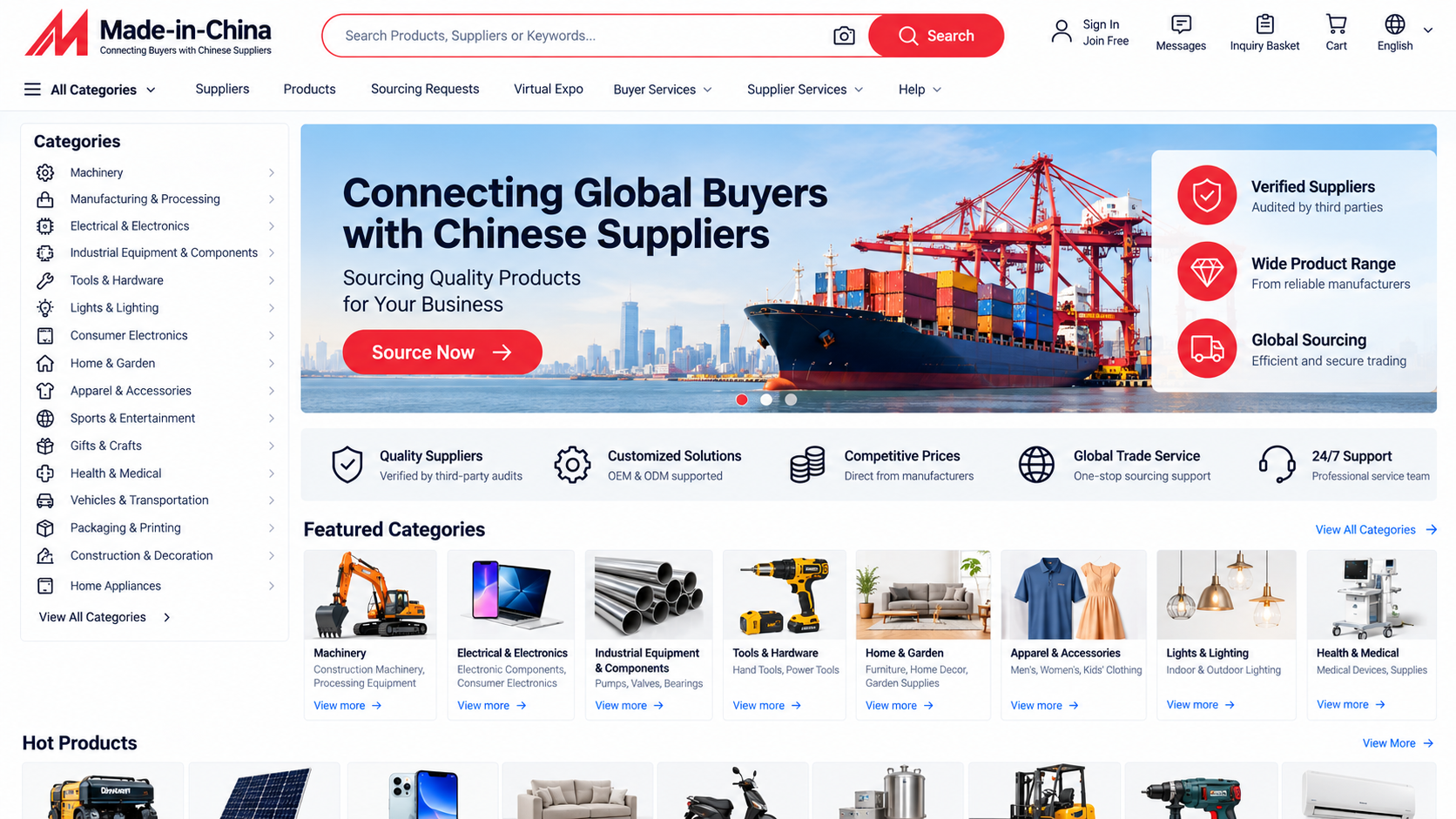
For example, Made-in-China currently says it offers access to more than 20,000 customized and commercial suppliers , while Global Sources says its network serves more than 14 million registered buyers and users .
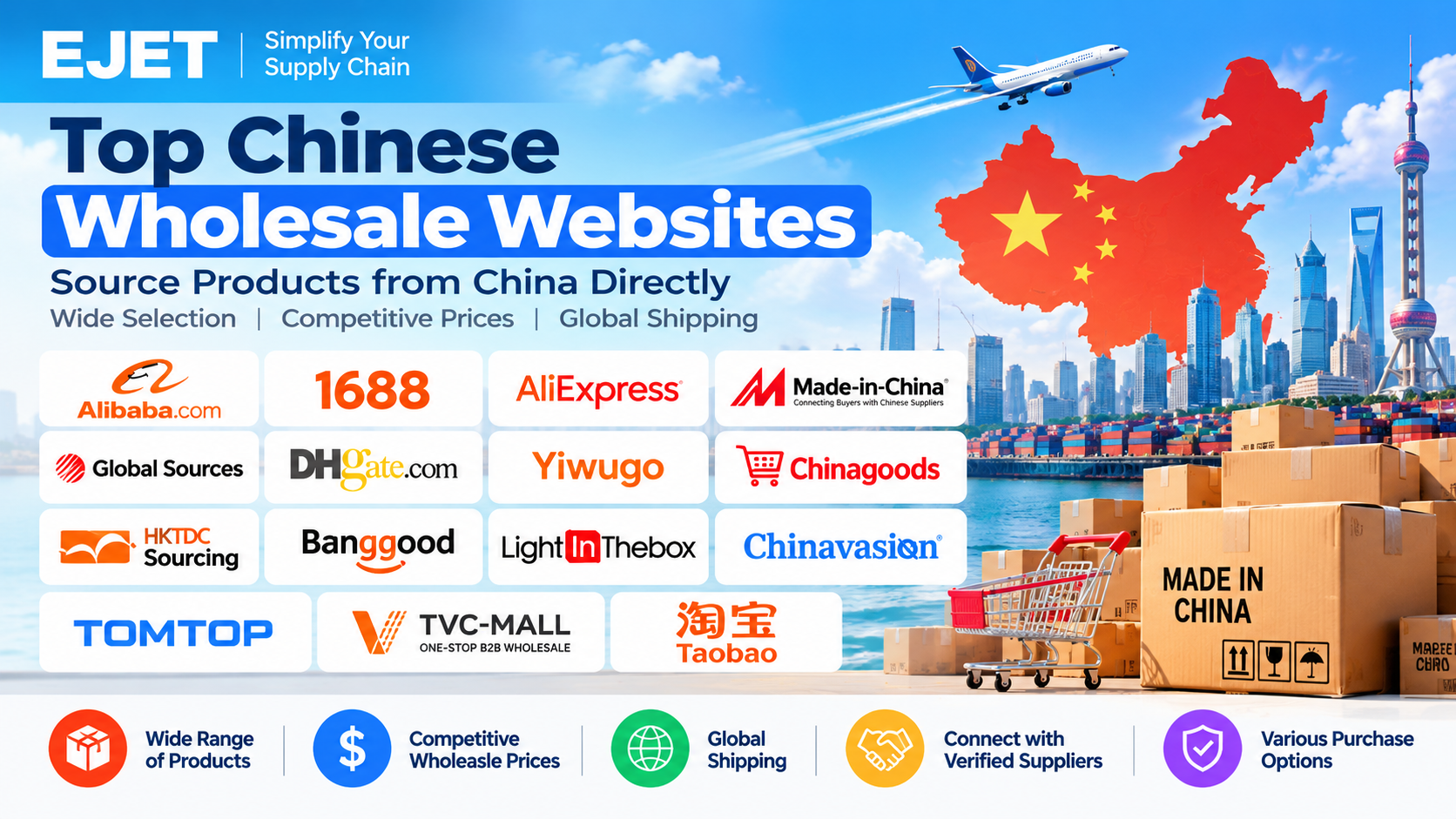
This compare guides 15 platforms that international buyers can investigate when sourcing products from China . It also explains a point that beginners sometimes learn the expensive way: the cheapest unit price is rarely the same thing as the lowest landed cost . Samples, defects, inspection, packaging, freight, customs, duties, compliance, payment fees, and inventory risk all matter.
| Rank | Website | Best For | Buyer Type |
|---|---|---|---|
| 1 | Alibaba.com | Factory sourcing, OEM/ODM, bulk orders | Importers, brands, Amazon sellers |
| 2 | 1688.com | Lowest China domestic wholesale prices | Experienced buyers with agents |
| 3 | Made-in-China.com | Machinery, industrial goods, manufacturers | Industrial buyers |
| 4 | Global Sources | Electronics, verified suppliers | Professional importers |
| 5 | DHgate | Small wholesale orders, testing products | Small businesses, resellers |
| 6 | AliExpress | Samples, dropshipping, small quantities | Beginners |
| 7 | Yiwugo | Yiwu market products (gifts, accessories, small goods) | Traders and wholesalers |
| 8 | Chinagoods | Yiwu Commodity Sourcing | Small commodity buyers |
| 9 | HKTDC Sourcing | Electronics, gifts, fashion, suppliers from China/HK | Export buyers |
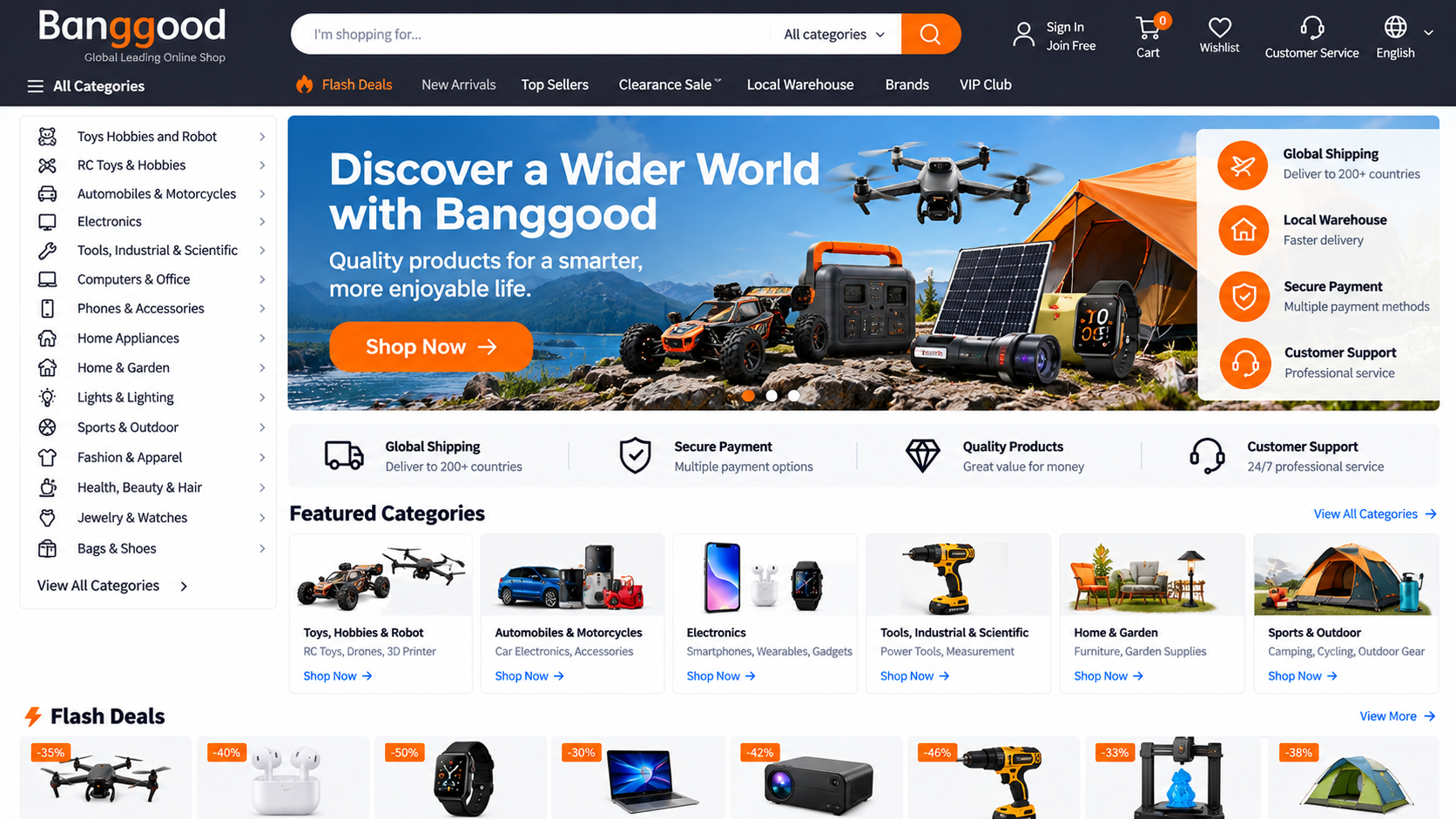
| 10 | Banggood | Electronics, gadgets, hobby products | Online sellers |
| 11 | LightInTheBox | Apparel, home goods, consumer products | Retailers |
| 12 | Chinavasion | Electronics wholesale | Gadget sellers |
| 13 | TOMTOP | Export Electronics wholesale | B2B buyers |
| 14 | TVC-Mall | Global supplier marketplace | International traders |
| 15 | Taobao | General wholesale website | Online sellers |
Why Buy Wholesale Products from China?
China is known as the “world's factory” because of its strong manufacturing infrastructure, skilled workforce, and extensive supplier network. Businesses around the world source products from China because of its competitive wholesale prices, wide range of product choices, and flexible manufacturing options.
Chinese suppliers also offer private labeling, OEM and ODM services, and efficient production capabilities to meet different business needs. With access to experienced manufacturers and suppliers across multiple industries, buyers can find products ranging from electronics and clothing to machinery, home appliances, and household goods.
This makes China customized a popular sourcing destination for retailers, wholesalers, importers, and eCommerce businesses looking to purchase products in bulk or develop products for their brands.
Top 15 China Wholesale Websites
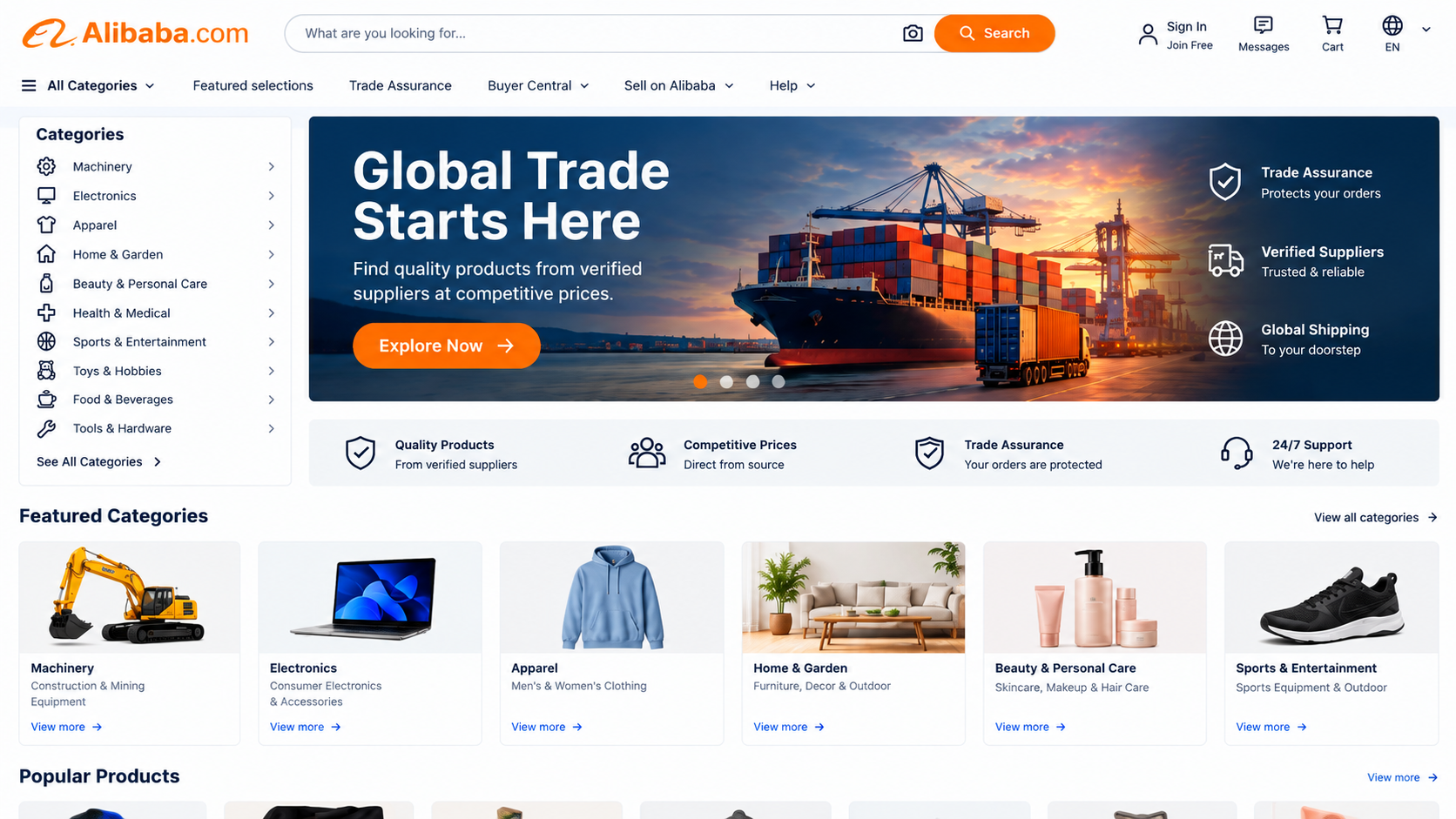
1. Alibaba – Best Overall China Wholesale Marketplace
2. 1688 – Best Website for Lowest China Wholesale Prices
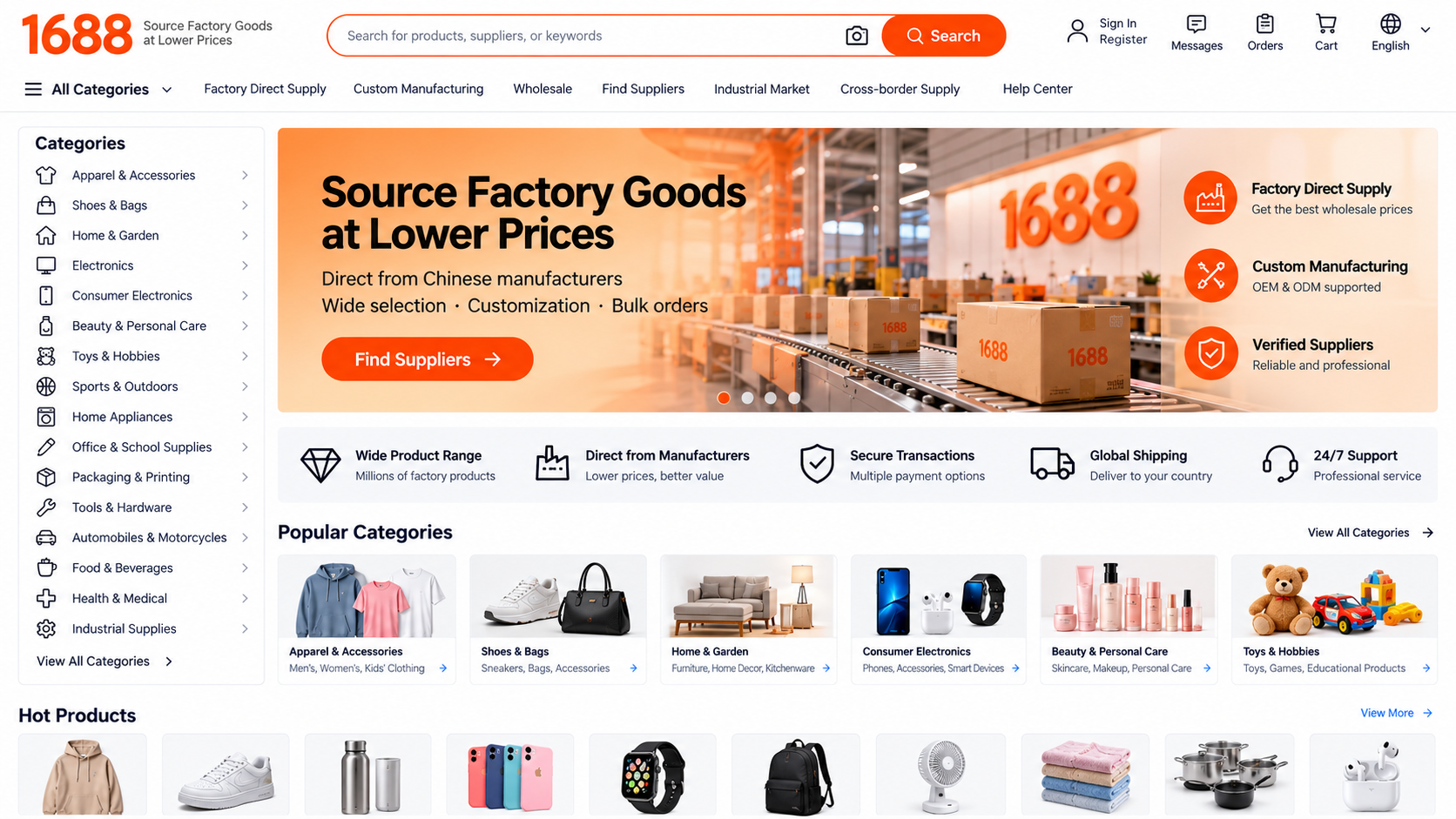
1688.com occupies a different corner of the sourcing world. It is closely associated with China's domestic wholesale market, which is exactly why experienced sourcing agents and cross-border sellers pay attention to it.
Products that appear on export-oriented marketplaces may sometimes be found through domestic Chinese supply channels at different price structures, although comparing listings isn't enough—you need to compare specifications, quantities, tax treatment, service, quality, packaging, and logistics on equal terms.
The attraction is easy to understand. If Alibaba is something like an international trade exhibition with multilingual signs, 1688 is closer to walking deeper into China's domestic wholesale ecosystem. That can expose buyers to factories, wholesalers, product variations, and pricing that aren't necessarily presented for overseas customers.
The flip side is friction: language, domestic payment conventions, shipping arrangements, communication, returns, and export handling can make the platform substantially harder for a foreign beginner.
Best for China Domestic Wholesale Pricing
Experienced ecommerce sellers sometimes use 1688 as a product-research and price-discovery engine even when they ultimately transact through another channel. That's a sensible use because it helps reveal the depth of the domestic supplier market.
Search with product images, compare variations, inspect seller histories and product details, and use the results to sharpen your understanding of realistic factory and wholesale pricing.
3. Made-in-China – Best for Industrial Products
4. Global Sources – Best for Electronics and Verified Suppliers
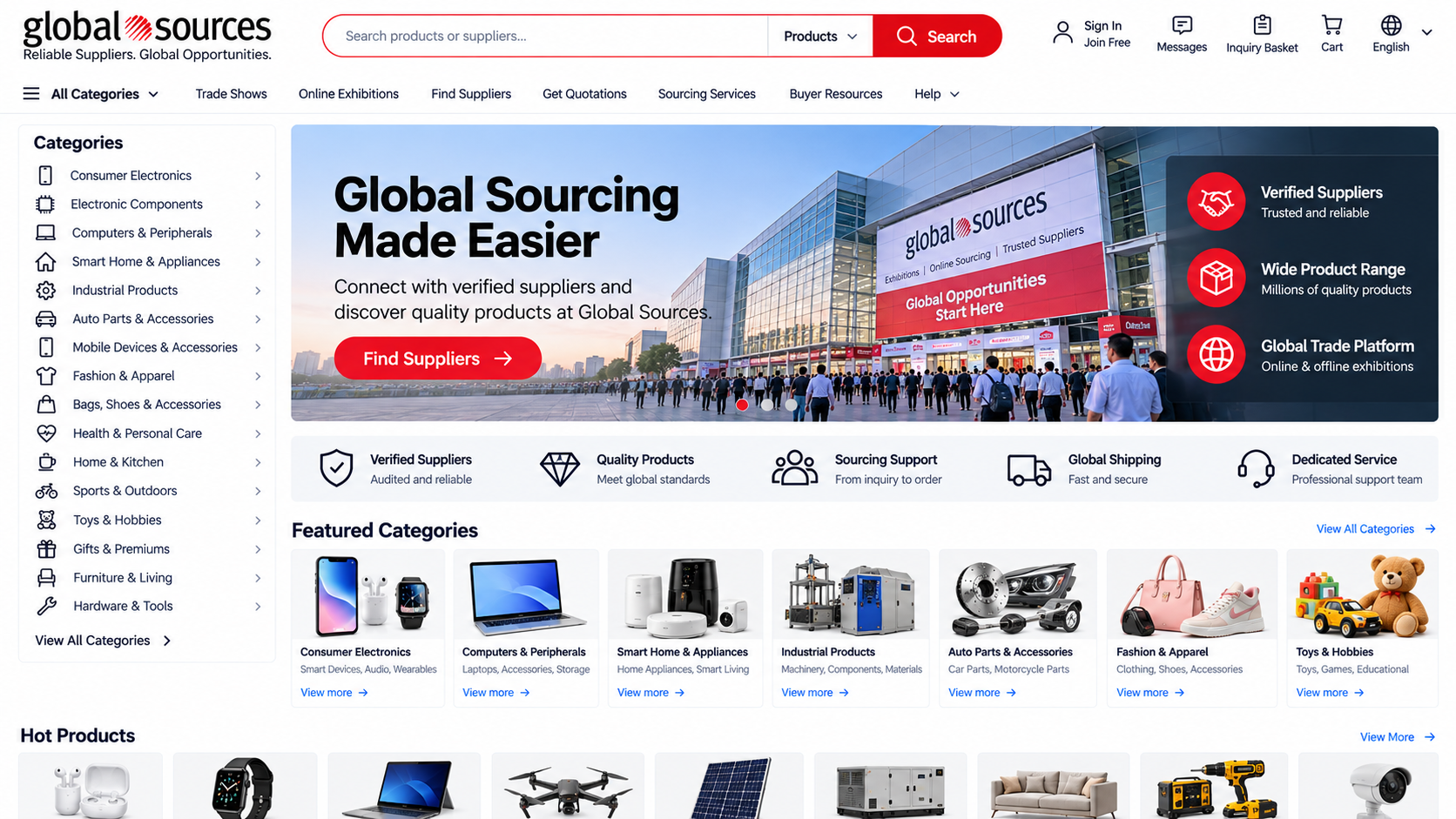
Global Sources has a long-standing position in Asian sourcing and combines its online marketplace with physical trade shows and supplier-matching services. The company says it has more than 14 million registered buyers and users worldwide, including 97 of the world's top 100 retailers.
That doesn't mean every supplier is appropriate for every buyer, but it illustrates why Global Sources remains relevant to professional sourcing teams.
Its verification structure is worth understanding. Global Sources explains that its Verified Suppliers have business-registration details checked by independent third parties, while Verified Manufacturers have manufacturing scope reflected in their government-licensed operations and credentials checked by third-party agencies. It also offers supplier capability assessments based on onsite visits. Global Sources These layers can help buyers separate basic legal verification from deeper manufacturing assessment.
5. DHgate – Best for Small Wholesale Orders
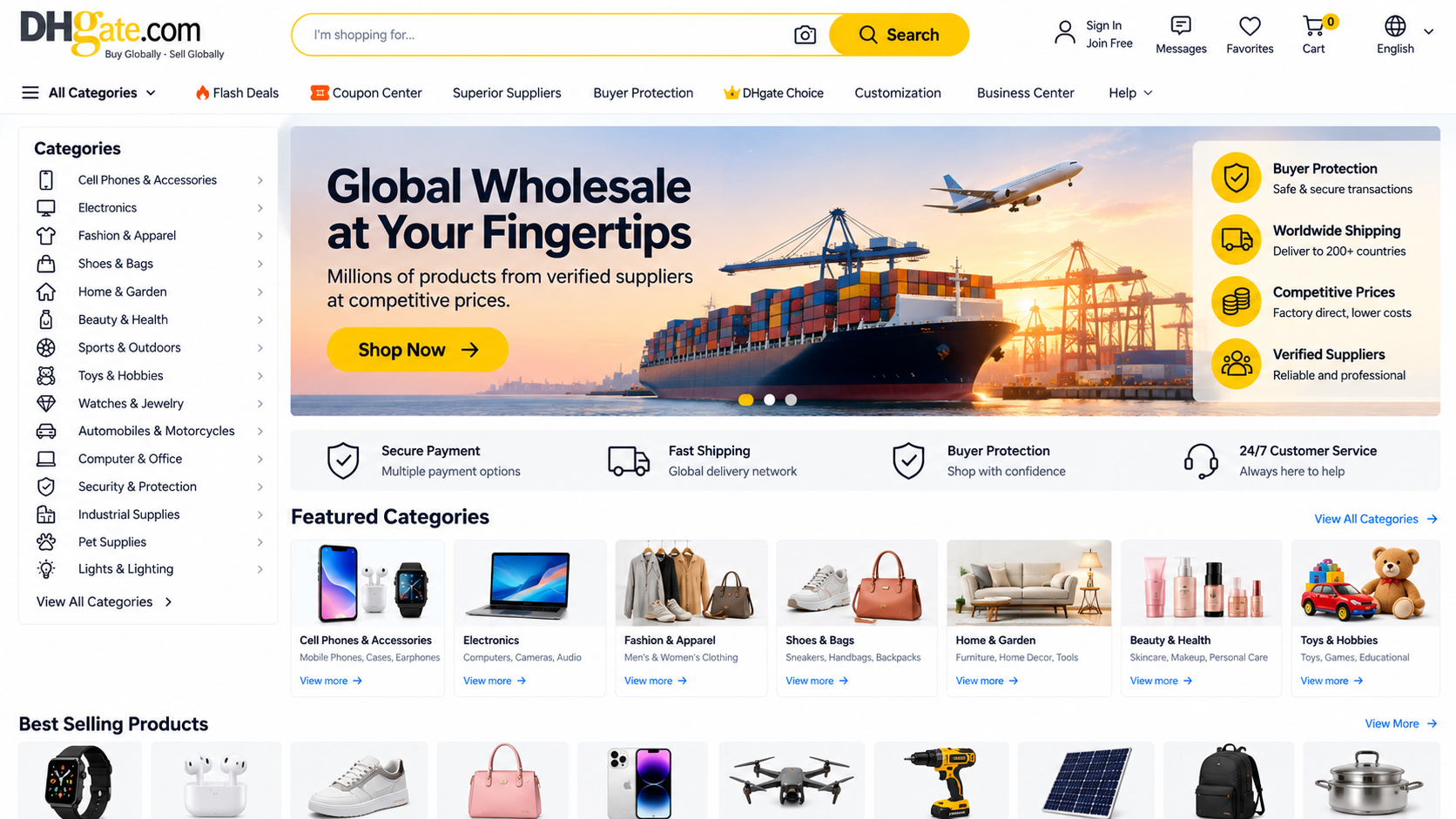
DHgate sits closer to the small-order end of Chinese wholesale sourcing. Instead of beginning with factory development, tooling, lengthy RFQs, and large MOQs, buyers can browse huge numbers of ready-made products and order relatively modest quantities from marketplace sellers. That makes it attractive to small retailers, product testers, resellers, and entrepreneurs who want to validate demand before committing significant inventory capital.
This convenience comes with a trade-off. DHgate is a marketplace, so the seller behind the listing matters enormously. Product photography alone tells you almost nothing about consistency, authenticity, after-sales service, or long-term supply capability.
Check seller history, reviews, product specifications, delivery conditions, dispute rules, and all order details before payment. Keep important communication within the platform so you retain a usable transaction record if something goes wrong.
6. AliExpress – Best for Small Orders and Product Testing
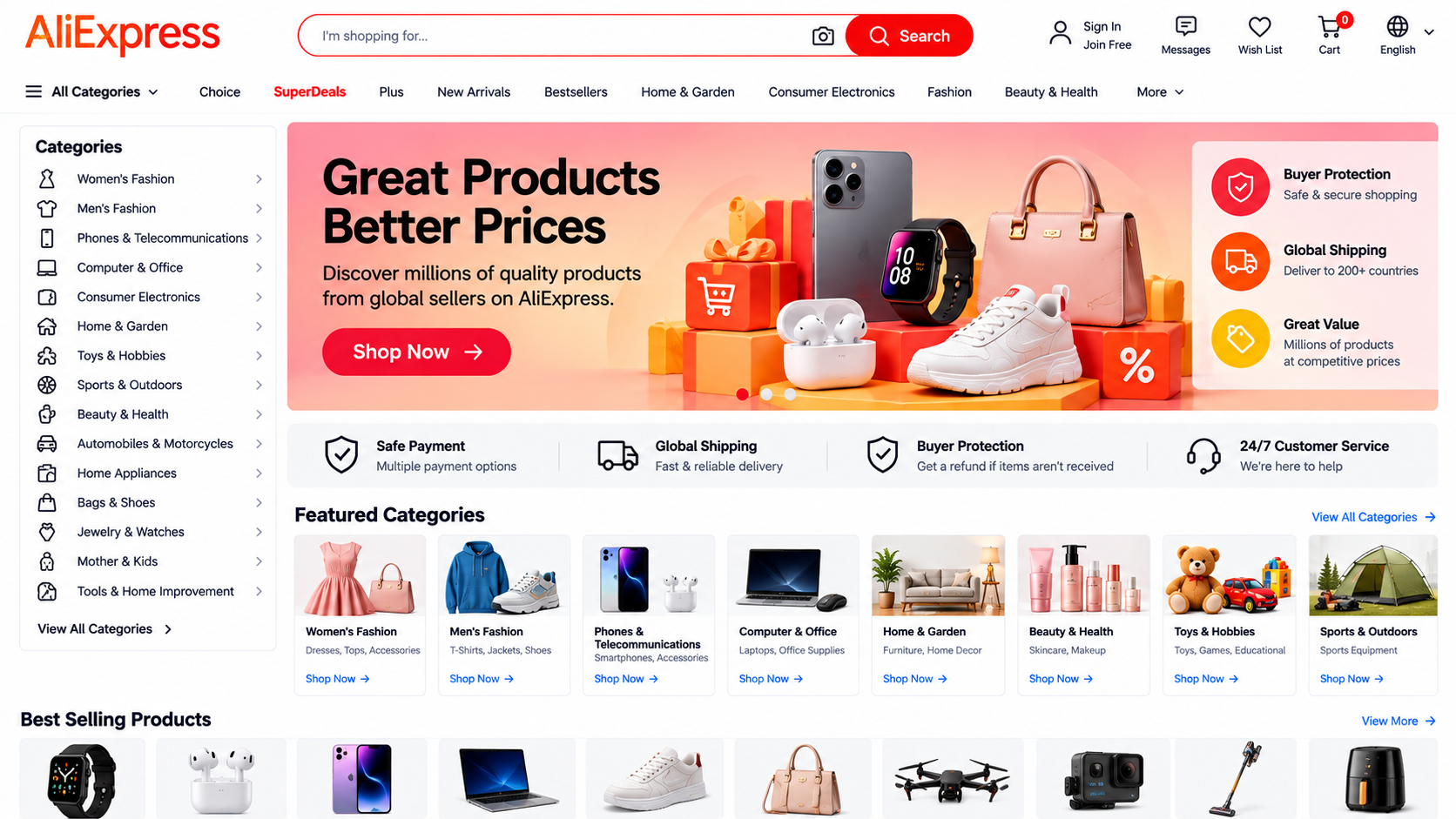
AliExpress is primarily known as a cross-border consumer marketplace, but it can still be extremely useful in a wholesale sourcing workflow—particularly before you're ready for wholesale quantities. Why order 500 units of an unproven item when you can first test a handful?
For product validation, competitor research, samples, accessories, and very small inventory experiments, AliExpress can function as a low-commitment laboratory.
The trade-off is margin. Buying a few ready-to-ship units generally won't deliver the same economics as negotiating directly with a factory for hundreds or thousands of pieces. You also have less control over materials, packaging, manufacturing processes, and product exclusivity. Consequently, AliExpress makes the most sense when speed and flexibility matter more than squeezing every cent from the unit cost.
7. Yiwugo – Best for Yiwu Wholesale Products
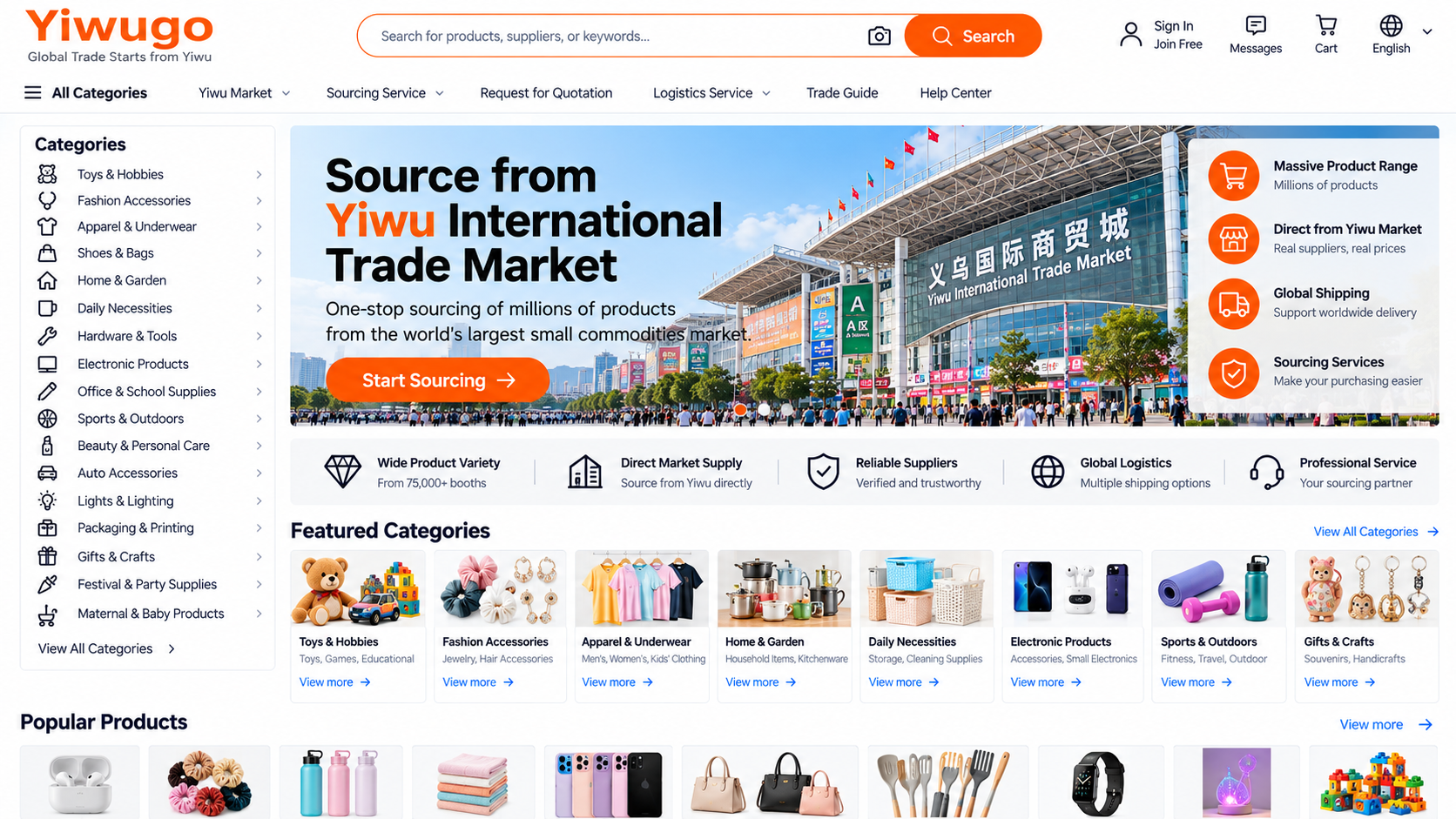
Yiwugo brings the famous Yiwu commodity market into a searchable online environment. Its current site maps an extraordinary number of physical-market merchants across sections of Yiwu International Trade City.
At the time of this research, the platform displayed 55,256 shops in its market directory. For buyers interested in general merchandise, accessories, toys, jewelry, crafts, hardware, household items, bags, seasonal goods, and countless small commodities, that connection to Yiwu is compelling.
Yiwu sourcing is different from traditional factory sourcing. Many businesses in the market specialize in existing designs, broad assortments, and wholesale distribution. That can be perfect when you want to build a mixed catalog instead of manufacturing one highly customized product. A retailer might source dozens of related SKUs from Yiwu, consolidate them, and ship them together rather than meeting a large factory MOQ for every individual item.
8. Chinagoods – Yiwu Commodity Wholesale Platform
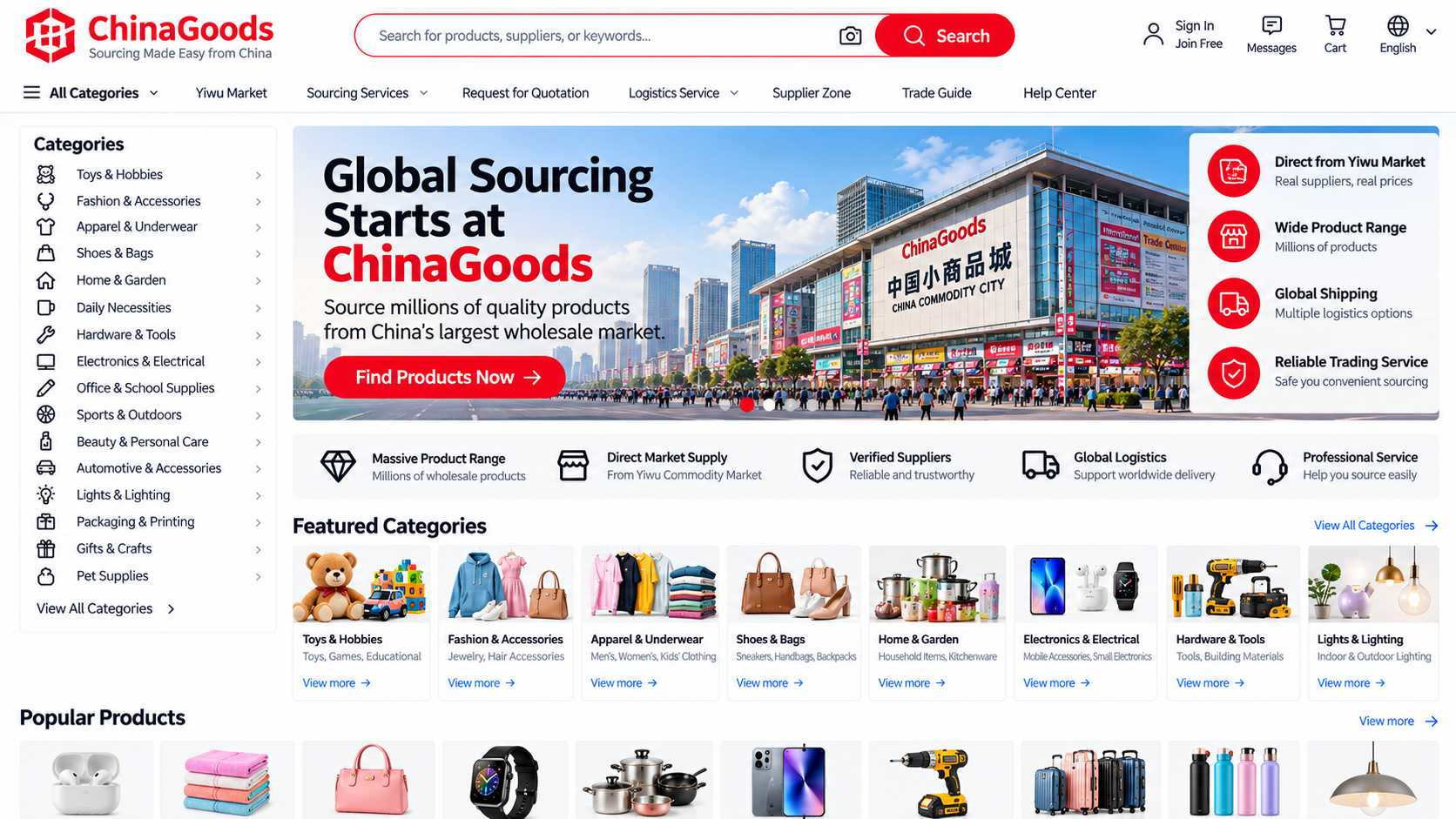
Chinagoods is another important gateway into the Yiwu ecosystem, but its positioning is especially interesting because it explicitly connects digital listings with physical Yiwu-market merchants. Chinagoods describes itself as the official website of Yiwu Market and says it connects 80,000 showrooms/suppliers in Yiwu with around 2 million upstream SMEs across China.
The platform covers categories including daily necessities, crafts and jewelry, festival products, toys, beauty products, stationery, clothing, shoes, sporting goods, automotive accessories, textiles, bags, packaging, electronics, home décor, hardware, and kitchen products.
Its site also states that stores on the platform have booths in Yiwu markets, creating a useful online-to-offline connection. For buyers who already understand Yiwu, that physical traceability can make supplier discovery much more practical.
9. HKTDC Sourcing – Best for Quality Suppliers
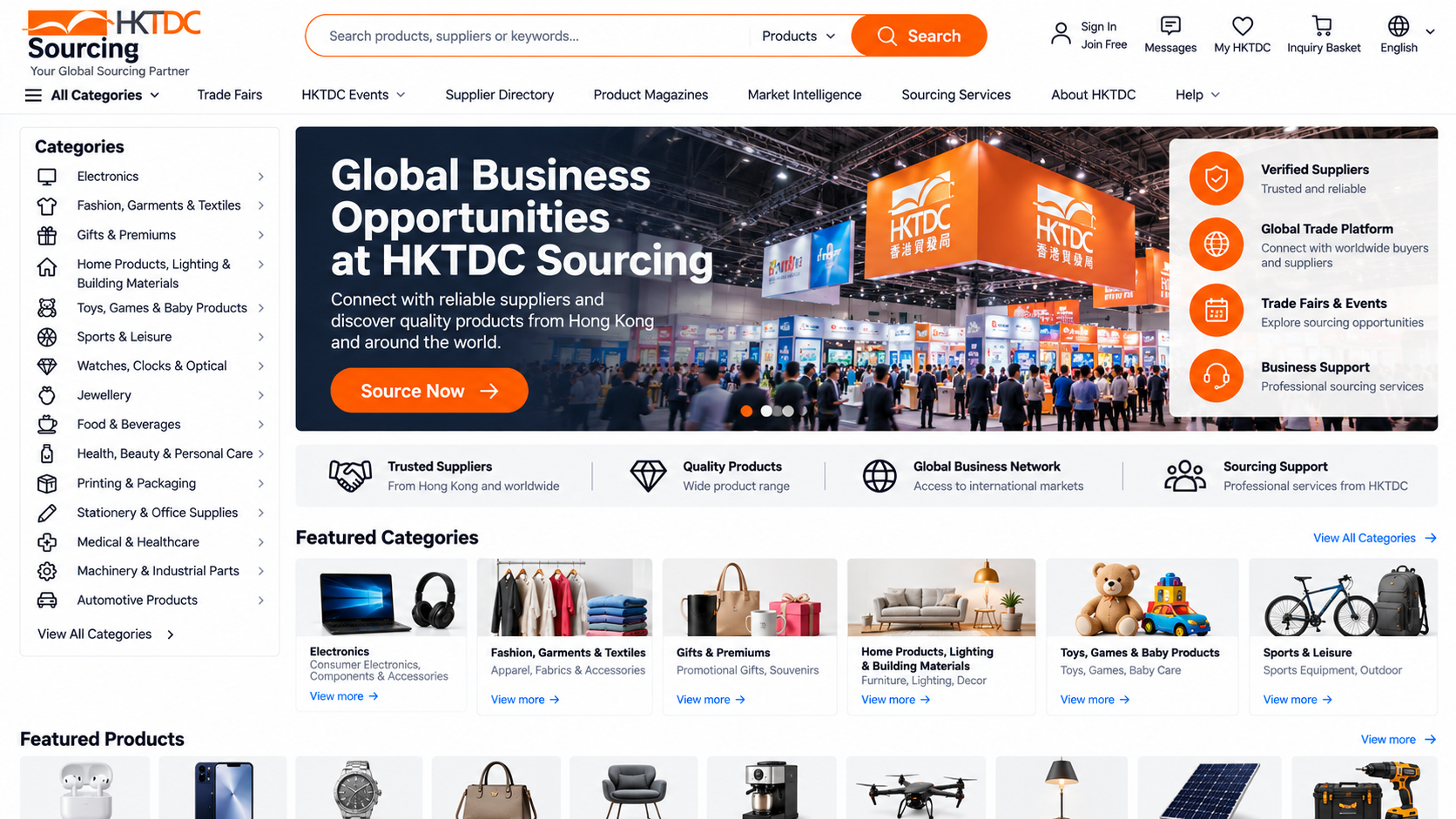
HKTDC Sourcing is operated within the Hong Kong Trade Development Council ecosystem and provides searchable products, services, and suppliers. Current supplier discovery tools include filtering by supplier type, country or region, factory location, nature of business, and company certification.
Its real value is supplier discovery rather than pretending every purchase should resemble clicking "Buy Now" on a consumer marketplace. Buyers can research businesses across Hong Kong, mainland China, and other sourcing regions, while industry and geographic clusters can help narrow the search. That makes HKTDC particularly relevant to importers who treat sourcing as business-partner identification rather than simple online shopping.
Use it as one layer of a broader sourcing process. Find suppliers, investigate their business nature, compare product expertise, request information, verify credentials, and then conduct transaction-specific due diligence. For buyers who also attend Hong Kong trade events, combining digital research with physical supplier meetings can create a more efficient shortlist before factory visits or sample development.
10. Banggood – Best for Electronics and Gadgets
11. LightInTheBox – Best for Fashion and Consumer Products
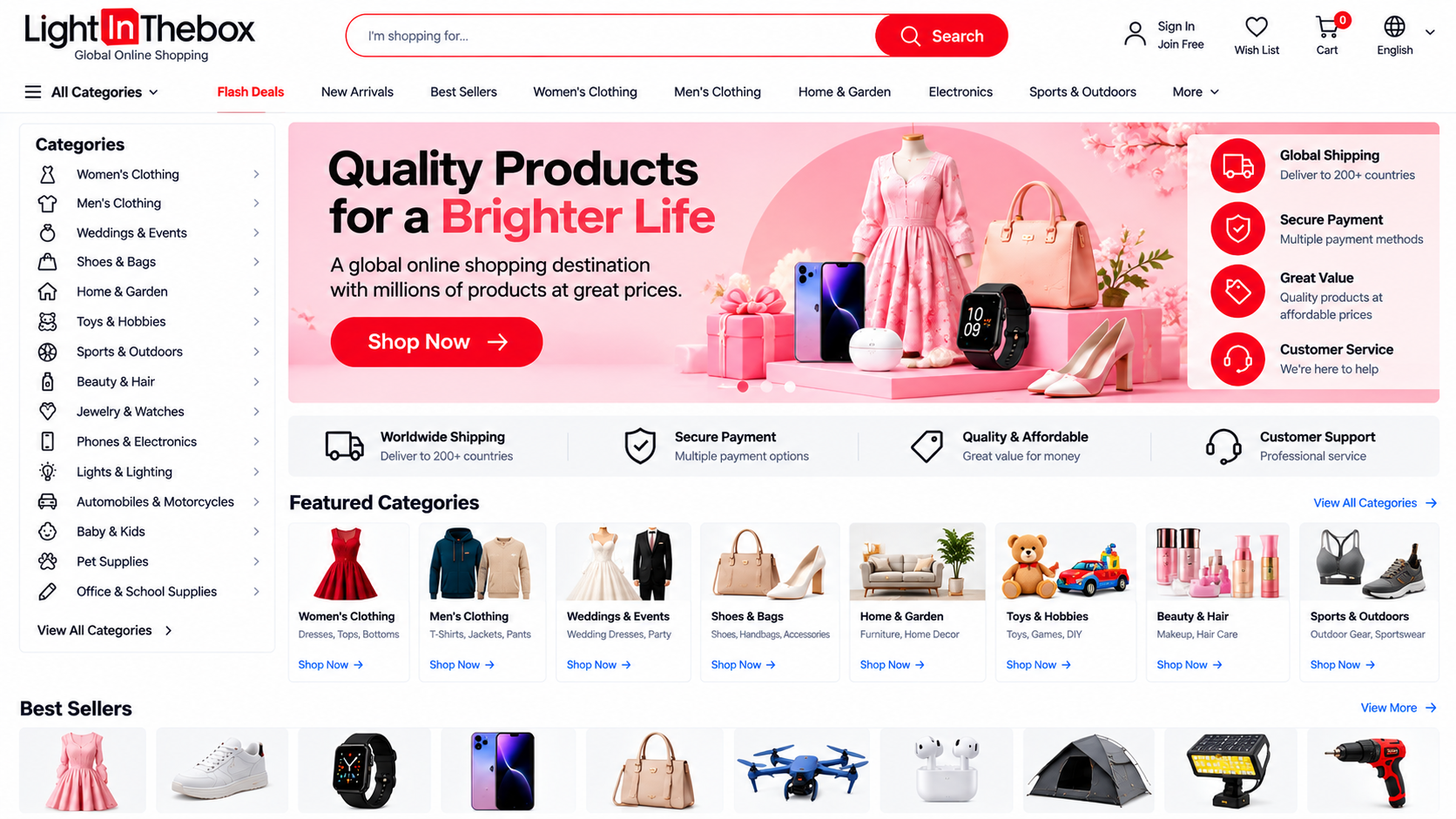
LightInTheBox Wholesale Center is another China-linked cross-border marketplace with a dedicated wholesale section. Its wholesale hub has historically covered categories such as apparel, sports and outdoor goods, electronics, computer accessories, automotive products, and other consumer merchandise.
The platform is better viewed as a ready-product purchasing channel than as a replacement for deep OEM factory sourcing. That distinction matters. If you need an existing product quickly and don't require significant customization, a marketplace-style wholesaler can be efficient.
If you need a proprietary mold, custom firmware, tightly controlled materials, or specialized regulatory documentation, a manufacturer-focused B2B platform will generally be the more logical hunting ground.
Before ordering, check current shipping availability, quantity pricing, returns, product specifications, and destination-specific costs. Cross-border marketplaces evolve quickly, so don't rely on a blog post's three-year-old claim about shipping times or minimum quantities.
12. Chinavasion – Best for Electronics Wholesale
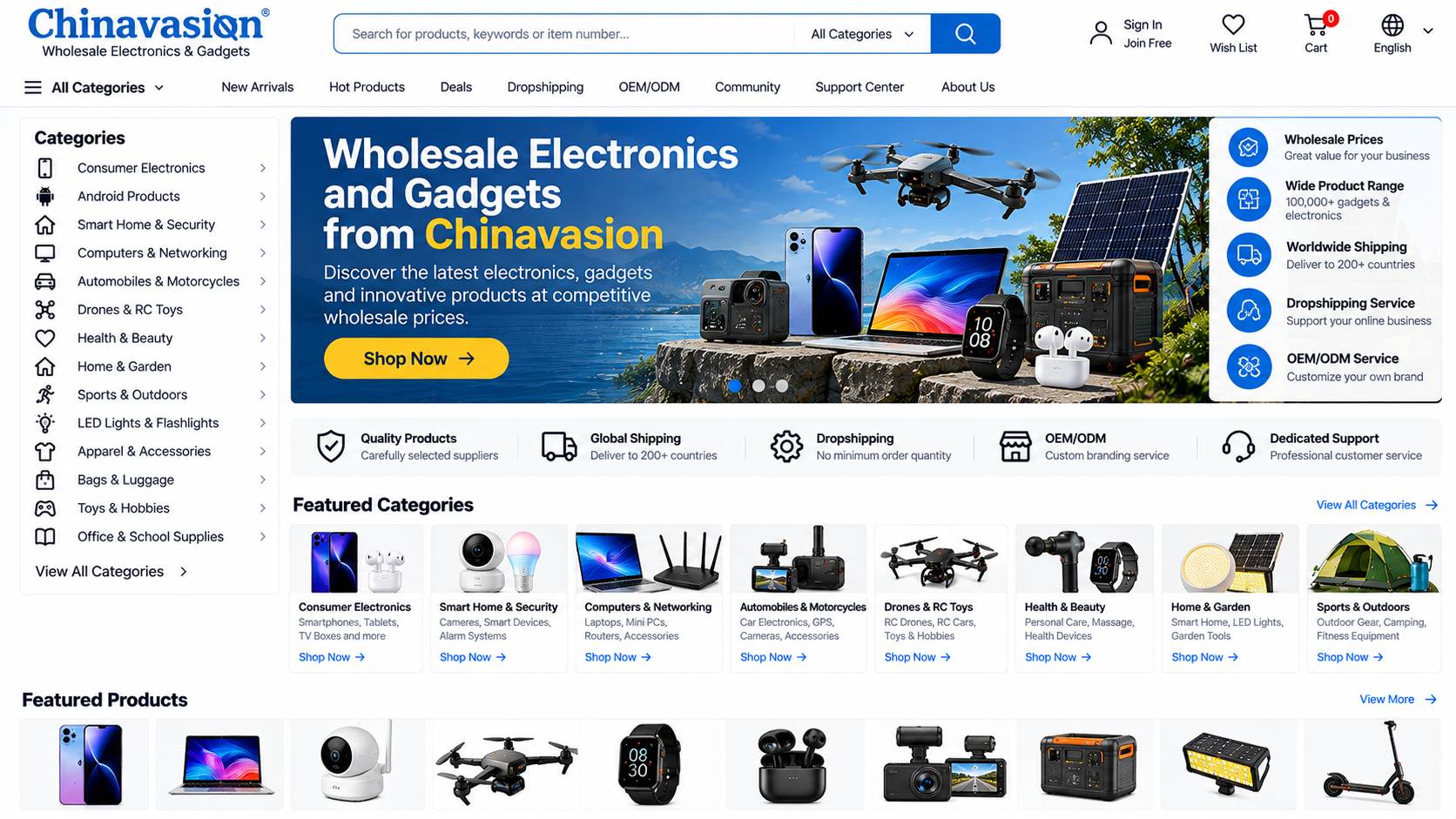
ChinaVasion has long focused on China-sourced electronics and related consumer products for overseas buyers. It can be investigated by retailers looking for existing merchandise without immediately establishing relationships with individual electronics factories.
This model can be useful when product variety matters more than heavy customization. Imagine running a small gadget store: ordering 20 different items from 20 factories would be operationally exhausting. A wholesaler can act as an aggregation layer, simplifying purchasing even if individual unit prices aren't always equivalent to high-volume factory quotations.
Electronics sourcing, however, demands stricter due diligence than buying something simple like an unbranded fabric pouch. Batteries, chargers, radio-frequency devices, children's electronics, power supplies, and connected products may trigger regulatory requirements in your destination market. Verify documentation and product compliance independently rather than treating a supplier's casual "yes, certified" message as sufficient evidence.
13. TOMTOP
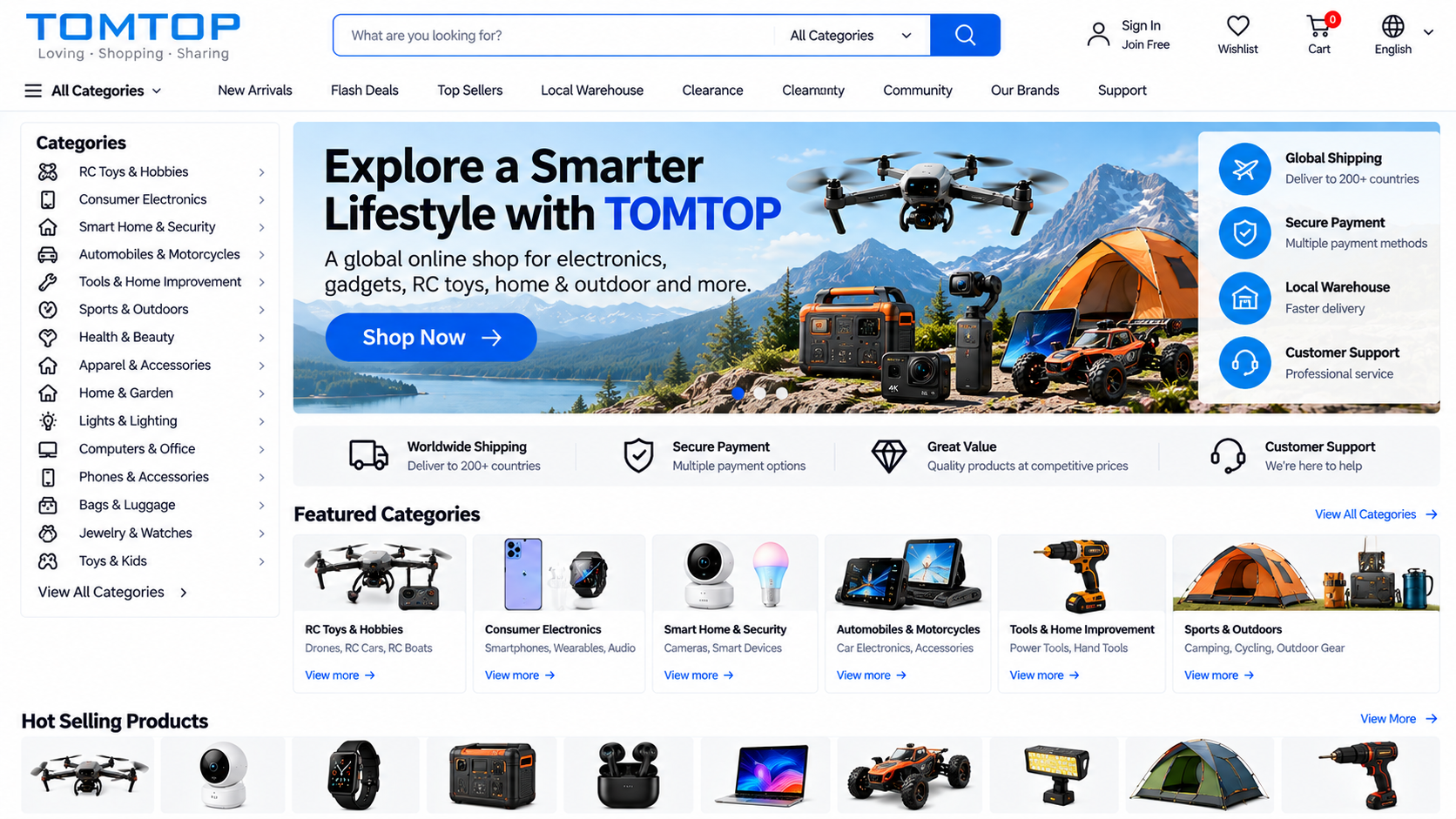
TOMTOP is worth exploring for electronics, photography equipment, smart devices, tools, hobby gear, automotive products, and consumer gadgets. Current product pages include wholesale-inquiry functionality, and some listings display buyer-protection language covering non-receipt or items differing from their descriptions.
For smaller ecommerce operators, the attraction is simplicity. Instead of negotiating production from scratch, you can investigate existing products and potentially source commercially viable inventory without the administrative weight of custom manufacturing. That can be helpful during early-stage product testing or when a store needs many relatively low-volume SKUs.
But the same rule keeps returning because it matters: convenience has a price. Once sales volume becomes predictable, compare the product against manufacturer-direct sourcing. Ask whether the extra work of supplier development would produce enough improvement in price, packaging, branding, quality consistency, or product differentiation to justify the change.
14. TVC-Mall
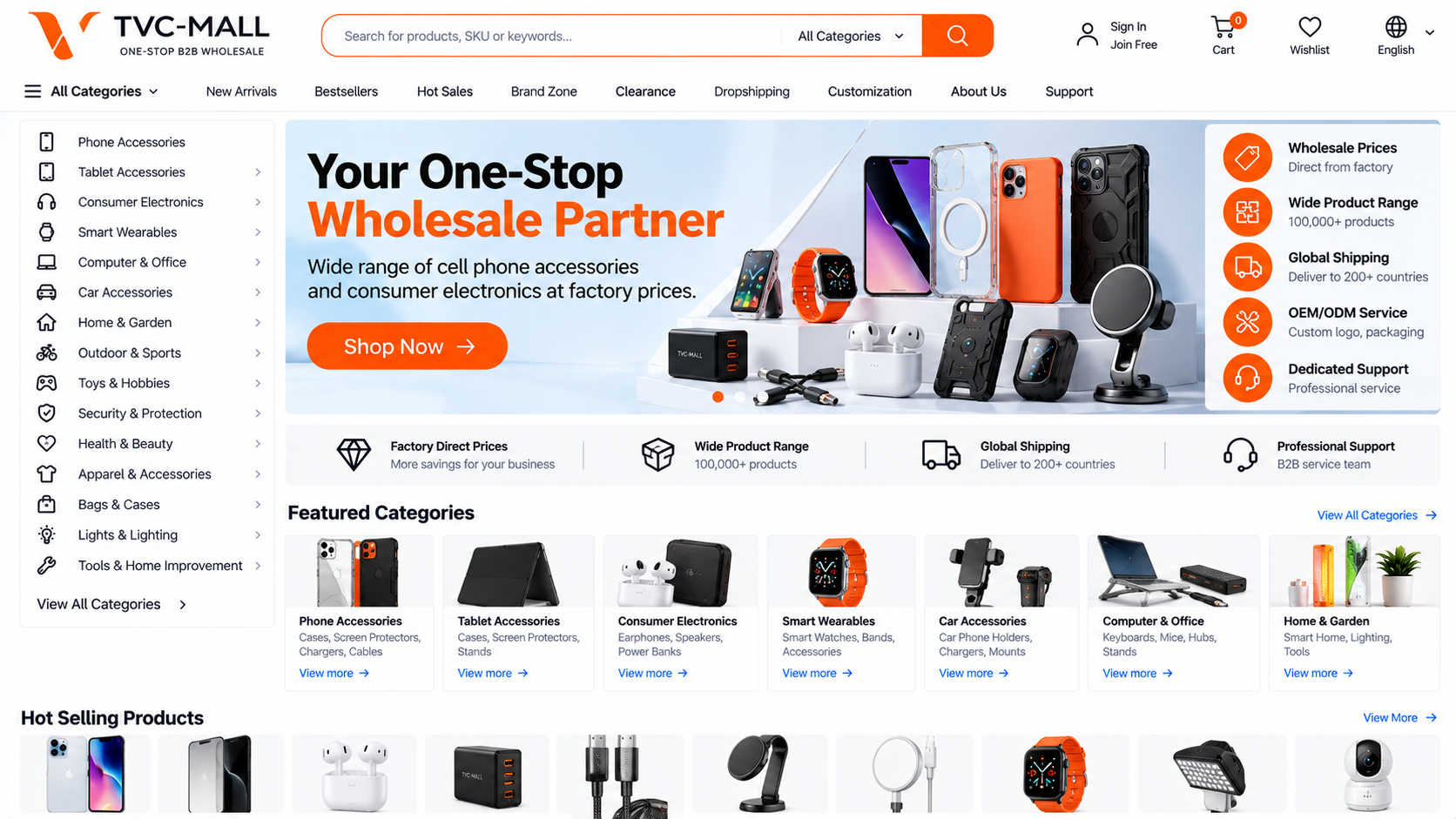
TVC-Mall is particularly relevant to buyers working in mobile-phone accessories, replacement parts, consumer electronics accessories, cases, chargers, cables, mounts, screen-related products, and adjacent categories. Specialized wholesalers can be useful because a focused catalog is often easier to navigate than an enormous general B2B marketplace when you already know your niche.
For repair shops, accessory retailers, ecommerce stores, and regional distributors, the key advantage is assortment. A buyer may need dozens or hundreds of related SKUs rather than 10,000 identical pieces. In that situation, the ability to consolidate a broad catalog can be more commercially important than obtaining the absolute lowest factory price for each item.
Electronics buyers need to pay particular attention to compatibility, electrical standards, batteries, labeling, intellectual property, safety certifications, and destination-market regulations. Never assume that because a product can be purchased online, it can automatically be legally imported and sold in your country.
15. Taobao
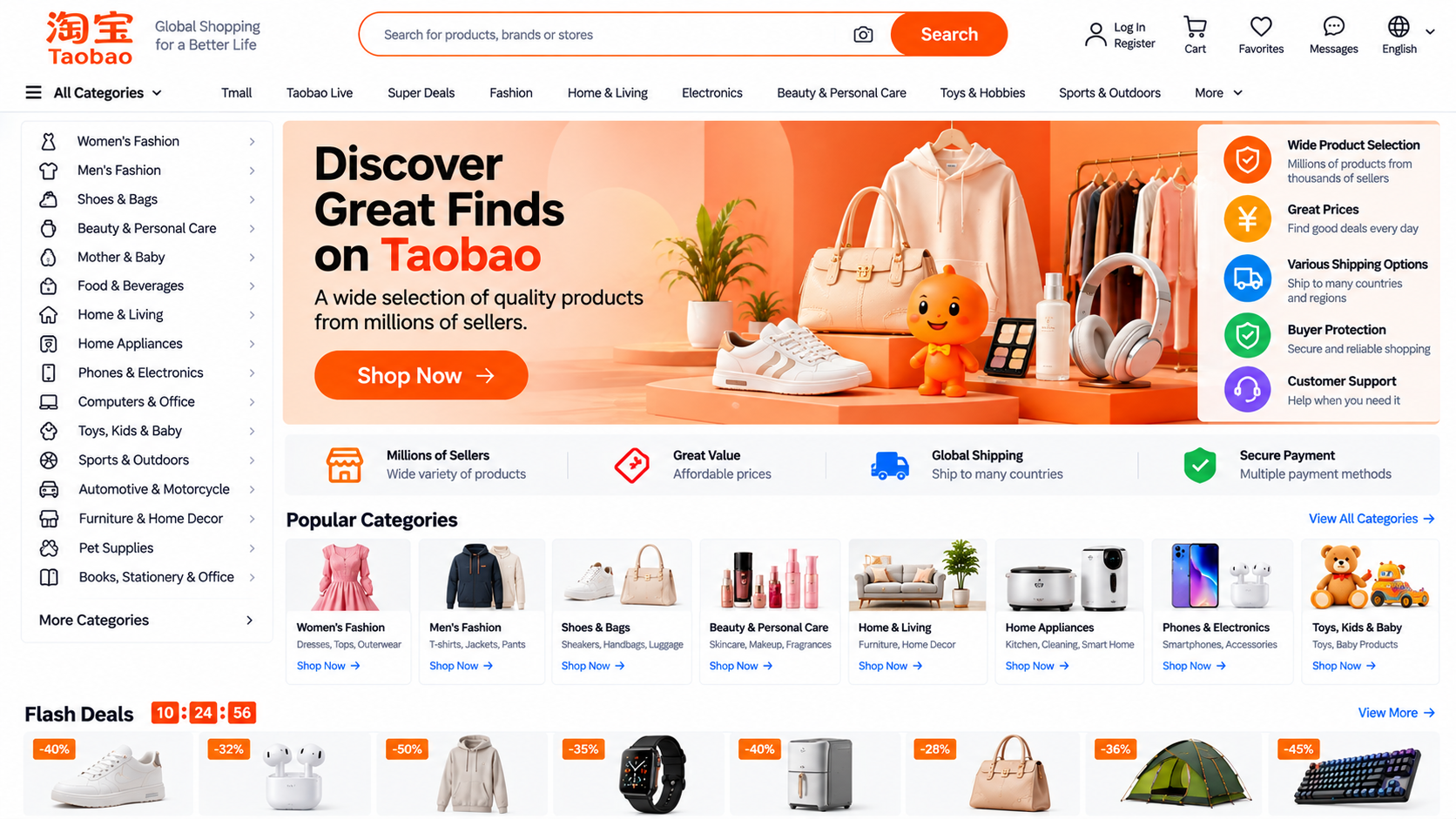
Taobao isn't a conventional export wholesale website, yet it belongs in a comprehensive China sourcing toolkit because it can be valuable for product discovery, samples, domestic-market research, and finding trends or suppliers that may not appear prominently on international B2B sites. Like 1688, however, it was built primarily around China's domestic ecommerce environment.
International wholesale buyers therefore need to approach Taobao differently from Alibaba. Language, domestic shipping, payments, seller communication, consolidation, and export logistics can create friction. A purchasing agent or warehouse partner may be necessary depending on your circumstances and destination.
Its best use is often intelligence. Search the domestic market to see product variations, merchandising styles, accessories, bundles, and price bands. If you identify a promising product, investigate the underlying supply chain rather than automatically treating a retail marketplace seller as your long-term manufacturer. Taobao can show you what exists; deeper supplier research determines how you should source it.
Why Buy Wholesale Products From China?
China sourcing is attractive because its manufacturing ecosystem isn't simply a collection of inexpensive factories. Think of it more like an enormous interconnected city: manufacturers, component makers, packaging suppliers, mold workshops, freight forwarders, inspection companies, trading firms, and wholesale markets often operate inside the same regional ecosystem.
That density can make everything from product development to packaging changes considerably easier once you've found the right supply chain. It is particularly useful for businesses selling consumer electronics, home products, apparel, accessories, toys, tools, packaging, automotive accessories, beauty equipment, gifts, and general merchandise.
The second advantage is choice. Buyers can approach the market at almost any scale. A new ecommerce seller might test 20 or 50 units from a cross-border marketplace, while an established importer might negotiate a custom production run directly with a manufacturer.
Somewhere between those extremes sit Yiwu wholesalers, sourcing agents, trading companies, and export-oriented B2B marketplaces. This is why asking for the "best Chinese wholesale website" without defining your business is a little like asking for the best vehicle without saying whether you're delivering pizza or hauling ten tons of steel.
China sourcing can also provide enormous customization flexibility. Many manufacturers offer OEM and ODM production, allowing buyers to change materials, dimensions, colors, packaging, logos, accessories, and sometimes the entire product design.
However, customization generally increases the importance of specifications, samples, quality-control procedures, tooling ownership, intellectual-property protection, and purchase contracts. A bargain can become expensive remarkably quickly when 2,000 units arrive with the wrong connector, inaccurate dimensions, weak packaging, or missing regulatory documentation.
That leads to the most important principle in this guide: a wholesale platform is a supplier-discovery tool, not a substitute for due diligence. Verification badges, audits, reviews, and transaction protection can reduce certain risks, but they don't guarantee that a supplier can manufacture your exact product consistently.
Serious importers verify the company, order samples, define measurable specifications, inspect production where appropriate, and understand applicable product regulations before committing substantial money.
Quick Comparison of the Top 15 China Wholesale Websites
The table below is a practical positioning guide rather than a promise about fixed MOQs or prices. Individual sellers determine many commercial terms, and those terms can change by product, quantity, customization level, destination, and negotiation.
| China Wholesale Website | Best Suited For | Typical Sourcing Style | Beginner Friendliness |
|---|---|---|---|
| Alibaba.com | Most international importers | B2B, OEM, private label | High |
| 1688.com | Experienced buyers/agents | Domestic China wholesale | Low |
| Made-in-China.com | Factory and industrial sourcing | B2B manufacturing | High |
| Global Sources | Established importers | Verified B2B sourcing | High |
| DHgate | Small orders | Cross-border marketplace | High |
| Yiwugo | Yiwu commodities | Wholesale-market sourcing | Medium |
| Chinagoods | Yiwu suppliers | Online/offline sourcing | Medium |
| HKTDC Sourcing | Supplier discovery | B2B sourcing | Medium-High |
| AliExpress | Samples and small quantities | Cross-border ecommerce | High |
| Banggood | Electronics/general merchandise | Retail and wholesale | High |
| LightInTheBox | Apparel/general merchandise | Retail and wholesale | High |
| TOMTOP | Electronics/gadgets | Cross-border wholesale | High |
| TVC-Mall | Mobile accessories | Wholesale distribution | Medium-High |
| ChinaVasion | Electronics | Wholesale ecommerce | Medium |
| Taobao | Product discovery/small sourcing | Domestic marketplace | Low |
How to Choose a Reliable Chinese Wholesale Supplier
Choosing a website is the easy part. Choosing the supplier is where the real sourcing work begins. Start by creating a written product specification before asking for quotations. Include exact materials, dimensions, tolerances, colors, functions, packaging, labeling, accessories, testing standards, destination market, quantity, and required certifications.
If your specification is vague, suppliers will quote different products while appearing to quote the same product—and the cheapest offer may simply represent the cheapest interpretation.
Next, verify the supplier behind the profile. Check its legal business name, registration information, manufacturing scope, address, years in operation, export history, relevant audit information, and whether it is actually a manufacturer or a trading company.
A trading company isn't inherently bad; good traders can provide valuable consolidation, communication, and product-development services. The problem arises when you believe you're negotiating directly with a factory when you're not.
Order samples and test them systematically. Don't simply hold the sample and say, "Looks good." Measure it. Use it. Stress it. Photograph it. Compare materials. Check packaging. Test functions repeatedly. If the product is regulated, use appropriate accredited testing and compliance processes for the market where you intend to sell it. The sample should eventually become part of the reference standard for production.
For meaningful orders, consider pre-shipment inspection. An independent inspection can verify quantities, workmanship, packaging, labeling, dimensions, and agreed test criteria before the remaining balance is released, depending on your commercial arrangement. Inspection isn't magic—it only works when the inspector has measurable criteria—but it is much cheaper to discover a serious defect while 5,000 units are still near the factory than after they've crossed an ocean.
Payment terms deserve equal care. Use platform protection when it meaningfully applies and understand exactly what is covered. Alibaba, for example, explicitly advises buyers to pay through its platform to retain its payment protections.
Never let a persuasive salesperson rush you into sending a large payment to an unrelated personal account because "the finance department changed banks today." Verify changes independently through established contact channels.
Finally, calculate landed cost, not product price. Your real unit economics may include product cost, molds or tooling, packaging, domestic Chinese freight, inspection, export handling, international freight, cargo insurance, customs brokerage, duties, taxes, warehousing, payment fees, damaged stock, and last-mile transportation. A $2.10 product with expensive volumetric freight can easily be worse than a $2.45 product designed to pack efficiently.
Conclusion
The top China wholesale websites serve very different buyers. Alibaba.com offers one of the most accessible international B2B ecosystems, particularly for private labeling and custom manufacturing.
Made-in-China.com and Global Sources provide strong alternatives when supplier verification and manufacturing capabilities are central to the search.
Buyers pursuing China's domestic wholesale ecosystem can investigate 1688.com, while Yiwu-focused businesses have compelling options in Yiwugo and Chinagoods.
For smaller purchases and product testing, platforms such as DHgate, AliExpress, and Banggood can lower the commitment required to validate a product. Specialized and catalog-based wholesalers can also make sense when assortment and convenience matter more than deep factory customization.
The smartest approach isn't to become loyal to one website. Use each platform as a different window into China's supply chain. Research broadly, shortlist carefully, verify independently, sample before scaling, document specifications, inspect important orders, and calculate the complete landed cost. A reliable supplier who consistently produces what you specified is ultimately worth far more than a spectacular quotation that exists only on a screen.
FAQs About China Wholesale Websites
1. What is the best China wholesale website for beginners?
Alibaba.com is one of the most accessible starting points for international B2B buyers because it combines supplier discovery, communication, RFQs, online payments, and transaction-protection tools. Its Trade Assurance program currently covers areas including secure payment, qualifying refunds, logistics, and dispute support.
eginners should still compare several suppliers, order samples, verify credentials, and avoid selecting a factory purely because it appears first in search results.
2. Is 1688 cheaper than Alibaba?
1688 can expose buyers to China's domestic wholesale pricing and supplier ecosystem, so buyers may find attractive prices there. However, advertised product price alone doesn't prove the total purchase will be cheaper. International buyers may need an agent, domestic freight, consolidation, inspection, export handling, and international shipping. Compare equivalent specifications and landed costs before deciding which channel offers better economics.
3. Which Chinese wholesale websites are best for low-MOQ orders?
Cross-border marketplaces such as DHgate and AliExpress are often practical starting points when the goal is buying small quantities or testing products rather than commissioning custom factory production. Banggood also currently maintains a wholesale program designed around quantity purchasing.
MOQ ultimately varies by seller and product, so always check the current listing or negotiate directly rather than relying on a universal minimum.
4. How can I avoid scams when buying wholesale from China?
Verify the legal business entity, keep important documented communication, request samples, confirm payment-account details, inspect meaningful orders, and use legitimate platform payment protections where appropriate. For example, Made-in-China's Audited Supplier program provides third-party audit reports, while Global Sources describes independent verification processes for verified suppliers and manufacturers.
No badge eliminates risk, so your due-diligence process should become stricter as order value rises.
5. Can I buy directly from Chinese manufacturers without a sourcing agent?
Yes. International B2B platforms allow buyers to communicate directly with many Chinese suppliers and manufacturers. A sourcing agent becomes more useful when you're purchasing through domestic platforms, combining products from many suppliers, conducting frequent factory visits, managing complicated customization, consolidating shipments, or dealing with language and logistics challenges.
The question isn't whether you can source without an agent; it's whether the agent's cost saves you more money, time, and risk than managing the process yourself.