White label and private label sourcing both let you sell products manufactured by another company under your own brand.
The practical difference is product control: white labeling usually starts with a shared, ready-made item, while private labeling involves a product or variation developed for your business.
When sourcing from China, that distinction helps you assess customization, launch costs, supplier requirements, and differentiation.
The right choice starts with what customers need—and how much uncertainty your business can afford before its first sale.
What is the difference between white label and private label products?
White label products are standard goods that a manufacturer supplies to multiple businesses, each using its own branding.
Private label products are made or adapted to a particular business’s specifications, potentially changing materials, features, formulation, or design.
Both models outsource manufacturing; the distinction is how much influence your brand has over the underlying product.
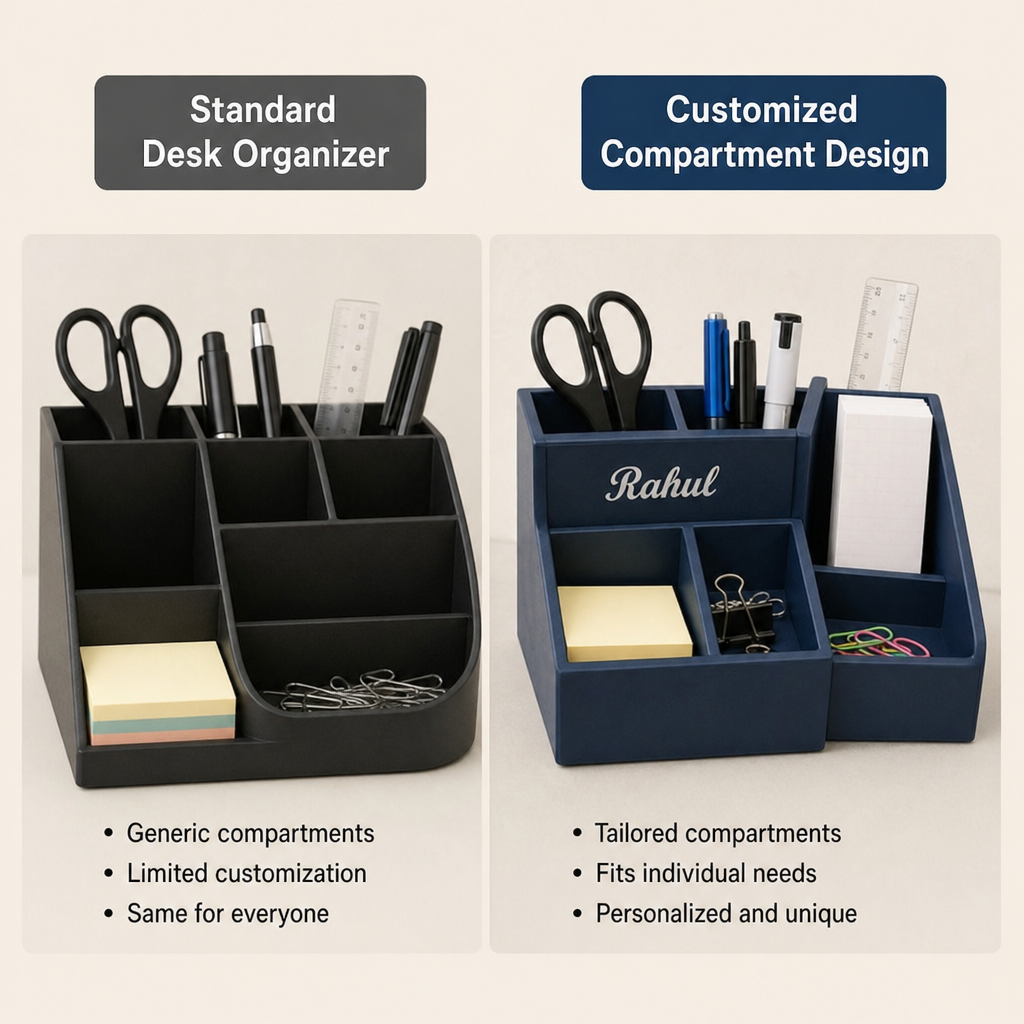
Imagine two hypothetical desk-accessory brands. One selects an existing organizer and adds its logo and packaging. The other commissions a different compartment layout and material finish to suit a particular workspace. The first illustrates white labeling; the second illustrates a more customized private-label approach.
Terminology is not perfectly consistent. Shopify notes that suppliers and sellers sometimes use these terms interchangeably, so a listing labeled “private label” is not enough to establish what customization you receive. Ask what changes, what stays standard, and what other buyers can purchase.
Treat exclusivity as a separate requirement to document, rather than something a product label automatically guarantees. Contracts should specify the intellectual property involved and the protections your business needs.
White label products vs private label at a glance
The following comparison describes common tendencies, not fixed supplier promises. Use it to frame your initial inquiry, then request written terms for your product.
|
Decision factor |
White label |
Private label |
|---|---|---|
|
Starting point |
Existing, standardized product |
Product adapted or developed to your specifications |
|
Customization |
Usually branding, labels, and packaging |
May include materials, construction, features, or formulation |
|
Development work |
Generally less product development |
More specification and sample approval work |
|
Launch speed |
Often faster when suitable goods are available |
Often slower when development is required |
|
Initial spending |
Usually less development spending |
May include development, tooling, and additional sampling |
|
Differentiation |
Primarily brand experience and positioning |
Can include meaningful product differences |
These differences explain why private label products vs white label comparisons should go beyond the purchase price. A faster launch may be valuable when testing demand; a customized feature may matter more when solving an established customer problem.
How do costs, minimum orders, and timelines compare?
White labeling generally requires less development work, while private labeling can introduce additional sampling and customization costs.
However, neither model has a universal price, minimum order quantity, or production schedule. Request a product-specific quotation rather than budgeting around an advertised starting price.
Build a landed-cost budget
For your own planning, create a worksheet that separates the supplier’s price from the total cost of making inventory available for sale. Include these lines where applicable:
- Goods and branding: Product price, logo application, retail packaging, inserts, and labels.
- Development: Samples, revisions, design work, and any agreed tooling charges.
- Verification: Supplier checks, inspections, and required testing.
- Transportation: Freight, insurance, customs brokerage, duties, and delivery.
- Inventory handling: Receiving, storage, preparation, and an allowance for unusable units.
Ask a customs broker to help confirm the classification and applicable duties before committing to the order. CBP identifies composition, intended use, origin, and transaction details as important information when determining import treatment.
Avoid using another seller’s duty estimate as your own.
Separate minimum quantities from cash exposure
Minimum order quantity, or MOQ, means the smallest quantity a supplier is willing to sell. Customization services can have supplier-set minimums, so confirm which minimum applies to the exact configuration you want.
Ask for separate answers covering the base item, each variation, and the packaging. Then calculate the cash committed across the whole order, not just the unit price. For example, compare one focused launch configuration with several color options before deciding how widely to spread your budget.
Request a schedule covering sample approval, production, inspection, and transport. When sourcing from China, account for factory holiday closures rather than treating the production estimate as an arrival date.
Product control matters more than a new logo
Private labeling offers opportunities to change the product itself, while white labeling generally leaves more differentiation to branding and customer experience. That does not make either approach automatically superior.
The useful question is whether a proposed change gives your customer a reason to choose you.
Before paying for customization, write a simple statement: “Our customer needs this change because…” If the answer only describes how different the item will look in a listing, reconsider its priority.
For a hypothetical travel pouch, an easier-to-clean lining or a more accessible pocket might address a specific use case. Start by interviewing potential buyers or reviewing feedback you have permission to use. Translate the problem into a testable requirement rather than asking the factory to make the item “premium.”
White labeling deserves the same discipline. Decide how you will make the buying experience useful: clearer dimensions, better instructions, thoughtful bundles, or a focused selection. Treat those as proposed advantages to validate, not proof that branding alone will overcome an interchangeable product.
A practical process for sourcing from China
Begin with a written specification and use it consistently across supplier conversations. Canada’s Trade Commissioner Service recommends defining requirements, conducting supplier due diligence, requesting samples, and checking quality before shipment. A strong sample should not replace production quality control.
Compare suppliers against one brief
Prepare a product brief covering intended use, dimensions, materials, appearance, packaging, branding, and unacceptable defects. Add your target market and ask suppliers to identify any requirements they cannot meet. Keep an assumptions column so missing details remain visible.
For example, replace “strong packaging” with a request to propose packaging for the product’s shipping conditions and explain how it will be evaluated. Replace “high-quality finish” with reference photographs and agreed acceptance criteria. The goal is not a longer document; it is fewer opportunities for different interpretations.
Use the same questions for each shortlisted supplier:
- Who performs production? Identify the manufacturer, any intermediary, and proposed subcontracting.
- What is standard? Separate existing specifications from requested changes.
- What is included? Itemize branding, packaging, samples, and development charges.
- What must be approved? Agree on the sample and documentation required before production.
- How are problems handled? Request written inspection, correction, and dispute terms.
Review the answers for clarity rather than rewarding whichever supplier says yes fastest. Ask for explanations when a quotation omits a requirement.
Turn sample approval into an inspection reference
Create an approval record identifying the sample, specification version, artwork, and unresolved issues. Do not approve production while important decisions remain scattered across messages. For a hypothetical organizer, record the compartment dimensions and finish reference alongside the logo placement.
Independent inspections can check whether production conforms to agreed specifications and identify defects before products reach the market. SGS describes checks at different production stages, including materials, components, labels, and finished goods.
Define the inspection scope before production begins so everyone knows what will be evaluated.
Finally, decide who reviews the report and authorizes shipment. Make the process explicit rather than assuming an inspection booking settles every quality issue.
Compliance and intellectual property need separate checks
Neither sourcing model removes the need to investigate your responsibilities in the destination market. For imported general-use products subject to applicable CPSC safety rules, the importer must issue the required General Certificate of Conformity.
Children’s products have separate certification requirements, so first establish which rules apply to the actual item.
Before placing an order, ask a qualified laboratory or compliance adviser to help identify relevant testing and documentation. Request evidence that corresponds to your product rather than accepting a certificate because it carries a familiar logo. Keep safety documentation separate from your visual inspection checklist: they answer different questions.
Intellectual property also deserves attention before detailed designs or branding are shared. The U.S. International Trade Administration advises businesses to plan protection early and explains that U.S. registration does not automatically confer rights in China.
btain jurisdiction-specific advice rather than assuming your existing registrations cover manufacturing overseas.
For a customized project, ask counsel to address ownership of designs, development work, tooling, confidential information, and any exclusivity arrangement. European Commission guidance recommends clearly identifying relevant intellectual property rights and allocating ownership of developments in supplier contracts.
Specify the scope of any restrictions instead of relying on a broad promise that the product is “yours.”
Which model fits your business stage?
White labeling is generally worth considering when an existing product meets your requirements and your priority is testing the market without extensive development. Private labeling becomes more compelling when you can identify a valuable product improvement and support the additional development work.
These are planning principles, not guarantees of demand or profit.
To make the private vs white label decision concrete, write down your answers to these prompts:
- Customer need: What problem must the product solve, and what evidence supports that need?
- Existing options: Does an available item meet the requirement without modification?
- Meaningful change: If not, exactly what must change—and how will you evaluate it?
- Financial limit: How much cash can remain committed while you develop, ship, and sell inventory?
- Operational capacity: Who will manage approvals, supplier communication, inspections, and replenishment?
Use those answers to choose the smallest sensible commitment. If a standard product meets the need, request samples before commissioning a redesign. If an essential requirement is missing, explore customization before spending heavily on branding an unsuitable item.
You can also plan in stages: test a clearly defined offer, record customer feedback, and consider product changes once you understand what matters. Set decision criteria in advance, such as repeated requests for a specific improvement, rather than treating every suggestion as a development instruction.
A brief search clarification: if you arrived through “difference between private label vs white label products godirek,” GoDirek’s current website describes real-estate marketing software. This article compares physical-product sourcing, not that software service.
Choose the product strategy before choosing the label
Start with the customer requirement, then select the sourcing model that can meet it within your budget and capabilities. Compare written specifications, complete costs, approval steps, and supplier commitments—not terminology alone.
Before paying a deposit, make sure you can explain what you are buying, how you will verify it, and why customers should want it.
Frequently Asked Questions About White Label vs Private Label Products
What is the main difference between white label and private label products?
White label products are pre-made and supplied by a manufacturer to multiple brands, allowing for minimal customization mostly related to branding. In contrast, private label products are specifically developed or modified according to a business's needs, involving greater customization and control over the product.
Which option is more cost-effective: white label or private label products?
Generally, white label products are more cost-effective initially since they require less development work and investment in product customization. Private label products may involve higher upfront costs due to development, customization, and tooling requirements.
Can I change the ingredients or materials in a private label product?
Yes, private label products allow for changes in materials, formulation, or features based on your specifications, while white label products typically do not offer such customization beyond branding.
How do I ensure quality when sourcing private or white label products from China?
To ensure quality, it's important to conduct thorough supplier due diligence, request samples, define clear specifications, and consider independent inspections before the final product is shipped.
What is Minimum Order Quantity (MOQ), and how does it differ between white label and private label products?
Minimum Order Quantity (MOQ) is the smallest quantity a supplier is willing to sell. MOQs can vary significantly based on the product and supplier, with private label products often having higher MOQs due to the customized nature of the orders, while white label products may offer lower MOQs as they are standardized offerings.