Shipping from China to the US can take a few days by express courier or several weeks by ocean freight, depending on the route and delivery scope.
This guide explains how to compare shipping methods, build a realistic timeline, understand landed costs, and prepare for customs.
Prepared on November 19, 2026, for 2027 planning, it distinguishes current guidance from future rates, schedules, and rules that still need confirmation before booking.
How long does shipping from China to US take?
Shipping from China to the US typically takes around 3–7 days by express courier, 5–10 days by air freight, or 22–60 days by ocean freight on a door-to-door basis.
These are planning ranges, not guaranteed delivery windows.
Your actual timing depends on the Chinese pickup locati0n, US destination, service, customs clearance, and inland transportation.
The following comparison separates the main international journey from the broader delivery process:
|
Shipping method |
Main international transit |
Estimated door-to-door time |
|---|---|---|
|
Express courier |
Around 2–5 days |
Around 3–7 days |
|
Air freight |
Around 2–5 days, airport-to-airport |
Around 5–10 days |
|
Ocean FCL to US West Coast |
Around 14–25 days, port-to-port |
Around 22–35 days |
|
Ocean LCL to US West Coast |
Around 18–30 days, port-to-port |
Around 28–42 days |
|
Ocean FCL to US East Coast |
Around 30–40 days, port-to-port |
Around 38–55 days |
|
Ocean LCL to US East Coast |
Around 34–45 days, port-to-port |
Around 45–60 days |
These published estimates are useful benchmarks, but they are not confirmed 2027 schedules. Ask whether a quotation uses business days or calendar days and whether its clock starts at pickup, cargo acceptance, or departure.
There is no single average shipping time from China to US destinations that works for every shipment. A small parcel headed to a major city and a shared container headed to an inland warehouse follow different processes. Compare shipments with the same transport mode, route, and delivery scope rather than relying on a countrywide average.
Choosing between express, air freight, and ocean freight
The right method balances the delivery deadline against shipment size and total cost. DHL distinguishes express services for time-sensitive packages from freight services for pallets and larger shipments. Start with what you are moving and when it must arrive, then request suitable options.
Express courier for samples and urgent parcels
Express courier is worth considering for samples, replacement parts, and compact orders that need prompt delivery. FedEx publishes international priority services with short business-day transit windows, but directs shippers to its quote tools for shipment-specific timing. Do not apply a general service promise to every Chinese origin and US ZIP code.
For a sample order, focus on the confirmed delivery date and complete customs information rather than the lowest headline rate. Ask whether brokerage is included, who pays duties, and whether the recipient must supply information before release. A fast transport service does not remove documentation requirements.
Air freight for larger time-sensitive shipments
Air freight is an alternative when parcels become a palletized or heavier shipment but ocean transit is too slow. Unlike an express booking, an airport-to-airport quotation may leave collection, clearance, and final delivery to separate arrangements. Confirm each handoff before comparing it with a courier price.
Ask the forwarder to quote the complete journey to your receiving address. Identify who handles destination terminal release and onward transport. Otherwise, a short flight schedule can create an unrealistic expectation about when inventory will reach your warehouse.
Ocean freight: FCL versus LCL
Full-container load, or FCL, gives one shipper exclusive use of a container, even when it is not completely full. Less-than-container load, or LCL, combines your goods with other shipments. LCL includes consolidation at origin and deconsolidation at destination, adding handling stages beyond the ocean crossing.
LCL can suit smaller, irregular orders that do not justify a dedicated container. FCL deserves consideration as volume grows or when reducing shared-container handling matters. Request both options when your shipment is large enough for either; avoid treating a fixed volume threshold as a universal rule.
Building a realistic door-to-door timeline
The vessel or aircraft journey is only part of the schedule. Maersk explicitly distinguishes time on the water from door-to-door transit. For purchasing and inventory planning, use the date goods become available at your required destination, not simply the arrival date at a port.
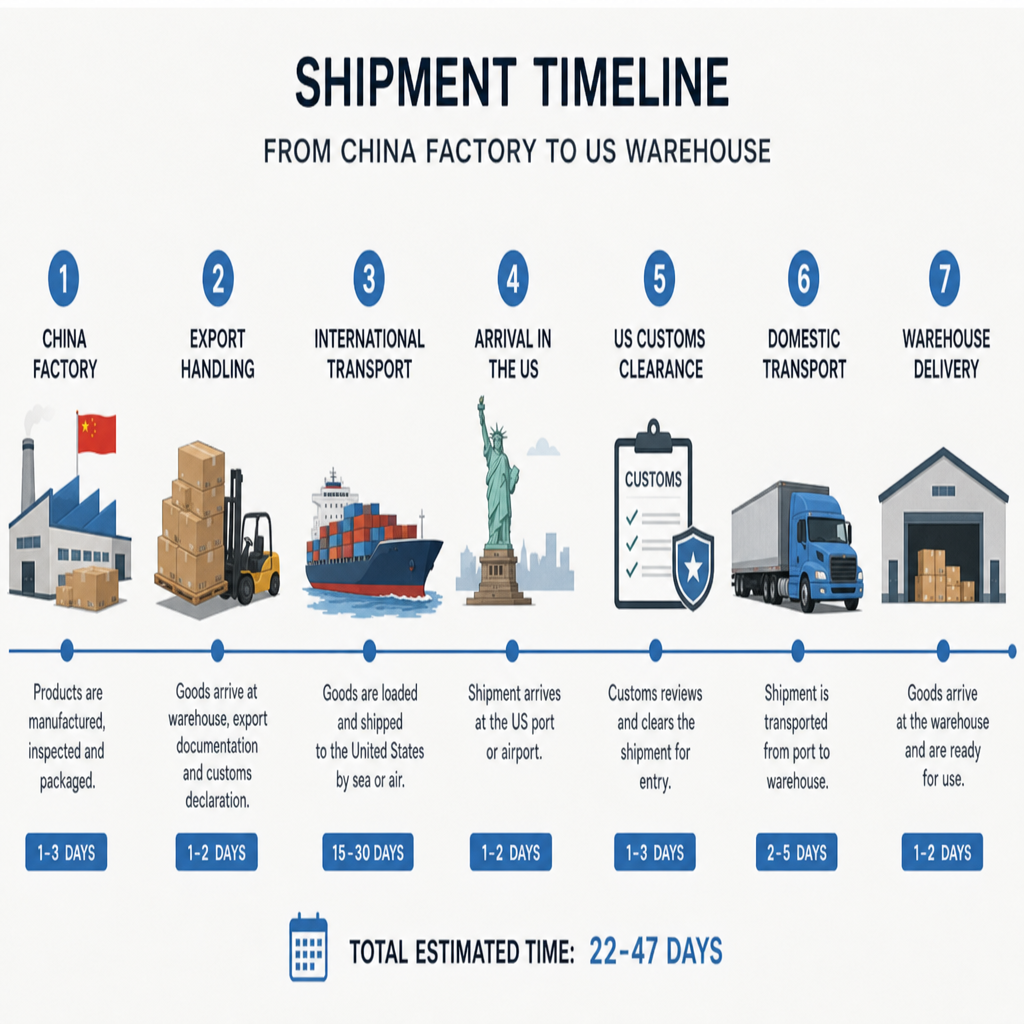
Build your working schedule around these milestones:
- Cargo ready: The supplier confirms that production, packing, and inspection are complete.
- Collection and acceptance: Goods reach the carrier, terminal, or consolidation warehouse before its cutoff.
- Export handling and departure: Required origin procedures are completed and the shipment departs.
- International transit: Track the booked flight or vessel and any connection.
- Destination release: Confirm arrival, customs status, and availability for collection.
- Final delivery: Arrange transport and any receiving appointment at your premises.
Ask your logistics provider to assign an expected date and responsible party to each milestone. This turns a vague delivery estimate into a schedule you can monitor. It also helps distinguish a supplier delay from a transport or clearance problem.
Keep manufacturing lead time separate from shipping lead time. If the supplier needs additional time to finish an order, choosing faster transport only affects the journey after cargo becomes ready. Record both dates in your purchase plan rather than allowing “delivery time” to mean different things to different parties.
When estimating the typical shipping time from China to US warehouses, also specify the endpoint: arrival at the gateway, customs release, delivery appointment, or inventory available for sale. Choose one definition and use it consistently in supplier and forwarder communications.
What does shipping from China to the US cost?
Shipping cost depends on origin and destination, cargo weight and dimensions, service level, and applicable surcharges. Duties, taxes, and customs-related charges can add to the transport bill. Without those shipment details, a precise price would be misleading; request a dated quotation rather than treating a general rate as a 2027 budget.
Compare landed cost, not just freight
For budgeting, separate the goods purchase from the logistics and import costs. Use the following as a quotation checklist, asking providers to identify each item as included, excluded, or not applicable:
- Collection from the supplier and origin handling.
- Export documentation and clearance services.
- Main air, ocean, or courier transport.
- Destination terminal, warehouse, or handling charges.
- Customs brokerage, duties, taxes, and applicable entry fees.
- Final delivery, appointments, and special unloading requirements.
- Cargo insurance and any optional services.
- Potential storage or equipment-related charges if collection is delayed.
This is a comparison framework, not a statement that every shipment attracts every charge. Require written exclusions and ask who invoices them. A useful quote should let you identify the expected total and the circumstances that could change it.
Understand dimensional weight
A large, lightweight carton can cost more to ship than its scale weight suggests. DHL explains that chargeable weight can be based on the greater of actual weight and dimensional weight. Its published dimensional calculation uses package length, width, and height divided by the applicable divisor.
Before requesting quotes, obtain the finished package measurements rather than product dimensions alone. Include pallets and protective packaging where relevant. Ask the provider to show the chargeable-weight calculation so you can compare equivalent figures.
Consider packaging changes only after protecting the product. Removing unnecessary empty space may be useful, but crushed cartons or damaged goods would defeat the saving. Ask your supplier to propose a protective packing specification and confirm it before production packing begins.
Evaluate speed against business impact
Compare the premium for faster shipping with the consequence of arriving late. A delayed sample approval, production interruption, and routine replenishment order have different priorities. Put the required arrival date and the reason for it in your quote request.
For example, consider pricing a small urgent portion by air and the balance by ocean. Treat this as a scenario to evaluate, not an automatic saving: additional handling and separate shipment charges may change the result. Compare the combined total before deciding.
Understanding Incoterms and shipping responsibilities
Incoterms define how buyers and sellers divide specified transport obligations, costs, and risks. They also address responsibilities such as export or import clearance and, under certain terms, insurance. They do not replace a complete sales contract, so record the chosen rule and named locati0n precisely.
|
Term |
Practical meaning to confirm |
|---|---|
|
EXW |
The buyer assumes broad transport responsibilities from the named collection point. Confirm loading and export arrangements. |
|
FCA |
The seller delivers to the carrier or other nominated party at the named place. Specify that locati0n clearly. |
|
FOB |
For sea or inland waterway transport, delivery and risk transfer occur when goods are onboard at the named shipment port. |
|
CIF |
The seller arranges freight and specified insurance to the named destination port; risk transfers earlier at shipment. |
|
DAP |
The seller arranges delivery to the named destination, while the buyer handles import clearance and associated duties. |
|
DDP |
The seller assumes import-clearance and duty responsibilities as well as delivery obligations to the named destination. |
Confirm the exact allocation in the applicable Incoterms rules rather than relying on these abbreviated descriptions. ICC guidance also directs containerized or multimodal shipments toward suitable carrier-delivery terms rather than automatically using traditional onboard terms.
DDP warrants particular scrutiny. ICC identifies it as the rule placing destination import formalities, duties, and taxes on the seller. Ask how the seller will meet those obligations and request clarity about the importer of record and entry records; “tax included” alone is not a complete explanation.
Preparing for US customs and import requirements
Customs planning should begin before dispatch. CBP advises importers to understand both its requirements and commodity-specific requirements administered by other agencies. Hiring a customs broker does not remove the importer of record’s responsibility for correct entry documentation and applicable duties, taxes, and fees.
Assemble consistent shipment documents
Prepare a commercial invoice with clear product descriptions, quantities, values, and seller information. CBP requires the commercial invoice or acceptable substitute as part of entry documentation before merchandise release. Descriptions should identify the actual goods rather than relying on internal stock codes or vague labels.
Ask your broker which documents the particular entry needs. A practical file may include the invoice, packing list, transport documents, and any special documents required for the goods. Check that package counts, descriptions, and transaction details agree across the file before dispatch.
Confirm classification, origin, and applicable duties
Tariff classification requires enough information to identify the product correctly. CBP asks importers to provide details such as composition, intended use, manufacturer, country of origin, and pricing. Where uncertainty remains, a broker can help research the classification, and importers can request a CBP ruling.
Do not assume every Chinese product has the same tariff burden. FedEx’s China-to-US guidance notes that Section 301 tariffs apply to specific commodities originating in mainland China. Have the applicable classification and additional duties checked for the intended entry date instead of applying a blanket percentage.
Recheck low-value shipment treatment
Do not budget on the old assumption that any shipment valued at $800 or less enters duty-free. CBP’s February 23, 2026 bulletin continued the suspension of duty-free de minimis treatment for covered imports. Ask your carrier or broker to confirm the entry process and charges applicable when your goods enter in 2027.
Postal shipments also require current guidance. CBP’s July 2026 international-mail guidance describes an indefinite suspension for low-value postal imports and a new postal informal-entry process with eligibility restrictions. A low selling price should not substitute for checking the applicable procedure.
Address ocean filings and restricted cargo early
For covered ocean shipments, required Importer Security Filing information generally must be submitted before vessel loading, with key data due at least 24 hours beforehand. Confirm who files, who supplies the information, and the provider’s earlier internal deadline. ISF is separate from simply sending an invoice to the forwarder.
Declare batteries and other potentially regulated contents before booking. FedEx publishes battery-specific acceptance, packaging, marking, and documentation requirements, including restrictions on defective or recalled batteries. Obtain commodity acceptance for the selected service rather than assuming ordinary cargo procedures apply.
Shipping from China to the US: a practical booking process
Use a repeatable process so providers quote the same job and responsibilities remain visible. The objective is not to collect the most quotations; it is to obtain comparable options with clear assumptions. Keep the information in one shipment brief that can be updated when details change.
- Define the goods. Include product descriptions, materials, intended use, quantities, value, and any batteries or special handling needs.
- Confirm packed dimensions. Obtain carton or pallet counts, gross weights, measurements, and photographs where useful.
- Set the commercial terms. Record the agreed Incoterm, named locati0n, supplier responsibilities, and importer arrangements.
- State both key dates. Give the realistic cargo-ready date and the latest acceptable warehouse arrival date.
- Request comparable quotes. Use identical addresses, cargo details, delivery scope, and service requirements for each provider.
- Review customs readiness. Have classification, documentation, filing responsibilities, and product-specific requirements checked before release.
- Approve and monitor. Retain the booking confirmation, track milestones, and obtain proof of delivery.
For provider selection, ask who handles questions at origin and destination, how exceptions are communicated, and what happens after a missed connection. Request written answers to important exclusions. A clear escalation process is more useful than an unsupported promise that delays never happen.
What can delay a shipment in 2027?
Shipping delays can arise from customs clearance, inaccurate documents, weather, operational backlogs, strikes, and the selected route or service. These factors can affect even a carefully booked shipment, so treat an estimated arrival as a planning input rather than an unconditional promise. Ask which milestones are confirmed and which remain provisional.
Plan around Chinese New Year
Chinese New Year falls on February 6, 2027. Maersk’s November 2026 planning guidance highlights concentrated pre-holiday shipping activity and a gradual post-holiday production recovery. Supplier closure periods and logistics constraints may extend beyond the holiday itself.
Ask your supplier for its own production cutoff, last dispatch date, and expected restart schedule. Share those dates with the forwarder before selecting a departure. Build a fallback plan for essential goods rather than assuming production and transport resume simultaneously.
Keep alternative arrangements practical
Maersk recommends flexibility in transit planning and discussing alternative transport arrangements where appropriate. Use that discussion to identify a realistic backup service, not merely a theoretical faster option. Ask about acceptance requirements and availability before you need to switch. (
Maintain a simple exception log: what changed, who owns the next action, and when the next update is due. If a milestone slips, request a revised delivery forecast that includes all remaining stages. An unchanged port ETA does not by itself answer whether your receiving deadline is still achievable.
Final checks before committing to a shipment
The most useful answer to “how long does shipping take from China to US destinations?” is shipment-specific: a confirmed service, defined endpoints, and a realistic allowance for unresolved steps. Use published ranges to shortlist methods, then replace them with a written route-specific quotation and milestone plan.
Before approving, confirm that:
- The cargo description, packaging, weight, and dimensions are final.
- The quote identifies inclusions, exclusions, validity, and payment terms.
- The Incoterm and named locati0n match the sales agreement.
- Customs and advance-filing responsibilities have named owners.
- The delivery estimate reaches your actual receiving address.
- Any 2027 tariff, postal, or service assumptions will be rechecked before booking.
Choose the option that meets your deadline with understandable responsibilities and an acceptable total cost. That is a stronger basis for shipping decisions than either the lowest headline rate or the shortest advertised transit time.
Frequently Asked Questions Related to Shipping from China to the US
How long does shipping from China to the US typically take?
Shipping times can vary significantly based on the method chosen. By express courier, it takes approximately 3–7 days, while air freight ranges from 5–10 days, and ocean freight can take anywhere from 22 to 60 days.
What factors affect shipping times from China to the US?
Shipping times are influenced by several factors, including the shipping method (express, air freight, ocean freight), the pickup locati0n in China, the destination in the US, customs clearance procedures, and the chosen logistics provider.
What is the average cost of shipping from China to the US?
Shipping costs vary based on factors such as the size, weight, and dimensions of the shipment, the shipping method, and any applicable duties and taxes. It's best to request specific quotes from logistics providers for accurate pricing.
What should I include in shipping documents for customs clearance?
Essential documents for customs clearance typically include a commercial invoice, packing list, transport documents, and any additional documents required for specific commodities. These should clearly state product descriptions, quantities, and values.
What are Incoterms, and why are they important for shipping?
Incoterms (International Commercial Terms) define the responsibilities and obligations of buyers and sellers during the shipping process. They clarify who is responsible for shipping costs, risks, and duties, ensuring smooth transaction processes and minimizing misunderstandings.