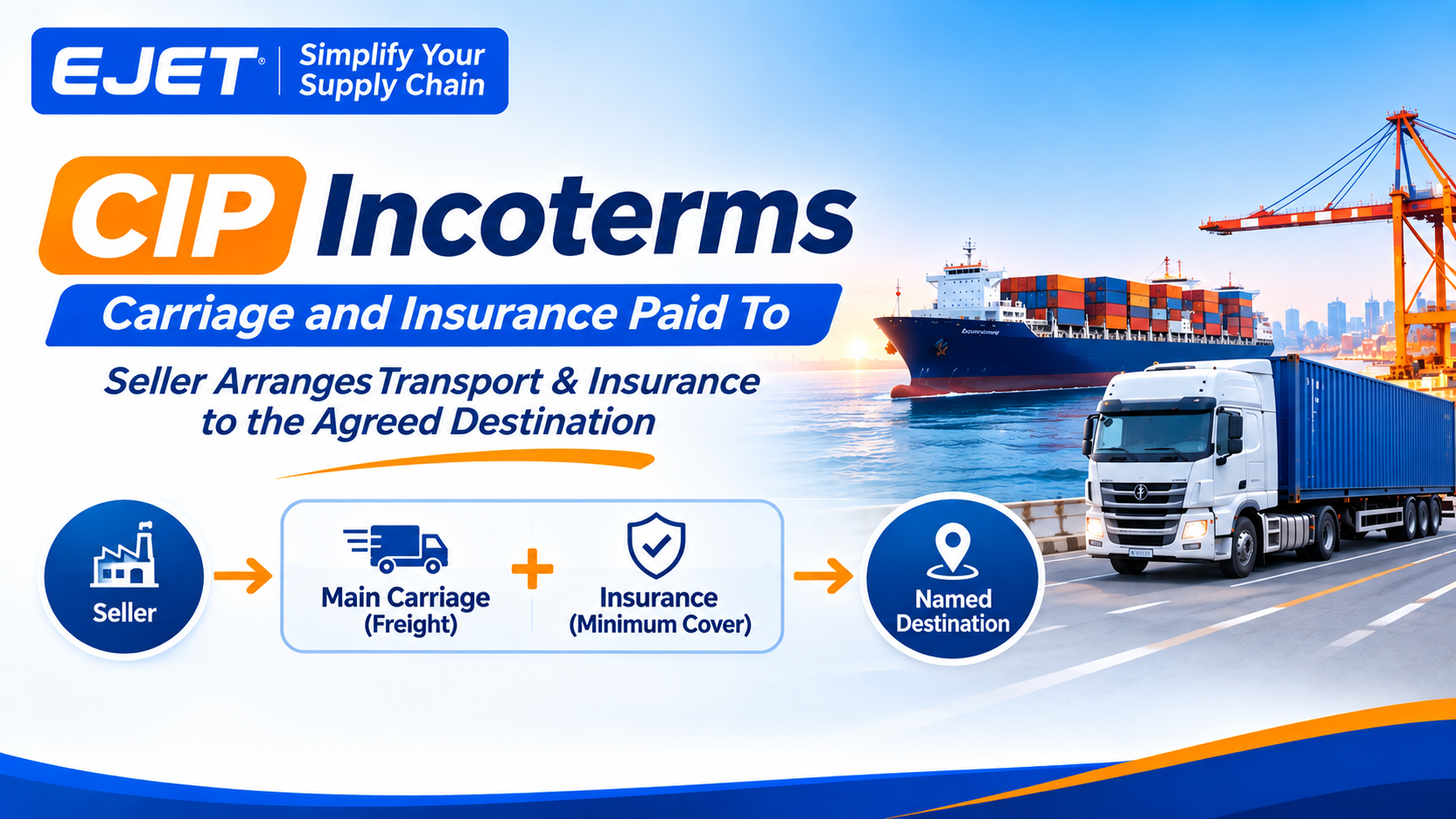
CIP stands for Carriage and Insurance Paid To, an Incoterms® rule under which the seller pays for transportation and cargo insurance to a named destination, while risk normally transfers when the goods are handed to the first carrier.
The distinction matters: paying for the journey does not mean bearing the risk throughout it.
This guide explains CIP shipping terms, insurance requirements, responsibilities, and practical comparisons under Incoterms® 2020.
What are CIP Incoterms, and how do they work?
CIP delivery terms divide transportation costs and transit risk between seller and buyer. The seller arranges carriage and insurance to the agreed destination, but delivery—the event that transfers risk—occurs when the goods are handed to the contracted carrier at the agreed delivery point.
Where several carriers are involved and no specific delivery point is agreed, risk normally passes at handover to the first carrier.
CIP belongs to the International Chamber of Commerce’s Incoterms rules. These rules allocate specified obligations, costs, and risks within a sales transaction; they are not a complete sales contract. Understanding that limited role helps prevent assumptions about what a shipping quotation includes.
Its defining characteristics are:
- Flexible transport: CIP can cover road, rail, air, sea, or a combination of modes.
- Seller-arranged carriage: The seller contracts and pays for transport to the named destination.
- Seller-arranged insurance: Cargo insurance protects the buyer’s transit risk, subject to the policy.
- Separate delivery and destination points: Risk can pass well before the seller-paid journey ends.
Think of CIP as two separate questions: “Who pays for the journey?” and “Who bears accidental loss or damage during it?” The answer can be the seller for freight costs and the buyer for transit risk at the same time. Insurance bridges that separation; it does not move the risk-transfer point to destination.
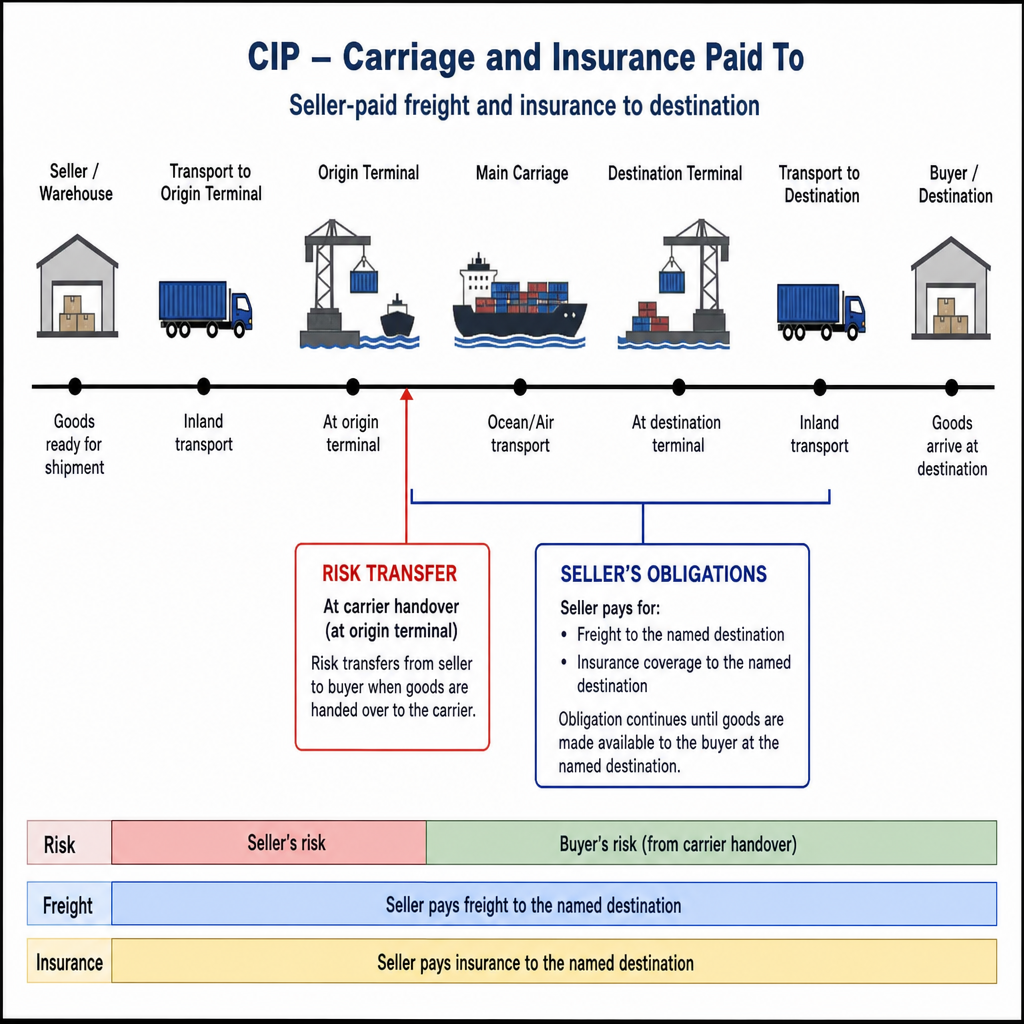
Seller and buyer responsibilities under CIP
A CIP quote should be evaluated as an allocation of responsibilities, not simply a freight-inclusive price. Export clearance generally belongs to the seller, while import clearance and applicable transit customs formalities belong to the buyer. Unloading deserves particular attention because its cost depends on the carriage contract.
|
Responsibility |
Seller |
Buyer |
|---|---|---|
|
Goods and commercial invoice |
Supplies goods and invoice conforming to the sales contract |
Pays the agreed price |
|
Export formalities |
Handles applicable export clearance |
Provides required assistance where applicable |
|
Carriage |
Arranges and pays to the named destination |
Arranges onward transport beyond that destination if needed |
|
Cargo insurance |
Obtains the required cover and evidence of insurance |
Reviews protection and identifies additional needs |
|
Import and transit customs |
Provides required assistance where applicable |
Handles applicable formalities, duties, and taxes |
|
Unloading at destination |
Pays when included in its carriage contract |
Normally pays when not included in seller-paid carriage |
Do not assume unloading is always included or always excluded. If the seller’s carriage contract includes destination unloading costs, the seller cannot normally recover those costs separately from the buyer unless otherwise agreed. Specify the terminal, warehouse, or other endpoint precisely so neither party mistakes a nearby location for the contracted destination.
Risk transfer also does not erase the seller’s other obligations. For example, handing goods to a carrier does not excuse failure to arrange the required through carriage. Evaluate compliance with the transport obligation separately from the question of who bears accidental transit damage.
What insurance does CIP require under Incoterms 2020?
Under Incoterms® 2020, CIP generally requires the seller to obtain cargo insurance complying with Institute Cargo Clauses (A), or similar clauses, unless otherwise agreed or customary in the trade. The insured amount must be at least 110% of the contract price, in the contract currency, and coverage must extend from delivery to at least the named destination. The buyer, or another party with an insurable interest, must be able to claim directly from the insurer.
The abbreviation ICC(A) here refers to Institute Cargo Clauses (A), not the International Chamber of Commerce. These clauses provide broad “all risks” physical loss or damage protection, but that phrase does not mean every loss is insured. Policy exclusions and conditions still matter.
For example, standard exclusions address delay, inherent vice—the goods’ own tendency to deteriorate—and certain insufficient-packing situations. War and strikes protection may require additional cover. A shipment can therefore satisfy the default CIP insurance requirement without protecting every commercial concern the buyer has.
Before shipment, ask for the insurance certificate or policy and check:
- Goods and route: Does the description match the shipment and intended transit?
- Coverage period: Does protection run through the agreed destination?
- Insured amount and currency: Do they satisfy the contract and CIP requirements?
- Exclusions and additional cover: Are cargo-specific risks, war, or strikes addressed where needed?
- Claims access: Who can claim, and what evidence and notification deadlines apply?
Treat this as a document-review checklist, not a substitute for reading the policy. Clarify discrepancies before dispatch rather than assuming the word “insured” settles them.
CIP vs CPT and CIF: the important differences
CIP and CPT share the same basic separation between seller-paid carriage and early risk transfer. The key difference is insurance: CIP requires the seller to arrange cargo cover; CPT does not impose that obligation. A buyer choosing CPT should therefore decide separately how to insure its transit exposure.
|
Feature |
CIP |
CPT |
CIF |
|---|---|---|---|
|
Full name |
Carriage and Insurance Paid To |
Carriage Paid To |
Cost Insurance and Freight |
|
Transport modes |
Any mode or combination |
Any mode or combination |
Sea or inland waterway only |
|
Seller pays main carriage |
Yes |
Yes |
Yes |
|
Seller must arrange insurance |
Yes |
No |
Yes |
|
Default 2020 insurance level |
Institute Cargo Clauses (A) or similar |
No seller insurance requirement |
Institute Cargo Clauses (C) or similar |
|
Normal risk-transfer point |
Carrier handover |
Carrier handover |
Goods placed on board at shipment port |
The Incoterms 2020 CIP insurance ICC(A) versus CIF insurance ICC(C) distinction is about the breadth of cover, not simply whether insurance exists. CIP’s default protection is broader; CIF retains the more limited Clauses (C) baseline. Parties can agree different coverage, so compare actual policies rather than relying only on the three-letter rule.
CIF is not interchangeable with CIP merely because a vessel appears in the route. For multimodal container movements involving handover before vessel loading, CIP is generally the appropriate insured-carriage rule. The delivery arrangement, not just the longest transport leg, should guide the choice.
When does CIP make practical sense?
CIP can suit transactions where the seller can arrange freight and insurance, while the buyer accepts transit risk from the agreed carrier handover. It works across transport modes, including multimodal movements, rather than being restricted to port-to-port shipping. Both parties need to understand that seller-arranged logistics do not amount to seller-held risk until arrival.
These hypothetical examples illustrate the practical distinction:
- Airfreighted equipment: A seller pays carriage and insurance to the destination airport. If the agreed endpoint is that airport, the buyer must plan any onward delivery separately.
- Containerized machinery: Goods travel by truck, vessel, and rail. Without a different agreed delivery point, risk normally passes at the first carrier handover, not vessel loading.
- Warehouse destination: Naming the buyer’s warehouse extends the seller’s carriage obligation there, but does not by itself postpone risk transfer until warehouse arrival.
If the commercial intention is for the seller to retain transit risk until destination, examine an appropriate D-group rule instead. DAP, DPU, and DDP have different unloading and customs allocations, so switching rules requires more than changing three letters on an invoice.
Writing clear CIP terms into the sales contract
Use the format CIP [precise named place of destination] Incoterms® 2020. Separately identify the agreed delivery point where risk transfers, especially when multiple carriers are involved. State the edition explicitly because earlier editions may have different requirements.
A practical contract review should also confirm:
- The exact destination address, terminal, or receiving point.
- The carrier handover point and evidence of delivery.
- Insurance terms and any agreed departures from default coverage.
- Unloading, onward transport, and document requirements.
- Separate provisions for payment, ownership, and dispute resolution.
The central CIP principle is simple: the seller pays carriage and insurance to destination, but risk normally transfers earlier. Keep that distinction visible in the contract, freight instructions, and insurance review.
Frequently Asked Questions About CIP Incoterms
What does CIP stand for and what does it entail?
CIP stands for "Carriage and Insurance Paid To." It is an Incoterm where the seller pays for the transportation and insurance of goods to a specified destination, while the risk is transferred to the buyer when the goods are handed over to the first carrier.
What are the key differences between CIP and CPT?
The main difference between CIP (Carriage and Insurance Paid To) and CPT (Carriage Paid To) is that CIP requires the seller to arrange and pay for insurance during transit, while CPT does not have this obligation. In both cases, risk transfers at the handover to the first carrier.
What types of transportation does CIP cover?
CIP can be used for any mode of transportation, including road, rail, air, sea, or a combination of these modes. This flexibility makes it suitable for various shipping scenarios.
What insurance coverage is required under CIP?
Under Incoterms 2020, the seller is typically required to obtain cargo insurance compliant with Institute Cargo Clauses (A) or similar clauses, covering at least 110% of the contract value and extending to the named destination.
When is it appropriate to use CIP instead of other Incoterms?
CIP is suitable in transactions where the seller can effectively arrange for freight and insurance, and the buyer is willing to take on the risk of loss or damage from the time the goods are handed over to the carrier, typically for multimodal transport scenarios.