


Importing from China can be a smart way to expand product lines, lower unit costs, or source specialized manufacturing, but it works best when you treat it as a structured business process rather than a quick online purchase.
This guide walks through sourcing from China, supplier checks, container shipping, customs documents, taxes for importing from China, and common mistakes to avoid when importing from China to USA.
How do you start importing from China?
Start by defining the product, landed cost, compliance requirements, and supplier standards before you place an order. The simplest answer to how to import from China is: choose a product you can legally sell, verify the supplier, confirm quality before shipment, and prepare the customs paperwork early.
Before you contact factories, write a clear product brief. Include dimensions, materials, packaging, labeling, target quantity, expected certifications, and any performance standards. Vague requests usually lead to vague quotes, and vague quotes create expensive surprises later.
A practical first plan should include:
- Product scope: exactly what you want to import goods from China for, including model, size, color, packaging, and branding.
- Target market: where you will sell the product and what safety, labeling, or agency rules may apply.
- Budget: product cost, samples, inspections, freight, customs duty, taxes, storage, and inland delivery.
- Timeline: sampling, production, quality control, ocean or air freight, customs clearance, and final delivery.
- Risk level: whether the product is regulated, fragile, seasonal, customized, or costly to replace.
This planning stage is also where many buyers discover that the cheapest supplier is not always the best supplier. A slightly higher unit price may be worthwhile if the factory communicates clearly, understands export documentation, and can meet your quality requirements consistently.

Strong sourcing decisions reduce costly surprises
Good china sourcing tips begin with supplier verification. A polished product listing is not proof that a supplier can manufacture your item, meet your specifications, or support repeat orders.
Ask direct questions about factory location, export experience, minimum order quantity, production capacity, lead times, quality control steps, and whether they are a trading company or manufacturer.
When sourcing from China, compare at least a few suppliers rather than rushing into the first attractive quote. Look for consistency in answers. If one supplier quotes far below the others, ask what is different: material grade, packaging, tolerance, testing, warranty, or shipping terms.
Useful supplier checks include:
- Request business and export details. Ask for the company name, address, license information, and references from similar products.
- Order samples before production. A sample helps you test material, finish, function, packaging, and labeling.
- Confirm specifications in writing. Use drawings, photos, tolerances, and packaging instructions instead of relying on casual chat messages.
- Use inspections when risk is meaningful. Pre-production, during-production, and pre-shipment inspections can catch issues before cargo leaves China.
- Avoid paying everything upfront. Many buyers use staged payments, such as a deposit and balance after inspection, but terms should match supplier trust and order risk.
These steps are not just for large companies. Small importers benefit even more because one failed shipment can consume cash, time, and customer trust.
What documents do you need to import goods from China?
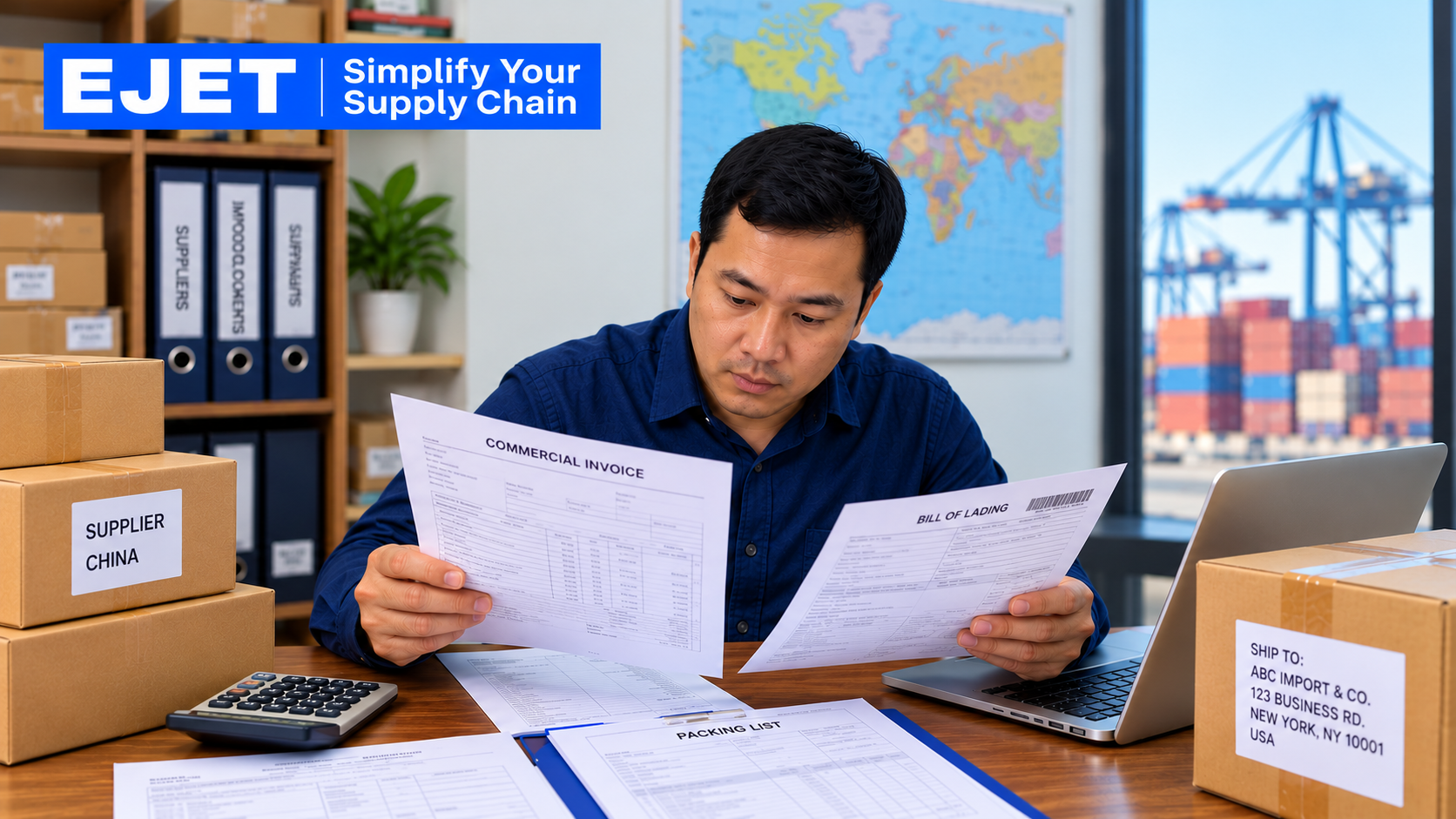
For most shipments, you need a commercial invoice, packing list, bill of lading or airway bill, customs entry documents, and any product-specific permits or certificates. CBP says invoices for entry should include an adequate merchandise description, quantities, values, and the appropriate eight-digit HTSUS subheading when required.
Documents are the language of international trade. If they are incomplete or inconsistent, your shipment can be delayed, examined, or assessed incorrectly. The product name on the invoice should match the packing list and shipping documents. Values should be accurate, and the country of origin should be clear.
Common documents include:
- Commercial invoice: seller, buyer, product description, value, currency, origin, and terms of sale.
- Packing list: carton count, weights, dimensions, and item quantities.
- Bill of lading or airway bill: transportation document issued for ocean or air freight.
- Arrival notice: sent by the carrier or freight forwarder when cargo is nearing destination.
- Entry summary: used for formal customs entry.
- Customs bond: often needed for formal commercial entries.
- Product certificates: may be needed for regulated goods, depending on the product.
CBP notes that many commercial shipments for resale are formal consumption entries requiring an entry summary and a customs bond, while informal entries generally apply to lower-value shipments under certain conditions.
If you are new to importing goods from China, a licensed customs broker can help classify the product, prepare entry documents, and coordinate duty payment.
Duties, taxes, and fees need early calculation
Many beginners focus on the factory price and forget the landed cost. Landed cost is the total cost to get the product to your warehouse or customer-ready locati0n. It includes product price, inland freight in China if applicable, export handling, ocean or air freight, insurance, U.S. port fees, customs duty, user fees, brokerage, inspections, storage, and final delivery.
The duty rate depends heavily on product classification under the Harmonized Tariff Schedule. CBP explains that the HTS provides duty rates for imported goods, and CBP administers and enforces the tariff at entry.
For importing from China to USA duty planning, do not guess based on a similar product name. A small classification difference can change the rate or trigger special requirements.
CBP also collects certain user fees. For formal entries, the Merchandise Processing Fee is assessed as a percentage of merchandise value, subject to a minimum and maximum, and ocean cargo may also be subject to Harbor Maintenance Fee.
Some goods may have federal excise taxes or other agency requirements, depending on the commodity.
China-origin products may also be affected by trade remedies such as Section 301 tariffs. USTR maintains China Section 301 tariff action and exclusion information, and it has stated that existing Section 301 tariffs on China vary by product. Because rates and exclusions can change, confirm the current HTS code, country of origin, and applicable additional duties before you approve production.
Shipping methods should match your margin and timeline
Air freight is faster, but it usually costs more per unit. Ocean freight is slower, but it is often the practical choice for bulky, heavy, or lower-margin products. Express courier can work for samples or small parcels, but it may not be economical for ongoing commercial importing.
If you are learning how to import containers from China, understand the difference between LCL and FCL. LCL, or less-than-container load, means your cargo shares container space with other shipments. FCL, or full-container load, means the container is booked for your shipment, even if you do not fill every inch.
Consider these shipping factors before booking:
- Cargo volume and weight: determine whether air, LCL, or FCL makes sense.
- Product fragility: affects packaging, palletizing, insurance, and inspection needs.
- Seasonality: holidays, port congestion, and peak shipping periods can affect timing.
- Incoterms: define who pays for freight, insurance, export handling, and risk at each stage.
- Destination plan: decide whether cargo goes to a port, warehouse, fulfillment center, jobsite, or customer.
For ocean cargo headed to the United States, Importer Security Filing, also called ISF or 10+2, must generally be submitted to CBP no later than 24 hours before cargo is loaded on the vessel bound for the U.S.; inaccurate, incomplete, or late filing can lead to penalties.
This is one reason importers often coordinate with a freight forwarder and customs broker before the shipment leaves China, not after it arrives.
Import regulations vary by product
Import regulations China-related searches often lead buyers to think there is one universal checklist. In reality, the rules depend on what the product is, what it is made of, how it will be used, and whether another U.S. agency regulates it. Toys, electronics, food-contact items, cosmetics, medical products, textiles, batteries, wood products, and vehicles can all involve different requirements.
Do not rely on the supplier’s statement that “many customers import this.” Your business is responsible for what it brings into the country. Ask your customs broker, compliance consultant, or relevant agency about labeling, testing, admissibility, and documentation before production begins.
A simple compliance review should ask:
- Is the product allowed for import into the destination country?
- Which HTS code applies?
- Are there anti-dumping, countervailing, Section 301, or other additional duties?
- Does a U.S. agency such as FDA, EPA, DOT, FCC, USDA, or CPSC have rules for this product?
- Are there labeling, safety testing, packaging, or certificate requirements?
- Does the product include batteries, chemicals, wood, food contact materials, or wireless components?
- Are trademarks, patents, or copyrighted designs involved?
This review is especially important for customized goods. If you add a logo, change materials, or modify electrical components, the compliance profile may change.
Special cases require extra caution
Some imports are more complex than standard consumer goods. For example, importing homes from China may involve prefabricated homes, modular units, building materials, or container-style structures.
The purchase may look like a product order, but the real project includes customs clearance, freight, cranes or heavy transport, local permits, engineering requirements, utility connections, inspections, and state or municipal building codes.
Large equipment, furniture, fixtures, and construction components also need careful packaging and damage planning. A low product price can disappear quickly if cargo arrives warped, missing parts, noncompliant, or difficult to unload. Before placing this type of order, confirm drawings, materials, certifications, replacement-part availability, and who is responsible if parts are damaged in transit.
The same caution applies to branded goods. If a supplier offers famous-brand products at unusually low prices, treat that as a major warning sign. Importing counterfeit or infringing products can lead to seizure, penalties, and reputational damage.
A practical ordering workflow keeps the process manageable
People often search for “how to order to china imported products,” but the better question is how to build a repeatable ordering workflow. A clear process helps you avoid rushed decisions and gives suppliers fewer opportunities to misunderstand your expectations.
Use this sequence for a first commercial order:
- Research the product and market. Confirm demand, price range, competition, and compliance risk.
- Estimate landed cost. Include duty, taxes, freight, fees, inspections, storage, and returns.
- Shortlist suppliers. Compare communication, samples, capabilities, and export experience.
- Approve a sample. Keep one approved sample as a reference for production quality.
- Confirm purchase terms. Define specifications, Incoterms, payment schedule, lead time, inspection rights, and packaging.
- Arrange freight and customs support. Choose a forwarder and broker before goods are ready.
- Inspect before shipment. Check quantity, workmanship, labeling, packaging, and carton marks.
- File required documents. Prepare invoice, packing list, ISF when applicable, entry documents, and product certificates.
- Track arrival and clearance. Respond quickly to broker or CBP questions.
- Review the shipment. Record defects, delays, unexpected fees, and improvements for the next order.
This workflow works whether you import small wholesale goods or larger container shipments. Over time, the goal is not just to buy cheaper; it is to make importing predictable.
Common mistakes new importers can avoid
The most common mistake is treating the supplier quote as the total cost. Another is waiting until cargo is already on the water to ask about duty, documents, or product restrictions. At that point, your options are limited and storage or delay costs can grow quickly.
Avoid these problems whenever possible:
- Unclear specifications: leads to wrong materials, dimensions, packaging, or colors.
- No sample approval: makes quality disputes harder to resolve.
- Wrong HTS classification: can affect duty, taxes, and admissibility.
- Ignoring added tariffs: may destroy profit margins.
- Weak packaging: increases damage risk during long transit.
- No inspection: defects may not be discovered until after customs clearance.
- Poor cash planning: deposits, freight, duty, and final delivery may come due close together.
- Assuming personal and commercial imports are the same: commercial resale goods often carry more formal entry obligations.
CBP says there is no legal requirement to hire a customs broker, but it also notes brokers are licensed to conduct CBP business on behalf of importers and can take on paperwork and bond tasks.
For many first-time importers, that support is worth considering.
Final takeaway
Importing from China can be profitable, but it rewards preparation more than speed. Define the product clearly, verify the supplier, calculate the full landed cost, understand taxes for importing from China, and confirm import regulations before production starts.
If you are importing from China to USA for the first time, begin with a manageable order and build a process you can repeat. The best importers do not simply find cheap products; they create reliable systems for sourcing, quality control, shipping, customs compliance, and long-term supplier relationships.
Frequently Asked Questions About Importing from China
What are the essential steps to start importing from China?
To start importing from China, define the product you want to import, verify the supplier, prepare all necessary documents, calculate the total landed cost, and understand the applicable import regulations.
What documents do I need to import goods from China?
Common documents required include a commercial invoice, packing list, bill of lading or airway bill, customs entry documents, and any product-specific permits or certificates that may apply.
How do I calculate the landed cost of imported products?
The landed cost includes the product price, freight costs, export handling fees, customs duties, taxes, insurance, and any other fees related to getting the product to your warehouse or customer-ready locati0n.
What are the common mistakes to avoid when importing from China?
Common mistakes include unclear product specifications, not approving samples, incorrect HTS classification, ignoring added tariffs, and poor cash flow planning.
Is it necessary to hire a customs broker when importing from China?
While there is no legal requirement to hire a customs broker, it is highly recommended, especially for first-time importers, as they can assist with paperwork, duty payment, and regulatory compliance.