Importing toys from China means selecting products, verifying suppliers, meeting destination-market safety requirements, and arranging customs clearance before selling.
This article explains how to move from a product idea to a controlled first shipment, with particular attention to importing into India.
The starting point is not the cheapest quotation: it is confirming that your chosen toy and manufacturing facility qualify for your market.
What do you need before importing toys from China?
Before you import toys, you need a defined product specification, a verified supplier, a destination-specific compliance plan, and a realistic landed-cost calculation. You should also identify who will handle testing, shipping, customs declarations, and product records.
Treat these as purchasing prerequisites rather than tasks to resolve after production begins.
Start with a narrow product range. Instead of requesting an entire catalog, choose a small group of toys aimed at a clearly defined customer and sales channel. A retailer selling preschool puzzles needs a different buying brief from a distributor supplying electronic activity toys.
Prepare a sourcing brief covering:
- Customer and age group: Intended users, play patterns, and the evidence supporting the proposed age grading.
- Product details: Materials, dimensions, components, colors, functions, and included accessories.
- Sales destination: Every country where you intend to offer the product.
- Commercial requirements: Initial quantity, packaging, customization, delivery locati0n, and target selling price.
- Compliance evidence: The destination-specific licenses, testing, labeling, and records your advisers identify as applicable.
Use this same brief with every candidate. Otherwise, you may compare a basic stock item against a customized, retail-ready product without recognizing the difference.
Choose products around compliance and commercial fit
Evaluate Chinese toys as individual products, not as a single quality category. Your purchasing decision should depend on the exact design, manufacturing controls, supporting evidence, and economics of the item you intend to sell.
For a first order, consider prioritizing products whose construction you can describe and inspect clearly. Ask your testing laboratory to assess potential hazards before approving the design, particularly where magnets, small components, batteries, cords, or projectiles are involved.
CPSC toy guidance identifies product-specific requirements alongside generally applicable toy-safety provisions, illustrating why one testing checklist does not suit every toy.
Build a product-selection worksheet with three decisions: whether the item can qualify for your destination, whether the supplier can reproduce it consistently, and whether the economics leave enough room for selling costs. Reject products that fail any one of these checks, even if their appearance or quoted price is attractive.
For established toy brands, request written evidence that the supplier can provide the branded goods through an authorized channel. For private-label products, make design ownership, artwork permissions, and any tooling arrangements part of your supplier review. Do not treat a familiar character printed on a sample as proof of permission.
Find suppliers through a documented sourcing process
Searches such as “wholesale toys China” can help build an initial supplier list, but your next step should be a structured request for information. Ask each candidate to identify its legal business name, manufacturing locati0n, product specialization, and role in the transaction.
Decide whether you want a factory, a trading company, or a sourcing agent. Rather than assuming one model is always better, compare the responsibilities each candidate will accept. Your evaluation should make clear who manufactures the toys, who signs the contract, who receives payment, and who resolves defects.
Use Yiwu for product discovery
Yiwu toys are worth investigating when you want to explore multiple product styles in a wholesale-market setting. Yiwu International Trade Mart’s District 1 lists toys among its first-floor product categories. Use the market as a discovery channel, then conduct separate checks on the seller and the actual manufacturing facility.
When discussing an item with a market seller, request a model reference, factory details, available compliance documents, and a written quotation. Photograph the product and its packaging with permission, and connect those images to the quotation. This creates a reference trail when several products look similar.
Compare suppliers on the same evidence
Send shortlisted toy companies an identical information request. Ask for a sample quotation, minimum order requirements, packaging options, production milestones, and documents relevant to your destination. Record unanswered questions rather than filling the gaps with assumptions.
Avoid choosing on responsiveness alone. A quick reply is useful, but your approval should depend on whether the candidate provides verifiable information and accepts clear product, inspection, and documentation requirements.
Verify the business and the manufacturing site
Before paying a deposit, assemble a supplier file containing the business registration details, factory address, contact information, proposed contract, and payment beneficiary. Review any mismatch between the seller, manufacturer, and account holder. Ask for a documented explanation before proceeding.
Arrange a factory assessment appropriate to the order’s risk. Give the assessor specific questions: where the product will be made, which processes are subcontracted, how materials are identified, and how production records connect to finished batches. Request evidence rather than a general statement that the factory has “good quality.”
Review test reports with the laboratory or compliance specialist. Check the named product, model, materials, photographs, manufacturer, standards, and report authenticity. Ask whether the evidence supports your exact proposed product and destination, not simply whether the document looks official.
For India, factory identity is especially important: BIS explains that a toy license is granted to a manufacturer for specific manufacturing premises, rather than to a marketing or distribution business. Do not assume a trader’s documents authorize production at a different facility.
How do you import toys from China to India legally?
To import toys from China to India legally, first establish that the actual foreign manufacturing facility holds the applicable valid BIS license and that your intended toys are covered.
Then confirm your importer registration, customs classification, labeling, and shipment documentation. Do not place a commercial order on the assumption that a laboratory report alone will satisfy India’s compulsory certification requirements. BIS states that products covered by relevant Quality Control Orders require the Standard Mark under a valid license.
Check BIS eligibility before negotiating an order
India’s Toys (Quality Control) Order requires covered toys to conform to the corresponding Indian Standards and bear the Standard Mark under a BIS license. BIS identifies foreign manufacturers as applicants under its Foreign Manufacturers Certification Scheme. This makes factory eligibility an early purchasing decision, not a port-clearance formality.
Request the license number and verify its status, manufacturing address, applicable standards, and coverage through BIS. Have a qualified adviser confirm that the intended product falls within the licensed scope. If you cannot establish eligibility for the chosen factory and toy, stop the order rather than relying on a promise to arrange certification later.
BIS guidance distinguishes electric and non-electric toys for licensing purposes. Give your adviser the full product specification, including every powered function, so the review addresses the correct category.
Prepare the importer and retail packaging
DGFT states that an Importer-Exporter Code, or IEC, is mandatory for imports unless a specific exemption applies. Its listed core import documents include the transport document, commercial invoice with packing list, and Bill of Entry. Product-specific requirements can add further documentation.
Before printing packaging, obtain a review of the applicable Legal Metrology declarations. Government guidance lists requirements including manufacturer or importer details, country of origin, product identity, quantity, maximum retail price inclusive of taxes, and consumer-care information for covered retail packages. Treat these as a starting point for reviewing the complete artwork, not an exhaustive label template.
For the import of toys from China to India, ask your customs broker to confirm the current product-specific policy conditions before shipment. DGFT’s general import notes expressly direct toy and doll imports to the BIS-related conditions in Chapter 95. (content.dgft.gov.in)
Match safety evidence to every destination market
Do not build a global sales plan around one supplier certificate. Create a separate compliance file for each destination and ask an appropriate specialist to identify the applicable standards, testing, certification, marking, and importer obligations.
For the United States, CPSC guidance explains that toys intended primarily for children aged 12 or younger generally require applicable testing by a CPSC-accepted third-party laboratory and certification through a Children’s Product Certificate. Other requirements can include lead, phthalates, small-parts provisions, and tracking labels, depending on the product.
Use that distinction to guide supplier discussions. Ask for the exact evidence your market requires rather than requesting an undefined “international toy certificate.” Have the laboratory explain which parts of an existing report are relevant and what additional work is necessary.
Include change control in your compliance plan. For example, CPSC states that changes to design, manufacturing processes, or component sourcing that could affect compliance can trigger material-change testing and a new certificate. Require suppliers to disclose proposed changes before implementing them.
Turn samples into a production specification
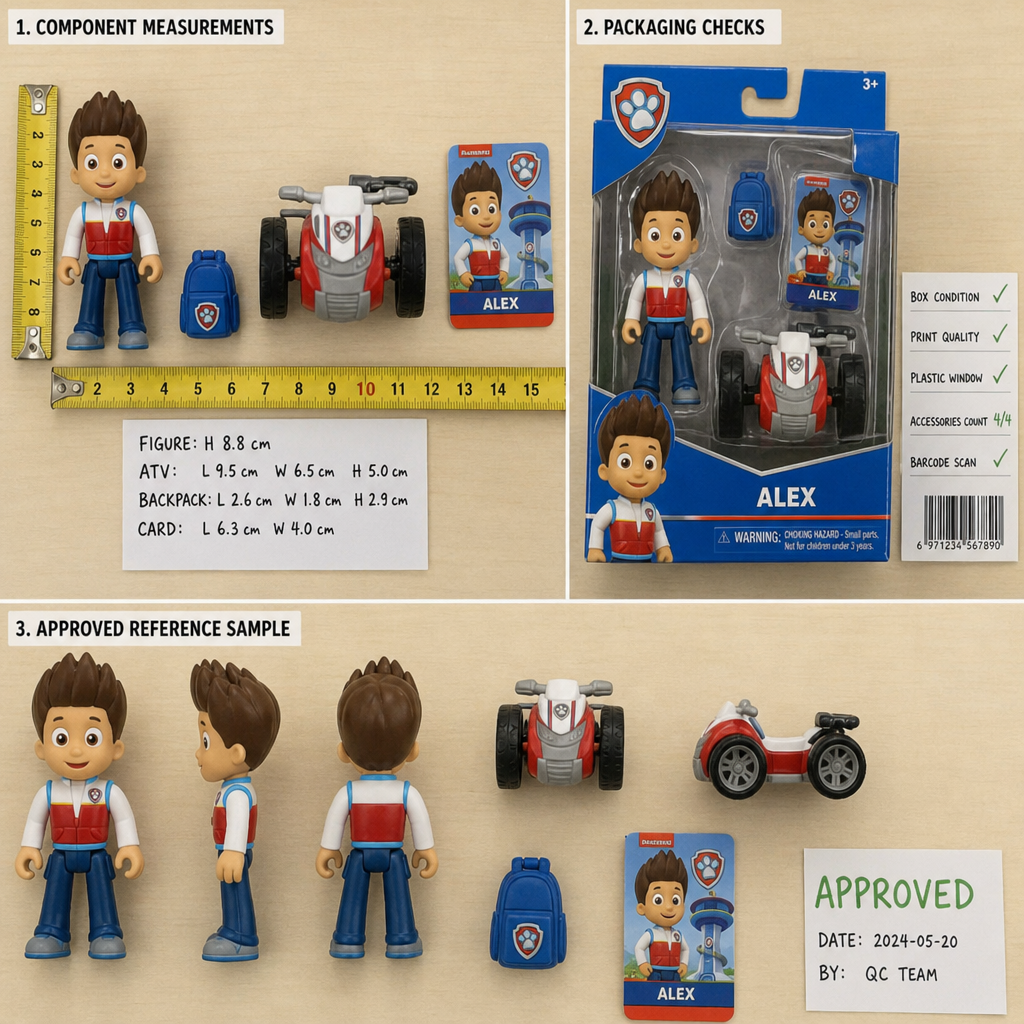
Use samples to settle the product definition before authorizing production. Request a sample matching the proposed materials, components, functions, and packaging, then record every approved detail. If the sample differs from the intended commercial product, list those differences explicitly and require another approval where necessary.
Keep a dated reference sample and an illustrated specification. Together, they should tell the factory and inspector what to check without relying on phrases such as “standard quality” or “same as discussed.” Ask the supplier to acknowledge both documents in writing.
Your approval checklist should cover:
- Construction: Dimensions, assembly, component attachment, seams, edges, and moving parts.
- Function: Controls, mechanisms, included accessories, and the expected operating sequence.
- Appearance: Agreed colors, printing, surface finish, and acceptable cosmetic variation.
- Packaging: Product protection, instructions, warnings, barcode placement, and carton identification.
- Traceability: Model references and batch identifiers connecting the goods with production records.
Separate your commercial inspection criteria from the laboratory’s compliance assessment. Passing your appearance checklist is not a substitute for the testing or certification required by the destination. Use production-representative samples as directed by the laboratory; CPSC’s guidance, for example, emphasizes representative sampling for periodic testing.
What is the import duty on toys from China to India?
The import duty on toys from China to India must be checked against the exact tariff classification, origin, customs value, and applicable notifications for the shipment. Do not treat a single percentage quoted for “toys” as a reliable total tax estimate. Use ICEGATE’s official import-duty enquiry system and have your customs broker confirm the calculation before committing to an order.
Give the broker a complete description rather than a catalog category: what the item does, how it operates, its materials, intended use, and included components. Ask for the proposed tariff code and the basis for selecting it. Resolve classification uncertainty before treating the cost estimate as final.
Your costing sheet should separate basic customs duty, any applicable surcharge, import IGST, and other applicable charges. Ask the broker to show the calculation sequence and identify the notifications used. ICEGATE provides the official enquiry route; your shipment-specific review should establish which entries apply.
Next, build the full landed-cost budget. Landed cost includes more than the supplier price: the U.S. International Trade Administration identifies freight, insurance, tariffs, taxes, and other fees among its components. Add your own testing, inspection, customization, and delivery costs to the purchasing worksheet.
For internal planning, calculate both total shipment cash outlay and cost per saleable unit. Ask your accountant how any recoverable import tax should be treated rather than automatically counting every payment as a permanent expense. Then test whether your selling price still supports marketplace fees, fulfillment, returns, advertising, and your required margin.
Put responsibilities and payment milestones in writing
Convert the accepted quotation into a purchase agreement that identifies the parties, factory, products, quantities, specifications, and packaging. Attach the approved sample references and inspection criteria. Ask an appropriately qualified adviser to review important contractual provisions rather than assuming a purchase-order template protects every interest.
Make the agreement address:
- Production approval: What must be accepted before manufacturing starts.
- Change control: Which substitutions require written permission and compliance review.
- Inspection access: Who can inspect, when, and against which criteria.
- Defect handling: How rework, replacement, rejection, or other remedies will be determined.
- Payment milestones: Which documents and approvals are required before each payment.
- Shipment release: Who authorizes dispatch after inspection and documentation review.
Include the selected Incoterms rule, named place, and version. ICC explains that these rules allocate buyer and seller obligations, costs, and the point of risk transfer. Review those allocations with your freight forwarder instead of assuming a term simply means “shipping included.”
Keep payment instructions under a separate verification procedure. If the beneficiary or bank account changes, pause and independently confirm the request through a previously established contact. Make that check part of your purchasing workflow, especially when several organizations are involved.
Plan shipping around the complete shipment
Obtain transport quotations only after you have realistic packed dimensions, weights, carton counts, and the proposed collection and delivery points. Ask forwarders to quote the same scope. Your comparison should identify which origin, destination, clearance, storage, and final-delivery charges remain outside the quoted price.
Request suitable options for the order rather than choosing a mode automatically. Ask the forwarder to compare air, courier, or sea transport where appropriate, explaining both cost and schedule assumptions. Give the provider full details of batteries, liquids, or other components that may affect shipment acceptance.
Build a schedule backward from the date you need saleable inventory. Include sample approval, compliance work, production, inspection, corrections, transport, and clearance. Ask each provider to identify dependencies and leave room for unresolved issues rather than promising customers a delivery date based only on transit time.
Before booking, confirm the cargo-insurance arrangement and claims process. Check who bears transit risk under the agreed trade term and whether the proposed cover matches that exposure. ICC’s guidance makes clear that the allocation of costs, risk, insurance obligations, and customs responsibilities depends on the selected rule.
Inspect the shipment and review documents before dispatch
Give your inspector the final specification, approved sample reference, packing requirements, and a written reporting brief. Ask for clear photographs and results tied to the selected cartons or units. Agree beforehand how a failed inspection will be handled and who authorizes a reinspection.
Keep the inspection focused on evidence. Request checks of quantities, model assortment, functions, workmanship, packaging, and required markings. Where a finding could affect safety or compliance, refer it to the laboratory or adviser rather than treating it as a cosmetic concession.
Arrange a pre-dispatch document review with your broker. For India, start with DGFT’s core document requirements, then add the BIS and other product-specific evidence the broker identifies. Check that descriptions, quantities, model references, parties, and shipment details agree across the file.
Use a final release checklist:
- Required compliance evidence has been verified for the exact goods.
- Inspection results meet the agreed acceptance criteria.
- Any corrective work has been documented and accepted.
- Packaging and label artwork match the approved versions.
- Shipping instructions, insurance, and customs documents have been reviewed.
- A named person has authorized dispatch.
After arrival, reconcile received quantities and condition against the shipment records. Retain the supplier, production, inspection, and compliance file together so you can investigate a complaint without reconstructing the purchase from scattered messages.
Build a repeatable importing process
Learning how to import toys from China is ultimately about controlling decisions in the right order: establish eligibility, verify the supplier, approve the product, confirm the economics, and release only an acceptable shipment.
Start with a manageable order and use what you learn to improve the next specification, inspection brief, and cost forecast. For India-bound toys, keep factory-level BIS verification ahead of price negotiation and production approval. A low quotation is not a buying opportunity until the product can be imported, sold, and supported responsibly.
Frequently Asked Questions About Importing Toys from China
What are the common import duties on toys from China to India?
Import duties vary based on the specific classification of toys. It's essential to check the latest tariff rates through ICEGATE or consult a customs broker for accurate calculations.
How do I ensure my toys meet safety standards?
To ensure compliance, verify that the toys adhere to destination-specific safety regulations, obtain necessary certifications, and conduct tests through accredited laboratories.
What documentation do I need to import toys?
Key documents typically include the Importer-Exporter Code (IEC), commercial invoice, packing list, Bill of Entry, and product-specific compliance documents.
How can I verify a toy supplier’s reliability?
Conduct background checks on the supplier, request business registration details, assess their manufacturing capabilities, and seek references from previous clients.
What are the steps to calculate landed costs for imported toys?
Landed costs include the supplier price, shipping fees, insurance, customs duties, and other associated fees. Be sure to account for all costs involved in bringing the product to your locati0n.