



Importing goods from China to Mexico requires more than finding a supplier and booking transport. You need to confirm the product’s classification, establish importer eligibility, meet applicable trade regulations, and prepare documents for customs clearance.
This article explains how to import from China to Mexico, with practical checkpoints for sourcing, shipping, budgeting, and delivery. Confirm product-specific obligations with a Mexican customs professional before committing funds.
What do you need to import from China to Mexico?
For a typical commercial import, you need an eligible importer registered with Mexico’s tax authority, SAT; the correct tariff classification; compliant merchandise; and supporting customs documents.
Businesses generally need enrollment in the Padrón de Importadores, while certain goods also require registration in specific sectors. Exceptions exist, so establish the correct route for your shipment rather than assuming every purchase follows identical rules.
SAT’s published registration conditions include an active RFC tax registration, a valid e.firma electronic signature, compliant tax obligations, an acceptable fiscal-address status, and a validated Buzón Tributario. The importer must also arrange appropriate customs representation. Complete these checks before cargo leaves China, not when it reaches the destination terminal.
Clarify whether you are importing permanently for sale or use in Mexico, or temporarily under an applicable arrangement. These are different customs regimes, not interchangeable shipping options. This article focuses on ordinary permanent commercial imports; temporary imports require separate planning.
Your first action should be to send a Mexican customs broker or agency a product dossier: photographs, technical specifications, materials, intended use, quantities, supplier details, and expected value. Ask for a written assessment before paying a production deposit.
Classify the product before negotiating the order
Mexico identifies merchandise through an eight-digit tariff fraction and an additional two-digit commercial identification number, or NICO. Have the Mexican classification confirmed independently rather than treating the supplier’s export code as a complete destination-country classification.
Classification helps identify applicable duties and non-tariff requirements. Those requirements may involve permits, safety standards, labeling, sanitary controls, or other restrictions. Mexico’s SNICE resources provide a starting point for investigating the obligations attached to your merchandise.
Request a compliance review covering:
- Import eligibility: Whether the goods are permitted and which authorizations apply.
- Standards: Whether relevant Normas Oficiales Mexicanas, or NOMs, require certification or other evidence.
- Labeling: Required language, content, and the permitted compliance procedure.
- Trade remedies: Whether the product falls within a resolution imposing additional duties.
- Importer registration: Whether a sector-specific enrollment is necessary.
Do not assume labeling can always be corrected after arrival. SNICE describes different compliance arrangements, including specified procedures involving inspection units or authorized facilities. Agree on the applicable method before production so packaging and documentation support it from the outset.
Verify the supplier and define acceptance standards
Treat supplier verification as a separate task from price negotiation. A background check helps establish whether a potential partner exists and identify warning signs, but preliminary checks do not replace deeper due diligence.
Ask for the supplier’s registered business name, registration documents, production address, and banking details. Independently verify unexplained differences between the contracting company and payment beneficiary. If the seller is a trading company, establish who manufactures the goods and who handles quality disputes.
Before ordering, create a specification sheet covering materials, dimensions, performance, packaging, labeling, and acceptable defects. Approve a sample against that sheet rather than relying on photographs alone. For repeat production, keep an approved reference sample and require written approval for substitutions.
Consider an independent pre-shipment inspection, particularly when an order is difficult to rework after delivery. Define what the inspector should examine and what happens if the goods fail. Put remedies, payment milestones, and responsibility for corrective work into the purchase agreement.
For your first China imports, consider a manageable pilot order. Use it to test product quality, document accuracy, and delivery coordination before increasing exposure.
Choose shipping around the complete delivery journey
Shipping from China should be planned around shipment size, urgency, packaging, handling requirements, and the final destination. Compare the complete movement to your warehouse, not merely the international freight charge. Mexico’s import guidance identifies these factors as central to choosing transport.
|
Option |
Suitable use |
What to evaluate |
|---|---|---|
|
Ocean FCL |
Orders using a dedicated container |
Total container cost and delivery arrangements |
|
Ocean LCL |
Smaller orders sharing container space |
Consolidation charges and destination handling |
|
Air freight |
Urgent or high-value shipments |
Speed against the higher transport expense |
LCL means less-than-container load; FCL means full-container load. A dedicated container can still be worth comparing before you have enough merchandise to fill it, so request both quotations when shipment size makes either plausible.
Air freight is suited to urgent movements, but its cost must be justified by the shipment’s commercial needs.
Ask freight forwarding providers to quote the same cargo dimensions, weight, collection point, destination, and service scope. Quotes depend on these inputs, transport mode, and additional services; inconsistent requests make comparisons unreliable.
Request separate milestones for cargo readiness, departure, arrival, customs release, and warehouse delivery. Use these dates to build a working schedule, with contingency time rather than an unsupported fixed delivery promise.
Make delivery responsibilities explicit
Record the agreed Incoterms® rule, named place, and version in the purchase contract. These rules allocate delivery responsibilities, costs, and risks between buyer and seller. They do not eliminate the need to confirm how local customs requirements will be fulfilled.
Be especially careful with Delivered Duty Paid, or DDP offers. Under DDP, the seller is responsible for import clearance and applicable import duties and taxes, but national regulatory requirements can complicate that arrangement. Confirm the legal importer and customs process instead of relying on an “all-inclusive” description.
Ask the seller and logistics provider to identify:
- Who contracts each transport leg and handles cargo claims.
- Who pays destination charges and unexpected storage costs.
- Who appears as importer on the customs declaration.
- Which customs and payment records you will receive.
Require written answers before accepting the quotation. If responsibilities remain unclear, resolve them before shipment.
How much does importing from China to Mexico cost?
The cost is the merchandise price plus transport, insurance, applicable duties and taxes, compliance expenses, customs services, destination handling, and final delivery. There is no reliable universal percentage to add to every order: tariff treatment and regulatory costs depend on the merchandise and applicable measures.
Build a landed-cost worksheet with these lines:
- Supplier price and any separately charged packaging.
- Collection, export handling, international freight, and insurance.
- Testing, certification, labeling, and permit expenses where applicable.
- Import duties, trade-remedy duties, taxes, and customs processing charges.
- Broker fees, terminal handling, storage allowance, and inland delivery.
- Inspection costs and a contingency reserve.
- Ask your broker to calculate the customs value rather than assuming it equals the invoice total.
- Mexican customs law provides for adjustments that can include relevant freight, insurance, packaging, and other specified costs.
- Avoid counting an expense twice when it is already included in the supplier’s price.
Mexico’s general VAT rate is 16%, although product-specific treatment and exemptions must be checked. For taxable imports of tangible goods, the VAT base generally includes customs value plus import duty and other applicable import contributions and charges. Ask your accountant to distinguish the cash needed at import from any VAT credit you may legally claim later.
Check trade remedies separately. The scope of the relevant resolution matters, not just the tariff number on a quotation.
Prepare documents before the goods depart
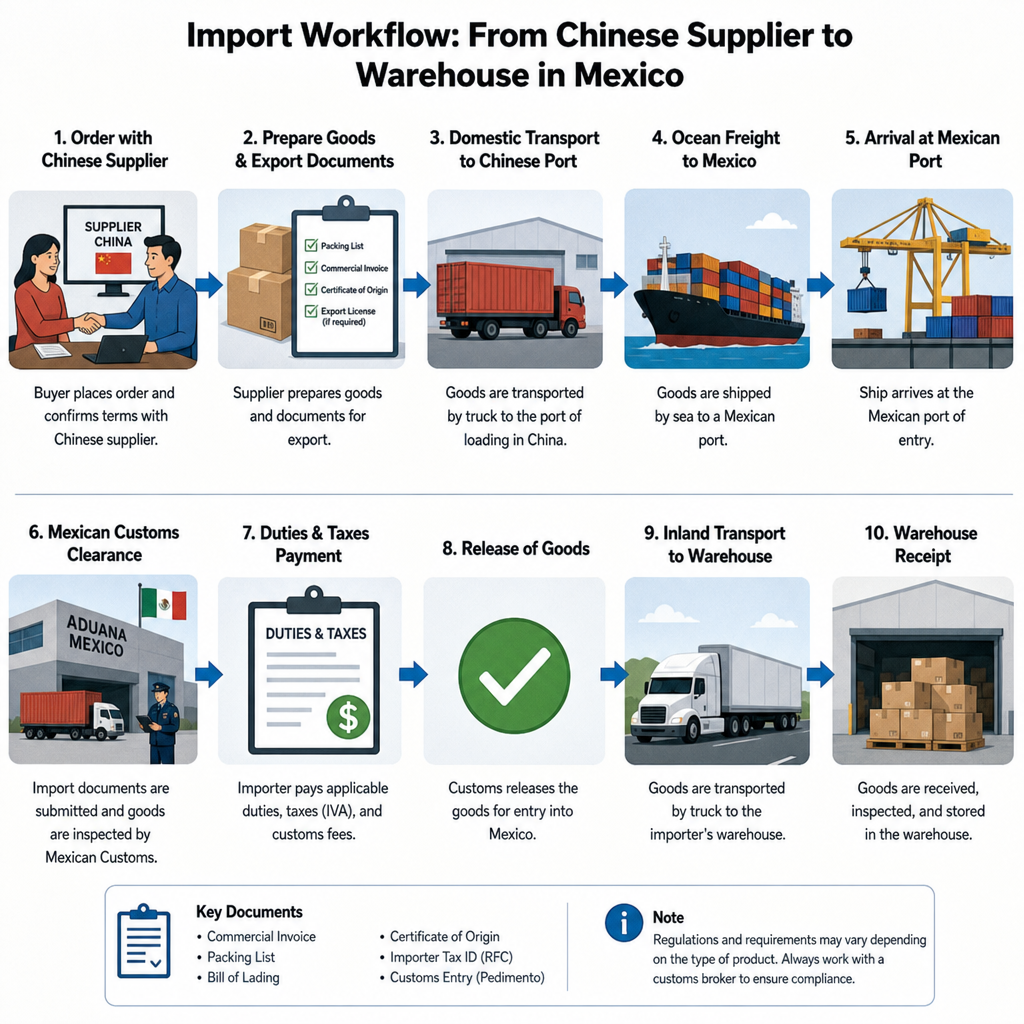
For ordinary commercial imports, the pedimento is the electronic customs declaration. Supporting information addresses value, transport, regulatory compliance, and origin where relevant. Your broker should specify the exact electronic submissions and evidence required for your operation.
Prepare a shared shipment file containing:
- Commercial invoice: Detailed goods descriptions, quantities, prices, currency, and transaction parties.
- Packing list: Carton identifiers, contents, weights, and dimensions.
- Transport document: Bill of lading for ocean freight or air waybill for air cargo.
- Compliance evidence: Applicable permits, certificates, and labeling documentation.
- Origin information: Evidence needed for the relevant customs treatment.
- Valuation support: Purchase agreements, payment records, and cost details requested by the broker.
Use a single review process before authorizing departure. Check that product descriptions, quantities, carton marks, and invoice information agree across the file. SNICE specifically recommends consistency between invoices and packing lists, detailed descriptions, and identifiable packages.
Ask the supplier to submit drafts early enough for corrections. Keep a clear version history so the forwarder and broker do not work from different documents. Resolve discrepancies before the shipment is difficult to inspect or amend.
What happens during customs clearance in Mexico?
During customs clearance, the declaration is prepared, applicable contributions are paid, and the shipment is presented through the relevant customs process. Mexico’s automated selection mechanism determines whether a customs examination is required; release follows when the applicable requirements are satisfied.
Agree on responsibilities among your supplier, forwarder, broker, and receiving warehouse. Ask who monitors arrival, answers document queries, arranges payment, confirms release, and books collection. A single shipment tracker should show the current status and the person responsible for the next action.
Request a written breakdown of terminal storage and equipment-related charges before arrival. SNICE notes that storage expenses can arise while goods remain at customs facilities and vary by service provider. Build those charges into your contingency planning rather than treating them as an afterthought.
After delivery, reconcile the shipment against the purchase order and approved specifications. Record shortages or damage promptly, retain photographs, and follow the contractual claims process. Collect the final customs file alongside logistics invoices so the transaction remains traceable.
Turn the first shipment into a repeatable process
Use the pilot shipment to improve supply chain management, not just to confirm that the goods arrived. Compare estimated and actual spending line by line. Identify which delays came from production, documentation, transportation, or receiving arrangements.
Before reordering, review this checklist:
- Product consistency: Have materials, components, packaging, or intended use changed?
- Compliance review: Has your broker reconfirmed applicable requirements and tariff treatment?
- Supplier performance: Were defects corrected and specifications followed?
- Cost accuracy: Which charges were missing from the original budget?
- Schedule reliability: Which milestones need more preparation or contingency time?
- Record quality: Can you retrieve the purchase, payment, transport, and customs documents together?
Maintain one product record containing approved specifications, classification advice, compliance evidence, and shipment history. Assign someone to update it whenever the product or sourcing arrangement changes. That creates a practical basis for the next order instead of restarting the process from scattered emails.
Start with compliance, then commit to scale
Before placing an order, establish three things: whether the product can enter Mexico compliantly, what the complete shipment should cost, and who owns each operational step. Then verify the supplier, approve the product, and release the shipment only after document review. A disciplined first import gives you a stronger basis for deciding whether to reorder, renegotiate, or change suppliers.
Frequently asked questions (FAQs) related to importing from China to Mexico:
What documents are required to import goods from China to Mexico?
You will need various documents including a commercial invoice, packing list, transport document, compliance evidence, and valuation support. The electronic customs declaration, or pedimento, is also essential for customs clearance.
How do I classify my product for import?
Mexico uses an eight-digit tariff fraction and an additional two-digit commercial identification number, known as NICO. It’s important to have an independent confirmation of the Mexican classification rather than relying solely on the supplier’s export code.
What are the costs involved in importing from China to Mexico?
The costs typically include the merchandise price, transport and insurance fees, applicable duties and taxes, compliance expenses, customs services, destination handling, and delivery costs.
Do I need a customs broker for importing?
Yes, using a Mexican customs broker is highly recommended. They can assist with ensuring compliance with trade regulations, handling documentation, and facilitating customs clearance.
What are Incoterms, and why are they important for international shipping?
Incoterms are international commercial terms that define the responsibilities of buyers and sellers regarding the delivery of goods. They clarify who is responsible for shipping, insurance, and tariffs, making them crucial for avoiding misunderstandings in the shipping process.