A freight consolidator for China to Canada shipments combines smaller cargo orders into a coordinated international shipment.
For Canadian importers, this can mean sharing container space or bringing purchases from several suppliers together before export.
The right arrangement depends on shipment size, supplier readiness, delivery deadlines, and the complete cost—not simply the ocean freight price.
What does a freight consolidator do for China to Canada shipments?
A freight consolidator organizes cargo so smaller shipments can travel together rather than move independently. In ocean shipping, less-than-container-load service, or LCL, combines different customers’ freight in a shared container. Buyer’s consolidation instead brings purchases from multiple suppliers together for one importer; that combined order may justify a dedicated container.
These services solve related but different problems. LCL addresses unused container capacity, while buyer’s consolidation addresses fragmented purchasing. Before requesting freight consolidation in China, explain whether you have one small supplier shipment, several supplier orders, or both.
The service can extend beyond the international journey. Depending on the booking, a provider may coordinate pickup, consolidation, documentation support, destination handling, and inland delivery.
Do not assume every task is included: ask where responsibility begins and ends, particularly when separate origin and Canadian agents are involved.
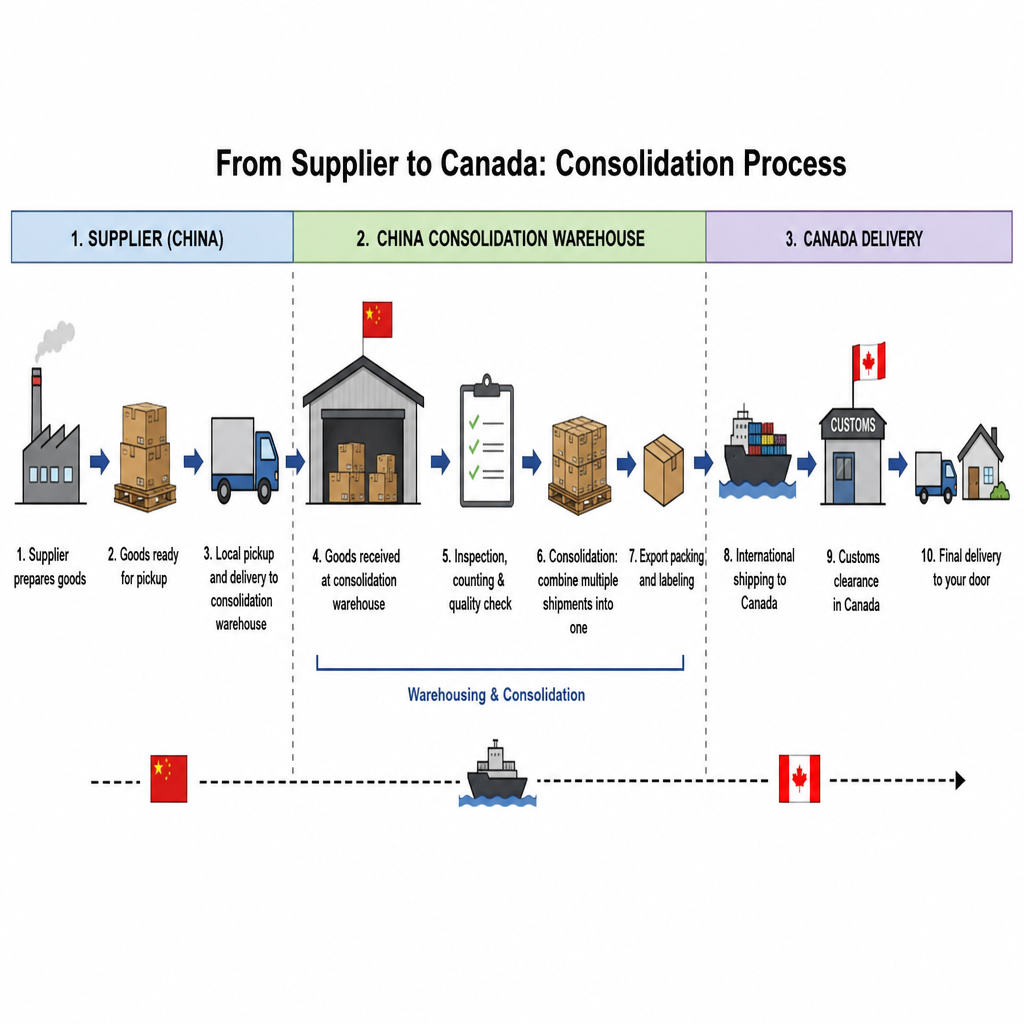
How consolidation works from supplier pickup to Canadian delivery
Think of consolidation as a series of controlled handoffs. Your booking should identify who receives each supplier’s goods, who confirms the final shipment measurements, and who releases the freight for delivery.
The following framework follows the typical LCL movement through origin and destination consolidation facilities.
- Confirm cargo readiness. Obtain a realistic completion date, packing list, carton count, dimensions, and weight from every supplier. Flag any order that is still awaiting production or inspection.
- Arrange collection or warehouse delivery. Give suppliers the correct receiving address, shipment reference, labeling instructions, and cutoff date. Confirm who pays domestic transport charges.
- Agree on warehouse checks. Request a defined receiving report covering carton counts, visible packaging condition, and measurements. Specify whether photographs, relabeling, or repacking are required.
- Approve the outbound shipment. Review the final cargo list, transport method, charges, and schedule before authorizing dispatch. Establish what happens if one supplier misses the cutoff.
- Coordinate Canadian release and delivery. Identify the customs broker, destination contact, and receiving locati0n before departure. Ask who will notify you when the cargo is available.
Treat these as booking requirements, not assumed inclusions. Maersk’s LCL terms, for example, distinguish delivery arrangements and list services such as repacking and palletization as potential extras.
When is consolidated shipping to Canada worthwhile?
Consolidated shipping to Canada is worth considering when your order does not fill a container or when several suppliers would otherwise dispatch separate shipments. It can help you move smaller quantities without purchasing a dedicated container, but warehouse storage and additional handling must be weighed against the expected savings.
Start with a side-by-side comparison rather than a promise of cheaper shipping. Ask for the cost of sending orders separately and the cost of combining them, using the same delivery address and service scope. Include the warehouse work needed to make consolidation possible.
For example, imagine that two suppliers are ready but a third has not finished production. Ask for two plans: ship the ready goods now, or hold them until the final order arrives. Compare the additional storage and later delivery against the expense of a separate shipment.
Consolidation is less attractive when waiting undermines the reason for buying the goods. Set a latest acceptable dispatch date before cargo starts accumulating. That gives the consolidator a clear decision rule instead of leaving your whole shipment dependent on the last factory.
Match LCL, FCL, and air freight to the order
Shipping from China should begin with the inventory requirement, not an automatic preference for one transport method. LCL accommodates smaller ocean shipments, while full-container-load service, or FCL, becomes worth comparing as your volume grows. LCL involves consolidation and deconsolidation handling, so its timing and handling exposure differ from a dedicated container movement.
|
Option |
When to investigate it |
What to compare |
|---|---|---|
|
Ocean LCL |
Your shipment needs only part of a container |
Minimum charges, warehouse handling, destination fees, and delivery timing |
|
Ocean FCL |
Your combined orders could justify dedicated equipment |
Complete container cost, loading arrangements, and inland delivery |
|
Air freight |
A delivery deadline makes ocean options unsuitable |
Chargeable weight, available service, and the value of earlier arrival |
For a larger combined order, request both LCL and FCL quotations rather than relying on a universal volume threshold. Flexport specifically recommends comparing FCL when cargo approaches container capacity. Ask the forwarder to explain the cost difference for your actual packing and destination.
You can also request a split-shipment scenario: move a small urgent portion separately and consolidate the balance. Compare its total cost with the business consequence of waiting. The useful question is which plan supports your stock requirement at an acceptable cost.
Read China shipping rates as a complete cost breakdown
China shipping rates are meaningful only when the charging basis and service boundaries are clear. LCL pricing commonly considers cargo volume or weight and may include minimum charges. Air freight also uses chargeable weight, which compares actual weight with a volumetric calculation; the applicable method should appear in your quotation.
Ask the provider to organize the quote into these categories:
- Origin transport: supplier pickup or delivery to the consolidation facility, including separate collection points.
- Warehouse services: receiving, storage, measuring, labeling, palletizing, repacking, and any minimum handling fee.
- International transport: the freight charge, calculation basis, routing, applicable surcharges, and quote validity.
- Canadian destination services: deconsolidation, terminal or warehouse handling, documentation, and cargo release charges.
- Brokerage and government charges: brokerage fees separated from estimated duties, taxes, and other applicable assessments.
- Final delivery and optional protection: inland transport, special unloading requirements, and cargo insurance if requested.
Use this list to ask what applies, rather than assuming every category will be charged. Request a written list of exclusions and identify which amounts are estimates. Also confirm the billing currency and how any currency conversion will be handled.
Check whether quoted measurements include the final packaging and pallets. DHL’s freight guidance includes packaging in gross weight, while Maersk’s LCL terms specify a weight-or-measurement charging method. A supplier’s preliminary product dimensions are therefore not a substitute for the packed shipment measurements.
Keep Canadian customs preparation separate from freight booking
A transport booking does not replace import preparation. The Canada Border Services Agency requires importers to establish whether goods can enter Canada, determine the applicable classification and valuation, and complete the required release and accounting processes. Confirm these requirements before committing to collection or shipment.
Commercial importers need the appropriate business and import program setup, including registration in the CBSA Assessment and Revenue Management system, known as CARM. If you use a customs broker, arrange the necessary authorization and CARM delegation before expecting the broker to manage your account. Discuss payment and release arrangements early rather than treating them as an arrival-day task.
Prepare a document package for review that includes:
- Commercial invoices with clear product descriptions, values, currencies, and seller and buyer details.
- Packing information connecting each supplier’s goods to the cartons in the combined shipment.
- Available product specifications to support classification and regulatory checks.
- Any permits, certificates, or other documents your broker identifies as necessary.
Ask your broker to confirm the final requirements for the actual goods. A consolidated shipment does not remove the need to understand each product, and some goods may be subject to additional controls or another government agency’s requirements.
Hiring a broker also does not remove the importer’s responsibility for accurate accounting and payment. CBSA states that importers remain responsible even when an agent acts for them. Avoid any arrangement that depends on inaccurate descriptions or understated values.
Evaluate freight logistics in China and Canadian support together
When comparing freight logistics in China, examine the handoff to Canada as closely as the origin service. Ask each provider to describe its responsibilities in writing. Use the same questions for every candidate so you can compare answers rather than marketing language.
Focus on practical operating details:
- Warehouse visibility: What receiving confirmation will you get, and how will shortages or damaged cartons be reported?
- Supplier coordination: Who provides delivery instructions and follows up on missing information?
- Departure planning: Which cutoff applies, and what decision is required if an order is late?
- Canadian responsibility: Which company handles destination coordination, and who answers delivery questions?
- Exceptions and claims: Who must be contacted, what evidence is required, and which deadlines apply?
For Canada freight forwarding, request a destination charge breakdown before accepting the booking. Ask the provider to identify the party issuing each invoice and the conditions for releasing cargo. If an answer remains vague, resolve it before your suppliers deliver to the warehouse.
Discuss cargo insurance separately from transport liability. DHL explains that carrier liability and cargo insurance serve different purposes, and standard liability may not cover the goods’ full value. Request the actual coverage terms, exclusions, and claims procedure rather than relying on the word “insured.”
Plan around warehouse cutoffs, not just departure dates
A vessel’s departure date is only one milestone. LCL cargo must pass through consolidation at origin and deconsolidation at destination, and those stages can add time beyond the main ocean journey. Ask for an end-to-end estimate that distinguishes cargo readiness, warehouse receipt, departure, arrival, availability, and final delivery.
Build your own plan backward from the date goods must be usable. Leave a separate decision point for supplier delays, then establish when the forwarder needs final documents and dispatch approval. Do not schedule a customer commitment solely around an estimated port arrival.
Before booking, send one consistent shipment brief containing every supplier’s address and ready date, product descriptions, packed dimensions, gross weights, carton counts, and your Canadian delivery postal code. Add receiving constraints, requested warehouse work, and the latest acceptable delivery date. Ask every provider to quote that same brief and identify assumptions or missing details.
Choose the shipment plan, not the lowest headline rate
The strongest consolidation proposal is the one you can understand and manage. It should show how supplier orders will be received, when freight will leave, which services are included, and who takes responsibility at each handoff. Use those details alongside price when choosing a freight consolidator.
Start with accurate cargo information, compare equivalent quotes, and approve a clear rule for late suppliers. Then confirm customs readiness and Canadian delivery arrangements before dispatch. That preparation gives you a practical basis for deciding whether consolidation fits this order—and a repeatable process for the next one.
Frequently Asked Questions About Freight Consolidation From China to Canada
What is freight consolidation, and how does it work?
Freight consolidation is the process of combining multiple smaller shipments from different suppliers into a single larger shipment. This coordinated approach allows importers to share container space, reducing shipping costs and improving efficiency. Freight consolidators manage the logistics from supplier pickup to delivery in Canada.
When is it beneficial to use a freight consolidator?
Using a freight consolidator is beneficial when your shipment does not fill an entire container, or when you have multiple orders from different suppliers. It helps lower shipping costs by allowing you to share the costs of shipping and handling while ensuring timely delivery.
What are the key factors to consider when choosing a freight consolidator?
Key factors include the consolidator's experience, the range of services offered (such as pickup and customs clearance), pricing structures, reliability in handling cargo, and their ability to provide clear communication throughout the shipping process.
How can I calculate the total cost of shipping with a consolidator?
To calculate the total cost, request a detailed quote that includes all fees associated with origin transport, warehouse services, international freight, destination services, and any customs brokerage fees. Compare this to the costs of shipping orders separately for better decision-making.
What documents are required for shipping from China to Canada?
Necessary documents typically include commercial invoices, packing lists, product specifications, import permits, and any regulatory documents required for customs clearance. It's crucial to ensure that all paperwork is accurate and complete to avoid delays at customs.