











A buyer in Toronto signs a contract for 500 industrial pumps from a factory in Ningbo. The price reads “CIF Vancouver.” She assumes the seller carries every risk until the pumps reach Canada.
Then a storm damages the container mid-ocean. Who pays? The answer surprises many buyers, and misreading it can cost thousands of dollars.
The CIF Incoterm (Cost, Insurance and Freight) is one of the most widely used trade terms in sea freight, and one of the most misunderstood.
More than 80% of world merchandise trade by volume travels by sea, according to UNCTAD, so CIF shapes a huge share of global contracts.
This guide explains how CIF works, who pays for what, where risk transfers, and how to avoid the mistakes that drain profit.
What Does CIF Mean in International Trade?
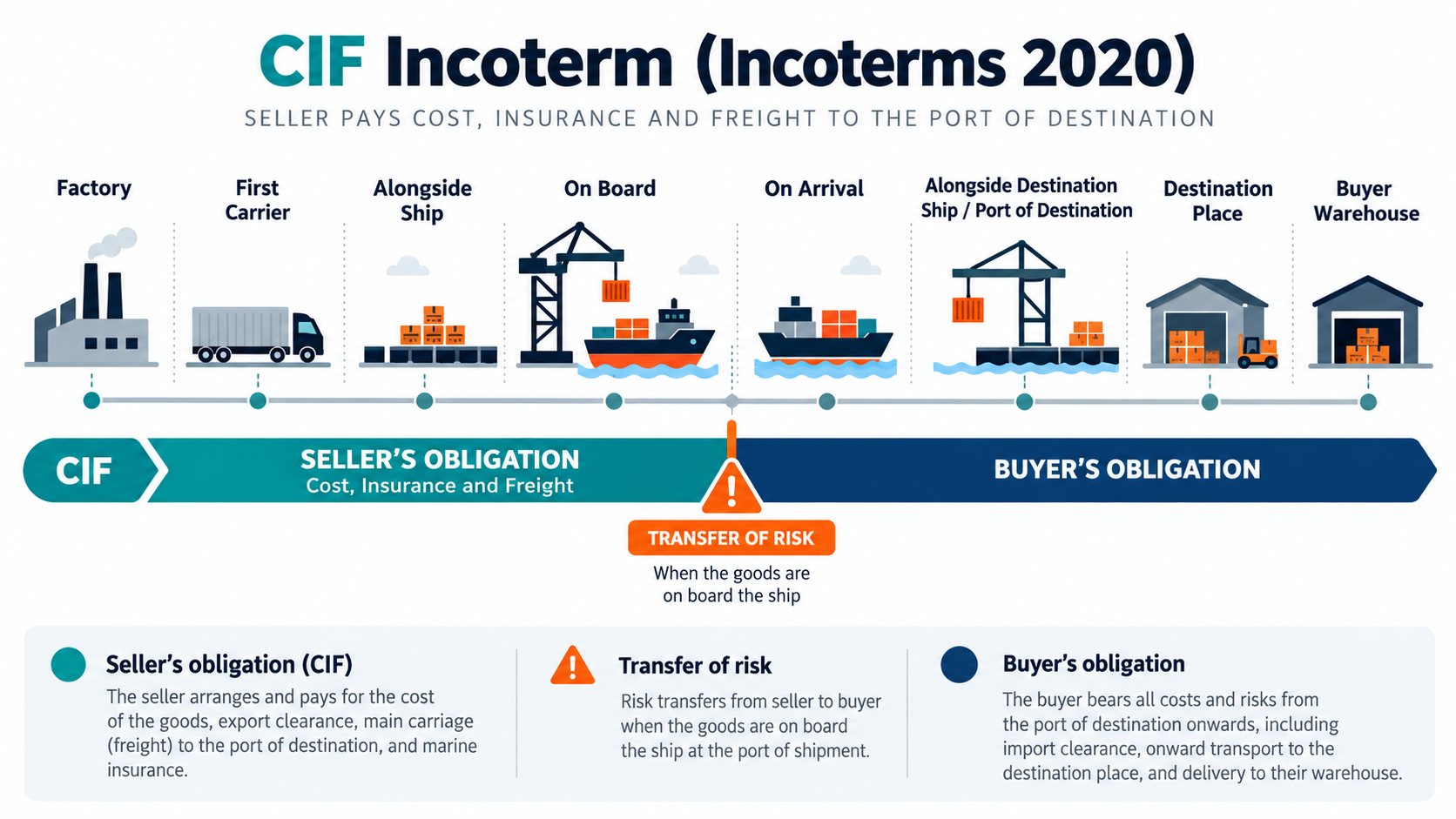
CIF stands for Cost, Insurance and Freight. It is one of the 11 Incoterms rules published by the International Chamber of Commerce (ICC) in Incoterms 2020, the current edition at the time of writing. Incoterms are standardized terms that define who handles transport, insurance, customs, and risk in an international sale.
Under CIF, the seller:
- Delivers the goods on board the vessel at the port of shipment
- Pays the ocean freight to the named port of destination
- Buys minimum cargo insurance for the buyer’s benefit
- Clears the goods for export
You write the term as “CIF [named port of destination], Incoterms 2020”, for example, “CIF Vancouver, Incoterms 2020.”
Remember this about CIF: it applies only to sea and inland waterway transport. Use it for bulk cargo, break-bulk cargo, or traditional shipments. For containerized cargo, most trade professionals recommend a different term (more on that below).
The Most Important CIF Rule: Cost and Risk Transfer at Different Points
Most disputes arise from this single concept, so read it carefully.
-
Costs transfer at the port of destination. The seller pays freight and insurance up to that point.
-
Risk transfers at the port of shipment, once the goods are on board the vessel.
In practice, the seller pays for the journey, but the buyer bears the risk of loss or damage during it. That is why insurance matters so much. The seller buys the policy, but the buyer is the beneficiary and files any claim.
Return to our Toronto buyer. Her pumps were damaged after loading, so the risk was already hers. She was not stranded, however, because the seller had provided insurance. She filed a claim and recovered the loss, and that outcome is exactly how CIF should work.
How a CIF Shipment Works: 6 Steps
Follow this sequence to understand the flow of a typical CIF transaction:
- Sign the contract. Both parties agree on price, quantity, and “CIF [named port], Incoterms 2020.”
- Seller prepares the goods. The seller packs, labels, and delivers the cargo to the port of origin.
- Seller clears export customs. The seller handles export formalities and fees.
- Seller books freight and insurance. The seller selects the carrier, pays the freight, and purchases the cargo policy.
- Goods load on board. Risk passes to the buyer at this moment.
- Seller sends documents. The seller delivers the commercial invoice, bill of lading, and insurance certificate to the buyer.
Upon arrival, the buyer clears import customs, pays duties and taxes, and arranges delivery from the port.
CIF Responsibilities: Seller vs. Buyer
| Responsibility | Seller | Buyer |
|---|---|---|
| Export packaging and loading | ✔ | |
| Export customs clearance | ✔ | |
| Carriage to port of destination | ✔ (pays) | |
| Cargo insurance (minimum cover) | ✔ (pays) | Beneficiary |
| Risk during ocean transit | ✔ | |
| Unloading at destination port | Depends on contract | Depends on contract |
| Import customs clearance | ✔ | |
| Import duties, GST/HST, and taxes | ✔ | |
| Delivery to final destination | ✔ |
Unloading charges deserve special attention. Carrier contracts sometimes pass terminal handling charges at the destination port to the buyer. Therefore, state in your contract exactly who pays them.
CIF Insurance Requirements: What Is Actually Covered?
Many buyers overlook this area, and it is where CIF causes the most disappointment.
Under Incoterms 2020, the CIF seller must obtain insurance meeting Institute Cargo Clauses (C), which is the minimum level of cover. Clause C protects against major casualties such as fire, explosion, vessel sinking, grounding, and collision. It does not cover many common losses, including theft, water damage from heavy weather, and general handling damage.
The policy must also:
- Cover at least 110% of the contract value
- Be issued in the currency of the contract
- Cover the goods from the port of shipment to the named port of destination
- Allow the buyer, or any party with an insurable interest, to claim directly from the insurer
If your cargo is fragile or high-value, negotiate higher coverage, such as Institute Cargo Clauses (A), which provides “all risks” protection. You can ask the seller to purchase it, usually at your expense, or buy a supplemental policy yourself. Do not assume the default cover is enough.
CIF vs. FOB vs. CFR vs. CIP: Which Incoterm Should You Choose?
Comparing CIF with similar terms helps you select the right one.
CIF vs. FOB (Free on Board): Under FOB, the buyer arranges and pays for the main freight and insurance. Under CIF, the seller does. FOB gives buyers more control over carrier choice and costs, so experienced importers often prefer it.
CIF vs. CFR (Cost and Freight): CFR is identical to CIF except the seller does not buy insurance. Choose CFR if you already hold an annual cargo policy.
CIF vs. CIP (Carriage and Insurance Paid To): CIP works for any mode of transport, and Incoterms 2020 requires higher insurance cover (Institute Cargo Clauses (A)) under CIP. For containerized cargo, CIP is generally the more accurate choice because the risk transfers when the goods are handed to the carrier, not when they are loaded on board. This matches how container shipping actually works.
The takeaway: Use CIF for conventional sea cargo. For containers, consider CIP or FCA instead. Use FOB when you want control over freight.
Advantages of CIF for Buyers and Sellers
For buyers:
- Simplicity. The seller coordinates freight and insurance, which saves time.
- Predictable pricing. You see freight and insurance costs built into one quoted price.
- Lower logistics burden. First-time importers gain a manageable starting point.
For sellers:
- Competitive edge. Quoting CIF gives buyers a complete delivered-to-port price that is easy to compare.
- Control over the shipping process. Sellers choose the carrier and manage timing.
- Possible volume discounts. Large exporters often secure better freight rates than individual buyers.
Disadvantages and Risks of CIF
CIF also carries real drawbacks. Consider these before you agree to it:
- Limited carrier control. The buyer cannot choose the shipping line, route, or schedule.
- Minimum insurance only. Default coverage leaves significant gaps.
- Hidden markups. Sellers may inflate freight or insurance charges within the bundled price.
- Risk without control. The buyer carries transit risk but has no say in how the goods travel.
- Destination charges. Surprise fees at the port can raise your landed cost.
You can reduce each of these risks through careful contract drafting, as the next section shows.
8 Smart Strategies to Protect Yourself Under CIF
Apply these practical steps to every CIF deal:
- Always cite the edition. Write “CIF [port], Incoterms 2020” so there is no ambiguity.
- Name the port precisely. Specify the exact terminal when possible, because charges vary.
- Request the insurance certificate. Verify coverage level, value, and beneficiary before the vessel sails.
- Upgrade the insurance for valuable cargo. Ask for Institute Cargo Clauses (A).
- Clarify unloading costs. Settle who pays terminal handling charges at destination.
- Compare against FOB quotes. Request both and calculate the real difference.
- Check the freight rate independently. Ask a freight forwarder what the route should cost.
- Use a customs broker at destination. This keeps import clearance smooth and fast.
Common CIF Mistakes That Cost Businesses Money
Avoid these frequent errors:
- Assuming the seller carries risk until arrival. Risk passes at loading, not at destination.
- Using CIF for containers without reflection. CIP often fits better.
- Ignoring the insurance details. Basic cover rarely satisfies fragile or high-value goods.
- Forgetting import costs. CIF covers freight to the port. Duties, GST/HST, brokerage, and inland transport remain yours.
- Leaving terms vague. An unclear contract invites disputes.
How to Calculate Your Landed Cost Under CIF
A CIF price is not your final cost. Use this formula:
Landed cost = CIF price + import duty + GST/HST (or other applicable taxes) + brokerage fees + destination port charges + inland delivery
Many importers also calculate duty on the CIF value, or on a similar customs value, depending on their country’s valuation rules. Always confirm how your customs authority values imported goods. Because rules differ by country, consult a licensed customs broker before you finalize pricing.
Frequently Asked Questions About CIF Incoterm

What does CIF stand for?
CIF stands for Cost, Insurance and Freight. The seller pays for carriage and minimum insurance to the named port of destination.
Who is responsible for insurance under CIF?
The seller buys the insurance, but the buyer is the beneficiary. The buyer files any claim with the insurer.
When does risk transfer under CIF?
Risk transfers when the goods are on board the vessel at the port of shipment.
Who pays import duties under CIF?
The buyer pays import duties, taxes, and customs clearance costs at the destination.
Can I use CIF for air freight?
No. CIF applies only to sea and inland waterway transport. For air freight, use CIP or CPT.
Is CIF good for container shipping?
Not ideally. Most experts recommend CIP or FCA for containerized cargo because risk transfers when the carrier takes custody, not when goods are loaded on board.
Is CIF cheaper than FOB?
Not necessarily. CIF bundles freight and insurance into the price, which adds convenience but can hide markups. Compare both quotes before you decide.
Is CIF still valid under Incoterms 2020?
Yes. CIF remains one of the 11 rules in Incoterms 2020, though the ICC advises caution when using it for containers.
When Should You Use CIF?
CIF works best when:
- You ship bulk, break-bulk, or conventional cargo by sea
- You are a first-time importer who values simplicity
- Your seller has strong freight relationships and competitive rates
- You trust your supplier and can verify insurance details
Avoid CIF when:
- You want full control over carrier choice and shipping costs
- Your cargo is fragile, high-value, or time-sensitive
- You ship in containers and want precise risk alignment
Conclusion: Master CIF Before You Sign
The CIF Incoterm offers convenience, but it demands careful attention. Remember the core rules: the seller pays for freight and insurance to the destination port, yet the buyer carries the risk from the moment the goods are loaded. Insurance defaults to minimum coverage, and import duties, taxes, and local charges remain your responsibility.
Importers and exporters who understand these details negotiate stronger contracts, avoid disputes, and protect their margins. Before your next shipment, review your contract wording, verify the insurance certificate, and compare CIF with FOB and CIP. A few minutes of preparation today can prevent a costly surprise at the port tomorrow.
Take action now: audit your current trade terms, and make sure every contract states the Incoterms edition, the named port, and the insurance level you actually need.

_1751507038923.png)