For Amazon sellers planning for 2027, practical products such as drawer organizers, packing cubes, cable-management accessories, and craft-storage cases deserve a place on the research shortlist.
This guide explains which product concepts to investigate, how to improve them, and what to check before ordering.
These are sourcing recommendations—not confirmed 2027 best sellers—and the focus is selling to US customers.
What are the best products to source from China for Amazon in 2027?
My recommended starting point is compact, non-powered organization and storage products with a clearly defined use.
Consider travel organizers, desk accessories, household storage, and hobby supplies before committing to more technically demanding concepts.
Treat each recommendation as a hypothesis: validate customer demand, supplier capability, compliance requirements, and profitability before buying inventory.
Amazon’s Product Opportunity Explorer can help test those hypotheses using search behavior, purchasing trends, competition, customer reviews, and return information.
Use that evidence to select a specific customer problem rather than assuming a broad category will sell. The best products to sell on Amazon are not necessarily the most visible ones; look for an unmet need you can address convincingly.
For an initial shortlist, prioritize these characteristics:
- A specific purpose: Explain who needs the product and which frustrating task it improves.
- A demonstrable difference: Favor a better fit, clearer layout, or stronger construction over a logo change.
- Manageable inspection: Choose features you can measure and test against written specifications.
- Workable economics: Reject concepts that depend on optimistic selling prices or unusually cheap shipping.
Eight product concepts worth investigating
The following ideas are proposed starting points for sourcing from China, not a ranking based on verified sales. For each, use the suggested improvement as a research prompt and the sample checks as a starting specification. Avoid launching every variation at once; first establish whether one focused version earns its place in the market.
1. Drawer organizers and adjustable dividers
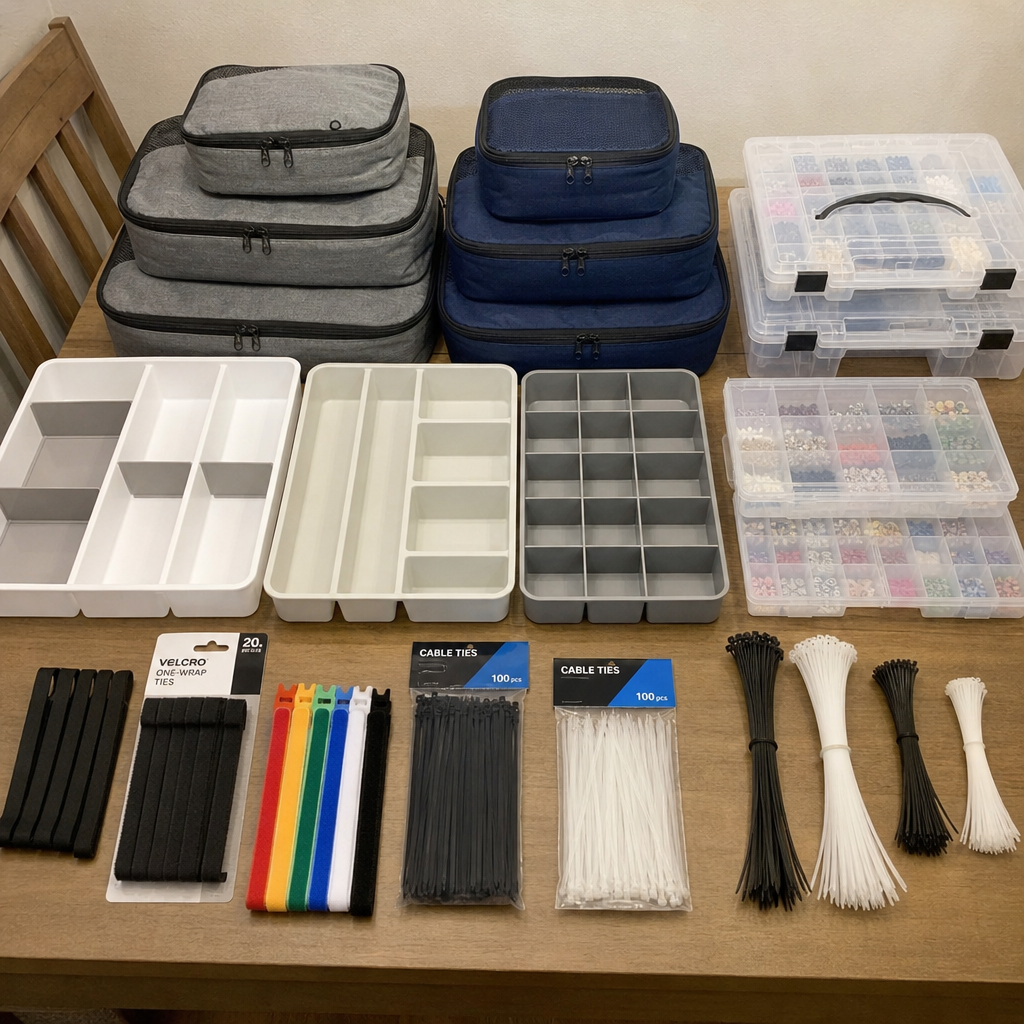
Investigate organizers designed for a specific space, such as shallow office drawers or bathroom vanity drawers. Instead of requesting a generic assortment, ask suppliers to quote a coordinated set with clearly documented internal and external measurements.
Look for a differentiation opportunity in customer complaints about wasted space or confusing sizing. Your proposed improvement might be a printable measuring guide, a more useful compartment mix, or dividers tailored to one drawer type. During sampling, check edge finish, stability, assembly, and whether the advertised arrangement actually fits the stated space.
2. Packing cubes and travel pouches
Consider a targeted travel set rather than another large bundle of loosely related bags. A carry-on organization kit or a set separating clean clothing from worn items gives you a specific concept to validate.
Ask suppliers for exact dimensions, fabric specifications, zipper details, and packed carton measurements. Test the samples with realistic contents, including repeated packing and unpacking.
If you propose compression or water-resistance claims, establish how you will substantiate them before printing packaging. Build the listing around verified capacity and usability rather than broad promises about making travel effortless.
3. Cable-management accessories
Explore reusable cable ties, desk-routing clips, and cable-identification systems as a non-powered accessory concept. Define the intended setup first: a home-office desk, a shared workstation, or a travel electronics pouch.
For adhesive components, specify the surfaces and conditions you intend to test. Check cable fit, repeated opening, installation clarity, and removal on representative surfaces.
A useful proposed bundle could combine ties and labels with an illustrated routing guide. Keep charging equipment out of the initial specification if your intended product is simply a cable-organization system.
4. Craft and hobby storage
Investigate storage designed around one hobby rather than a vague “multipurpose” box. Possible concepts include embroidery-thread organizers, sewing-tool pouches, or compartment cases for adult craft supplies.
Start by listing exactly what the customer needs to store. Then test compartment dimensions, latch operation, visibility, and whether small contents move between sections when the closed case is carried.
Consider removable labels or an inventory card as functional additions. Specify the intended audience honestly, and review the applicable safety requirements rather than treating an adult-use label as a substitute for compliance assessment.
5. Gardening organization accessories
Research plant-label sets, garden-tool rolls, and seed-storage organizers built around a defined gardening task. A practical concept might organize seed packets by planting plan or keep frequently used hand tools together.
Ask suppliers to explain material choices and provide samples of the proposed construction. Test label legibility, closure strength, pocket access, and cleaning instructions as appropriate.
Avoid describing an item as weatherproof or UV-resistant without supporting evidence. For an initial project, keep the concept focused on storage and organization rather than adding chemicals, seeds, or treatment claims to the offer.
6. Closet and laundry organizers
Consider laundry mesh bags, shelf dividers, or compact accessory organizers for a specific storage problem. Define the intended contents before deciding on dimensions, materials, or the number of pieces in the set.
For washable products, include repeated washing in your sample evaluation and document the conditions used. For shelf accessories, test the proposed fit and installation method on representative shelving.
Request packaged measurements before approving the design, then model the economics using those figures in Amazon’s Revenue Calculator rather than relying on the unpackaged sample.
7. Pet-owner travel organizers
Explore storage for the owner’s supplies, such as grooming-tool pouches or bags for walking accessories. Keep the initial concept distinct from chew toys, restraints, feeding equipment, or products making animal-health claims.
Map the intended contents and test the layout with representative items. Check seam strength, pocket accessibility, closures, and the practicality of the proposed cleaning method.
A useful improvement might be a removable inner pouch or a clearer separation between clean and used accessories. Present these as design options to validate, not features customers necessarily want without research.
8. Desk and document organization
Investigate document pouches, portable stationery organizers, and compact desk trays for a defined workspace. For example, develop a concept around carrying paperwork between a home office and shared desk rather than targeting every office user.
Specify the paper sizes and accessories the product must accommodate. Test closures with the organizer full, check corners and edges, and assess whether the contents remain accessible.
Ask whether the proposed materials protect the intended contents during ordinary handling. Do not add “fireproof,” “waterproof,” or security claims simply because similar wording appears in supplier listings.
How do you validate demand before placing an order?
Validate a product by combining Amazon demand research, competitor-review analysis, physical samples, and a conservative cost model. No single keyword, bestseller position, or supplier recommendation should make the decision for you. Amazon recommends ongoing research because product popularity can change.
Use this sequence before committing to china wholesale products:
- Define a narrow buyer and task. Replace “storage products” with a specific problem, such as organizing embroidery supplies for transport.
- Review demand and competition together. Examine search terms, purchasing behavior, and competing offers through Product Opportunity Explorer.
- Read critical reviews. Record recurring complaints and separate fixable design issues from expectations you cannot realistically satisfy.
- Write an improvement hypothesis. State what you would change, why it matters, and how the sample will demonstrate it.
- Set rejection criteria. Decide in advance which costs, quality failures, or unresolved compliance questions would stop the project.
Treat china market trends as leads, not proof of US demand. If a supplier promotes certain items as top Chinese products, ask for the reasoning, then independently investigate the relevant Amazon niche. Your purchasing decision should follow customer evidence, not the supplier’s enthusiasm.
Build the margin before negotiating the order
Start your cost model with the proposed selling price, then account for every cost needed to deliver and sell a usable unit. Amazon’s Revenue Calculator supports comparisons between fulfillment methods, but its figures are estimates and can change. Recheck the model using the final packaged dimensions and weight before ordering.
Use this planning framework:
Estimated contribution per unit = selling price − landed product cost − Amazon selling and fulfillment costs − advertising allowance − returns allowance.
For your landed-cost worksheet, request separate figures for the product, customization, packaging, inspection, freight, insurance where applicable, customs clearance, duties, and domestic delivery. Add the other costs relevant to your chosen fulfillment method rather than assuming a supplier’s shipping quote covers everything.
For importing from China into the United States, confirm classification and applicable duties with a qualified customs broker. The US International Trade Commission notes that importers are ultimately responsible for understanding CBP requirements and complying with federal rules. Do not assume a tariff quoted for another product applies to yours.
Run a downside scenario before approving the purchase: a lower selling price, higher freight expense, slower sales, and more returns than planned. If the concept only works when every assumption goes right, reconsider the specification or reject it. Keep funds available for the next order instead of spending the full launch budget on inventory.
China sourcing tips for consistent quality
Compare suppliers against one written specification, not a collection of attractive listing photos. Alibaba’s buyer guidance recommends detailed purchase orders, samples, and production monitoring or inspection. Use those steps to establish what the supplier must deliver before discussing a larger commitment.
Send each shortlisted supplier the same request:
- Materials, dimensions, tolerances, colors, and required functionality.
- Packaging, labeling, carton configuration, and packaged measurements.
- Minimum order quantity, sample cost, production schedule, and payment terms.
- Relevant documentation, inspection arrangements, and remedies for nonconforming goods.
Approve a reference sample and turn its important characteristics into measurable acceptance criteria. Instead of writing “strong zipper,” describe the intended test and acceptable result. Arrange inspection against the order specification; Alibaba’s inspection guidance includes quantity, conformity, workmanship, functionality, and contractual quality requirements among the checks available.
If using Trade Assurance, review the protection for that particular order and document quality requirements and shipping commitments in the agreement. Alibaba describes protection for specified shipping and quality disputes, subject to its rules. Treat it as a contractual safeguard, not a replacement for supplier checks or inspection.
Check compliance before paying a deposit
Check both legal requirements and Amazon eligibility before production. Amazon may require approval for particular products, and similar existing listings can help identify likely restrictions when researching a new item. Confirm the requirements for your own account and product rather than assuming a competitor’s listing proves eligibility.
Product-safety obligations depend on the actual item, intended user, and applicable rules. Consult CPSC guidance and qualified testing support where needed; a supplier’s general certificate should not replace checking what documentation your specific product requires. Also clarify who is responsible for obtaining and retaining the necessary records.
Before choosing a brand name, conduct appropriate trademark clearance. The USPTO describes searching its federal database as one essential step within a broader clearance search and notes that these searches can be complex. Resolve branding concerns before printing packaging.
Choose a testable opportunity, not a prediction
For 2027, use this shortlist to investigate one focused product, not to justify a large speculative order. Define the buyer, prove the improvement, verify requirements, and confirm the economics before scaling. A disciplined sourcing process gives you a clearer basis for deciding what to launch—and what to leave behind.
Frequently Asked Questions About Sourcing Products from China for Amazon in 2027
What are the advantages of sourcing products from China for Amazon sellers?
Sourcing from China often provides competitive pricing, a wide variety of products, and scalable manufacturing options, allowing sellers to establish a diverse inventory and potentially improve their profit margins.
How can I validate demand for a new product before ordering from China?
You can use Amazon’s Product Opportunity Explorer to analyze search behavior, review customer feedback, and study competitors. This research helps gauge market demand and identify potential challenges.
What steps should I take to ensure product quality when sourcing from China?
Implement a stringent supplier vetting process, request detailed product specifications, and arrange for quality inspections of samples before making larger orders. Establish clear acceptance criteria to measure quality upon delivery.
What common compliance issues should I be aware of when importing products from China?
Compliance issues may include product safety regulations, applicable tariffs, and Amazon's specific listing requirements. It is essential to understand and meet these standards to avoid legal and operational challenges.
How do I calculate the costs involved in importing products from China?
Calculate all related costs, including manufacturing, shipping, customs duties, and Amazon fees. Use Amazon's Revenue Calculator to develop a clear financial model that accounts for all expenses to ensure a sustainable profit margin.