


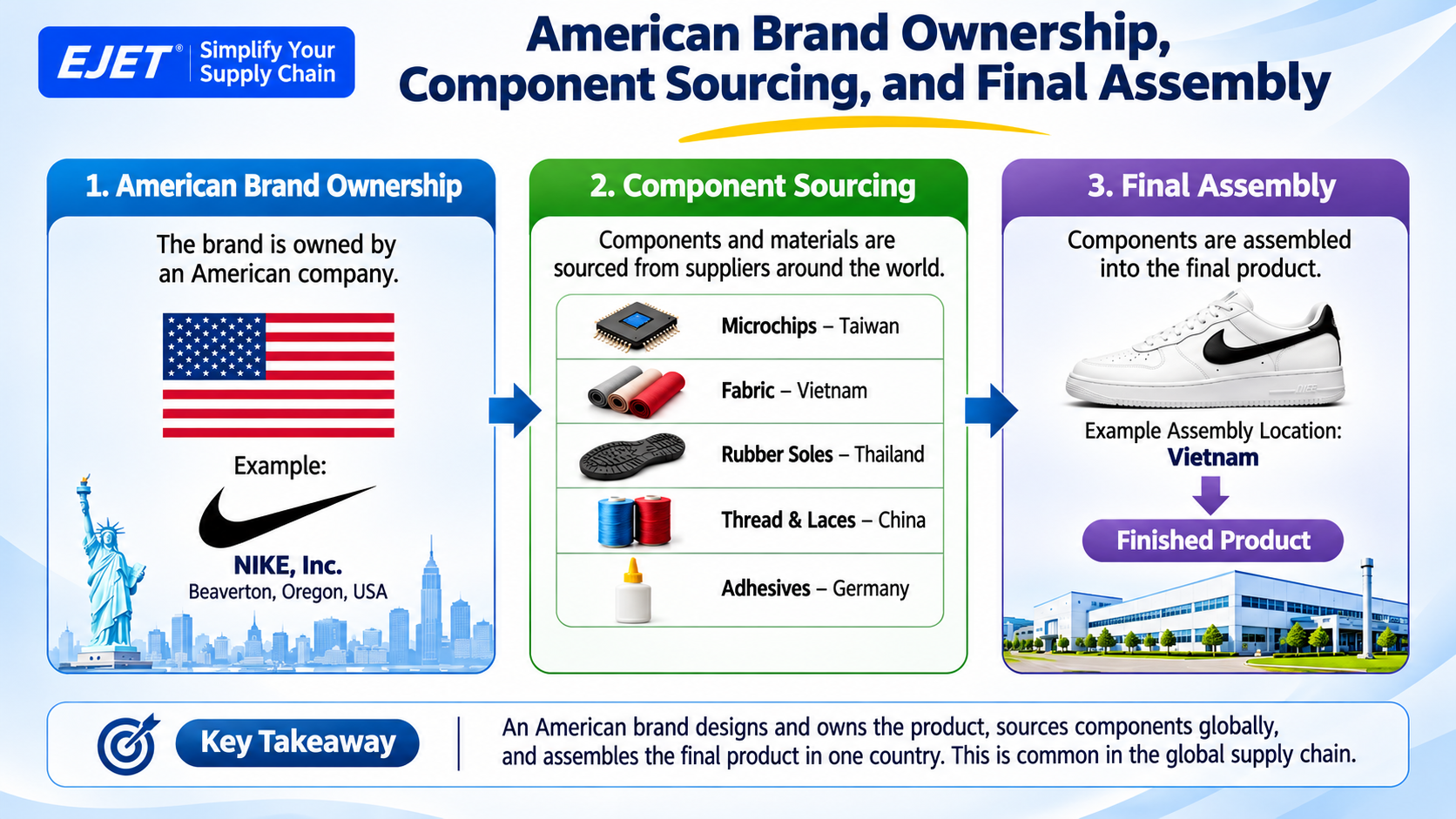
American products made in China are goods sold under U.S. brands but manufactured or assembled, wholly or partly, in China. Apple, Nike, and Mattel provide documented examples, although their production networks also span other countries.
Understanding those networks helps you distinguish brand ownership from manufacturing origin—and check a specific product without relying on assumptions about its logo.
The useful question is not simply whether a company is American. It is where the item in your hands was made, what its label establishes, and whether the evidence applies to that particular model.
Why do American brands manufacture in China?
American brands use manufacturing partners in China to access established production capabilities, manage costs, and supply products at scale. The arrangement can involve outsourced assembly, component sourcing, company-owned factories, or a combination. Apple's disclosures describe extensive outsourcing, while Mattel reports using both its own facilities and third-party manufacturers.
That distinction matters. An American company does not necessarily own the Chinese factory producing its goods. Nike, for example, identifies contract manufacturers in its production network; Mattel describes a different mix of owned and outside production. Treating every overseas factory as a brand-owned operation obscures how these businesses work.
Manufacturing decisions also involve trade-offs. Apple says outsourcing arrangements can lower operating costs but reduce direct control over production and distribution. Its disclosures identify potential effects on cost, quality, quantity, and flexibility—an important reminder that overseas production is not simply a search for the lowest wage.
For shoppers, factory ownership is useful context, not a verdict on the product. Start with the manufacturing information for the item, then consider the features, support, and transparency that matter to your purchase. A familiar brand name should be the beginning of that investigation, not its conclusion.
An American products made in China list, with important limits
A useful list needs more than recognizable names. It should identify the product category, explain the evidence, and avoid implying that everything a company sells comes from one country. The following examples document manufacturing connections—not a guarantee of origin for every item.
|
American brand |
Documented connection to China |
What shoppers should verify |
|---|---|---|
|
Apple |
Apple's supply-chain information identifies iPhone assembly in mainland China. |
The assembly information for the specific device, rather than assuming all Apple hardware shares one origin. |
|
Nike |
Its fiscal 2025 report identifies China as a production locati0n for footwear and apparel. |
The country label on the particular shoe or garment. |
|
Mattel |
Its 2025 report lists China among the countries containing principal owned or third-party manufacturing facilities. |
The origin marking on the individual toy or package. |
These examples come from company disclosures and supply-chain reporting, not assumptions based on headquarters or branding.
Apple: assembly is one part of the picture
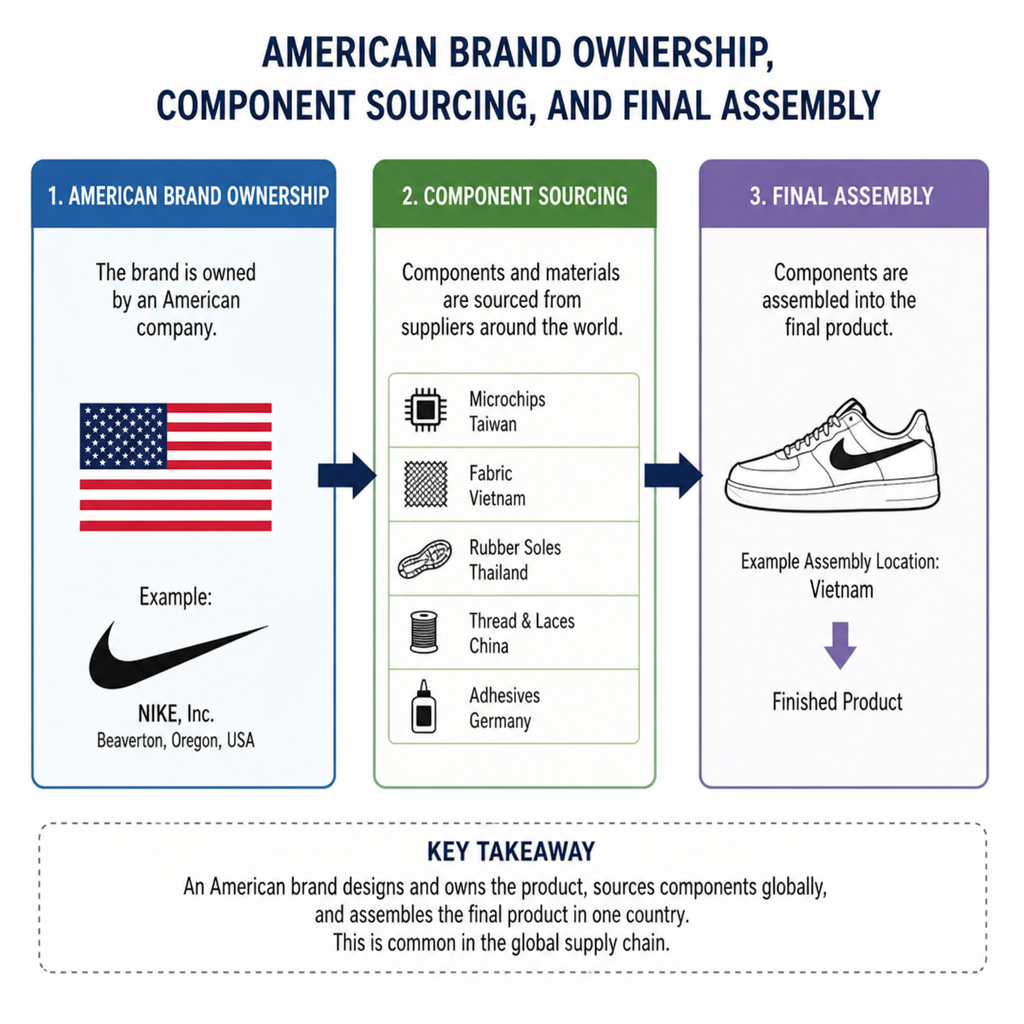
Apple describes products designed in California and built through a worldwide supplier network. Its supply-chain materials distinguish component manufacturing from assembly, packaging, shipping, and recovery. An assembly locati0n therefore provides meaningful information, but it does not identify where every chip, display, battery, or other part originated.
For a device purchase, ask about final assembly separately from component sourcing. If you want both answers, make both questions explicit rather than expecting one label to supply a complete manufacturing history.
Nike and Mattel: avoid brand-wide assumptions
Nike reported that factories in China manufactured approximately 17% of NIKE Brand footwear and 15% of NIKE Brand apparel in fiscal 2025. Those figures describe different product categories and a specific reporting period—not the share of every Nike product sold in the United States.
Mattel's 2025 report lists manufacturing facilities across China, Vietnam, Indonesia, Malaysia, Mexico, and Thailand. It also reports ending production at two Chinese plants, one in 2024 and another in 2025. That changing footprint shows why an old brand list should never replace checking the actual package. (sec.gov)
How many American products are made in China?
There is no single defensible count available from the sources used here. Answering how many American products are made in China first requires defining “American products”: U.S.-owned brands, goods purchased by American consumers, or goods containing American intellectual property.
Census trade statistics organize imports by origin and product classifications, which does not directly answer all those different questions.
Questions about how much American production happens in China, or how much of American brands' output is made there, also need a defined denominator.
These are different measurements:
Number of models: Counts distinct products or stock-keeping units, regardless of sales volume.
Units manufactured: Counts physical items, but combines products with very different values and uses.
Import value: Measures goods entering the country, rather than every product an American company manufactures worldwide.
Manufacturing value added: Focuses on the contribution of a production stage rather than treating the finished product as entirely local.
Choose the measure before looking for a percentage. A statistic about footwear units cannot answer a question about electronics spending, and neither describes all American brands.
Census provides country-and-product trade datasets, including classifications by industry and end use. Those can support a question such as the value of a defined category imported from China during a specified year. They should not be relabeled as the percentage of all American products manufactured there.
If a sweeping percentage appears online, ask for its year, product scope, unit of measurement, and source. Without those details, it offers little help in evaluating a purchase.
What should you know about American food products made in China?
American food products made in China require product-specific checking because a U.S. brand name does not establish where food was grown or processed. FDA guidance addresses country-of-origin labeling and prohibits false or misleading food labeling. For shoppers, the practical starting point is the package's origin statement—not the familiarity of the brand.
Historical sourcing evidence can provide context, but it needs a date. Testimony in a 2018 U.S. Trade Representative hearing identified China as a source of mandarin oranges for major brands and private labels, including Del Monte and Dole. That testimony documents sourcing at that time; it does not establish the origin of every can or fruit cup sold today.
When investigating a food item, separate three questions:
- Where was the agricultural ingredient grown? Ask about the named ingredient rather than the brand's overall sourcing.
- Where was the finished food processed? Request that information separately if it is important to your decision.
- What does the package actually disclose? Record the wording, product code, and lot information before contacting customer service.
Do not treat a country name as a complete food-safety assessment. FDA states that imported and domestically produced foods must meet the same U.S. legal requirements, and importers are responsible for ensuring covered products are safe, sanitary, and properly labeled. Those requirements do not mean every shipment receives individual FDA approval.
For a specific concern, prioritize product and lot information over a circulating brand list.
Reading origin labels without overinterpreting them
“Made in China” and “American brand” describe different things. One concerns manufacturing origin; the other concerns the business or brand behind the product. The FTC explains that an American brand name alone ordinarily does not constitute a claim that the product was made in the United States.
Likewise, a U.S. shipping locati0n does not establish domestic manufacture. FTC consumer guidance distinguishes “Ships from the USA” from “Made in the USA” and “Assembled in the USA.” A warehouse locati0n answers a delivery question, not necessarily an origin question.
For an unqualified “Made in USA” claim, the FTC's standard is “all or virtually all” U.S. production. More limited statements, such as identifying where design occurred, should not be interpreted as claims about the entire product. Read the qualifying words instead of treating every reference to America as equivalent.
The safest reading is narrow: take a clear statement for what it says, and ask follow-up questions about what it leaves unanswered.
A practical checklist for checking a product
Use a repeatable process rather than collecting brand-level rumors. Begin with the item itself, then work outward to product documentation and the manufacturer. Keep your question specific enough that a customer-service team can answer it.
- Record the exact identifier. Note the model, size, color, SKU, or food lot code so your inquiry refers to one item rather than an entire range.
- Inspect the product and packaging. Photograph any origin statement and retain the image if origin affects your buying decision.
- Read the listing carefully. Look for a definite country statement. If the listing gives only a shipping locati0n or vague regional description, request clarification.
- Ask a narrowly framed question. Try: “Where is this exact model manufactured for the U.S. market?” For food, ask separately about ingredient origin and processing.
- Request written confirmation. Save the reply alongside the model or lot information, and check that the answer addresses your actual question.
- Recheck when buying again. Treat your notes as evidence about the identified item, not a permanent guarantee about the brand.
Use corporate reports for background, but recognize their scope. Nike's category-level production percentages and Mattel's facility disclosures are helpful context; neither substitutes for an origin statement on a particular purchase. (sec.gov)
If a seller cannot provide a clear answer, treat the origin as unverified. That is more accurate than assuming either domestic or Chinese production.
Changing supply chains make dated evidence essential
Manufacturing locations are not fixed forever. Mattel's reported Chinese plant closures illustrate changes within an existing international network. Apple has also announced investments supporting U.S. component manufacturing, demonstrating why sourcing should be examined at the component and production-stage level rather than through a simple country-wide label.
A useful way to evaluate a relocation announcement is to check its scope. Look for the named product, facility, manufacturing stage, implementation date, and whether the statement describes a plan or completed production. Do not extend a claim about one component into a conclusion about every finished product.
The same discipline applies to lists. Prefer a short, dated list supported by disclosures over a long list that never explains its evidence. When sharing sourcing information, include the reporting year and the product category so readers can understand its limits.
The takeaway: verify the item, not just the brand
Exploring American brands manufacturing in China is most useful when it leads to better questions, not blanket judgments. Separate ownership from production, distinguish assembly from component sourcing, and reject percentages without a clear definition.
Before your next purchase, check the exact product, save its origin information, and ask for clarification where needed. That approach gives you a stronger basis for choosing than either a familiar American logo or an undated online list.
Frequently Asked Questions About American Brands Manufacturing in China
What are some examples of American products made in China?
Many well-known American brands manufacture products in China, including Apple, Nike, and Mattel. However, the origin of specific products may vary, so it’s essential to check individual labels for precise information.
Why do American brands choose to manufacture in China?
American brands often manufacture in China to take advantage of established production capabilities, manage costs effectively, and scale their production to meet large market demands. This includes a combination of outsourcing, component sourcing, and company-owned factories.
How can I find out where a specific product was made?
To determine a product's origin, always check the label on the item itself. Look for specific statements about where it was manufactured or assembled, and if needed, contact the manufacturer’s customer service for clarification.
Are all American brands' products made in China?
No, not all products from American brands are made in China. Many companies, including Apple and Nike, have diversified manufacturing sources across multiple countries. Therefore, the origin can differ by product or even product models within the same brand.
What should I know about American food products made in China?
When it comes to food products, the origin can vary significantly. Always check the packaging for country-of-origin labeling. The FDA provides guidance on food labeling, and consumers should verify the source of ingredients and where the food was processed, not just the brand name.