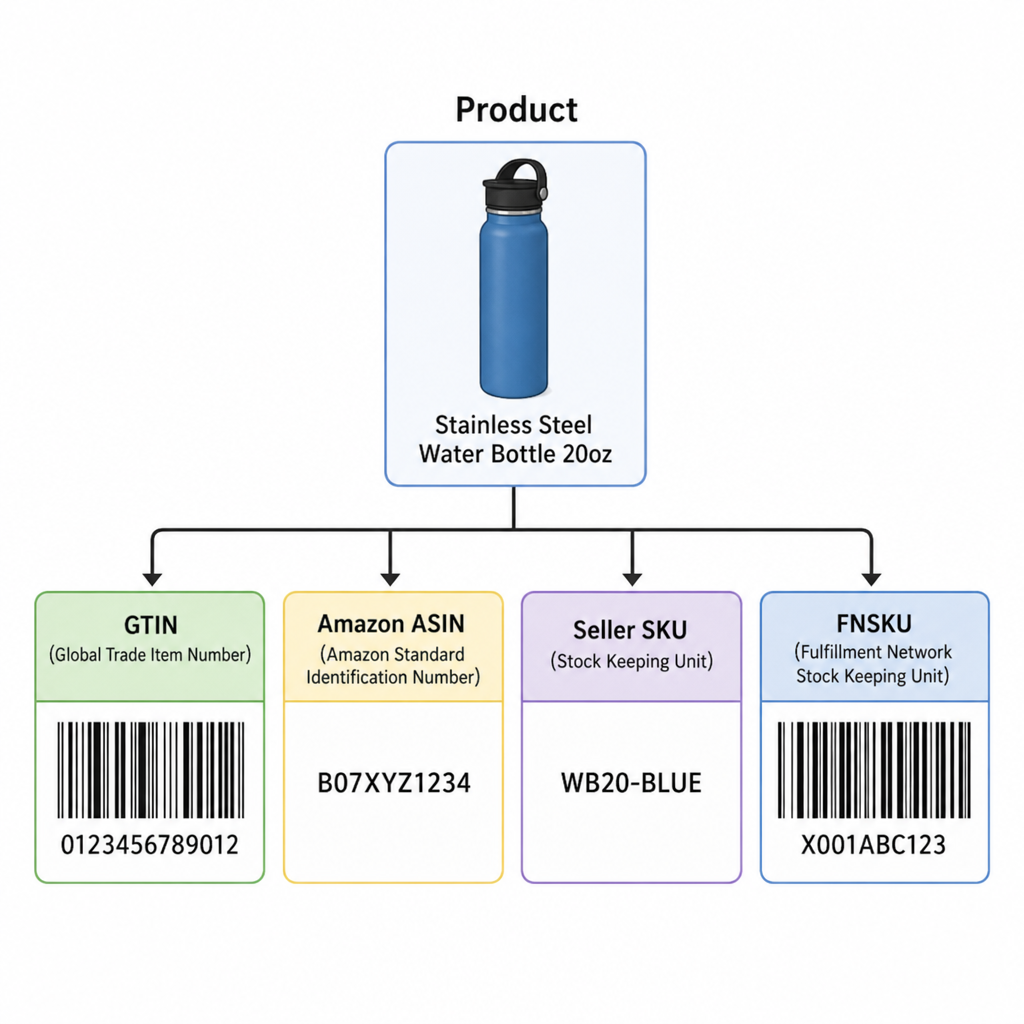
Amazon product identifiers serve different jobs: GTINs identify products across retailers, ASINs identify products in Amazon’s catalog, SKUs organize your inventory, and FNSKUs support Amazon fulfillment tracking.
Understanding those differences helps you choose the right listing information and prepare inventory correctly.
This guide explains the identifiers, current US labeling requirements, and practical checks for sellers planning for 2027.
Planning note: This article reflects guidance available on November 27, 2026, not a guarantee of future policy. Check the requirements shown in your marketplace and shipment workflow before printing packaging or dispatching inventory.
What is the difference between ASIN, FNSKU, SKU, and GTIN?
A GTIN is a standardized product identifier, an ASIN is Amazon’s catalog identifier, a SKU is your internal inventory reference, and an FNSKU identifies inventory within Amazon’s fulfillment network.
They can all relate to the same product, but they are not interchangeable. Think of them as different reference fields rather than competing barcode options.
|
Identifier |
Meaning |
Main purpose |
Who provides it |
|---|---|---|---|
|
ASIN |
Amazon Standard Identification Number |
Identifies a product in Amazon’s catalog |
Amazon |
|
FNSKU |
Fulfillment Network Stock Keeping Unit |
Supports identification and tracking within Amazon fulfillment |
Amazon |
|
SKU |
Stock Keeping Unit |
Organizes a seller’s inventory and offers |
Seller |
|
GTIN |
Global Trade Item Number |
Identifies a trade item across retailers and supply chains |
Assigned through the GS1 system |
These distinctions explain why obtaining a UPC does not automatically remove an FBA labeling requirement, and why creating a seller SKU does not create a new product identity. Listing identifiers and fulfillment barcodes solve different problems.
ASIN: the catalog reference
An ASIN is a 10-character combination of letters and numbers assigned to a product in Amazon’s catalog. You can find it on the product detail page and use it to locate the product. If the exact item already exists, match your offer to that listing rather than creating another product page.
Before matching, compare the brand, model, size, color, and package quantity. A visually similar product is not necessarily the same sellable item. Make this comparison part of listing approval, not something left to whoever prints the labels.
SKU: your operational shorthand
Your SKU is the reference you use to organize your inventory. Different sellers can use different SKUs for the same product because these codes belong to their internal systems, not a universal product-identification standard.
For example, you might use MUG-BLU-350-1PK for a blue mug sold individually. Choose a consistent pattern, document its meaning, and avoid embedding details that change frequently, such as the selling price. Readability matters more than cramming every attribute into one code.
FNSKU: the fulfillment identifier
An FNSKU supports inventory identification in Amazon’s fulfillment network. When Amazon barcode labeling is required, use the label generated for the correct inventory record in Seller Central. Do not substitute a barcode you created from your own SKU.
An FNSKU is not a unique serial number for every physical unit. Multiple interchangeable units can share the same FNSKU. The important check is whether the label belongs to the correct product and inventory record—not whether every sticker has a different number.
GTIN: the cross-retailer product identity
A GTIN is the identifying number; a barcode is the machine-readable symbol carrying data. Common formats include GTIN-12, typically carried in a UPC-A barcode, and GTIN-13, typically carried in an EAN-13 barcode. Treating every GTIN as a 14-digit number is incorrect.
For a new brand-owned product, obtain identifiers through GS1 rather than assuming any inexpensive barcode number will work. GS1 warns that third-party numbers may be associated with another company, creating identification and validation problems.
Which barcode should you use for Amazon FBA?
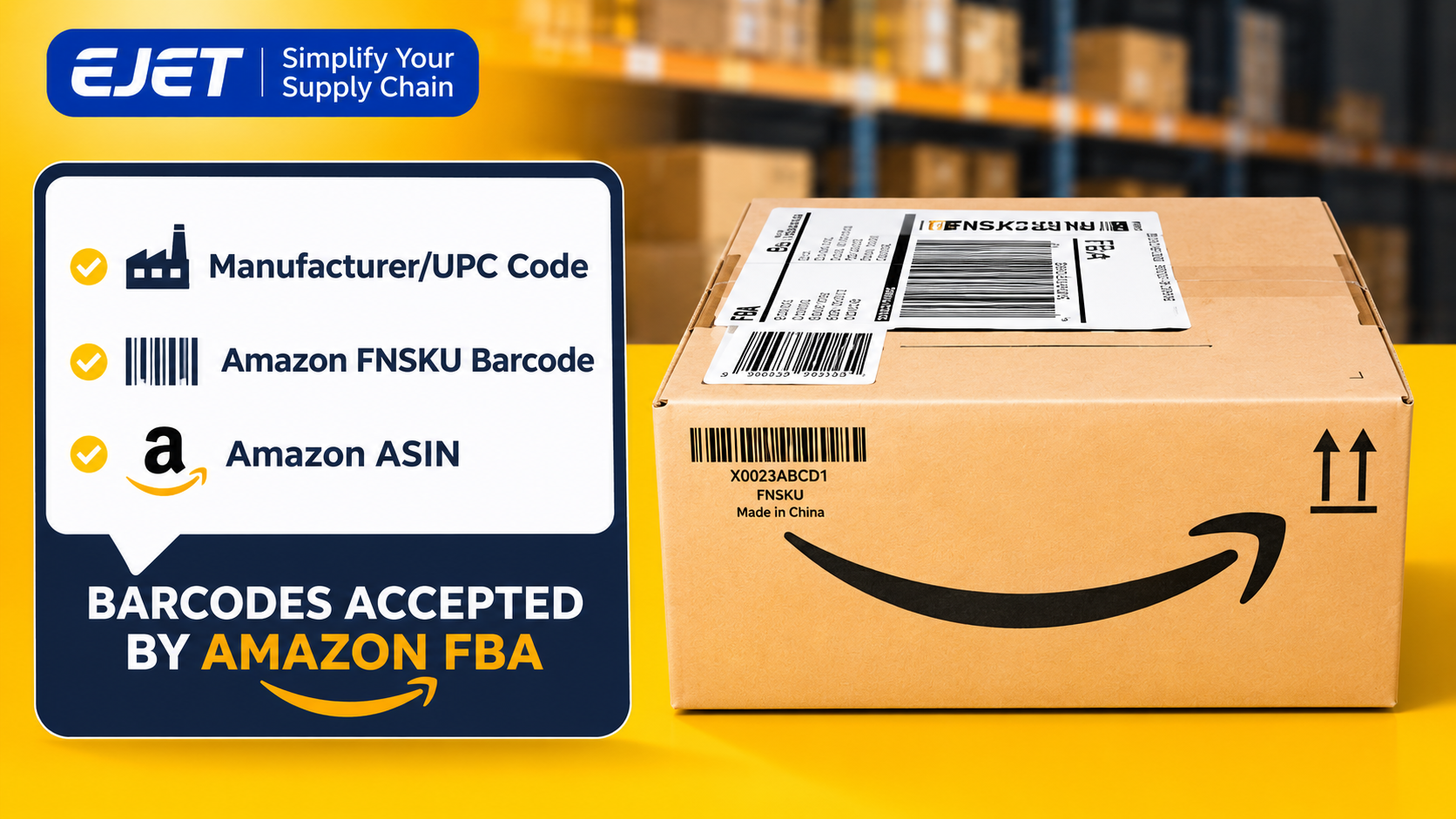
Under Amazon’s current US requirements, resellers must use Amazon barcodes even when products already have manufacturer barcodes. Eligible brand owners can use manufacturer barcodes, subject to Amazon’s requirements and the appropriate Brand Registry role. These rules apply to inventory shipped on or after March 31, 2026.
This matters because older amazon selling tips may describe manufacturer-barcode eligibility without distinguishing brand owners from resellers. Amazon’s announcement specifies the Brand Representative selling role in Brand Registry for the brand-owner route. Merely having a UPC on the packaging is not enough.
Use this decision sequence before ordering labels:
- Confirm your selling role. Establish whether you qualify as the brand owner under Amazon’s rules or are reselling another brand’s products.
- Check product eligibility. Even eligible brand owners must meet the manufacturer-barcode requirements for the product.
- Inspect the listing’s barcode setting. Confirm the selection for the inventory you are preparing.
- Follow the shipment workflow. Print the required Amazon labels when instructed, rather than relying on the packaging’s existing barcode.
If an existing offer needs to switch to Amazon barcode tracking, Amazon documents a process involving a new SKU for the affected ASIN. Do not assume changing an account preference will update every existing offer or inventory already received. Follow the applicable switching instructions before your next replenishment.
There is another operational change to include in your 2027 planning: Amazon ended US FBA prep and item labeling services on January 1, 2026. Arrange preparation yourself, through your manufacturer, or with a third-party provider before inventory reaches FBA.
GTIN exemptions and product variations
A GTIN exemption can allow an eligible product to be listed without a GTIN. It is not permission to ignore FBA identification requirements, and eligibility is not universal. Amazon’s application process can require product information and images showing the product and packaging.
Search the catalog first. Amazon explains that sellers may add an offer to an exact existing product listing without obtaining a new GTIN; an exemption is relevant when creating an eligible new listing without one. Keep catalog matching and exemption applications as separate decisions.
For brand-owned ranges, plan identification around the actual sellable variations. GS1 requires distinct GTINs for variations such as size, color, style, and package count. A single mug and a two-pack should not be treated as the same trade item simply because the individual mugs are identical.
A useful planning worksheet includes:
- Product description: Brand, model, variant, and quantity sold together.
- Existing identifier: The manufacturer’s GTIN, where one exists.
- Catalog match: The ASIN verified against the physical product.
- Seller reference: Your SKU and its documented meaning.
- Fulfillment choice: The confirmed barcode method and labeling owner.
Complete this worksheet before approving packaging artwork. It gives your catalog, purchasing, and warehouse teams one shared reference rather than several disconnected spreadsheets.
Barcode best practices for preparation and printing
Good amazon product labeling starts with the correct inventory record, not the printer. Amazon requires each FBA item to have a barcode for identification and tracking, and required labels must remain accessible for scanning. A label on the shipping carton does not identify every individual sellable unit inside it.
Build your preparation procedure around these checks:
- Generate the correct label. Download it from the relevant Seller Central workflow rather than recreating an identifier manually.
- Verify the physical item. Compare the label with the product’s variant, condition, and package quantity before applying it.
- Keep scanning access clear. Check the finished unit after bagging, wrapping, or other preparation—not only before packaging.
- Control competing product barcodes. When applying Amazon labels, follow Amazon’s instructions for covering other visible barcodes, preserving exceptions such as serial-number barcodes and Transparency authentication labels.
For print quality, avoid stretching barcode artwork, cutting off its surrounding white space, or placing it across a fold.
Amazon’s labeling guidance specifies white space around the barcode and related text. Use the current requirements for your marketplace rather than copying dimensions from an old label template.
As an internal quality check, print a sample and test it on the finished package before approving a full batch. Inspect whether handling causes smudging, lifting, wrinkling, or glare. A successful test scan is useful, but it does not replace checking that the encoded identifier belongs to the right item.
Keep labeling batches small enough to control. Finish one SKU, reconcile its count, clear unused labels, and only then start the next. This creates a straightforward checkpoint when similar-looking variations share a packing table.
Build identifier checks into Amazon inventory management
For amazon inventory management, maintain a master mapping between each sellable product and its identifiers. The GTIN, ASIN, seller SKU, and applicable FNSKU should be separate fields—not interchangeable entries in a column called “barcode.” Their different purposes make that separation important.
Consider adding the supplier’s item number, pack quantity, barcode method, and label-file approval date. Store identifiers as text so spreadsheet software does not remove leading zeros or alter long numbers. Give one person responsibility for approving changes and recording why they were made.
Before releasing a purchase order or shipment, use a short reconciliation checklist:
- Does the ordered product match the approved sellable configuration?
- Does the ASIN match the physical variant and pack count?
- Is the supplier using the approved label file for this seller SKU?
- Has the barcode method been checked for this replenishment?
- Have sample finished units been inspected before dispatch?
If something fails, isolate the affected batch before making corrections. Keep photographs, label files, and a record of the mismatch so the team can distinguish a catalog problem from a printing or packing problem. These practical amazon selling tips put verification at the handoff points where your team can still stop a mistake.
Does Sunrise 2027 replace Amazon’s barcode requirements?
No. GS1’s Sunrise 2027 initiative concerns retail readiness to scan two-dimensional barcodes at checkout; it is not an announcement that Amazon’s FBA barcode rules disappear. GS1 also states that one-dimensional barcodes are not going away. Keep retail packaging plans separate from Amazon’s fulfillment requirements.
Amazon’s current US FBA guidance does not recognize non-standard barcode types for item identification in its fulfillment network. Do not replace an accepted manufacturer barcode or required Amazon label with a marketing QR code merely because your packaging is being redesigned for 2027.
If you plan to add a GS1-based 2D barcode, coordinate with your packaging provider and retail partners. Confirm the data it will carry, where it will appear, and which existing symbols must remain. Then separately verify the barcode Amazon expects for each FBA offer.
A reliable labeling routine for 2027
Successful selling on amazon starts with knowing which identifier answers which question: the GTIN identifies the trade item, the ASIN identifies the catalog product, your SKU organizes your records, and the FNSKU supports fulfillment identification. None should be substituted casually for another.
Before your next production run, verify the catalog match, confirm the barcode method, approve a finished sample, and document the identifier mapping. Repeat those checks when the product, packaging, selling role, or fulfillment setup changes. A clear routine is more dependable than treating labels as a last-minute shipping task.
Frequently Asked Questions About Amazon Barcodes and selling on Amazon
What are the main differences between ASIN, FNSKU, SKU, and GTIN?
ASIN (Amazon Standard Identification Number) is specific to Amazon's catalog, FNSKU (Fulfillment Network Stock Keeping Unit) is used for tracking in Amazon's fulfillment network, SKU (Stock Keeping Unit) is a seller's internal inventory reference, and GTIN (Global Trade Item Number) is a universal identifier used across various retailers.
Do I need to use Amazon barcodes if my products already have manufacturer barcodes?
Yes, Amazon requires sellers to use Amazon barcodes for FBA items, regardless of existing manufacturer barcodes. However, eligible brand owners may use manufacturer barcodes under certain conditions, as specified in Amazon's guidelines.
How do I apply for a GTIN exemption on Amazon?
To apply for a GTIN exemption, you must provide product information and images. The application process verifies if the product can be listed without a GTIN. Ensure you compare existing listings first to see if your product matches an existing ASIN.
What are the best practices for printing Amazon labels?
Best practices include downloading the correct label from Seller Central, verifying the physical item matches the label, ensuring clear scanning access, and following Amazon’s guidelines for covering competing barcodes.
Will Amazon's barcode requirements change with the 2027 Sunrise initiative?
No, the 2027 Sunrise initiative relates to retail readiness for scanning two-dimensional barcodes but does not alter Amazon's existing barcode requirements for FBA. Sellers should continue to follow Amazon's guidelines regardless of upcoming barcode advancements.