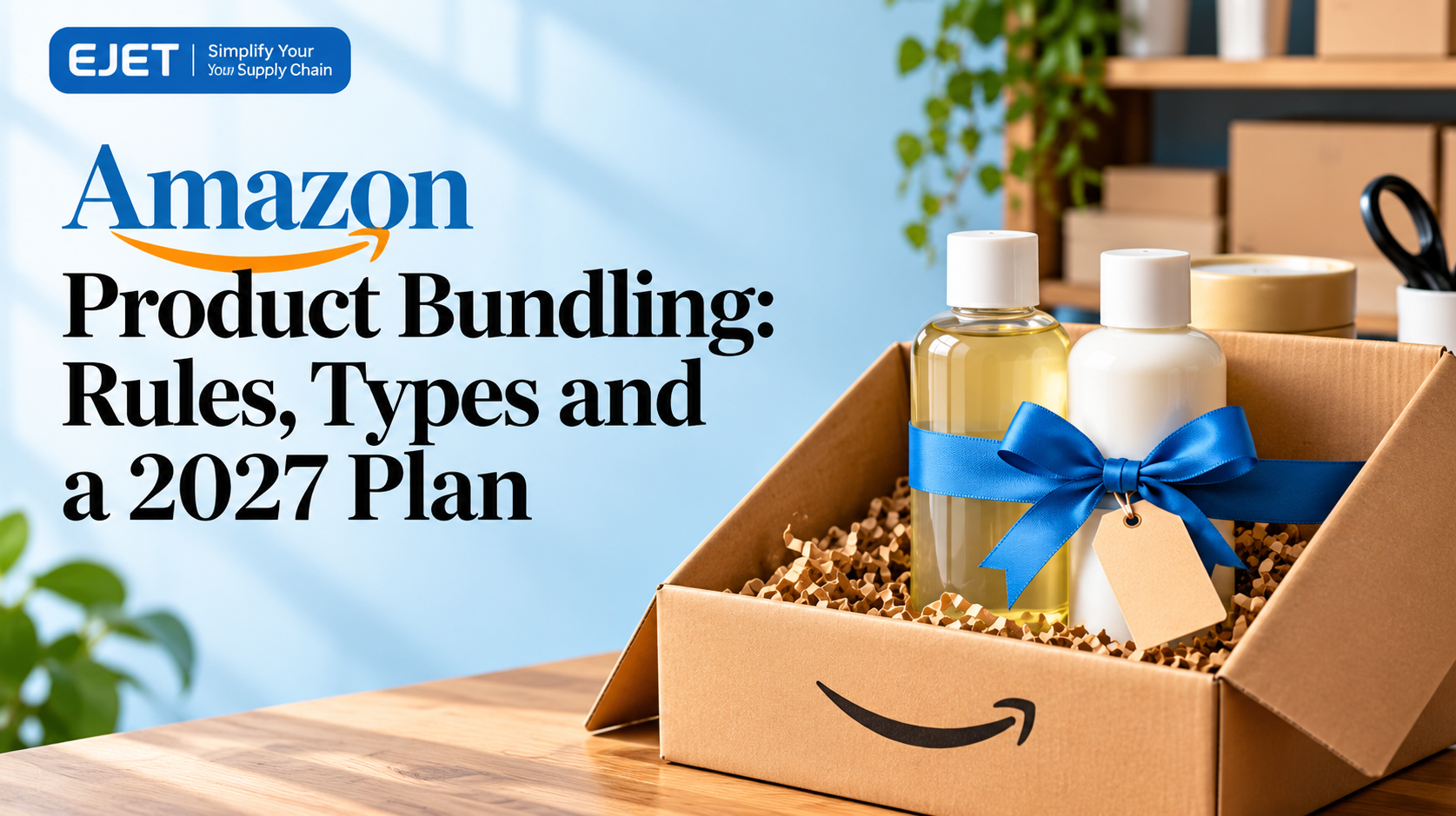
Amazon Product Bundling combines complementary products into one offer, giving shoppers a convenient way to buy items that work together.
It can support larger purchases and introduce customers to more of your catalog, but the opportunity depends on relevant products, sound economics, and compliant execution.
This article explains how to choose bundle combinations, prepare for Amazon’s January 11, 2027 policy change, and evaluate profit—not just sales volume.
What is Amazon product bundling, and when does it make sense?
Amazon defines a bundle as two or more complementary products that offer convenience or price value. A bundle differs from a multipack: a notebook paired with compatible writing accessories illustrates a bundle concept, while several identical notebooks constitute a multipack. Amazon identifies the highest normally priced item as the primary product.
Treat bundling as an Amazon sales strategy for solving a shopping problem, not simply increasing the number of items in a box. Ask what customers need immediately before, during, or after using your main product. Then assess whether buying those items together offers a clear advantage.
For example, consider a hypothetical brand-owned cleaning tool and its compatible replacement heads. Your proposed offer should make compatibility and quantities obvious. Before sourcing packaging, confirm that the configuration meets the applicable bundling requirements.
Avoid starting with slow-moving inventory and inventing a connection afterward. Instead, write a one-sentence customer benefit: “Everything needed for this specific task, without searching for compatible accessories.” If that sentence feels strained, reconsider the combination.
Choose the right bundle format
Amazon distinguishes physically packaged bundles from virtual bundles, while its “Frequently bought together” recommendations offer another way shoppers encounter complementary products.
Those recommendations present individually purchasable items rather than one physically assembled product.
Use this distinction when planning your offer:
|
Format |
What the shopper buys |
Planning priority |
|---|---|---|
|
Physical, or hard kit, bundle |
Complementary products packaged as one unit |
Packaging authority, identifiers, preparation, and complete-unit economics |
|
Virtual bundle |
Complementary products offered together without prepackaging them as one unit |
Tool availability, component eligibility, inventory, and pricing |
|
Multipack |
Multiple identical products |
Separate multipack and ASIN creation requirements |
These formats are not interchangeable; Amazon excludes multipacks from its bundle definition and applies separate requirements to them.
For product bundling for Amazon FBA, compare physical and virtual options before committing stock. Amazon’s Virtual Bundles tool avoids physically prepackaging the components, but availability can depend on your store, brand, and fulfillment-channel combination. Check the tool in your account rather than assuming every proposed combination is eligible.
The 2027 Packaging Change and How to Build Compliant Bundles
Effective January 11, 2027, Amazon is extending its manufacturer-or-brand packaging requirement to most product categories in its US store. Most physical bundles listed as a single ASIN must be packaged by the original manufacturer or brand.
The announced change covers both new and existing listings; it is not limited to newly launched bundles.
This is a requirement about who creates the product configuration, not merely whether your outer carton is sturdy. Buying authentic branded products does not, by itself, satisfy the new manufacturer-packaging requirement. Amazon identifies these exceptions:
- Authorized repackaging: A letter of authorization from the relevant brand owner or manufacturer permits reconfiguration or repackaging with the other included brands for Amazon sale.
- Specified gifting and camera configurations: Qualifying gifting browse nodes and camera product types have exceptions.
- Virtual bundles: These are not physically packaged together and do not need manufacturer-created configurations.
Amazon has also announced a 30-day grace period for most affected listings, measured from the violation notice—not automatically from January 11. A brand-owner report may remove that protection, and receiving no notice on the effective date does not establish compliance. Amazon says one authorization letter per brand is sufficient rather than one per bundle.
Use the remaining preparation period to audit existing offers, request documentation, and make inventory decisions. Do not treat the grace period as your operating plan. Review the current Amazon product bundling policy before placing purchase orders or sending additional bundled inventory.
How do you build compliant bundles for Amazon FBA?
Build a compliant physical bundle by confirming permission for the configuration, checking every component’s selling eligibility, and preparing the finished unit according to FBA requirements.
These are separate checks: correct warehouse preparation does not substitute for authorization to create the bundle. Amazon sets both configuration requirements and packaging requirements.
Use this prelaunch checklist:
- Record the exact contents. List brands, models, quantities, sizes, and variants. Make this your reference for purchasing, assembly, and listing reviews.
- Verify your compliance route. Record whether the original brand supplies the finished configuration or which documented exception applies.
- Retain supporting records. Keep relevant authorization, supplier documentation, packaging photographs, and internal specifications together for efficient review.
- Check the finished sellable unit. FBA requires sets to be identified as sets on their packaging. Follow Amazon’s current preparation instructions, including applicable component-specific requirements.
- Inspect before shipment. Compare a finished sample with your content list, listing images, and shipment information. Resolve discrepancies before repeating assembly at scale.
For product bundling, Amazon FBA preparation should be a quality-control checkpoint rather than the first compliance review. Ask your supplier or preparation partner to confirm who assembled the configuration and what documentation supports it. Keep that answer alongside the bundle specification, not buried in an email thread.
Select products around a specific customer task
Start product selection with a use case narrow enough to explain quickly. “Home office supplies” is broad; “a coordinated note-taking setup” gives you a more useful starting point. Treat every proposed combination as a hypothesis until your customer and financial analysis support it.
Evaluate each candidate against four questions:
- Functional fit: Does the accessory genuinely support the main product, including model or size compatibility?
- Quantity fit: Do the quantities suit the same task, or will shoppers receive an awkward surplus?
- Audience fit: Would the same buyer reasonably want every included item?
- Supply fit: Can you replenish the full combination without repeatedly waiting for one component?
Review available purchase patterns, customer questions, and return feedback for clues. Where accessible, Amazon’s Market Basket Analysis can inform product-pairing decisions. Use that evidence to develop candidates rather than assuming that products sharing a category belong together.
For your first test, prefer a combination with a simple benefit and few compatibility questions. Document why each component belongs. This gives you a stronger basis for both listing copy and later decisions about whether to continue the offer.
What bundle pricing strategy protects profit?
A useful bundle pricing strategy starts with complete costs and a minimum acceptable contribution per order, then tests whether the resulting offer provides convincing customer value. Do not choose a discount first and hope the remaining margin is sufficient.
Use Amazon’s Revenue Calculator to estimate relevant fees, while remembering that its outputs are estimates rather than guaranteed results.
Build your worksheet around:
Estimated contribution per order = selling price − product costs − Amazon fees − preparation and logistics costs − advertising allocation − expected returns allowance.
Include packaging materials, assembly labor, inbound transportation, and any applicable storage or placement costs in your planning. Allocate shared expenses consistently so that competing bundle ideas receive a fair comparison. Avoid counting the same cost twice if it is already included in another worksheet line.
For a physical bundle, enter the finished package’s information rather than adding together assumptions from individual listings. Amazon’s estimation tools use inputs such as dimensions, weight, category, and price. Recalculate after finalizing packaging.
Test three internal scenarios: your planned price, a promotional price, and a downside case with higher advertising costs or returns. Reject an offer that only works under optimistic assumptions.
When presenting Amazon bundle deals, make any savings comparison clear and supportable. Use actual relevant standalone prices rather than an inflated reference total, and check Amazon’s applicable fair-pricing requirements. A convenience-led offer is worth evaluating even when a deep discount is not financially sensible.
Finally, compare the proposed bundle contribution with the alternative of selling its components separately. Your goal should be a better business outcome, not merely a higher checkout total.
Listing Rules: Make the contents unmistakable
Your listing should answer three things immediately: what arrives, how much arrives, and why those items belong together. Amazon requires bundle titles to include “Bundle,” descriptions to identify the contents, and the first feature bullet to state the item count and identify the products. The main image must show all included products without adding products outside the offer.
Draft the contents statement before writing promotional copy. For a hypothetical stationery offer, “Bundle includes one notebook and two compatible pens” is clearer than “Complete productivity collection.” Follow that with supported details about sizes, colors, or compatibility where relevant.

Use supporting images to clarify quantities, dimensions, and intended use, while following the applicable image requirements. Keep optional props out of any presentation that could imply they are included. During your final review, ask someone unfamiliar with the offer to describe exactly what they expect to receive.
Do not promise a specific outcome simply because the products appear together. Explain the practical connection instead: fewer compatibility decisions, a coordinated selection, or supplies grouped for a defined task.
Test performance before expanding inventory
Launch with a limited commitment that matches your replenishment lead time and risk tolerance. Define the decision you want the test to answer: whether shoppers want the combination, whether the price works, or whether the listing communicates the offer. Avoid changing all three at once.
Track a small scorecard:
- Conversion: Compare purchases with available traffic data and investigate whether shoppers understand the offer.
- Contribution: Evaluate the money remaining after your defined costs, not revenue alone.
- Returns and complaints: Review comments for missing-item, quantity, and compatibility misunderstandings.
- Component sales: Check whether bundle sales appear to replace profitable standalone purchases.
- Inventory exposure: Monitor stock committed to the configuration and the next replenishment decision.
mazon recommends tracking bundle sales, conversion, and profit margins. For virtual bundles, be careful with reporting: Amazon notes that most Seller Central reports record sales against the component products rather than the bundle ASIN. Build your analysis around how your specific reports attribute those orders.
Set your review criteria before launch so enthusiasm does not move the goalposts. If the offer misses its profit target, investigate the cause before discounting further. If customers misunderstand the contents, fix the presentation before increasing traffic.
Build a better offer, not just a bigger order
Approach bundling in sequence: identify a customer task, confirm the compliance route, calculate complete economics, and test the offer with controlled inventory. Keep authorization, packaging, and listing reviews connected throughout that process.
Before your next launch, choose one proposed bundle and complete the checklist and pricing worksheet. Scale only when you can explain both why customers should buy it and why the sale is worthwhile for your business.
Frequently Asked Questions About Maximizing Sales with Amazon Product Bundling
What is product bundling on Amazon?
Product bundling on Amazon involves combining two or more complementary products into a single offer, allowing shoppers to conveniently purchase items that complement each other, often at a perceived value or price advantage.
What are the different types of bundles on Amazon?
Amazon offers different bundle types, including physical (hard kit) bundles, which are packaged together as one unit, and virtual bundles, which are presented as a combination of items without being physically prepackaged.
What are the benefits of using product bundling for Amazon FBA?
Product bundling can increase average order value, enhance customer shopping experience, and reduce the hassle of searching for compatible items, leading to higher conversion rates and customer satisfaction.
How do I ensure my bundles comply with Amazon’s policies?
To ensure compliance, verify that all products in your bundle are eligible for sale, follow Amazon's packaging and labeling requirements, and keep necessary documentation for any authorized repackaging or bundle creation.
What should I consider when setting a price for my bundle?
Consider all costs associated with the bundle, including product costs, Amazon fees, preparation costs, and expected returns, and ensure that the bundled price offers a compelling value to customers without sacrificing your profit margins.