The best dropshipping sourcing agents for your 2027 shortlist depend on what your store needs: product discovery, supplier coordination, branded packaging, or more controlled fulfillment.
This article compares 15 sourcing and fulfillment partners, explains their potential fit, and highlights what to verify before committing. Use it to narrow your options—not as a promise that one provider will outperform every alternative.
Planning note: This forward-looking selection uses provider information available on November 4, 2026. The recommendations reflect published capabilities, not independent warehouse inspections or hands-on performance testing; reconfirm services, eligibility, and quotes before launching in 2027.
What does a dropshipping sourcing agent do?
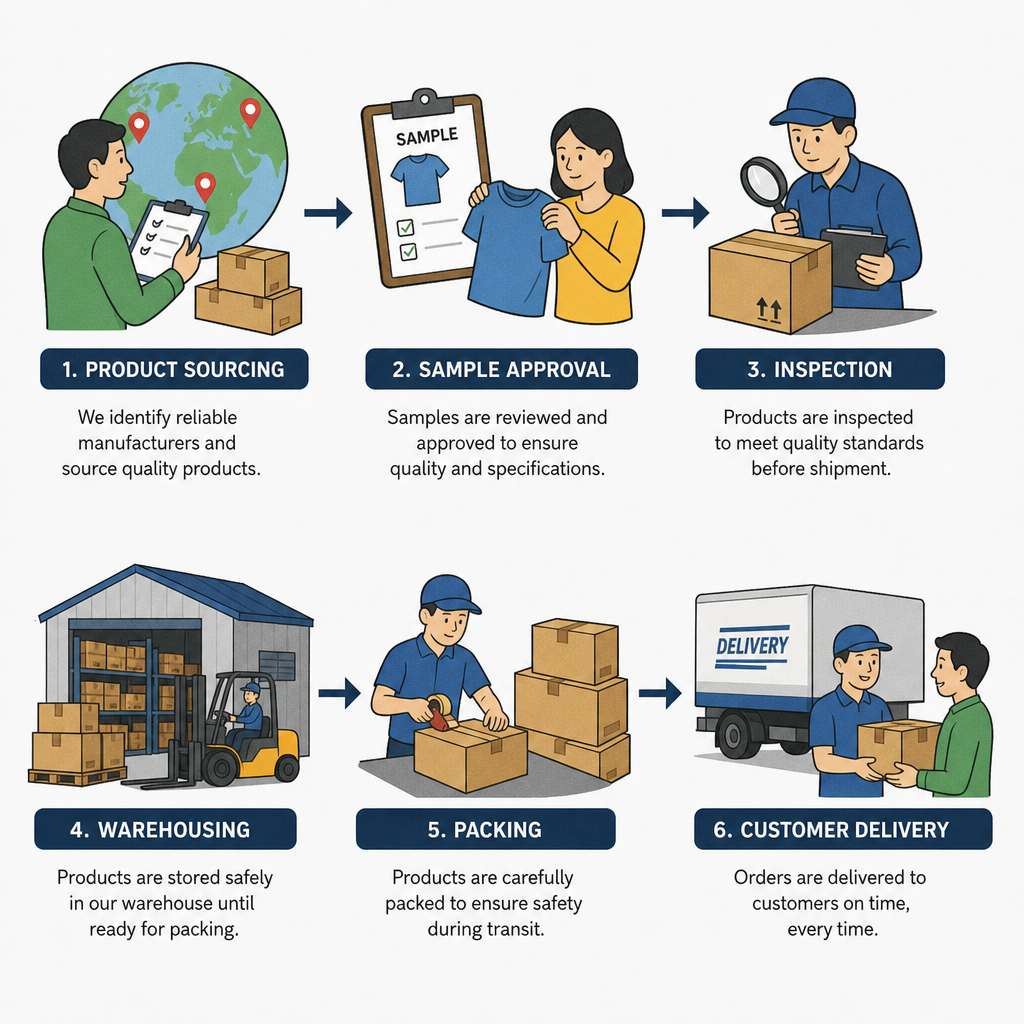
A dropshipping sourcing agent helps an online seller find products and coordinate the work between suppliers and customers. Depending on the provider, that can include purchasing, quality checks, warehousing, packaging, order processing, and shipping.
Some dropshipping agents operate through self-service platforms, while others offer more direct account management and factory coordination.
The distinction matters when comparing sourcing solutions. A product catalog helps you discover merchandise, but your operating brief should also address replenishment, inspection standards, packaging instructions, and responsibility when an order goes wrong.
Ask candidates to explain those workflows rather than assuming every advertised service is included.
For this shortlist, consider three possible arrangements:
- Catalog-led sourcing: Start with listed products and request alternatives when needed.
- Managed sourcing: Give an agent your specifications and ask for supplier options, samples, and quotations.
- Inventory-backed fulfillment: Purchase approved stock in advance and have a partner dispatch individual customer orders.
Providers on this list offer different combinations of these approaches. Treat the categories as a way to organize your questions, not interchangeable service packages.
How this shortlist was selected
The selection prioritizes companies that explicitly describe product sourcing alongside fulfillment or related supply-chain support. It includes platform-based dropshipping services and more consultative partners because readers may be testing their first product or improving an established operation. The numbered order is for navigation, not a measured performance ranking.
The suggested fits below are editorial judgments based on published service scope. No universal “best” designation can replace a quote for your product, destination, and order volume. Use the practical checks in each profile to build a comparable evaluation.
15 sourcing partners to consider for 2027
1. CJdropshipping — Broad sourcing and fulfillment options
CJdropshipping combines a browsable product catalog with sourcing requests, warehouse options, and fulfillment services. Its published workflow lets sellers look beyond existing listings when they need a particular product. CJ also describes custom packaging and product-branding options.
Suggested fit: Sellers who want to test products and investigate stocked fulfillment through the same provider.
Send the exact variant, destination, and packaging requirements when requesting a quote. Ask whether the item is physically available in your preferred warehouse or must first be purchased from a supplier. For your pilot, record payment, warehouse receipt, dispatch, and delivery separately rather than judging the entire experience by the advertised shipping estimate.
2. HyperSKU — Sourcing with brand-building support
HyperSKU publishes a service range covering product sourcing, sampling, inspection, warehousing, bundles, print on demand, and brand customization. Its platform also supports store connections and centralized order management. Those capabilities make it worth evaluating when product development and fulfillment need to work together.
Suggested fit: Growing stores exploring customized products, bundles, or a more distinctive customer experience.
Start the conversation with your current bestseller rather than an undefined request for “winning products.” Provide an approved sample or detailed specification, then ask which customization options suit your forecast volume. Request separate approval points for the product, packaging artwork, and finished parcel so that a branding decision does not obscure an unresolved quality issue.
3. Zendrop — Catalog sourcing with connected order fulfillment
Zendrop describes a workflow in which sellers import products, receive customer orders, pay fulfillment costs, and have suppliers ship directly to buyers. Its help center also documents a product-request feature for items outside the existing catalog.
Suggested fit: Sellers who prefer product selection and routine order handling within a connected platform.
Before subscribing or importing a large catalog, confirm that your store platform and intended features are supported. Test the complete payment-to-tracking workflow with a small order. Also plan how you will fund fulfillment while customer payments are awaiting payout; do not assume that receiving an order means its proceeds are immediately available for supplier payment.
4. EPROLO — Sourcing with apparel-branding possibilities
EPROLO presents product sourcing, inventory management, order fulfillment, and branding services, with particular attention to fashion labels, hangtags, and packaging. It also describes store integrations and access to warehousing services.
Suggested fit: Apparel and accessory sellers evaluating branded presentation alongside product sourcing.
For clothing, make sample approval specific: check measurements, fabric feel, stitching, label placement, and packaging. Ask whether each proposed branding treatment applies to your chosen item, not simply to the platform generally. Request a written breakdown of recurring program charges and per-order customization costs. Your comparison should show what an ordinary unbranded order costs and what changes when branding is added.
5. Wiio — Connected sourcing and operational support
Wiio describes an integrated offering spanning sourcing, quality control, inventory synchronization, fulfillment, branding, and payment-related services. Its published information also distinguishes assistance for new sellers from dedicated-agent support available as stores grow.
Suggested fit: Sellers who want to evaluate several operational services through one partner, including stores serving multiple markets.
Confirm which functions are available for your country, checkout setup, and ecommerce platform. If direct agent access is important, ask about eligibility before treating it as part of your starting package. During testing, include an exception—not just a straightforward order. Ask how the team handles an unavailable variant, an address correction, or a shipment needing investigation.
6. SourcinBox — Managed sourcing with app-based fulfillment
SourcinBox describes direct work with Chinese manufacturers alongside sourcing requests, inspections, customization, warehousing, and automated order fulfillment. Its Manager Code system connects sellers with a customer manager for one-to-one assistance.
Suggested fit: Stores seeking a named contact while retaining an app-based ordering workflow.
Use your first sourcing request to assess how carefully the manager interprets specifications. Ask for confirmation of materials, dimensions, variants, and acceptable substitutions before comparing prices.
If you plan to pre-purchase stock, agree on inventory reporting and replenishment alerts. Keep an approved sample and inspection checklist so later orders can be evaluated against something more concrete than the original listing photographs.
7. NicheDropshipping — Sourcing for a transition toward branding
NicheDropshipping lists factory sourcing, quality inspections, branded packaging, private labeling, inventory storage, and worldwide fulfillment. Its site presents different service arrangements for stores at different stages, while emphasizing greater value once sellers have products ready to scale.
Suggested fit: Sellers with validated demand who want to discuss branding and stocked fulfillment.
Ask which operating arrangement matches your actual order history rather than your growth target. Request distinct quotations for buying products after orders arrive and purchasing stock ahead of demand. If customization is involved, clarify ownership of packaging and unused inventory. Keep the initial project focused on a manageable product range before transferring your entire store.
8. Sup Dropshipping — Branded presentation options
Sup Dropshipping’s brand-building service describes product sourcing and customized packaging intended to support a seller’s own brand identity. That published emphasis makes it a candidate for merchants exploring presentation beyond a generic parcel.
Suggested fit: Sellers evaluating packaging-led differentiation and a coordinated sourcing discussion.
Begin with a precise brief showing the product, packaging dimensions, artwork, and desired unboxing sequence. Ask the team to identify which elements it can supply and fulfill for that item. Approve a physical sample before committing to packaging stock, and request photographs of the packed order. Compare the complete parcel rather than approving an attractive box without checking how the product fits inside.
9. EcommOps — Supply-chain support for established sellers
EcommOps describes sourcing, factory relations, inventory management, warehousing, branding, customization, and direct-to-consumer fulfillment from China. It explicitly says its specialized services are not a good fit for startups or businesses with low order volume.
Suggested fit: Established stores evaluating a more managed supply chain around proven products.
Bring sales history, supplier information, replenishment needs, and destination data to the first discussion. Ask how responsibilities would be divided among your factory, your team, and EcommOps.
Request a transition plan that addresses existing orders and inventory reconciliation. For this type of evaluation, prioritize operational control and service scope rather than looking only for the lowest single-item quotation.
10. Fulfillman — Sourcing alongside photography and branding
Fulfillman publishes services covering dropshipping, China sourcing, branding, product photography, Amazon FBA preparation, and crowdfunding fulfillment. Its sourcing description spans existing products and manufacturing coordination.
Suggested fit: Merchants who want to discuss product procurement and supporting creative work with one provider.
Separate those workstreams in your brief. For sourcing, specify the approved product and inspection requirements; for photography, specify deliverables, usage rights, and revision expectations. .
Ask for independent sign-off on each service rather than one vague project approval. If you use multiple sales channels, request a clear explanation of how inventory and orders would be allocated between them before stock is received.
11. USAdrop — Sourcing with international warehouse options
USAdrop describes sourcing, inspections, warehousing, fulfillment, customization, and after-sales support. Its published information distinguishes orders shipped from China from products pre-stocked in overseas warehouses, including US locations.
Suggested fit: Sellers comparing individual-order sourcing with a possible move toward domestic inventory.
Do not infer that a US warehouse means your selected product is already available there. Ask for item-level stock confirmation and a quotation for replenishing that location.
Compare the complete inventory plan, including inbound movement and unsold stock, with shipping directly from China. Make the decision using your expected sales pattern rather than a warehouse-locati0n badge alone.
12. Dropshipman — Sourcing with an explicitly described service component
Dropshipman lists sourcing, custom packaging, private labeling, warehousing, and fulfillment. Its sourcing page explains that sourcing requests have no upfront charge, while product costs include a service component.
Suggested fit: Sellers who want to evaluate sourcing assistance and the complete quoted cost together.
Use the same specifications when requesting prices from Dropshipman and other candidates. Ask what the quotation includes, which services require separate approval, and how long the offer remains valid. Avoid treating “free sourcing” as the deciding benefit.
Your comparison should focus on the approved product delivered through an acceptable workflow, with sufficient clarity to understand what changes if your order volume increases.
13. Yakkyofy — Access to 1688 with sourcing assistance
Yakkyofy advertises direct 1688 access, English and image-based product search, supplier communication, price negotiation, quality checks, and fulfillment. It also publishes custom-packaging and private-label services.
Suggested fit: Sellers who want to investigate Chinese domestic-market listings with sourcing and fulfillment support.
Treat a marketplace listing as the start of verification, not as a finished product specification. Ask the team to confirm the exact material, size, variant, packaging, and supplier before approving a sample. Request a quotation that clearly distinguishes purchasing from delivery-related services. If repeat supply matters, also ask how a replacement factory or changed listing would be presented for your approval.
14. Dropship China Pro — Sourcing with branded fulfillment services
Dropship China Pro lists product sourcing, quality-control-related fulfillment, custom packaging, private labeling, kitting, and automated order handling. Its published workflow also describes shipping under the seller’s brand without visible Dropship China Pro branding.
Suggested fit: Sellers evaluating coordinated handling for branded orders or multi-item packages.
For a kit, provide a component checklist, quantities, assembly instructions, and a photograph of the finished arrangement. Ask how an order is handled when one component is unavailable. Request confirmation that stock reporting distinguishes individual components from completed kits. Before launch, place a sample order through the intended workflow and inspect both the contents and the customer-facing tracking experience.
15. SourcingCat — Sourcing and fulfillment in a connected workflow
SourcingCat describes product sourcing, store connections, order management, inspections, inventory warehousing, custom packaging, and global fulfillment. Its published service pages emphasize coordinating these tasks through one platform.
Suggested fit: Sellers seeking another platform-based candidate for a sourcing and fulfillment comparison.
Ask which integrations support your store and what happens when a product listing, price, or stock position changes. Test variant mapping carefully, especially when visually similar items have different sizes or specifications. Request an example of an inspection record and an explanation of the escalation process. Keep the pilot narrow enough that you can reconcile every order manually before relying on broader automation.
What should you compare beyond the product price?
Compare the full quoted service and the conditions attached to it, not just the item cost. Published pricing models differ: Dropshipman describes a service component within product pricing, while other providers describe plan-based or product-and-shipping arrangements. Ask each candidate to price the same order scenario so that your comparison is meaningful.
Use this checklist when reviewing proposals:
|
Area |
Information to request |
|---|---|
|
Product |
Exact specification, approved variant, and substitution policy |
|
Inspection |
Checks performed, evidence provided, and defect handling |
|
Packaging |
Materials, customization charges, storage, and reorder requirements |
|
Fulfillment |
Receiving, pick-and-pack, additional-item, and special-handling charges |
|
Delivery |
Dispatch origin, route, tracking, and assumptions behind estimates |
|
Inventory |
Ownership, stock reports, storage terms, and exit arrangements |
|
Exceptions |
Lost-parcel investigation, damaged-item evidence, refunds, and reshipments |
For your internal budget, also reserve space for expenses outside the agent’s quote. Keep advertising, platform charges, payment costs, and customer-service allowances visible in your own worksheet. Do not label the difference between retail price and the sourcing quote as final profit.
Avoid filling unknown charges with optimistic guesses. Mark them as unresolved and send the worksheet back to the provider. A complete, understandable quotation is more useful than a low headline number surrounded by assumptions.
How do you choose the best sourcing partner for your store?
Choose the partner that meets your documented requirements in a controlled pilot, not the one with the most persuasive homepage. Start by defining your product, customer destinations, order pattern, packaging needs, and available inventory budget. Then compare a small group of candidates against the same brief.
- Write one specification. Include materials, dimensions, variants, packaging, and photographs. Identify which details are mandatory and which alternatives you would consider.
- Request comparable quotations. Use identical quantities and destination examples. Ask candidates to flag exclusions instead of silently assuming a different scope.
- Approve samples. Inspect the product and finished parcel. Keep written notes and photographs so approval can guide future purchasing and inspections.
- Run a limited pilot. Record order submission, payment, dispatch, tracking, delivery, and support responses. Include more than one variant where relevant.
- Review exceptions and exit terms. Ask how unresolved orders, unused packaging, remaining inventory, and account data would be handled if you leave.
Give communication a place in your scorecard. During the pilot, note whether answers address the question, identify uncertainty, and explain the next action. You are selecting a working relationship as well as a sourcing system.
For a new store, consider prioritizing a manageable workflow over elaborate customization. For a proven product, put more attention on replenishment, repeatable specifications, and inventory visibility. These are evaluation priorities, not guarantees that any particular provider will suit your business.
Build your shortlist around the next operational step
The top agents for your store are the ones worth testing against your actual requirements. Use these 15 candidates to identify a few relevant conversations, then let quotations, samples, and pilot orders determine the next move.
Do not try to select every dropshipping supplier you might ever need. Choose a partner for the work in front of you, document expectations, and expand only when the working process is clear. The best sourcing decision is one you can explain with evidence from your own evaluation.
Frequently Asked QuestionsAbout Dropshipping Sourcing Agents
What is a dropshipping sourcing agent?
A dropshipping sourcing agent is a service provider that helps online retailers find products, manage supplier relationships, and handle logistics such as packaging, shipping, and quality control. They act as intermediaries between sellers and manufacturers to streamline the dropshipping process.
How do I choose the best sourcing agent for my business?
To choose the best sourcing agent, define your specific needs, such as product type, delivery speed, and budget. Then, request quotes and samples from different agents, compare their offerings, and consider factors like communication, experience, and reliability.
What services do dropshipping sourcing agents typically provide?
Dropshipping sourcing agents often provide a range of services, including product sourcing, inventory management, quality inspections, order fulfillment, custom packaging, and branding solutions. The specific services can vary by provider.
Are there any upfront costs associated with using a dropshipping sourcing agent?
Some dropshipping sourcing agents may charge a fee for their services, while others include their costs within the product price. It's important to clarify any potential fees upfront before committing to a contract.
What should I look for in a dropshipping sourcing agent's contract?
When reviewing a dropshipping sourcing agent's contract, pay attention to service descriptions, pricing structures, shipping terms, and conditions for resolving issues such as damaged products or missed deliveries. Ensure that the contract aligns with your business requirements.